
A-Book and B-Book forex brokers are the two primary models shaping how your trades actually get handled in the forex market. The difference between them comes down to one thing: what happens to your order after you click buy or sell, and who ends up on the other side of that trade.
A-Book brokers give you a more direct, transparent path into the market with tighter spreads, but they tend to set higher entry thresholds. B-Book brokers are easier to access and often feel more beginner-friendly, but they come with wider spreads and a built-in counterparty conflict you need to understand. Which one suits you depends entirely on your risk tolerance, how you trade, and how much capital you are working with.
- A-Book and B-Book forex brokers operate under fundamentally different execution models, with the distinction meaningfully affecting both retail trading experience and broker incentive alignment.
- We see A-Book brokers passing client orders directly to liquidity providers, with the broker earning commission and spread mark-up regardless of client trading outcomes.
- B-Book brokers internalise client orders as counterparty trades, with the broker profiting when clients lose and losing when clients win.
- Hybrid execution models combining A-Book treatment for selected high-volume clients and B-Book treatment for smaller accounts have become the contemporary industry norm.
- Regulatory disclosure of execution model varies meaningfully across jurisdictions, with ESMA-regulated EU brokers facing more demanding disclosure than offshore alternatives.
- For most considered retail forex traders we view broker execution model awareness as a foundational dimension of broker selection across the typical retail trading journey.
- Who is this for?
- Retail forex traders evaluating broker selection, alongside the brokers, regulators and educators framing execution model discussions.
- What is happening?
- A read of A-Book versus B-Book forex brokers, covering execution model dynamics, hybrid framework variations, regulatory disclosure and the broader broker selection landscape.
- When did this emerge?
- The article reflects current market structure through 2025 and 2026, with reference to the multi-year evolution of retail broker execution models.
- Where is this happening?
- The piece covers the global retail forex broker complex, including ESMA-regulated EU brokers, FCA UK brokers, ASIC Australian brokers and offshore alternatives.
- Why does it matter?
- Broker execution model shapes incentive alignment with retail clients, which is why understanding the framework matters before any broker selection decision.
How A-Book Forex Brokers Operate
The broker-execution distinction sits squarely inside the regulator-mapped landscape. The FCA in the UK and CySEC in Cyprus both publish detailed rules on order handling and conflict-of-interest disclosure. The ASIC framework in Australia covers the same ground.
For US-domiciled clients, the NFA and CFTC rule book sets the disclosure standard. Reading the broker's own published execution policy alongside the rule book is the baseline due-diligence step that most retail traders skip.
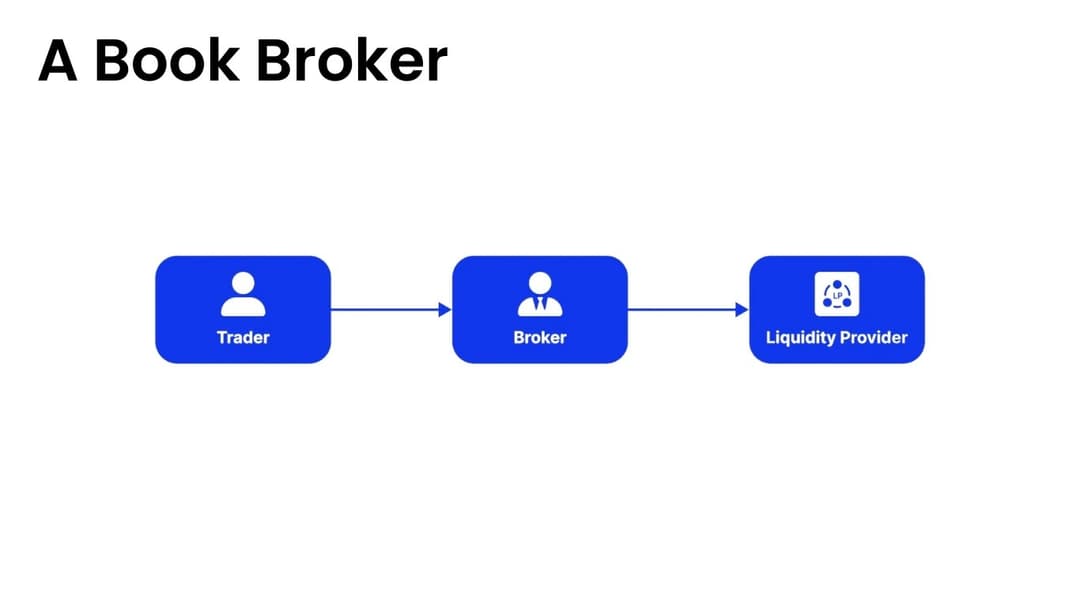
A-Book brokers go by another name you may have heard before: no dealing desk brokers. What sets them apart is Direct Market Access, or DMA. Every order you place gets routed straight to the interbank market through a liquidity provider.
The engine running this process is called Straight Through Processing, or STP, and it means your trade moves fast, without anyone at the broker’s end touching it or slowing it down.
No dealing desk means no one is sitting there adjusting prices or interfering with your orders. That transparency is a genuine advantage if you value a clean, trustworthy relationship with your broker. And here is the part that really matters: A-Book brokers do not sit on the other side of your trade.
They have no financial reason to want you to lose, which is a very different dynamic from what you get with B-Book brokers.
The Role of Liquidity Providers
Liquidity providers are the backbone of the A-Book model. These are the institutions that actually supply the market depth your broker needs to fill your orders. By tapping into multiple liquidity pools, A-Book brokers can offer you competitive spreads and genuine access to real market pricing.
For high-volume traders or institutional accounts, this setup is especially valuable because tighter spreads at scale translate directly into meaningful savings.
But it does come with some real operational weight. Securing agreements with liquidity providers takes time, money, and ongoing relationship management. Add in the technical infrastructure and regulatory compliance requirements, and you start to see why running an A-Book operation carries higher costs.
That overhead eventually gets passed on somewhere, which is worth keeping in mind.
How A-Book Brokers Earn
A-Book brokers do not profit from your losses. Their revenue comes from commissions, and it works in one of two ways. Either they charge a fixed commission per transaction, often calculated per lot, or they add a small markup on top of the spread provided by the liquidity provider.
Because their income ties directly to your trading volume rather than your trading outcomes, the model is structurally more aligned with your interests.
That alignment matters. Your broker earns more when you trade more, not when you blow up your account. The more active and successful you are as a client, the better it is for both of you.
That shared direction is not just good ethics, it is good business.
How B-Book Forex Brokers Operate
For deeper context, the breakdown in a working example of a real broker review under this lens is worth reading alongside this analysis.
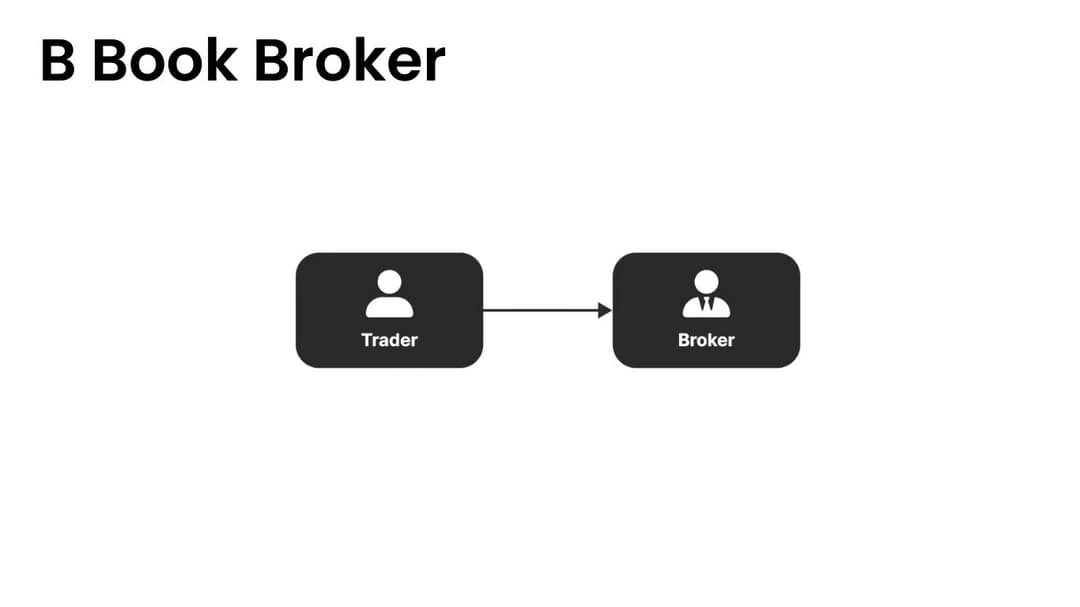
B-Book brokers take a fundamentally different approach. Instead of routing your orders out to external liquidity providers, they keep everything in-house. Your order never touches the interbank market.
It stays inside the broker’s own platform, and the broker effectively becomes the market maker, filling your trade internally.
This internal processing gives B-Book brokers some real execution advantages. Orders fill fast because there is no waiting on external confirmations. During volatile market conditions, when prices are moving quickly, that speed can actually work in your favor.
And because they control the environment, they can often offer tight spreads and a smooth overall experience.
But here is the catch. When a B-Book broker acts as your counterparty, your gain is their loss and your loss is their gain. That is not a subtle conflict of interest.
It is a structural one baked directly into the business model. And while most regulated B-Book brokers operate fairly, the incentive to tip the scales in their favor does exist.
That conflict can, in the hands of less scrupulous operators, lead to real problems. Some unethical brokers have used server-side tools to adjust price quotes or trigger client stop-losses artificially. These practices erode trader trust quickly, and the reputational damage tends to be permanent once word gets out.
Risks and Rewards of the B-Book Model
From the broker’s perspective, the B-Book model can be extraordinarily profitable. According to financial industry observers, the majority of retail forex traders lose money, and in many cases they lose it fast. When most of your clients are on the losing side of the market, keeping trades in-house generates substantial revenue without the overhead of external liquidity relationships.
But the downside is just as real. Traders who feel manipulated do not stay. And in the forex world, reputation travels fast.
One wave of complaints, a few bad reviews, or a whisper of price manipulation can strip a broker of its client base in a matter of months. Long-term success in this space requires trust, and trust is fragile.
Balancing Trust and Profitability
Many B-Book brokers try to offset the conflict-of-interest perception by offering genuine value elsewhere. Tighter spreads, fast execution, strong customer support, and educational resources all help build goodwill with traders. Done right, these perks make the overall experience feel fair even within a model that has inherent tensions.
Still, transparency is the long game. B-Book brokers who prioritize fair trading conditions and resist the temptation to exploit their counterparty position tend to build lasting businesses. Those who lean too hard into the conflict eventually find that no amount of tight spreads can repair a broken reputation.
How Hybrid (C-Book) Forex Brokers Operate
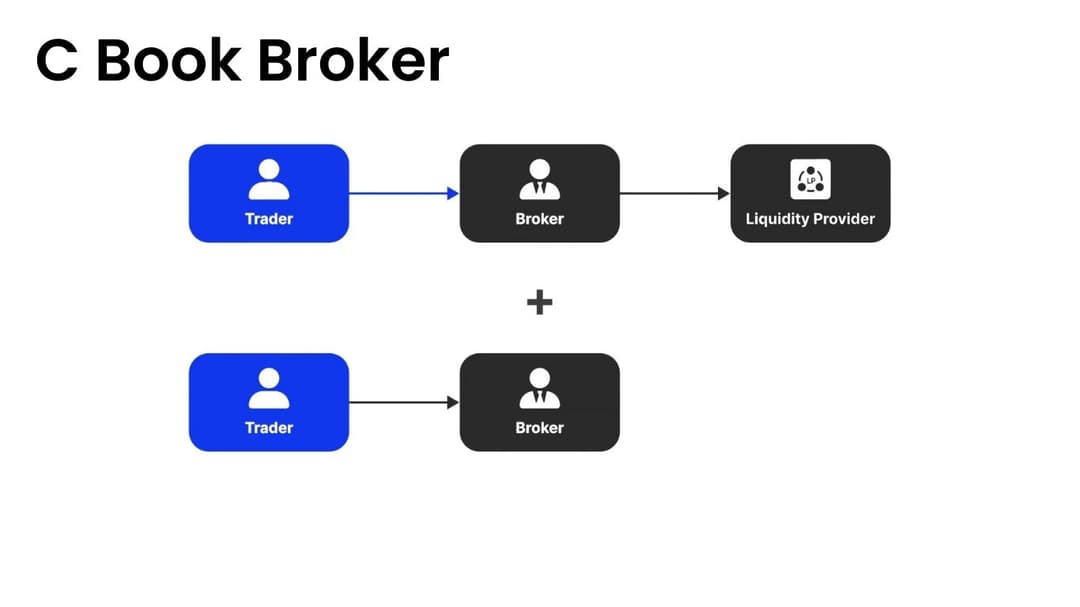
The C-Book model is where things get sophisticated. Think of it as a dynamic blend of A-Book and B-Book, where the broker assesses each trade individually and routes it based on its risk profile. Some trades go external.
Others stay in-house. The decision happens in real time, driven by the broker’s internal risk management systems.
- Low-risk trades are passed directly to liquidity providers (similar to the A-Book model), ensuring transparency and competitive spreads for clients.
- High-risk trades are processed internally (similar to the B-Book model), allowing the broker to manage risks in-house and potentially increase profitability.
This flexibility lets brokers manage their overall exposure more intelligently while still delivering competitive trading conditions to their clients on both ends of the spectrum.
Benefits of the Hybrid (C-Book) Model
The hybrid approach lets brokers cherry-pick the strengths from each model. You get the speed and market access that the A-Book model delivers, combined with the internal processing efficiency of the B-Book approach. The result is a more agile operation that can adapt to different client types and market conditions without being locked into a single structure.
- Balanced Risk Management: By routing low-risk trades to external liquidity providers, brokers ensure transparency and competitive pricing. At the same time, they can manage high-risk trades internally, which can reduce potential losses and optimize profitability.
- Optimized Trading Conditions: For traders, this means better trading conditions on low-risk orders, as their trades are processed through the interbank market with reduced spreads and quicker execution times.
- Increased Broker Profitability: Brokers benefit from the internal handling of high-risk trades, allowing them to capitalize on the revenue potential from B-Book strategies. This balance of A-Book and B-Book orders enables brokers to enhance profitability without compromising transparency on client-friendly trades.
- Flexible and Adaptive: The hybrid model adapts to various market conditions. During periods of high market volatility, brokers can adjust their approach depending on client risk profiles, ensuring they remain profitable while offering good trading conditions to their clients.
Challenges of the Hybrid Model
The C-Book model sounds ideal on paper, and in many ways it is. But it is also one of the most technically demanding broker models to build and run well. Getting the segmentation logic right, maintaining transparency with clients, and managing regulatory scrutiny all add layers of complexity that smaller brokers often underestimate.
- Sophisticated Risk Management Systems: Brokers need advanced software to accurately classify trades and determine which ones should be executed via A-Book or B-Book. This involves monitoring a wide range of factors, such as trade size, deposit amounts, leverage usage, risk levels, and whether or not traders are using protective stops.
- Operational Complexity: Maintaining both A-Book and B-Book systems can be a challenge in terms of operational costs and technical infrastructure. The broker needs to ensure seamless execution between two different trade processing methods, which can increase the potential for errors if not managed properly.
- Correct Trade Categorization: A major challenge for brokers is correctly identifying which trades fall into the low-risk or high-risk categories. Mistakes in classification can lead to inefficient execution, higher risk exposure, or missed profit opportunities.
Comparing A-Book and B-Book Brokers
If you are serious about forex trading, understanding the difference between these two broker types is not optional, it is essential. The model your broker uses shapes everything from how your orders get filled to whether your broker’s financial interests are aligned with yours or working against you.
A-Book vs B-Book: Execution Process
With an A-Book broker, your order goes straight to a liquidity provider and from there into the interbank market. You get genuine, transparent price discovery. With a B-Book broker, your order never leaves the house.
The broker fills it internally and becomes your counterparty. That can mean faster execution, but it also means a built-in tension that you need to account for when choosing who to trade with.
A-Book vs B-Book: Profitability for Brokers
A-Book brokers earn steadily through commissions and spread markups, and their revenue grows when your trading volume grows. B-Book brokers, by contrast, can generate larger short-term profits by keeping losing trades in-house and adjusting their exposure strategically. The potential upside is higher, but so is the temptation to prioritize broker profits over fair execution.
Impact on Traders’ Experience
Your day-to-day experience differs meaningfully depending on which model your broker uses. A-Book brokers give you clean prices and straightforward execution, with no one on the other side rooting for you to lose. B-Book brokers might offer you faster fills and attractive pricing, but that comes alongside a model where your losses are their revenue.
Knowing that going in changes how you evaluate every aspect of the relationship.
| Aspect | A-Book Brokers | B-Book Brokers |
|---|---|---|
| Execution Process | Direct Market Access via Liquidity Providers | In-House Processing |
| Profitability | Steady but Lower Profit Margin | Potentially Higher Profits via Trader Losses |
| Impact on Traders | Transparency and Unbiased Execution | Quick Fills but Potential Manipulation |
Advantages of A-Book Forex Brokers
Picking an A-Book broker brings some clear, tangible benefits to your trading. Here is what you actually gain from this model.
First, you get real transparency. Your orders go directly to liquidity providers, giving you genuine direct market access. There is no middleman profiting from your positions, and your broker’s incentives line up with yours from the start.
Second, the Straight Through Processing model means your trades move to the market automatically, with no dealer touching them along the way. That translates to faster execution and a meaningfully lower risk of slippage or requotes on your orders.
And financially, A-Book brokers earn from commissions or spread markups regardless of how your trades perform. That stability is a real advantage compared to B-Book brokers, whose earnings can depend on your losses. You are not trading against your own broker.
Disadvantages of A-Book Forex Brokers
A-Book brokers offer a lot to like, but the model is not without its friction points. The biggest one is cost. Running an A-Book operation is expensive.
Partnerships with liquidity providers come with licensing fees, ongoing technical infrastructure, and compliance overhead that all add up fast.
That reliance on liquidity providers also means spreads can widen during major news events or volatile periods, which can affect your execution quality. In some cases you will experience slippage, where your fill price differs from what you expected when you placed the order. On top of that, the commission structure adds a layer of trading cost that can make smaller or more frequent trades feel less efficient for retail-sized accounts.
Profit margins for A-Book brokers also tend to run thinner than their B-Book counterparts. Revenue comes from spread markups and commissions, which means the model depends heavily on trading volume to stay profitable. During quieter market periods, when activity naturally drops, that dependency can put real pressure on the business.

Advantages of B-Book Forex Brokers
B-Book brokers do offer some genuine advantages worth acknowledging. As market makers, they control the execution environment directly, which gives them the flexibility to offer competitive pricing and manage order flow efficiently without waiting on external systems.
The profit potential for a B-Book broker is also higher than for A-Book operators. Because they earn from spreads and, in many cases, from trader losses, they are less dependent on external liquidity relationships. That independence lowers their operating costs and gives them more room to play with pricing strategies that attract traders.
Speed is another real advantage. Internal trade processing cuts out the latency that comes with routing orders externally. Fills happen faster, execution feels smoother, and in a market where seconds matter, that edge is not trivial. Bloomberg’s forex market coverage has consistently highlighted execution speed as one of the top priorities for active retail traders.
The table below compares how A-Book and B-Book models stack up across key operational areas and profit margins.
| AspectA-Book Forex BrokersB-Book Forex Brokers | ||
|---|---|---|
| Compensation Method | Commission or Spread Markup | Spread Increase & Trader Losses |
| Trade Execution | Direct Market Access | In-House Processing |
| Profit Margin Stability | Lower but Steady | Higher but Variable |
| Operational Cost Dependency | High (External Liquidity Providers) | Low (Internal Management) |
Disadvantages of B-Book Forex Brokers
The B-Book model’s advantages come with a significant structural problem you should not overlook. Because your broker acts as the counterparty to your positions, they profit when you lose. That conflict of interest is not theoretical.
It creates a real financial incentive to influence trade execution in ways that favor the broker’s bottom line over your own.
Reputation risk is the other major downside. In the forex market, where competition for clients is fierce, trust is everything. Any hint of price manipulation or compromised execution can spread quickly through trader communities and review platforms.
Once that reputation damage sets in, recovering it is extremely difficult. Clients leave, referrals dry up, and the business starts to contract.
The numbers around retail forex losses are stark. Estimates suggest that somewhere between 80% and 95% of retail traders lose their initial capital within the first six months, which on the surface looks like a reliable revenue stream for B-Book brokers. But unexpected market events can flip that equation fast, leaving brokers holding significant losses on trades they kept in-house. Reuters’ currency markets desk has covered several episodes where sudden volatility created outsized losses for market-making operations.
No model is bulletproof.
Hybrid Forex Broker Model
The forex industry has matured, and with that maturity has come the hybrid broker model. By blending A-Book and B-Book approaches into a single operation, these brokers aim to improve both trade execution quality and internal risk management. Forbes has noted that hybrid models are becoming the preferred structure for mid-to-large forex brokers looking to stay competitive without taking on unnecessary risk.
Combining A-Book and B-Book Models
The hybrid model fuses direct market access from the A-Book side with the in-house processing efficiency of the B-Book side. Your broker can route certain trades to external liquidity providers while keeping others internal, depending on how the risk calculus works out in real time. That flexibility lets the broker balance consistent commission-based income with the higher-margin potential that comes from selectively internalizing trades.
Benefits and Challenges of Hybrid Models
For brokers, the hybrid model opens up a more diversified revenue stream, blending the reliable income of A-Book commissions with the higher-ceiling potential of B-Book internalization. For you as a trader, the experience can feel closer to an A-Book in terms of market access and execution quality, while still offering the competitive spreads and leverage options that B-Book structures tend to make available.
The challenge is that managing conflicts of interest becomes more complex, not less, when you are operating across both models simultaneously.
Trader Segmentation and Risk Management
Running a hybrid model well requires serious trader segmentation. Your broker is essentially categorizing clients by risk profile, order size, and trading behavior, then routing each trade through whichever model makes the most sense for their exposure. Traders who prefer higher leverage or come in with smaller initial deposits typically end up in the B-Book side of the equation.
This kind of precision segmentation lets brokers manage their aggregate risk more tightly while tailoring the trading environment to different client profiles. Done right, it is a sophisticated operation. Done poorly, it creates exactly the kind of opacity that erodes trader trust.
We last reviewed this analysis in May 2026.


Alex Tzoulis
Alex Tzoulis is Co-Owner and Markets Analyst at The Luxury Playbook, specializing in equities, crypto, forex, and global financial markets. His work focuses on analyzing macroeconomic trends, geopolitical developments, and monetary policy, translating them into actionable insights across both traditional and digital asset classes. He leads the platform's financial market coverage, providing structured analysis across stock market investing, trading strategies, and cryptocurrency markets. His expertise strengthens the publication's authority in financial markets and capital allocation, bridging traditional finance with emerging digital investment ecosystems.