Cubism is the moment in early twentieth-century painting when the picture plane stopped pretending to be a window and became an autonomous structure. The movement begins in 1907 with Picasso's "Les Demoiselles d'Avignon" and Cézanne's posthumous retrospective at the Salon d'Automne, runs through the Analytic phase (1908-1912), the Synthetic phase (1912-1919), and influences nearly every subsequent development in twentieth-century art.
The core cohort is small: Picasso, Braque, Léger, Gris, Gleizes, Metzinger, Lhote, La Fresnaye, Marcoussis, Survage.
The supply at the top is closed, the scholarship is mature, and the market behaves with the kind of discipline that defines the deeper modern segments.
What follows is our editorial read on the Cubist market in 2026: what the canon actually covers, how the work trades at evening sale, and where serious collectors are finding depth in the category.
- Cubism emerged in Paris around 1907 through the close working relationship between Pablo Picasso and Georges Braque and became the most influential movement of early modernism.
- The Demoiselles d’Avignon, painted by Picasso in 1907 and held at MoMA, is widely treated as the structural starting point of the Cubist project.
- Analytical Cubism, running roughly from 1908 to 1912, broke pictorial form into fragmented planes and remains the most scholarly studied phase of the movement.
- Synthetic Cubism followed from around 1912 and introduced collage, mixed media and the flatter compositional approach associated with the later phase.
- Fernand Leger, Juan Gris and Jean Metzinger anchor the second tier of Cubist artists whose work continues to appear in serious Impressionist and Modern sales.
- For modern collectors, Cubism is a foundational chapter whose canonical works rarely appear at auction and command top-tier prices when they do.
- Who is this for?
- Modern art collectors, family offices and advisors building positions in early-twentieth-century European painting, alongside curators and scholars of the Cubist canon.
- What is happening?
- A collector field guide to Cubism, covering Picasso and Braque, the analytical and synthetic phases, the second-tier Cubist artists and the realistic auction supply environment.
- When did this emerge?
- Most active around the May and November Impressionist and Modern sales at Christie’s and Sotheby’s in New York and London and around major loan exhibitions on Picasso and Braque.
- Where is this happening?
- Centred on the Paris and New York markets historically, with major institutional holdings across MoMA, the Centre Pompidou, the Musee Picasso and the Tate Modern.
- Why does it matter?
- Cubism is the structural pivot of twentieth-century painting, and a clear field guide helps collectors engage with the movement’s scholarship, scarcity and pricing with appropriate discipline.
The shape of the Cubist canon
Picasso and Braque are the originating duo. Their parallel work between 1909 and 1912 (the so-called Analytic Cubist phase) produced canvases that are now mostly in museum collections: MoMA, the Pompidou, the Met, the Hermitage, the Pushkin (with the Shchukin material), Tate, the National Gallery in Washington.
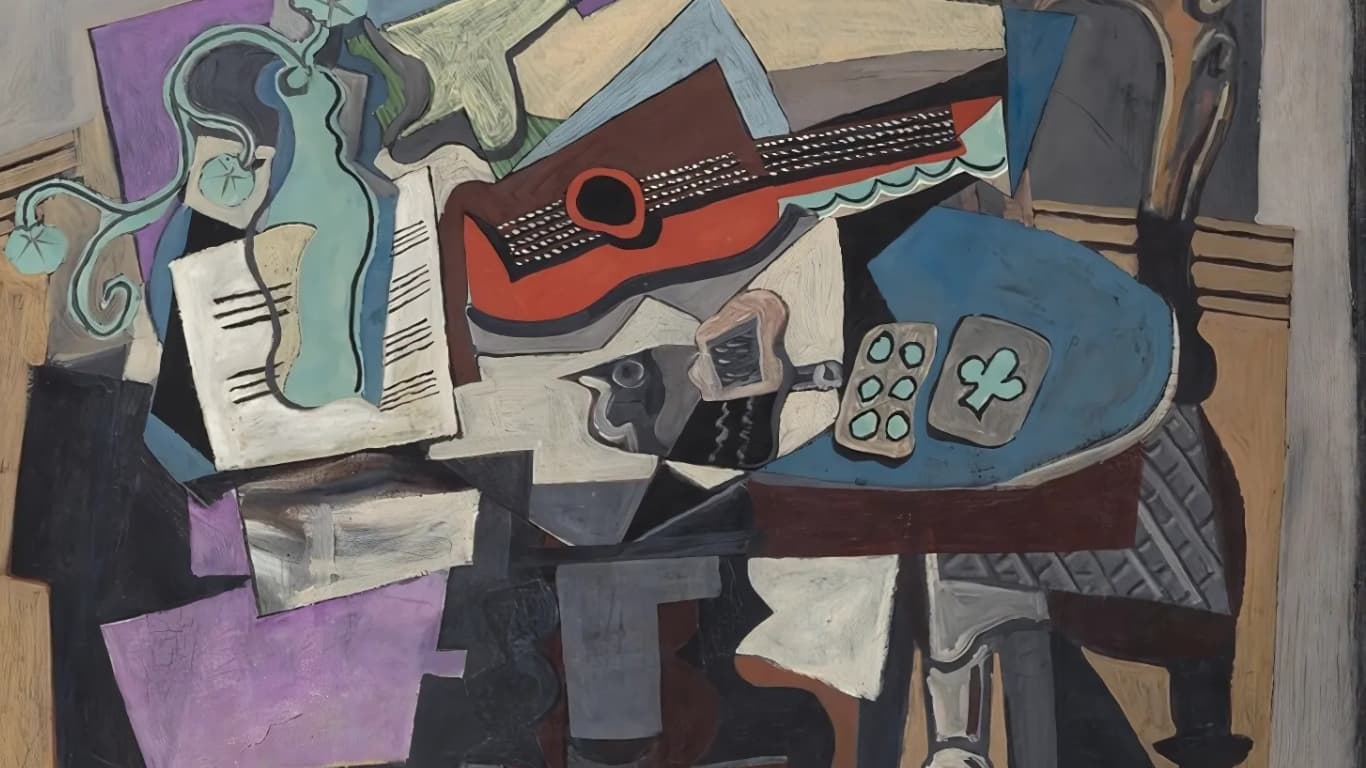
The Synthetic Cubist phase (1912-1919) opens out the picture plane to incorporate collage, papier collé, and a return to recognizable subject matter alongside the geometric structure. This is the period of the famous chair-caning collage by Picasso ("Still Life with Chair Caning," 1912, now at the Musée Picasso, Paris) and the parallel work by Braque.
Beyond the founding pair, the second tier is anchored by Fernand Léger and Juan Gris. Léger's mature work runs from 1909 through the 1950s; his Cubist period (1909-1920) sits inside a much longer career that moved through machine aesthetics and figurative work. Gris (1887-1927) is the third great Cubist; his Synthetic Cubist canvases from 1913-1920 are now among the most coveted secondary-tier lots in the broader Cubist market.
How the Cubist market actually trades
Cubist works appear at the Impressionist and Modern evening sales at Christie's, Sotheby's, and (selectively) Phillips. The strongest Pablo Picasso Cubist canvases have made trophy prices over the past two decades. Even single-figure Picasso prices through 2015-2018 included multiple post-Cubist and Cubist-adjacent works in the nine-figure tier.
Braque Cubist works appear less frequently at auction, with much of the strongest material in museum collections. When a confirmed major Braque from 1908-1914 surfaces, the market behavior is similar to that of a top Picasso from the same period: deep buyer interest, prices in the high seven and eight figures, and frequent guarantee participation.
Léger's Cubist and immediate-post-Cubist work prices in the high seven and eight figures for major canvases. His broader career (the figurative and machine-themed paintings of the 1920s-1950s) trades at related tiers. Gris's Synthetic Cubist works have priced into the high seven figures consistently, with the strongest 1915-1919 paintings making more.
The wider Cubist cohort (Gleizes, Metzinger, Lhote, La Fresnaye, Marcoussis, Survage) trades at meaningfully lower tiers, typically in the high six and low seven figures for top-quality work. This wider tier is where serious mid-market collectors have been building depth through the past several cycles.
The institutional record that anchors the market
The institutional position of Cubism is unusually deep. MoMA's collection (the Lillie P. Bliss bequest as a foundational layer) defines the American institutional reference. The Pompidou holds the deepest European institutional Cubist collection.
The Hermitage and the Pushkin hold the Shchukin and Morozov material. Tate, the Royal Academy, and the Courtauld carry the British position.
Major retrospectives have shaped scholarship and market over the past two decades. The Cubist retrospectives at MoMA (Picasso and Braque: A Symposium, 1989; The Cubist Vision, 2005), the Met, the Pompidou, and the Tate have consolidated the canonical position of each artist. The Léger retrospectives at the Pompidou and the Albright-Knox have done the same for him.
The Gris retrospectives at the Reina Sofía and other European institutions have continued through the past decade.
The catalogue raisonné scholarship across the canon is mature. The Picasso project (initiated by Christian Zervos, continued by the Picasso Project and the Musée Picasso) is the foundational reference. The Braque, Léger, and Gris catalogues raisonnés provide secondary depth.
Where Cubism sits in the broader modern conversation
Cubism is one of the four foundational movements of twentieth-century modern painting (alongside Fauvism, German Expressionism, and Surrealism). It sits at the structural center of the modernist tradition and shapes everything from the Russian Constructivists through Pop Art and Minimalism.
The market position reflects that centrality. Cubism overlaps with the broader Picasso market (which is the deepest single-artist market in modern art), with the Fauvist market (Braque worked in Fauvism before turning to Cubism with Picasso), with the German Expressionist market (whose painters absorbed Cubist lessons), and with the Post-Impressionism conversation (especially around Cézanne, who is treated as the godfather of Cubism by most scholars).
For serious modern collectors, a strong Cubist piece often anchors the early-twentieth-century section of a collection. The work connects naturally to surrounding holdings in Fauvism, Surrealism, and the Abstract Expressionist tradition that followed.
The collectors building serious Cubist depth
The serious Cubist collector base is broad and intergenerational. American collectors, often museum trustees, anchor the deepest holdings. European collectors (French, Swiss, German, Italian) operate through long-tenure relationships with the senior modern-art dealers and the major-house Impressionist and Modern specialists.
Asian buyers have been increasingly active in the Cubist market through the past decade. Several Japanese, Korean, and mainland Chinese collectors hold significant Picasso and Léger material; the Asian institutional collections (Mori, Leeum, M+) have built modern positions that include Cubist work.
The Gulf collector tier (Louvre Abu Dhabi, Qatar Museums, the broader institutional buildup in the region) has continued to acquire selectively across the Cubist canon. The Louvre Abu Dhabi's acquisitions have included foundational Cubist material.
What distinguishes serious Cubist collecting
Three disciplines define serious Cubist acquisition. First, period authenticity. The market distinguishes carefully between Analytic Cubist work (1908-1912), Synthetic Cubist work (1912-1919), and post-Cubist work that uses Cubist vocabulary but sits outside the founding moment.
Each period prices differently.
Second, provenance discipline. The strongest Cubist works carry chains of ownership back through Daniel-Henry Kahnweiler's gallery (the original Cubist dealer in Paris), Léonce Rosenberg's Galerie de l'Effort Moderne, the early American collectors (the Stein family, the Cone sisters, A.E. Gallatin), and the canonical European collectors (Shchukin, Morozov, Hermann Rupf).
Third, technical and condition documentation. The early Cubist works are now over a century old. Conservation history, technical analysis, and condition reports are part of standard due diligence on serious lots.
The major-house specialists and the named modern-art conservators handle the technical reads.
What this means for collectors
Cubism is one of the deepest categories in the modern art market. The closed canon, the strong institutional record, the mature scholarship, and the broad intergenerational buyer pool combine to support a market that prices on fundamentals.
For collectors entering the category, the practical starting points are the works on paper and prints markets across the canon. Picasso and Braque produced significant graphic work alongside their painted Cubist output, and the editions market offers serious entry below the painting tier. Engagement with the named modern-art dealer tier (Acquavella, Helly Nahmad, Marlborough, Lévy Gorvy) and with the major-house Impressionist and Modern specialists is the standard discipline.
What we'll watch next
The Picasso market remains the most active part of the Cubist conversation, with strong evening-sale results across recent cycles. The Léger market has been a quieter but consistent secondary segment, and we expect that pattern to continue.
The Gris market has built notable strength through the past five years, with major museum acquisitions and consistent evening-sale activity at the upper tier. We are watching whether that pattern translates into a broader rerating of the secondary-tier Cubist canon (Gleizes, Metzinger, Lhote, La Fresnaye, Marcoussis), which has been quietly accumulating institutional interest over the past decade.
We last reviewed this analysis in May 2026.

Frequently Asked Questions
- What is Cubism in simple terms?
- Cubism is a modern art style where artists break down objects into geometric shapes and show multiple viewpoints at once. It focuses more on structure than realistic appearance.<br><br>
- Who founded Cubism?
- Pablo Picasso and Georges Braque co-founded Cubism in the early 20th century, starting with <em>Les Demoiselles d’Avignon</em> in 1907.<br><br>
- What are the two main phases of Cubism?
- The two phases are Analytical Cubism (1908–1912), known for muted tones and complex geometry, and Synthetic Cubism (1912–1919), which introduced color and collage.<br><br>
- Why is Cubism important in art history?
- Cubism redefined how artists represent space and form. It led to major art movements like Futurism, Constructivism, and Abstract Expressionism.<br><br>
- Which artists are most valuable in the Cubism market?
- Picasso, Juan Gris, Georges Braque, and Fernand Léger are top performers. Their museum-grade works can sell for $10–50 million+ at auction.<br><br>
- What’s the minimum budget to invest in Cubism?
- Works by lesser-known Cubists start around $50,000–$150,000. Blue-chip paintings by Picasso or Gris require budgets above $2 million.<br>

Stefanos Moschopoulos
Stefanos Moschopoulos founded The Luxury Playbook in Athens and has spent the better part of a decade following the auction calendar, the en primeur releases, and the watchmakers, gallerists, and shipyards the magazine covers. He writes the field guides and listicles that anchor the Connoisseur section — pieces built on Phillips and Christie's results, Liv-ex movements, and conversations with collectors he has met across Geneva, Bordeaux, Basel, and Monaco. His own collecting habits sit closer to watches and wine than art, and it shows in the level of detail in the magazine's coverage of those categories. Under his direction, The Luxury Playbook now publishes long-form field guides, market-defining year-end listicles, and the Voices interview series with the founders behind the houses and the brands.