

The Valencia real estate market in 2026 puts forward a strong value proposition if you’re hunting for stable yields, capital appreciation, and lifestyle-driven demand in one of Spain’s fastest-growing urban markets. As Spain’s third-largest city, Valencia keeps drawing in local buyers, international relocators, and remote workers who are attracted to its livability, affordability, and long-term investment fundamentals.
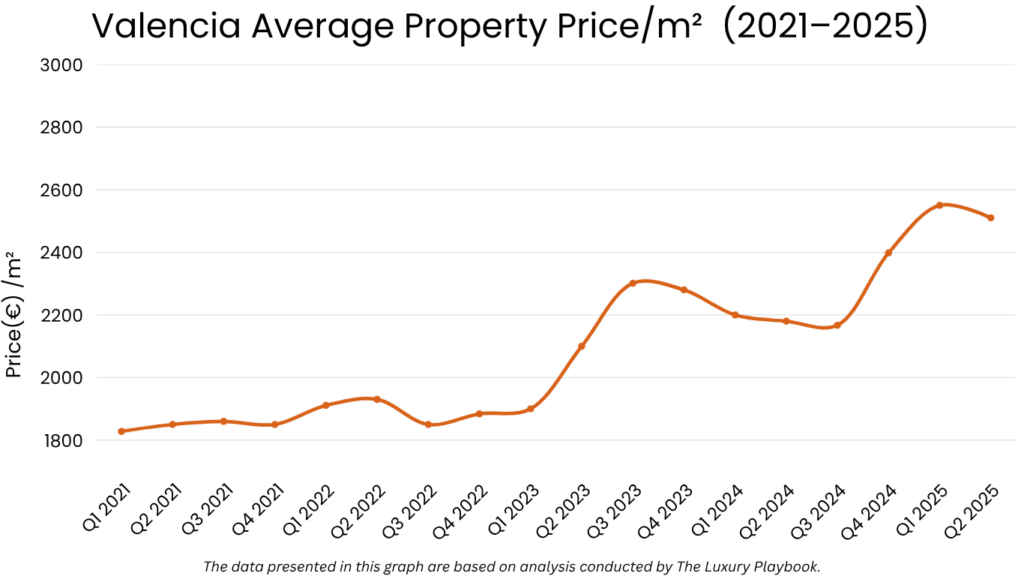
Over the past 24 months, property prices in Valencia have seen consistent growth, with average citywide values now reaching €2,400 to €2,600 per square meter, and climbing higher in coastal and well-connected central districts.
Foreign demand, a favorable climate, and a lower price per square meter compared to Madrid and Barcelona all keep pushing transaction volumes upward.
New construction activity is slowly recovering, but limited supply in central zones and rising costs in the resale market are adding further upward pressure on prices. Rental demand is robust across long-term, student, and executive segments, though you’ll need to navigate regulatory proposals on tourist rentals and potential rent controls before committing capital.
Table of Contents
Overview of The Valencia Housing Market
The Valencia housing market in 2026 is defined by rising demand, relative affordability, and steady upward pressure on both sales prices and rental rates. Compared to Madrid and Barcelona, Valencia offers lower entry costs and higher yield margins, making it one of Spain’s most attractive mid-tier investment destinations right now.
As of Q2 2026, the average residential property price in Valencia sits at approximately €2,510 per square meter, marking a year-over-year increase of 6.4%.
Premium districts such as El Pla del Remei, Ciutat Vella, and Russafa command prices between €3,200 and €3,800 per sqm, while more affordable areas like Benicalap, Patraix, and Campanar stay in the €1,800 to €2,200 per sqm range, offering accessible entry points for first-time and yield-seeking investors.
Valencia’s buyer composition is increasingly international, with strong activity from Germany, France, the Netherlands, Italy, and Latin America. Many foreign buyers are relocating for lifestyle reasons, while others are after rental income or Golden Visa-qualifying properties that meet the required investment thresholds.
At the same time, local demand stays strong, backed by improving employment rates and a growing startup ecosystem.
Development activity stays limited, especially in central and heritage-protected zones. Most new supply is concentrated in peripheral neighborhoods or larger suburban projects. That dynamic has reinforced pricing strength in well-located second-hand properties that offer renovation potential and strong rental appeal.
Key market characteristics in 2026
- Average citywide property price: €2,510/sqm
- Prime district pricing: €3,200–€3,800/sqm (Ciutat Vella, El Pla del Remei)
- Value districts: €1,800–€2,200/sqm (Patraix, Benicalap, La Olivereta)
- Buyer mix: 60% local, 40% international in central zones
- New-build premium: 20–25% over resale market pricing
- Annual price growth: 6.4% citywide (2024–2025)
Valencia’s housing market is undersupplied, competitively priced, and well-positioned for continued appreciation. If you’re seeking long-term rental returns and market entry below Spain’s major capitals, Valencia delivers strong fundamentals and rising global interest.

Neighborhood Analysis
Valencia’s housing market is defined by its diversity, blending historic charm, coastal appeal, and value-oriented neighborhoods. Pricing and investment potential vary widely across districts, with central zones offering asset preservation and outer areas delivering higher yields.
El Pla del Remei
El Pla del Remei is Valencia’s most prestigious district, known for its wide boulevards, Modernist buildings, and proximity to luxury retail. It draws high-net-worth buyers and second-home investors looking for long-term asset security.
The average property price runs at approximately €3,800 per square meter, with large, renovated apartments selling for €450,000 to €1 million. Yields are lower here, but the area offers strong resale demand and minimal vacancy risk.
Ciutat Vella
Ciutat Vella is the historic heart of Valencia, home to Gothic architecture, tourist landmarks, and narrow, walkable streets. The area stays highly desirable for both lifestyle buyers and investors targeting renovated properties with character.
Prices average around €3,500 per sqm, with opportunities for value-add investments in older buildings. Tourist rental restrictions apply, but long-term rental demand stays solid.
Russafa (Ruzafa)
Ruzafa has undergone serious gentrification over the past decade, evolving into one of Valencia’s trendiest neighborhoods. It’s known for its cultural scene, cafes, and nightlife, which draws younger tenants and digital nomads in steady numbers.
Properties here typically trade around €3,200 per sqm, with consistent rental demand and moderate appreciation. The area is ideal if you want balance between yield and liquidity.
Benicalap
Benicalap is an up-and-coming area in the north of the city. It offers green space, residential towers, and relatively low entry prices, making it a target for investors looking for mid-term capital gains and stable occupancy.
Average prices sit around €1,850 per sqm, with strong demand from families and working professionals. It delivers some of the city’s highest gross yields.
Patraix
Patraix gives you a suburban feel while staying well-connected to the city center. It’s known for affordability, livability, and easy access to local services.
Pricing averages €2,000 per sqm, with small apartments often priced between €180,000 and €250,000. Rental performance is stable, and appreciation tracks closely to infrastructure and mobility upgrades in the area.
Neighborhood Median Prices and Price per Square Meter
Valencia_Neighborhood_Home_Prices_2025.csv
Valencia Rental Market Overview
The Valencia rental market in 2026 stays one of Spain’s most stable and investor-friendly segments. Strong demand from students, professionals, and international relocators keeps absorbing available supply, driving moderate rent increases across most districts. And unlike some other cities, Valencia has not imposed the same level of rent restrictions you’d find in Barcelona. Wealthy renters driving up prices is a global trend playing out in premium urban markets worldwide.
Rental demand in Valencia gets structural support from affordability, urban expansion, and demographic diversity, making it a favored city for yield-driven investors.
Average Monthly Rent by Property Type (2026)
- 1-Bedroom Apartment: €650 – €900
- 2-Bedroom Apartment: €850 – €1,200
- 3-Bedroom Apartment: €1,200 – €1,600
- Luxury Apartments (El Pla del Remei, Ciutat Vella): €1,800 – €2,500+
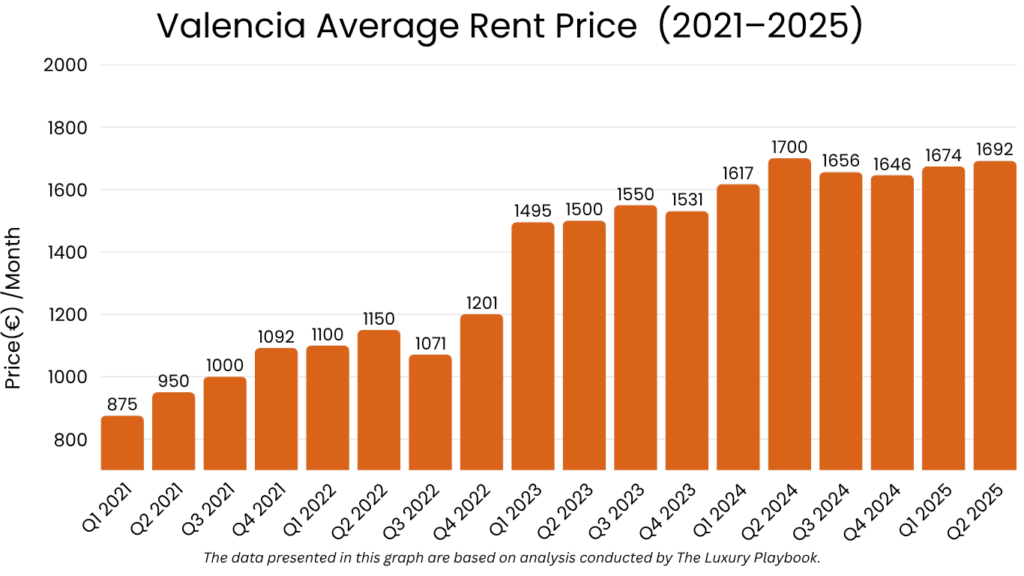
Rental demand is highest in Ruzafa, El Pla del Remei, and Ciutat Vella, where lifestyle appeal and proximity to amenities attract expats, digital nomads, and professionals.
Districts like Benicalap, Campanar, and Patraix offer reliable tenant occupancy and higher yield ceilings, especially for well-managed units priced for the middle-income segment.
Yield Performance and Tenant Profiles
Gross yields in Valencia typically range between 4.5% and 6.5%, depending on district, condition, and rental model. You can achieve higher performance in value-oriented zones where purchase prices stay below €2,000 per sqm.
- High-Yield Areas: Benicalap, La Olivereta, Patraix (5.5%–6.5%)
- Balanced Core Districts: Ruzafa, Campanar, Quatre Carreres (4.8%–5.5%)
- Capital Preservation Zones: El Pla del Remei, Ciutat Vella (4.0%–4.8%)
Tenant demand is diverse, ranging from Spanish professionals and international remote workers to Erasmus students and long-term retirees. Many properties are rented furnished, with growing interest in mid-stay leases of three to twelve months from foreign tenants.
Valencia has not imposed formal rent caps as of 2026, though the regional government keeps monitoring affordability. Short-term rentals are allowed but subject to zoning, licensing, and registration requirements, especially in Ciutat Vella and the historic core.
The market increasingly favors long-term leasing strategies, especially as licensing limits and regulatory compliance become more important to sustaining stable income. Off-market properties can give you a meaningful edge in sourcing well-priced rental assets before they reach wider buyer pools.
The Valencia rental market in 2026 offers a favorable combination of yield potential, stable tenant demand, and regulatory flexibility. Investors who align property type and location with target renter profiles can achieve reliable income performance with moderate risk exposure.

Factors Influencing the Valencia Housing Market
The Valencia housing market in 2026 is driven by a combination of demographic expansion, infrastructure upgrades, affordability advantages, and growing international attention. As one of Spain’s most balanced urban markets, Valencia benefits from both local and foreign capital, with investor decisions shaped by economic trends, urban policy, and evolving buyer preferences.
- Population Growth and Internal Migration: Valencia continues to attract both Spanish nationals relocating from costlier regions and international residents seeking quality of life. The population increase supports sustained demand for residential housing, particularly in well-connected neighborhoods close to transit, universities, and business centers.
- International Buyer Activity: Valencia has become increasingly popular among European investors (Germany, Netherlands, France) and Latin American buyers. Many are attracted by the city’s lower price point compared to Madrid and Barcelona, the Golden Visa program, and a favorable climate for relocation or retirement.
- Limited New Supply in Prime Areas: Construction activity remains modest within core districts due to zoning, building height restrictions, and protected heritage zones. This has created supply bottlenecks in high-demand neighborhoods such as El Pla del Remei, Russafa, and Ciutat Vella, reinforcing price resilience and supporting renovation-led strategies.
- Rental Market Pressures and Tenant Demand: A growing tenant population—including students, remote professionals, and foreign residents—fuels demand for rental housing. Long-term rental contracts continue to dominate, though short-term leasing remains viable with proper licensing. Vacancy rates are particularly low in areas with good metro access and recent public investment.
- Infrastructure and Urban Redevelopment: Projects like the extension of Metrovalencia lines, upgrades to the Turia river park, and modernization of Quatre Carreres and Benicalap districts have enhanced the liveability and connectivity of previously overlooked neighborhoods, increasing their rental appeal and long-term investment value.
- Affordability and Political Environment: Compared to Spain’s largest cities, Valencia remains affordable. However, affordability is tightening in central areas, and political discussions surrounding rent stabilization and social housing mandates are ongoing. For now, no rent cap law has been enacted, but investor sentiment will continue to watch regional policy closely.
- Climate and Lifestyle Migration: Valencia’s Mediterranean lifestyle, walkability, and international schools make it attractive for remote workers and digital nomads. This lifestyle-driven demand adds resilience to the market, particularly in mid- and upper-tier neighborhoods with good infrastructure and broadband connectivity.
Valencia Housing Market Forecast for 2026
The Valencia housing market is projected to maintain its upward trajectory through 2026, driven by sustained local and foreign demand, constrained central supply, and increasing lifestyle migration. With relatively low price-per-square-meter values compared to other major Spanish cities, Valencia stands out as one of the most undervalued yet high-potential urban markets in Southern Europe.
Appreciation is expected to moderate slightly from 2024 peaks, but yield performance and capital stability stay strong across both core and secondary districts.
Property prices in Valencia are forecast to increase by 4.0% to 6.0% in 2026. High-demand districts such as Ruzafa, El Pla del Remei, and Ciutat Vella are expected to post the most stable growth, with average prices projected to reach €2,700 to €3,000 per square meter, depending on building quality and location.
More affordable outer districts like Patraix, Benicalap, and La Olivereta are expected to grow faster, in the range of 5.5% to 7.5%, as buyers and renters move outward in search of better value and larger living space. These districts stay prime for mid-term capital appreciation and higher rental yield strategies.
Citywide, the average residential property price is likely to reach €2,700 to €2,750 per sqm by the end of 2026, supported by low inventory and macroeconomic stability. You can see how slower construction activity drives real estate prices higher across global markets, and Valencia is no exception.
Rental prices are projected to grow by 3.0% to 4.5%, fueled by tight supply, a growing tenant base, and increased interest from international relocators. With tourism regulations reinforcing long-term leasing, average rents are expected to rise steadily, especially in transit-oriented areas.
- 2-bedroom long-term rentals in Ruzafa and Campanar may exceed €1,300/month
- 3-bedroom units in Benicalap and Patraix will likely approach €1,200–€1,400/month, with strong yield performance
Occupancy rates are expected to stay high, with well-maintained, energy-efficient units outperforming in both prime and secondary zones.
New development activity will stay limited in central districts. Planning restrictions, cost pressures, and a preference for renovation over new construction will limit major delivery in Ciutat Vella, Russafa, and other mature neighborhoods. Investors focused on refurbished assets and professionally managed portfolios will hold a real competitive advantage.
Foreign investment will stay a consistent market driver. Buyers from Germany, the Netherlands, France, and Latin America will keep supporting demand across lifestyle and yield-driven segments. Golden Visa interest is expected to stay stable, especially for properties priced above €500,000 in prime areas.
The Valencia housing market in 2026 is positioned for stable price growth, robust rental income, and continued interest from international and domestic buyers. For investors seeking strong fundamentals with regulatory flexibility, Valencia offers one of the most attractive risk-adjusted profiles in the Spanish real estate market. Comparing it to other growing urban markets like Columbus makes clear just how competitive Valencia’s entry costs and yield potential really are.

Is It Worth Buying a Property in Valencia?
Yes. If you’re looking for a blend of affordability, steady rental income, and long-term appreciation, Valencia is a strategically sound choice in 2026. But your expectations need to be grounded in the market’s regulatory environment, supply limitations, and evolving rental framework.
The Valencia housing market offers some of the highest gross rental yields among major Spanish cities, with averages ranging from 4.5% to 6.5%, especially in mid-priced districts like Benicalap, Patraix, and La Olivereta. These areas offer accessible entry points and strong occupancy from local renters and long-term foreign residents. According to the Financial Times, Southern European cities are drawing increasing investor attention precisely because of this yield advantage.
Core neighborhoods such as El Pla del Remei and Ciutat Vella offer capital preservation and liquidity, but at higher entry prices and lower net yields. These zones suit buyers who prioritize asset safety and portfolio diversification over pure return.
That said, there are factors you need to build into your analysis before buying
- Ongoing political discussions about rent caps and tenant protections, which could affect pricing strategies or lease flexibility in the future.
- Regulatory constraints on short-term rentals in historic districts and areas with tourism saturation.
- Rising construction and renovation costs, which may compress margins in value-add projects.
Despite those considerations, Valencia stays one of Spain’s most balanced property markets, combining livability, infrastructure, and a growing international tenant base. Investors targeting long-term leasing, mid-market assets, or renovated units with energy efficiency upgrades are well-positioned to outperform. Bloomberg’s coverage of Spain’s property market points to Valencia as a city where fundamentals and lifestyle converge in a way that few other European cities can match right now.
Other Market Forecasts and Overviews
Madrid Real Estate Market Overview and Forecast
Barcelona Real Estate Market Overview and Forecast
Seville Real Estate Market Overview and Forecast
Zaragoza Real Estate Market Overview and Forecast
FAQ
Is Valencia a good place to invest in real estate?
Yes. Valencia offers strong rental yields, stable demand, and lower entry prices than Madrid or Barcelona.
What is the average property price per square meter in Valencia in 2025?
Around €2,510/sqm citywide. Prime areas exceed €3,800/sqm.
Are rental yields in Valencia attractive for investors?
Yes. Yields typically range from 4.5% to 6.5%, depending on location and asset type.
Can foreigners buy property in Valencia?
Yes. There are no restrictions on property ownership for international buyers.
Are rent caps enforced in Valencia?
Not yet. Rent regulation is under political discussion but not currently implemented.
Is short-term rental allowed in Valencia?
Yes, but it requires proper licensing, especially in historic or tourist-heavy zones.
Which Valencia neighborhoods offer the best investment value?
Benicalap, Patraix, Russafa, and La Olivereta offer the best combination of affordability, yield, and growth.