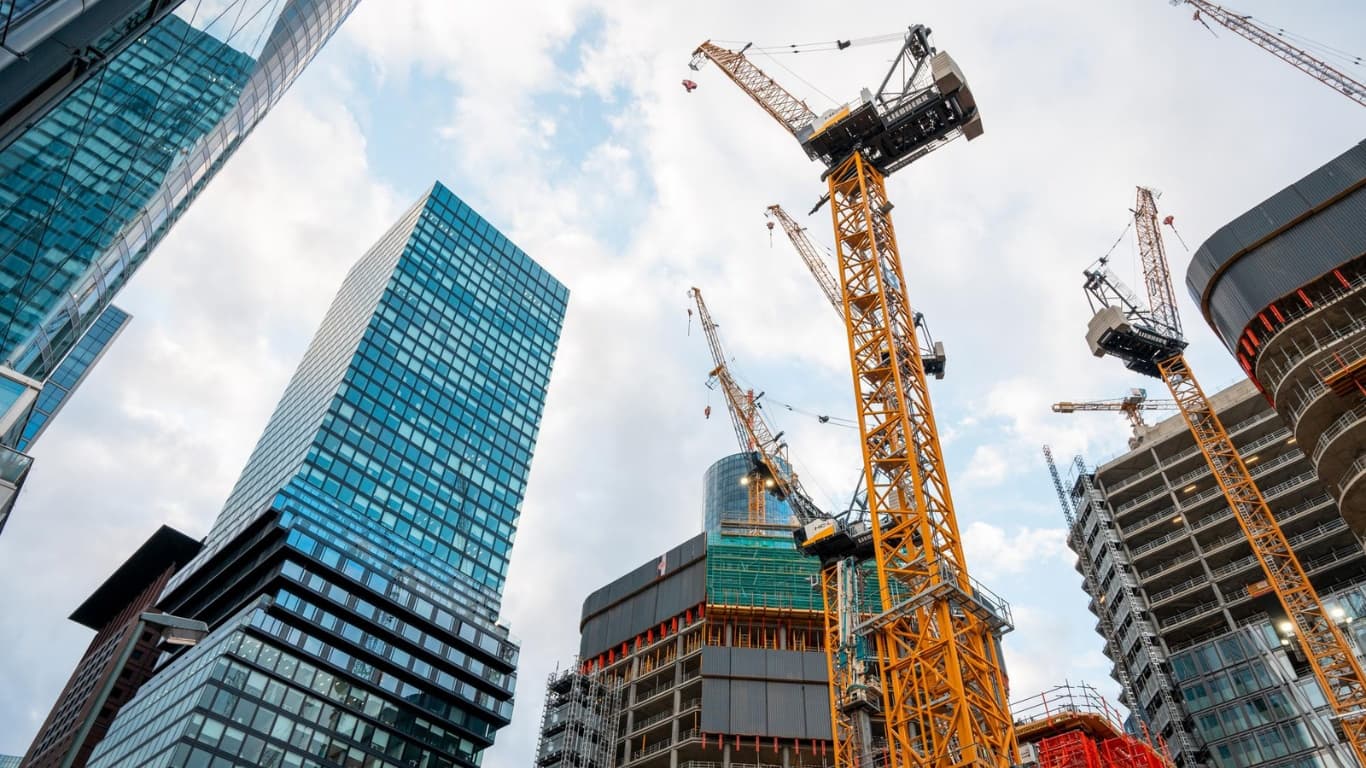
The story being missed in the slower construction impact on US luxury real estate is not about price. It is about supply. Construction starts on residential property hit their lowest level since 2020 in the most recent U.S. Census Bureau release, and the slowdown is steepest in exactly the segment that drives the prime market: large single-family homes on prime urban or suburban land.
The downstream effect is already showing up in the established prime markets. The architects, developers, and brokerage networks we have been talking to all expect it to define the next two to three years of the conversation.
The Compass private-client desk in Manhattan describes the inventory shortage in plain terms. The buyers are there, the financing is available, and the interest in trophy property has not weakened. What has weakened is the pipeline: new ground-up construction in the prime Manhattan and Brooklyn submarkets has slowed materially since 2023, and the inventory of architecturally interesting completions reaching the market is at a multi-year low.
- New construction levels remain below the historical run rate needed to address the structural US housing shortage, with the luxury segment showing the most pronounced supply constraints.
- We see labour shortages, materials cost inflation and the broader tariff landscape having lengthened construction timelines materially, with luxury custom projects most affected.
- Permit volumes have moderated in 2025 and into 2026, with builders responding to higher rates and softer absorption by pulling back from speculative starts.
- The luxury segment supply constraint has supported pricing in the most desirable enclaves, with limited new inventory in trophy markets reinforcing the existing pricing.
- Renovation and adaptive reuse activity has remained more active than ground-up construction, with the gap between completion timelines widening across the cycle.
- For most considered buyers we view the construction slowdown as supporting prices in the prime segment for the foreseeable future, with new supply unable to meet demand growth.
- Who is this for?
- Luxury property buyers, investors, developers and advisers tracking the US construction landscape, alongside the lenders and family office staff structuring acquisitions in supply-constrained markets.
- What is happening?
- An analysis of how slower construction is affecting US luxury real estate, covering labour, materials, tariffs, permit volumes and the implications for prime segment pricing.
- When did this emerge?
- The article covers conditions through 2025 and 2026, with reference to the post-pandemic construction cycle and the latest tariff and labour market developments.
- Where is this happening?
- The piece covers the US luxury market broadly, with reference to the prime enclaves where supply constraints most directly support pricing across the cycle.
- Why does it matter?
- Construction slowdown supports prime segment pricing structurally in 2026, which is why awareness of the supply dynamics matters for any luxury market acquisition decision.
Why the construction slowdown is structural
Three forces are pressing in the same direction. The first is the cost stack: lumber, structural steel, and the imported finish materials that distinguish the higher-end builds, including Calacatta marble from Italy, European-specification kitchen and bath fixtures, and imported oak and walnut joinery, have stayed materially above pre-2020 prices. The Engineering News-Record building cost index has run ahead of broader inflation for four consecutive years.
The second is labour. The skilled trades that build the prime inventory, including finish carpenters, plaster artisans, cabinet specialists, and the better foundation crews, are in genuine short supply across the markets that produced the most pre-pandemic prime construction. The Associated General Contractors of America's 2025 workforce survey put unfilled positions in residential construction above 480,000, with the highest gap in the upper-trade categories.
The third is permitting. The ULURP cycle in New York, the City of Los Angeles approval timelines, and the Westchester and Connecticut land-use processes that govern the established Northeast prime markets have all stretched in the past three years. Architects we have spoken to describe a current ground-up house in the prime Greenwich back-country as a 24- to 36-month process from architect engagement to certificate of occupancy, where ten years ago the same project ran 14 to 20 months.
Where the supply pinch is sharpest
The pinch concentrates in the markets that combine high prime demand with constrained land. Manhattan's prime townhouse inventory has fallen to a multi-decade low: the Brown Harris Stevens and Sotheby's International Realty pipelines combined showed under 80 actively listed townhouses above $20 million in late 2025, against a typical recent average closer to 120 to 140.
The Hamptons inventory has tightened similarly. Compass East End's 2025 mid-year report tracked 12 active prime listings (above $25 million) on the South Fork, against 22 a year earlier, and the Sotheby's International Realty East End desk corroborates the number.
The Mountain West prime markets, including Aspen, Park City, the Yellowstone Club, and Sun Valley, have seen a softer but parallel pattern. The trophy-completion inventory is thin, and the architects' books are full enough that the new ground-up custom builds reaching the market are mostly properties commissioned in 2021 or 2022. Architectural Digest has covered the supply-side compression in its Aspen and Mountain West dispatches across 2024 and 2025.
What is holding up better
The picture is not uniform. South Florida, especially Miami Beach, Coral Gables, and the secondary Coconut Grove and Pinecrest inventory, has continued to deliver prime completions, partly because the development cycle there has remained more concentrated in mid-tier developer-led projects (Indian Creek's villa quarter is the obvious exception). The newer South Florida ultra-prime, including the post-Faena and post-Aman Beach branded residences, Edition Residences, and the Cipriani-affiliated tower, has come on more or less to schedule, though several have repriced upward against original release pricing.
Texas and the Sun Belt cities such as Austin, Nashville, Charleston have similarly held steadier on the supply side. The prime inventory in those markets is concentrated in established neighbourhoods (Tarrytown and Westlake in Austin, Belle Meade and Forest Hills in Nashville, South of Broad in Charleston) where new construction is constrained by the historic streetscape rather than economic fundamentals.
The brokerage view
Compass, Douglas Elliman, Sotheby's International Realty, and Brown Harris Stevens, the four networks that handle the bulk of U.S. prime inventory, describe the same buyer behaviour. Buyers are widening their geographic search, accepting older inventory in established neighbourhoods rather than waiting for new ground-up product, and pursuing renovation-led purchases more aggressively than two years ago.
The pre-renovated Greenwich back-country house, the Aspen mid-century needing a refresh, and the Charleston single house with the carriage house in poor condition: these are the properties moving fastest right now, by every brokerage account.
The renovation-led pathway has its own constraints. The same labour and material pinch that has slowed ground-up construction has slowed the renovation calendar, and architects and contractors who would have begun a Greenwich renovation project six months from contract are now scheduling out twelve to eighteen months. Owners who can wait are waiting; owners who cannot are paying premium pricing to jump the queue.
The prime market reads now
The structural shortage of new prime inventory is, if anything, deepening the price stratification at the top of the U.S. market. Trophy property in the established prime addresses, meaning the deep Greenwich back-country lots, the Hamptons ocean-front South Fork, the prime Aspen West End and Red Mountain inventory, the central Park City Deer Valley ski-in/ski-out, and the Yellowstone Club ridgeline, has tightened further against everything else. Mansion Global's 2025 trophy-segment coverage has tracked the divergence carefully.
What this means for buyers
For buyers thinking about the coming two to three years, the question is less about timing the cycle than about identifying which inventory is genuinely scarce and which is merely currently constrained. The land-constrained prime addresses will not loosen on supply, and the renovation-led entry into those addresses is the obvious play for capital that can accept calendar risk.
The mid-tier suburban and mid-prime urban inventory may well loosen as the construction pipeline reaches the next completion wave, which is the segment where waiting is rewarded. The buyers we watch are concentrating on the former and patient on the latter.
Industry research from the National Association of Realtors and Bain has tracked the same pattern across the US market: shrinking construction starts, rising prime-asset scarcity, and a widening premium for already-built inventory.
We last reviewed this analysis in May 2026.


Savvas Agathangelou
Savvas Agathangelou co-founded The Luxury Playbook and has spent years reporting from the prime postcodes the magazine covers — Mayfair, Knightsbridge, the Athens Riviera, Dubai's Palm crescents, and the southern Mediterranean coastlines where the world's wealthy keep coming back. His background is in international hospitality, and that frame shapes how he writes about property: the developer's choices, the architect's signature, the agency's bench of named brokers, the building's service standard once the buyer moves in. He files developer spotlights, agency profiles, and the seasonal "Properties That Defined" listicles, and he hosts the magazine's founder-and-leadership interviews on the Voices side.