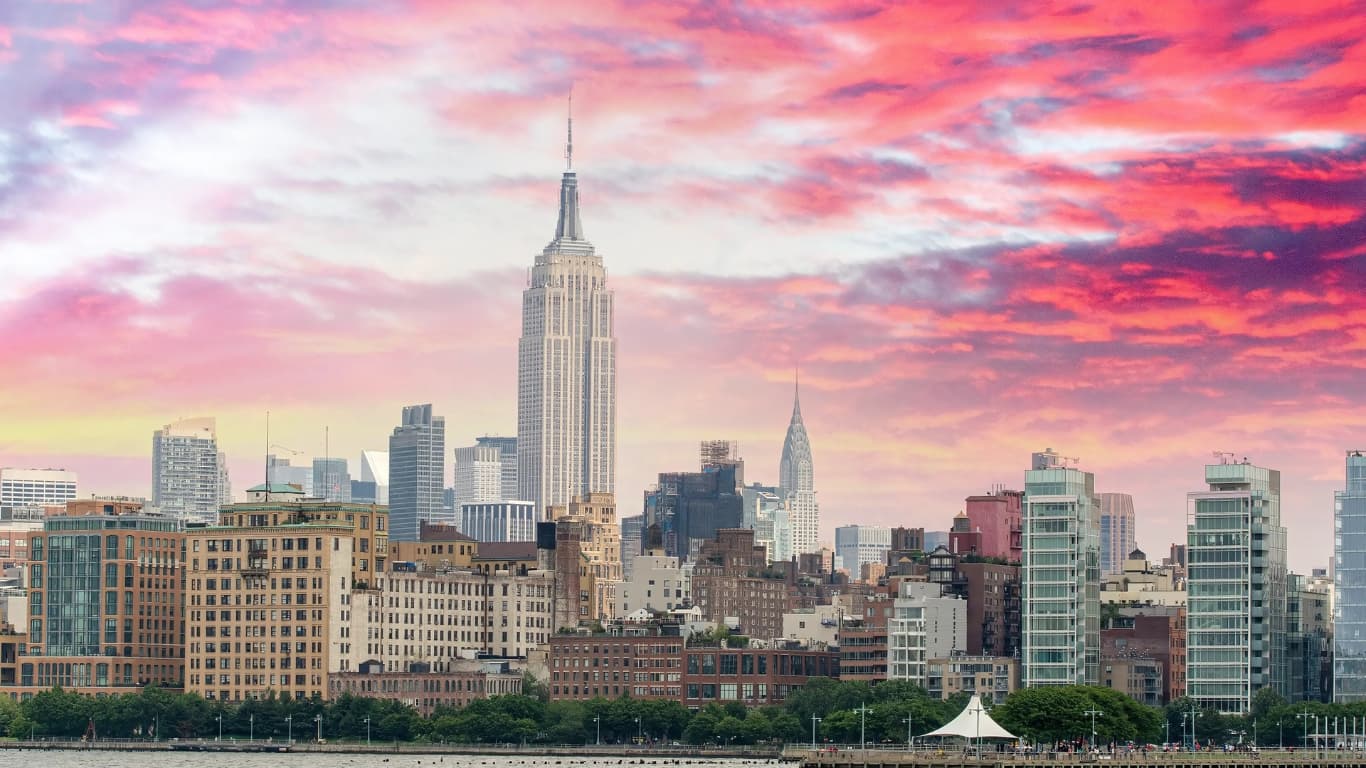
Wealthy renters are pushing Manhattan rental prices higher, and the surge is catching even seasoned brokers off guard. While most observers assume the ultra-wealthy simply buy their dream apartments, a growing number are choosing to rent and willing to pay eye-watering amounts to do so. We are talking about monthly rents exceeding $50,000 for prime properties, creating bidding wars that make luxury car auctions look tame by comparison.
Douglas Elliman’s September 2025 Market Report reveals that median luxury rental prices have jumped 18% in just one year, but the real story lies in who’s driving this surge and why they’re reshaping Manhattan’s entire real estate landscape.
For our editorial read, this marks a shift opening up extraordinary rental positioning while signalling how the world's wealthiest individuals are rethinking their relationship with Manhattan real estate. The upside on the landlord side is hard to ignore, but the more interesting story is the buyer behaviour driving it.
- Manhattan rental prices have continued to climb in 2026, with wealthy renters choosing flexibility over ownership and pushing premium-segment rents to fresh highs across the borough.
- We see the post-pandemic rental recovery having extended into a structural shift, with high-earning professionals increasingly opting for prime rentals over comparable purchase commitments.
- StreetEasy and Douglas Elliman data show median Manhattan rents at record levels, with the West Village, Tribeca and Hudson Yards leading the premium segment pricing.
- Mortgage rate normalisation around six to seven percent has made the rent-versus-buy calculation more favourable for renters, particularly for shorter-horizon stays.
- The FARE Act ending broker fee charges to renters has shifted the upfront cost calculation, although market-rate brokerage cost has been increasingly absorbed by landlords.
- For most considered renters in the prime Manhattan market we view the current flexibility as warranting honest assessment of the multi-year cost trajectory before extending the rental commitment.
- Who is this for?
- Manhattan renters in the premium segment, alongside landlords, brokers and investors tracking the urban rental market dynamics across the borough.
- What is happening?
- A market analysis of how wealthy renters are pushing Manhattan rental prices higher in 2026, covering the rent-versus-buy calculation, the FARE Act effects and the premium segment dynamics.
- When did this emerge?
- The article covers conditions through 2025 and 2026, with reference to the post-pandemic rental recovery, the mortgage rate normalisation and the FARE Act implementation.
- Where is this happening?
- The piece focuses on Manhattan, with particular reference to the West Village, Tribeca, Hudson Yards and the broader prime borough rental submarkets.
- Why does it matter?
- Manhattan rental dynamics reflect broader US affordability shifts in 2026, which is why understanding the rent-versus-buy calculation matters for residents considering longer-term commitments.
Manhattan rental market overview in 2026
The numbers coming out of Manhattan's rental market right now read like something from a different planet. Miller Samuel's Q3 2026 report shows average luxury rentals hitting $8,247 monthly, but that figure barely scratches the surface of what is really going on. The real action is happening at the very top.
Properties renting for over $20,000 monthly have increased by 34 per cent year over year, while ultra-luxury rentals above $40,000 monthly have exploded by 67 per cent, according to StreetEasy's latest market data. Manhattan is in a league of its own: while cities like San Francisco and Los Angeles are seeing luxury rental growth in the single digits, Manhattan's 18.3 per cent surge is more than quadruple the national average.
The geography of this rental boom tells its own story. Tribeca leads the charge with luxury rentals averaging $12,400 monthly, while SoHo commands $11,200 and the Upper East Side sits at $9,800, according to Compass's neighbourhood analysis. For a deeper read on where the broader New York market is heading, the New York City real estate market overview and forecast is worth your time.

Who Manhattan's wealthy renters actually are
The people behind these astronomical rents paint a picture of modern wealth that challenges traditional assumptions about real estate behaviour. Nest Seekers International's recent survey reveals that 67 per cent of luxury renters earn over $500,000 annually, with about a third pulling in over $1 million per year. These are not people who cannot afford to buy; they are choosing not to.
But here’s what’s really interesting: these aren’t people who can’t afford to buy, they’re choosing not to.
Finance professionals dominate this market at 42 per cent of luxury renters, followed by tech executives at 23 per cent. With jumbo mortgage rates sitting around 6.64 per cent according to the Mortgage Bankers Association's latest survey, a $5 million apartment that once demanded manageable monthly payments now costs dramatically more to finance, and that math is pushing high earners toward luxury rentals as the smarter short-term play.
The international component adds another layer. Wealthy foreign nationals are choosing Manhattan rentals over purchases in growing numbers to sidestep the maze of ownership structures and tax implications that come with international property buying. Knight Frank reports a 45 per cent increase in international luxury rental inquiries, led by executives from the UK, Switzerland, and Singapore.
Perhaps the most telling detail is that many of these wealthy renters cite flexibility as their primary motivation. They want the freedom to move between neighbourhoods, upgrade or downsize as their family situation changes, or leave Manhattan entirely if the right opportunity calls. That kind of optionality is nearly impossible when you are tied to a multimillion-dollar purchase.
Bidding wars and their impact on prices
The rental bidding wars playing out across Manhattan right now would have been unthinkable just a few years ago. Corcoran's data shows that 38 per cent of luxury rental applications now involve multiple qualified candidates, compared with just 12 per cent in 2024. The real drama unfolds in individual transactions that showcase how fierce this market has become.
Take the Tribeca penthouse that recently made waves. Listed at $35,000 monthly, it drew seven qualified applications within 48 hours and ultimately rented for $42,500, with the winning tenant paying a $7,500 monthly premium just to lock it down. A Central Park West apartment that attracted twelve applications at $18,000 monthly went to a successful renter offering $21,500 plus six months of payment upfront.
These are not isolated incidents but part of a broader pattern reshaping Manhattan's rental ecosystem. Tribeca leads the bidding war intensity with 52 per cent of luxury rentals drawing multiple qualified applications, followed by SoHo at 47 per cent and the West Village at 43 per cent. In these neighbourhoods, landlords are essentially running auctions and wealthy tenants are treating monthly rent like paddle raises.
The psychological impact extends beyond the immediate transactions. Renters who lose out on their first-choice properties tend to become more aggressive in their next search, willing to pay premiums to avoid another disappointing outcome. That creates a feedback loop where each bidding war raises the floor for the next property.
Opportunities on the rental side
For landlords and rental-focused operators, Manhattan's current dynamics represent the kind of opportunity that surfaces perhaps once a decade. CBRE's analysis shows luxury rental properties generating gross yields of 4. 8 to 6.
2 per cent annually, but those figures do not capture the full picture. If you are weighing the broader case for property exposure, the pros and cons of investing in real estate lays out the fundamentals worth knowing.
With rent growth running at 18 to 25 per cent annually in prime locations, total returns are clearing 20 per cent for well-positioned properties. Major firms including Blackstone and Starwood Capital have been active in Manhattan real estate transactions, with Bloomberg reporting a $389 million lending arrangement for a Long Island City residential tower in mid-2026, and Related Companies has been active with acquisitions like its $632.5 million purchase of 625 Madison Avenue.
When the smart money moves this aggressively into a market, individual investors should pay attention.
What makes this opportunity especially compelling is the rental-to-purchase price gap that has opened up from the current rate environment. Properties that buyers acquired in 2022 and 2023 are now generating rental returns 40 to 60 per cent above original projections, according to Marcus & Millichap's analysis. If you are curious how high-net-worth buyers are navigating similar dynamics elsewhere, the story of high-net-worth investors targeting Maui real estate offers a useful parallel.
The future outlook for Manhattan's rental market
Every forward-looking indicator suggests Manhattan's luxury rental boom has room to run. Cushman & Wakefield's forecasting team projects another 12 to 15 per cent increase in luxury rental prices through 2026, with ultra-luxury properties above $25,000 monthly expected to see 18 to 22 per cent growth as supply stays severely constrained. These are not wild projections; they are conservative estimates grounded in demographic and economic trends.
The underlying drivers go beyond current interest rates. McKinsey's research shows the number of individuals with liquid assets exceeding $5 million growing at 8 per cent annually through 2030, with a rising preference for flexible real estate arrangements. That demographic shift strongly favours Manhattan, which offers the world-class amenities, business connectivity, and cultural depth that appeals to globally mobile wealth.
International wealth creation patterns point to sustained demand from global sources that view Manhattan as an essential business and lifestyle hub. The Federal Reserve's projections suggest mortgage rates will stay above 6.5 per cent through 2026, keeping purchase financing expensive relative to rental alternatives and maintaining the upward pressure on luxury rental demand.
What this means for buyers
The transformation of Manhattan into a luxury rental hub looks less like a temporary anomaly and more like a permanent shift in how the wealthy choose to live here. For buyers thinking about Manhattan exposure, the more interesting position is now on the landlord side rather than the owner-occupier side, at least until the rate environment shifts materially. Brown Harris Stevens' rental desk confirms the texture: trophy tenants without trophy purchases, often paying multi-year upfront.
The buyers we watch are reading the optionality argument that the renters themselves are making and concluding the same thing in reverse: own the building, rent the suite. That is the position we would build for the coming two years.
We last reviewed this analysis in May 2026.


Savvas Agathangelou
Savvas Agathangelou co-founded The Luxury Playbook and has spent years reporting from the prime postcodes the magazine covers — Mayfair, Knightsbridge, the Athens Riviera, Dubai's Palm crescents, and the southern Mediterranean coastlines where the world's wealthy keep coming back. His background is in international hospitality, and that frame shapes how he writes about property: the developer's choices, the architect's signature, the agency's bench of named brokers, the building's service standard once the buyer moves in. He files developer spotlights, agency profiles, and the seasonal "Properties That Defined" listicles, and he hosts the magazine's founder-and-leadership interviews on the Voices side.