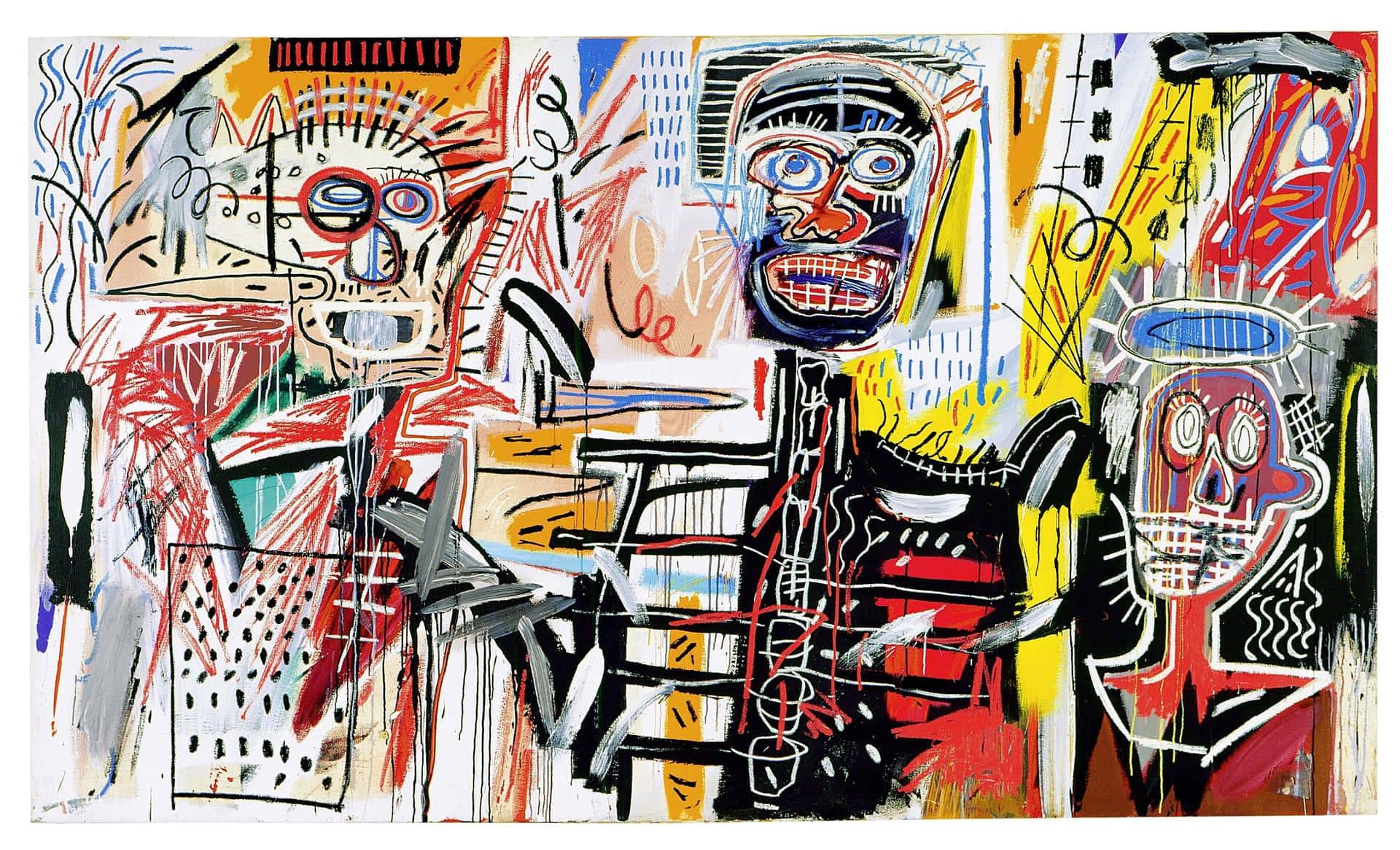
Jean-Michel Basquiat died in 1988 at twenty-seven, and the works he made in a working life of barely eight years now anchor the blue-chip contemporary auction-tier conversation. His paintings have set successive auction records for an American artist; his peak years (1981 to 1984) define what serious contemporary collectors consider the highest tier of post-war American work. The market for Basquiat sits at the very top of the contemporary salesroom and rarely behaves like the rest of it.
The benchmark sale is the one most collectors return to. "Untitled" (1982), the blue-background skull painting, made $110.5 million at Sotheby's New York in May 2017, paid by the Japanese collector Yusaku Maezawa. That figure remains one of the highest prices ever paid at auction for any contemporary American artist, and it reset what the top of the Basquiat market could be worth.
- Jean-Michel Basquiat anchors the very top of the post-war and contemporary market, with his 1981 to 1984 peak years defining what serious collectors will pay.
- Untitled 1982, the blue-background skull painting, made one hundred and ten point five million dollars at Sotheby’s New York in May 2017.
- That sale to Yusaku Maezawa reset what the top of the Basquiat market could be worth and remains one of the highest prices ever paid for a contemporary American artist.
- Other defining works include Dustheads, In This Case and a small group of canonical pieces from the same peak period that anchor evening-sale records.
- Basquiat sits inside the contemporary canon rather than alongside it, with MoMA, the Whitney and the Brant Foundation all holding work.
- For serious collectors, the top of the Basquiat market behaves like its own asset class and rarely tracks the rest of contemporary trading in any given season.
- Who is this for?
- Contemporary collectors, advisors and observers of the post-war and contemporary market who want a clear read on the Basquiat works that genuinely defined the artist’s auction tier.
- What is happening?
- An editorial overview of the Basquiat works that defined the market, covering Untitled 1982, Dustheads, In This Case and the canonical peak-period paintings.
- When did this emerge?
- Most relevant around the May and November evening sales at Christie’s, Sotheby’s and Phillips in New York, where peak-period Basquiat works set the contemporary tone.
- Where is this happening?
- Centred on the New York and London evening salesrooms, with major holdings across MoMA, the Whitney, the Brant Foundation and senior private collections worldwide.
- Why does it matter?
- Understanding the works that defined Basquiat’s market is essential context for any serious contemporary collector and for reading the very top of the post-war auction tier.
Why Basquiat sits inside the contemporary canon rather than alongside it
Basquiat is treated as a foundational contemporary artist, not an outsider. The Museum of Modern Art holds work. The Whitney has staged a major retrospective.
The Brooklyn Museum, the Guggenheim, and the Broad in Los Angeles all hold significant pieces. The Fondation Louis Vuitton in Paris held a landmark Basquiat-Schiele exhibition in 2018-2019 that crystallized his institutional position.
His placement in the Contemporary Art: A Collector's Field Guide conversation is anchored in that institutional record. Basquiat is neo-expressionist tier, but with cross-disciplinary depth that pulls into the figurative painting revival, the Black contemporary cohort, and the broader post-war American conversation.
That positioning matters for the market. Basquiat is not priced as a curiosity. He is priced as a canonical figure of the late twentieth century, alongside Warhol, Pollock, and Rothko in the top tier of American post-war painting.
The 1981-1984 cohort that anchors the market
Not all Basquiat works are priced the same. The market has settled on a clear hierarchy, and the top of it is the 1982 cohort, with the 1981-1984 window broadly the most coveted period.
The 1982 paintings sit at the peak. This was Basquiat's annus mirabilis: large-scale canvases, dense layering of text and figure, the symbolic vocabulary (crowns, skeletons, anatomical references, named historical figures) fully developed. The Sotheby's "Untitled" (1982) at $110.
5 million sits in this cohort. So does "Untitled" (Devil) at Sotheby's New York in May 2022, which made $85 million.
1981 paintings are scarcer and price strongly. 1983-1984 works are abundant relative to the rest of the catalogue, but the strongest examples (the multi-panel works, the collaborative pieces with Warhol from 1984-1985) sit close to the 1982 tier.
Works from 1986-1988, the late period, price meaningfully below the early-1980s peak. The drawings and works on paper across the full catalogue trade at a separate, lower tier, though strong examples have made into the seven figures consistently through the past decade.
How the Basquiat market actually behaves
The Basquiat market is unusual in two ways. First, it has been one of the most consistent secondary markets in contemporary art for over a decade. Major-house evening sales at Christie's, Sotheby's, and Phillips have placed strong Basquiat lots in every cycle since 2012, with prices that have trended upward through both bull and softer markets.
Second, the buyer pool is unusually global. American collectors remain the largest single base, but Asian buyers (Japanese, Korean, mainland Chinese, Hong Kong-based) have been heavy participants since the mid-2010s. The Maezawa purchase of "Untitled" (1982) was the most public Japanese acquisition; the broader pattern has been a sustained inflow of Asian capital into the top of the Basquiat market.
Gulf interest has been quieter but real. The Louvre Abu Dhabi, the Qatar Museums network, and several private collections in the region hold material from across the catalogue.
Provenance, authenticity, and the estate
The Basquiat Authentication Committee was dissolved in 2012, which closed the formal authentication channel. Since then, the market has relied on the catalogue raisonné project (the ongoing scholarly catalogue managed in collaboration with the estate), the major-house specialist reads, and provenance documentation from the artist's lifetime.
The Annina Nosei Gallery (Basquiat's early New York representation), the Mary Boone Gallery, and the Gagosian Gallery handled significant primary-market activity during Basquiat's lifetime. Works with documentation back to these original gallery placements price at a premium. Works without that primary-market chain face attribution friction.
The estate, represented by his sisters Lisane Basquiat and Jeanine Heriveaux, has become more active in the past five years, organizing the King Pleasure exhibition in New York and Los Angeles in 2022-2023 and engaging with the catalogue raisonné scholarship. That institutional activity has strengthened the market's documentation depth.
What sets the highest-tier lots apart
The top Basquiat works share characteristics. Large scale, often the full-stretcher canvases that were his ambition through 1981-1984. Dense surface activity: layered figure, text, and symbolic vocabulary across the picture plane.
A complete chain of provenance back to the original gallery placement. Exhibition history in major museum shows.
The strongest single feature, according to the major-house specialists, is what they call the "crown" pictures: works where the iconic three-pointed crown appears as a primary motif. These lots command consistent premiums in evening-sale rooms. The dense vocabulary of named historical figures, anatomical references, and text fragments adds further depth.
Condition matters but is less variable than in older categories. Most major Basquiat works are now between forty and forty-five years old. The painting supports (canvas, occasionally found materials) are stable when properly cared for, and conservation work to date has been mostly preventive rather than restorative.
What this means for collectors
Basquiat is one of the few contemporary names where the market behavior closely resembles that of modern blue-chip artists. The closed catalogue (he died in 1988), the deep institutional record, the consistent global buyer pool, and the documented provenance discipline make this a category that prices on fundamentals rather than on cycle sentiment.
For collectors entering at this level, the practical work is access. The top Basquiat works at auction routinely require third-party guarantee participation, irrevocable bids, or pre-arranged buyer relationships. The drawings and works on paper, plus the 1986-1988 paintings, offer more accessible entry points while remaining inside the same authentication and provenance framework.
What we'll watch next
The Basquiat catalogue raisonné project is in active development. As that scholarship publishes through this decade, the market's documentation layer will deepen further, with positive implications for the autograph 1981-1984 tier and likely some reattribution work on later or contested pieces.
We are also watching the broader contemporary evening-sale calendar. The Phillips and Sotheby's contemporary catalogues in the May and November New York rounds remain the venues where major Basquiat lots most often appear, and the activity at the top of those sales is the cleanest read on what serious contemporary collectors are currently willing to pay for the best post-war American work.
We last reviewed this analysis in May 2026.