Untitled (1982) cleared $110. 5 million at Sotheby's New York in May 2017, making Jean-Michel Basquiat the most expensive American artist ever sold at auction at the time. The work, a skull-headed composition on canvas, is the canonical example of why his 1982-1984 paintings command the prices they do.
Sotheby's published lot documentation made the case explicit, and the broader auction record across the period has reinforced the framing.
Basquiat died in 1988 at 27, after producing roughly 1,000 paintings and 2,000 drawings across an eight-year working career. The 1982-1984 window inside that career is structurally where the market concentrates, and the concentration is not arbitrary.
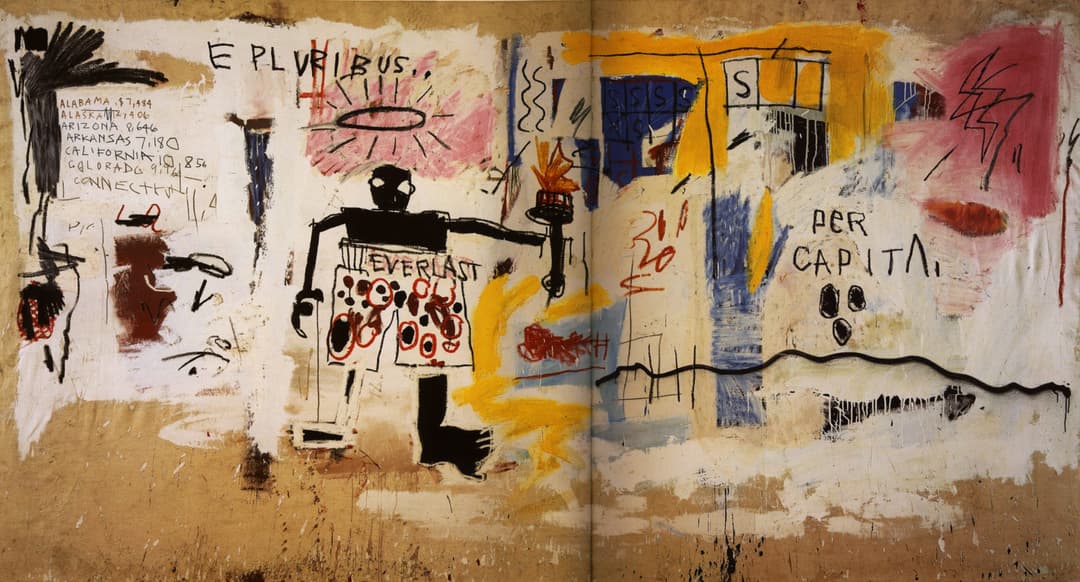
- Untitled from 1982 cleared one hundred and ten point five million dollars at Sotheby’s New York in May 2017, then the highest auction price for any American artist.
- Jean-Michel Basquiat died in 1988 at twenty-seven, after producing roughly one thousand paintings and two thousand drawings across an eight-year working career.
- The 1982 to 1984 window inside that career is structurally where the market concentrates, with three forces converging across those three years.
- In This Case from 1983 cleared ninety-three point one million dollars at Christie’s New York in 2021, the second-most consistent trophy result for the period.
- Versus Medici from 1982 sold for fifty point eight million dollars at Sotheby’s in 2021, and Made on Market Street from 1984 cleared over thirty million dollars in 2023.
- The Annina Nosei representation in 1982 and the Tony Shafrazi and Mary Boone gallery moves all happened inside this window, anchoring the institutional legitimisation of the practice.
- Who is this for?
- Contemporary collectors, advisors and observers of the post-war and contemporary market interested in why Basquiat’s 1982 to 1984 paintings command the record prices they do.
- What is happening?
- An editorial overview of why Basquiat’s 1982 to 1984 paintings command record auction prices, covering the technical maturation, the institutional reception and the trophy auction record.
- When did this emerge?
- Most relevant around the May and November contemporary evening sales at Christie’s, Sotheby’s and Phillips in New York where peak-period Basquiat works set the tone.
- Where is this happening?
- Centred on the New York and London salesrooms at the three major houses, with institutional holdings across the Whitney, the Brant Foundation and the Fondation Louis Vuitton.
- Why does it matter?
- Understanding why the 1982 to 1984 window concentrates the trophy market is essential context for serious contemporary collectors reading the very top of the post-war auction tier.
Why the 1982-1984 window specifically
Three forces converged in those three years. The first is the technical maturation. Basquiat moved from the SAMO graffiti tags of the late 1970s to a fully realised painting practice through 1981-82, and the canvases of 1982-1984 represent the period in which the visual vocabulary, compositional structure, and material handling all came together at the highest level.
The second is the institutional reception. The 1982 Annina Nosei representation, the inclusion in the Whitney Biennial and the New York / New Wave show at MoMA PS1, the major European exhibitions through 1983-84, and the Tony Shafrazi and Mary Boone gallery moves all happened inside this window. The institutional legitimisation of the practice runs through these years.
The third is the volume and quality. The output through 1982-1984 includes the largest, most ambitious canvases of his career, and the catalogue raisonné concentrates the most-cited works inside this window.
The trophy auction record
| Work | Year | Sale | Price |
|---|---|---|---|
| Untitled | 1982 | Sotheby's NY, 2017 | $110.5M |
| In This Case | 1983 | Christie's NY, 2021 | $93.1M |
| Versus Medici | 1982 | Sotheby's NY, 2021 | $50.8M |
| Made on Market Street | 1984 | Sotheby's NY, 2023 | $30M+ |
The Sotheby's, Christie's and Phillips lot documentation across these sales provides the most reliable single record of the trophy market for the period. The depth below the trophy tier is also meaningful, with mid-six and seven-figure clearings of works from the same window across most major contemporary sales each season.

What the catalogue raisonné concentrates
The Annina Nosei and post-Nosei work of 1982-1984 forms the largest cluster of canvases in the catalogue raisonné by both number and average scale. The output includes the major skull paintings, the heads-and-figures cycle, the head-on-text compositions, and the deeply worked black-on-white and figure-on-colour canvases that dominate the trophy auction record.
The catalogue scholarship has thickened significantly over the past decade. The Brooklyn Museum's holdings, the Mugrabi Collection's published documentation, and the major retrospective programming at the Whitney, the Fondation Louis Vuitton and the Brant Foundation have all extended the documentary record around the practice of these years.
How the secondary market behaves now
The 1982-1984 work trades with structural depth at the trophy tier. The major houses have placed canvases from the period above $20 million repeatedly through the recent cycle, and the secondary depth at the mid-seven-figure level has thickened. Works from outside the window (the 1981 pre-Nosei output, the 1985-1988 later cycle) trade at meaningful discounts to comparable works from inside it.
The institutional record sustains the framing. The Brooklyn Museum, the Whitney, the Fondation Louis Vuitton, the Centre Pompidou and the major Asian collectors (including the Yusaku Maezawa holding that drove the 2017 record) all anchor the long-run buyer base for the period.
What sustains the prices
Three structural arguments hold the prices through the cycle. The first is institutional record: the Brooklyn-Whitney-Pompidou-Louis Vuitton institutional pipeline is one of the deepest of any post-war American artist. The second is catalogue documentation: the raisonné, the conservation record and the provenance trail on the 1982-1984 canvases are among the most rigorous in the contemporary market.
The third is cohort placement: Basquiat sits structurally within the lineage from Abstract Expressionism through Pop and Neo-Expressionism that the auction market consistently rewards.
Our coverage of the buyer's-premium increases at the major houses reflects part of the broader cost-structure conversation around acquisition at this tier.
How to read works outside the window
The pre-Nosei work from 1980-1981 carries historical importance but a different market profile. The early SAMO output is closer to drawing and graphic work than canvas, and the market treats it accordingly. The late-period 1985-1988 work shows the practice in a different phase, with collaboration cycles (the Warhol collaboration paintings) and a meaningful production cycle in Hawaii.
The depth of the later-period market has thickened through the recent cycle but has not closed the gap with the 1982-1984 window in either trophy or mid-market terms. Serious collectors building positions in the artist's work have historically anchored on the central window and extended into the periphery selectively.
The broader framing
The Basquiat market is one of the most-documented contemporary cases of how concentration around a specific period of an artist's career drives long-run pricing power. The structural arguments (technical maturation, institutional reception, catalogue documentation, cohort placement) all sit inside the 1982-1984 window in a way that has not been comparably true for any later period of his practice.
Our broader coverage of the contemporary art field guide, the cohort of blue-chip artists defining 2026, and our piece on why collectors are drawn to art in 2026 all reflect the same disciplined framework that has historically defined serious Basquiat collecting.
What this means for collectors
The 1982-1984 window is not the only valuable part of the Basquiat market, but it is the structural anchor. Collectors evaluating any Basquiat acquisition should anchor on the catalogue raisonné entry, the institutional and exhibition record, the depth of recent comparable lots, and the position of the specific work within the broader chronology of the practice.
The cohort of trophy lots from the period will keep clearing at the multi-million-dollar level. The cohort of works outside the window will continue to trade at meaningful discounts that reflect the structural arguments. Both segments have their place in a serious post-war and contemporary collection; the framing matters.
Basquiat at 27 produced a body of work the institutional canon is still absorbing. The 1982-1984 window is the centre of that absorption, and the market has priced it accordingly.
Frequently asked questions
Why did Untitled (1982) sell for $110.5 million in 2017?
The work combines the strongest visual qualities of the 1982-1984 window: a fully realised skull composition at large scale, in the central institutional and catalogue period of Basquiat's practice. The Sotheby's lot documentation and the post-sale Yusaku Maezawa press placed the work alongside the most institutionally significant canvases in the artist's catalogue raisonné.
How does the 1982-1984 work compare to the rest of Basquiat's career?
The window concentrates the largest, most ambitious canvases, the central institutional reception of the practice, and the most-cited works in the catalogue raisonné. Works from outside the window (the 1980-1981 pre-Nosei output and the 1985-1988 late cycle) trade at meaningful discounts that reflect the structural difference in institutional and catalogue documentation.
Where do the trophy Basquiat works sit institutionally?
The Brooklyn Museum, the Whitney, the Centre Pompidou, the Fondation Louis Vuitton, and a tight cohort of major private collections (the Maezawa holding, the Mugrabi Collection, the Brant Foundation). The institutional record has thickened materially through the past decade.
What should a serious collector verify before buying a Basquiat?
Full catalogue raisonné reference, complete provenance documentation, condition report from a recognised conservator, conservation history, and the depth of recent comparable lots from the same period. The major auction houses provide most of the documentary apparatus, and any private acquisition should match the same documentary standard.
We last reviewed this analysis in May 2026.


Stefanos Moschopoulos
Stefanos Moschopoulos founded The Luxury Playbook in Athens and has spent the better part of a decade following the auction calendar, the en primeur releases, and the watchmakers, gallerists, and shipyards the magazine covers. He writes the field guides and listicles that anchor the Connoisseur section — pieces built on Phillips and Christie's results, Liv-ex movements, and conversations with collectors he has met across Geneva, Bordeaux, Basel, and Monaco. His own collecting habits sit closer to watches and wine than art, and it shows in the level of detail in the magazine's coverage of those categories. Under his direction, The Luxury Playbook now publishes long-form field guides, market-defining year-end listicles, and the Voices interview series with the founders behind the houses and the brands.