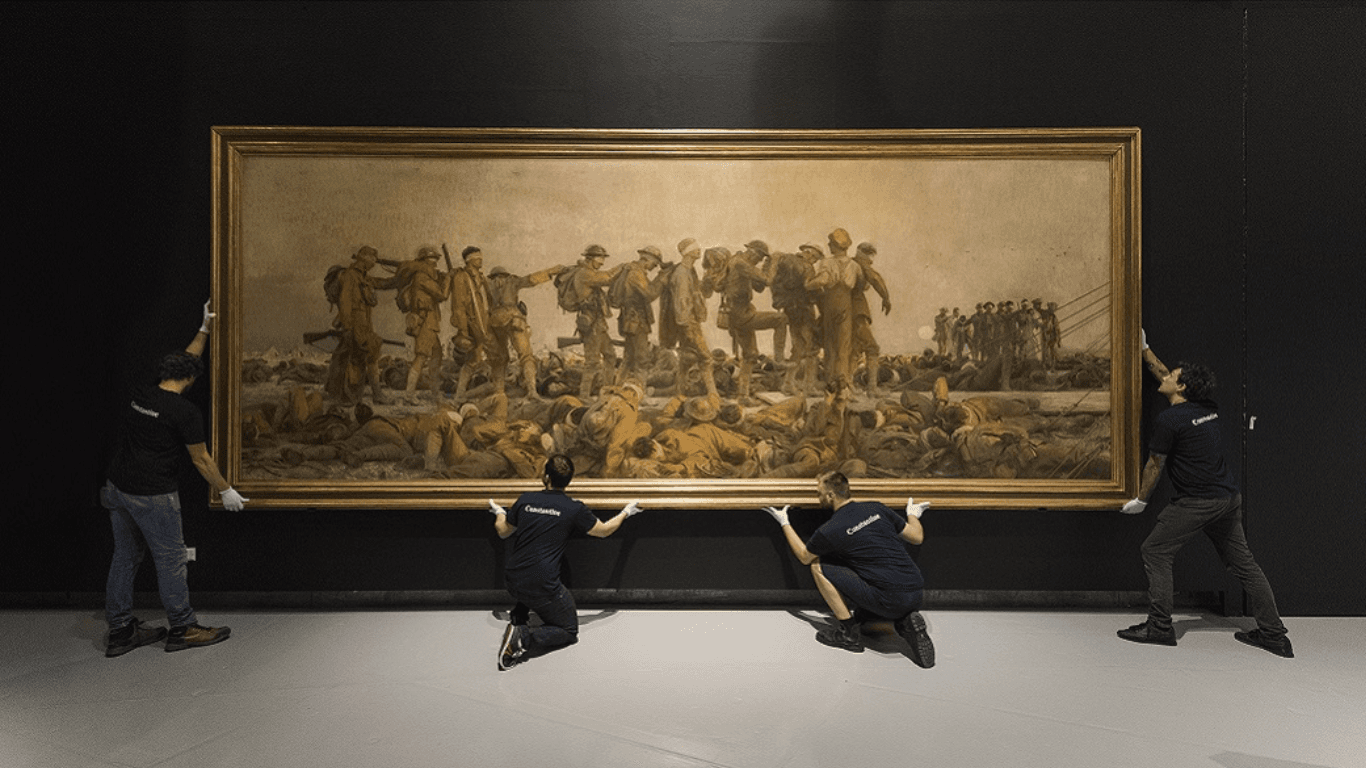
Moving a serious art work is the moment of greatest risk in the lifecycle of any collection. We have watched seven-figure works damaged in transit by carriers that should have known better, and the recovery from a transit failure is rarely complete. Specialist art transportation exists because the work required (climate control, structural protection, handling expertise, security, and documentation) is genuinely beyond what generic logistics can offer.
What follows is the magazine's editorial read on art transportation and handling in 2026. The major specialist carriers (Crozier, Dietl, Crown Worldwide Fine Art, Atelier 4, U.S. Art Company, Momart, Constantine, Cadogan Tate) anchor the institutional and serious-collector market, and the practices they have developed are the standards serious collections should be running.
Most are not, and the gap between institutional practice and private practice is where the bulk of transit failures originate.
- Serious art transportation begins with custom crating, climate control and tracked, white-glove handling that meets the standards expected by museums and major insurers.
- Climate-controlled trucks operating to museum specification remain the baseline for domestic and regional movement of significant works between residences and storage.
- Air freight on dedicated cargo flights or in temperature-controlled compartments is the standard for international movement of high-value paintings and three-dimensional work.
- Sea freight is reserved for less time-sensitive movement, with specialist providers offering climate-controlled containers and shock monitoring on a single owner’s holdings.
- Specialist handlers such as Crozier, Dietl, Momart and Gander and White anchor the global art-transport market and coordinate complex multi-leg moves between cities and continents.
- Documentation, customs work and underwriter notification matter as much as the physical move, since a single paperwork lapse can void coverage on an in-transit loss.
- Who is this for?
- Private collectors, family offices and estate trustees responsible for moving significant artworks between residences, storage facilities, fairs and institutional lending engagements.
- What is happening?
- A practical overview of art transportation methods, covering custom crating, climate-controlled road and air freight, specialist handlers and the documentation underwriters expect.
- When did this emerge?
- Most relevant when collections are being relocated, exhibited, lent to institutions or restructured for generational transfer through trusts and family-office vehicles.
- Where is this happening?
- Specialist art handlers operate global networks centred on New York, London, Paris, Hong Kong and Singapore, with bonded storage anchored in Delaware, Geneva and Singapore.
- Why does it matter?
- Bad transport is one of the fastest ways to damage a collection, and choosing the right specialist provider is the difference between a routine move and a recoverable loss.
The structural risks of transit
Transportation exposes art to several categories of risk that are absent or smaller in static display and storage situations. Physical shock from impacts, drops, and vibration during loading, transit, and unloading. Environmental excursions from temperature and humidity changes during transit, especially in air freight and during border-crossing customs holds.
Pressure changes during air transit that can stress framed works and works on paper. Security risks from theft, vandalism, or unauthorised handling during the multiple touchpoints of a typical move. Documentation risks from incomplete or inadequate condition reports at handover points.
Each of these risks is structurally manageable through appropriate carrier selection, packaging, and process discipline. The carriers and the practices that manage them well are well-established, and the cost of using them is rational relative to the value at risk.
Packaging: the first line of defence
The first structural discipline is appropriate packaging. The work needs to be protected from physical shock, environmental excursions, and pressure changes during transit, and the packaging is what does that work.
For paintings, the standard institutional approach is a custom crate with the work mounted on internal cleats or padded support, with sufficient airspace to allow the crate to absorb shock without transferring it to the work, and with appropriate moisture barriers and climate buffering. The crate is built to the work's specific dimensions and structural requirements; off-the-shelf crating is generally inadequate for any meaningful work.
For works on paper, the structural priority is rigid protection with appropriate archival materials in direct contact with the work. The standard approach is the work matted in archival board, then placed in a rigid mat folder, then crated with appropriate internal padding.
For sculpture, the packaging needs to be designed around the specific work's structural points, with custom internal cradling that supports the piece without stressing any single area. Three-dimensional works require structural engineering thinking that two-dimensional packaging does not.
Climate control during transit
The second structural discipline is climate control during transit. Temperature excursions outside the institutional standard band (18 to 22 degrees Celsius, 45 to 55 per cent relative humidity) cause material stress in many categories of work. The structural solutions vary by transit mode.
For road transit, the standard institutional approach is climate-controlled trucks with continuous temperature and humidity monitoring. The major specialist carriers operate fleets of trucks built specifically for art transit, with HVAC infrastructure that maintains the institutional standard band continuously through transit.
For air transit, the structural challenge is the temperature excursions of cargo holds. The standard institutional approach for serious works is either passenger-cabin transit (works small enough to travel as carry-on or seat-secured cargo with a courier) or climate-controlled air freight containers, which several specialist carriers offer in partnership with major freight providers.
For ocean transit, the longer transit times require more aggressive climate management. The major carriers offer climate-controlled ocean containers with continuous monitoring, but the longer transit window means that serious works typically use air rather than ocean freight when the cost-benefit allows.
Handling protocols at touchpoints
The third structural discipline is handling protocols at the touchpoints. The moment of greatest transit risk is typically the loading, unloading, and handover points where the work changes hands or moves between vehicles, storage, or display locations.
The standard institutional protocol at touchpoints includes documented condition assessment at handover (with photographs and written observations), two-person handling for any meaningful work, padded carts or dollies for any horizontal movement, planned routes that avoid stairs, narrow passages, and exposure to environmental hazards, and explicit handover documentation that establishes responsibility transfer cleanly.
The carriers that operate at institutional standards run these protocols continuously. The carriers that do not are typically where transit failures occur, and the damage often shows up as condition issues that are not noticed until later inspection.
Security during transit
The fourth structural discipline is security. High-value works in transit are vulnerable to theft, vandalism, and unauthorised handling, and serious carriers run security protocols that match the value at risk.
The standard institutional approach includes unmarked vehicles for high-value transit (no carrier branding that might attract attention), GPS tracking with continuous monitoring, two-driver teams that maintain continuous vehicle presence at stops, security escorts for the most valuable shipments, and secure overnight storage at the carrier's vetted facilities rather than at hotels or unsecured locations.
For international transit, the security framework extends to customs clearance and any in-country handling, with the carrier's local partners in each jurisdiction running the same protocols as the originating carrier.
Documentation and the audit trail
The fifth structural discipline is documentation. A serious move generates a comprehensive documentary trail that runs alongside the physical work and supports any subsequent insurance, conservation, or provenance questions.
The standard institutional documentation includes pre-move condition reports with high-resolution photography, the bill of lading and any associated transit documents, environmental monitoring logs from the transit period (temperature, humidity, shock events if relevant), handover documentation at each touchpoint with documented condition assessment, and the post-arrival condition report comparing the work's state to the pre-move baseline.
For collectors moving works across borders, the customs documentation (commercial invoices, certificates of origin where relevant, CITES documentation for any works with animal-derived materials) becomes part of the work's documentary trail and supports both the specific move and the work's future readability.
The carriers and the structural choices
The major specialist art carriers anchor the institutional and serious-collector market. Crozier (operating in the US, Europe, and Asia) is the largest and operates across the full spectrum of services from transit to storage. Dietl, U.S. Art Company, and Atelier 4 operate at similar institutional standards in the US.
Momart and Constantine anchor the UK market alongside specialist services in continental Europe. Crown Worldwide Fine Art operates an international network with strong Asian coverage.
For collectors making transit decisions, the structural choice runs across several dimensions. The work's value (higher value warrants higher-standard carriers). The transit complexity (international transit requires more carrier capability than domestic).
The schedule (some carriers offer faster turnaround at premium pricing). The specific origin and destination (carriers have stronger and weaker regional coverage).
The cost of specialist transit runs meaningfully higher than generic logistics, but the cost is rational relative to the value at risk. A $1 million painting moving from New York to London with appropriate specialist transit costs roughly $5,000 to $15,000 depending on the specific arrangement. The cost of a transit failure on a $1 million work runs many multiples of that, and serious collectors treat the specialist carrier cost as foundational rather than discretionary.
The intersection with broader collection management
Art transportation is one component of the broader collection-management infrastructure that serious collections require. The intersection with best practices for art preservation and art insurance is structural rather than incidental.
Insurance policies typically require specialist transit for any meaningful work, with explicit underwriting tied to the carrier's standards. Preservation discipline depends on the transit infrastructure being adequate; a work that experiences uncontrolled environmental excursions during transit faces structural risks that no amount of post-arrival conservation can fully reverse. White glove art moving services provide the complete infrastructure that serious collections require, and the carriers, the insurance, and the preservation discipline work together as an integrated framework.
What this means for collectors
Art transportation is foundational infrastructure for any serious collection that moves work. The transit risk is real, the specialist carriers exist to manage it, and the cost of using them properly is rational relative to the value at risk.
The collectors who treat transit as a discretionary line item face structurally larger problems when the inevitable transit events arrive; the collectors who treat it as foundational keep their collections intact across years and decades of movement, exhibition, and conservation activity.
The category rewards discipline and punishes its absence.
We last reviewed this analysis in May 2026.

Frequently Asked Questions
- What is the safest way to transport fine art?
- The safest method depends on the artwork’s size, medium, and fragility. For high-value pieces, custom crating, climate-controlled transport, and professional handling are essential. Air freight is typically the most secure for international shipments, while ground transport with air-ride suspension and GPS tracking is ideal for domestic moves.<br><br>
- How do art handlers prevent damage during transit?
- Art handlers use custom-built crates, shock-absorbing materials, and climate-controlled packaging to protect artworks from vibrations, impact, and environmental fluctuations. Pieces are carefully positioned and secured within transport vehicles to prevent movement.

Stefanos Moschopoulos
Stefanos Moschopoulos founded The Luxury Playbook in Athens and has spent the better part of a decade following the auction calendar, the en primeur releases, and the watchmakers, gallerists, and shipyards the magazine covers. He writes the field guides and listicles that anchor the Connoisseur section — pieces built on Phillips and Christie's results, Liv-ex movements, and conversations with collectors he has met across Geneva, Bordeaux, Basel, and Monaco. His own collecting habits sit closer to watches and wine than art, and it shows in the level of detail in the magazine's coverage of those categories. Under his direction, The Luxury Playbook now publishes long-form field guides, market-defining year-end listicles, and the Voices interview series with the founders behind the houses and the brands.