Jean-Michel Basquiat is no longer just an icon of 1980s New York. He is now a central figure in the global blue-chip art market. His explosive rise from SAMO-tagged downtown streets to record-breaking auction rooms has turned his body of work into one of the most sought-after investment classes in the post-war and contemporary art category.
For serious collectors and strategic investors, Basquiat’s paintings are not only culturally vital. They are financially potent.
In 2017, Untitled (1982) shattered auction expectations, selling at Sotheby’s for $110.5 million. That sale set a global benchmark for African-American artists and placed Basquiat ahead of Warhol, Pollock, and Rothko in auction history. Since then, demand has only intensified.
Billionaires like Ken Griffin, institutions like the Broad Museum, and global investors through platforms like Masterworks have aggressively acquired Basquiat’s works, elevating his paintings into the upper echelon of museum-grade investment assets.
Basquiat’s appeal sits at the intersection of cultural power, rarity, and liquidity. With fewer than 1,000 paintings in existence and only a small fraction regularly entering the secondary market, his works consistently command eight-figure prices, often doubling their valuation in under a decade.
Take Boy and Dog in a Johnnypump (1982). It was privately acquired in 2020 for over $100 million, a figure that reflects not just prestige but serious long-term value appreciation.
This article breaks down the most investable Basquiat works heading into 2026, examining auction data, historical ROI, art price index trends, and the stories behind each piece. You’ll find out what makes a Basquiat work worthy of institutional acquisition, how to evaluate provenance, and why works like Hollywood Africans, Per Capita, and Dos Cabezas keep outperforming traditional financial assets in terms of art investment return. And if you want to understand how blue-chip art fits alongside other alternative assets, this breakdown of how Paul Cézanne connects impressionism to modern art markets is worth your time.
Table of Contents
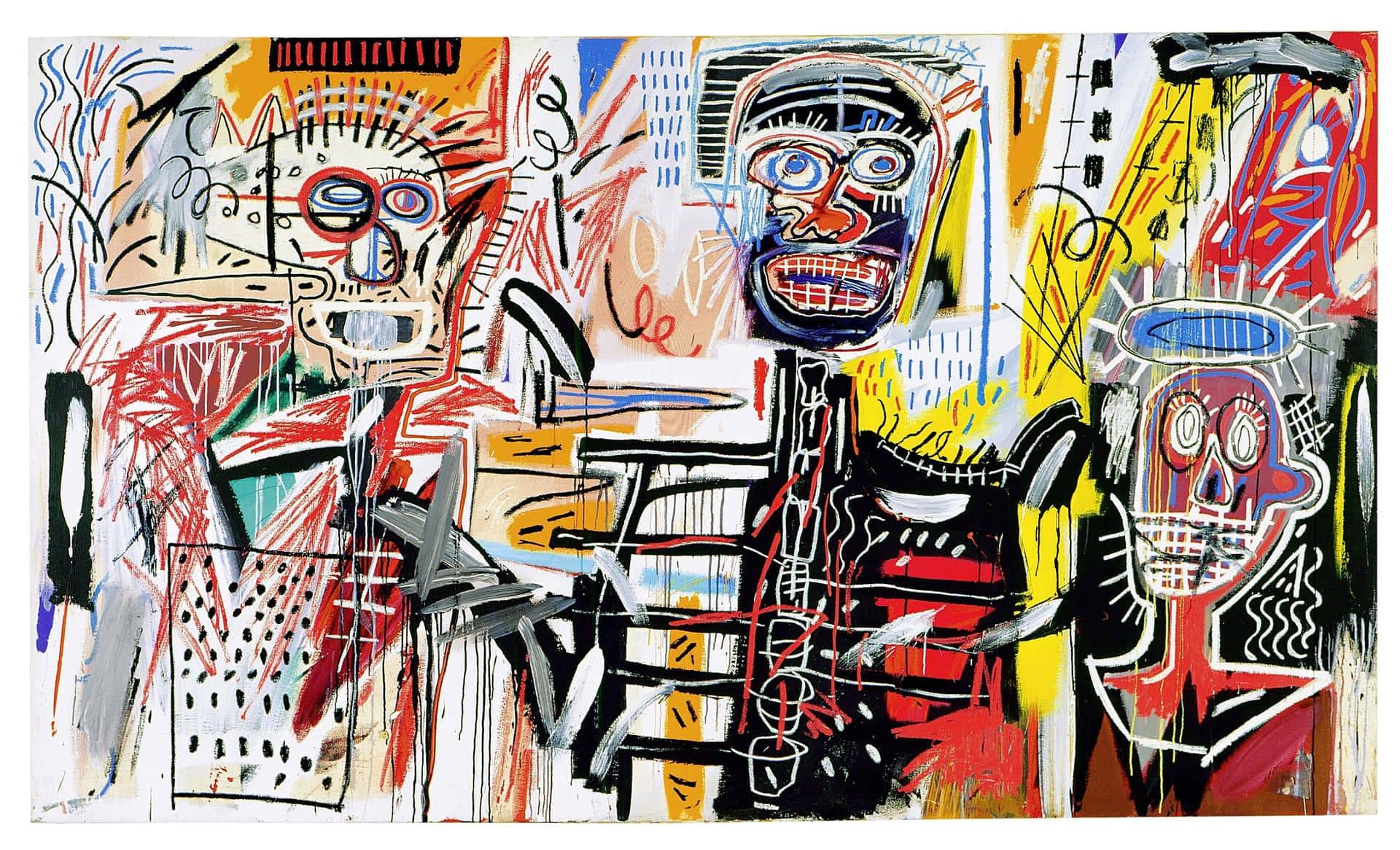
Per Capita (1981)
Painted at the height of Basquiat’s transition from the streets of SoHo to the institutional spotlight, Per Capita (1981) is a defining early work. It captures the raw urgency and socio-political commentary that made Basquiat an art market phenomenon.
Created shortly after his first solo show at the Annina Nosei Gallery, the painting marks the beginning of his entry into elite art circles while holding onto the visceral energy of his graffiti origins.
The composition features a chaotic yet calculated layering of text, skeletal figures, crowns, and fractured symbols, all emblematic of his Neo-Expressionist language. The title itself is a direct reference to economic systems and systemic inequality, a recurring motif in Basquiat’s work that speaks to themes of race, labor, and power.
That’s what makes Per Capita not only artistically weighty but deeply aligned with current cultural and socio-economic discourse, adding real substance to its cultural equity value.
Auction and Market Performance
Per Capita surfaced at auction at Christie’s New York in 2014, selling for $4.5 million, well above its $2.5 to $3.5 million estimate. Since then, its estimated private market valuation has more than doubled. Recent whispers in the art advisory space place its 2026 value in the $9.5 million to $11 million range, depending on provenance and condition.
That upward trajectory aligns with broader Basquiat market performance, which has shown annualized appreciation rates of 10% to 14% across key works sold between 2000 and 2023, according to the Artprice Index.
Investment Overview
- Holding Period ROI (2014–2025 projection): ~140% estimated return
- Rarity Factor: High—1981 pieces from this transitional period are limited in circulation
- Cultural Relevance: Strong—addresses wealth disparity, economic language, and systemic critique
- Institutional Appeal: High—frequently referenced in scholarly texts and retrospectives
If you’re a collector or fund looking at early-career Basquiat works with thematic clarity and historical importance, Per Capita deserves serious attention as a cornerstone asset. Its 1981 provenance and conceptual edge make it a standout for both capital appreciation and long-term cultural significance.

Untitled (1982)
No conversation about Jean-Michel Basquiat’s investment-grade works is complete without Untitled (1982). This painting rewrote global expectations and reshaped how the art world thinks about value. Created during Basquiat’s most prolific year, this raw and electrifying canvas captures the very essence of his brilliance: explosive linework, bold color fields, and an emotionally charged skeletal figure at its center.
Basquiat painted Untitled in a modest studio in Modena, Italy, during his short-lived partnership with gallery owner Emilio Mazzoli. Despite his youth, just 21 years old at the time, Basquiat already commanded the expressive force of a seasoned master.
The piece carries no text, focusing entirely on form, gesture, and presence. Many scholars read this as a departure into more existential, primal territory.
Auction and Market Performance
In May 2017, Untitled (1982) sold at Sotheby’s for $110.5 million, purchased by Japanese billionaire Yusaku Maezawa. That made it the highest-priced Basquiat ever sold and the most expensive artwork by an American artist at auction at the time.
The trajectory is what really stuns. The same painting sold in 2002 for just $4.5 million, meaning it appreciated by over 2,355% in 15 years, translating to an annualized ROI of roughly 29.4%. No other Basquiat work illustrates the market’s upward momentum with such clarity.
Since then, the painting has taken on iconic status in its own right, regularly cited in exhibitions at institutions like the Brooklyn Museum, The Broad, and Fondation Louis Vuitton. That institutional exposure only reinforces its long-term relevance and collector demand.
Investment Overview
- Auction Record: $110.5M (Sotheby’s, 2017)
- 2002 Price: $4.5M (Private sale)
- 15-Year ROI: ~2,355% total / ~29.4% annualized
- Institutional Interest: Extremely high; widely exhibited
- Legacy Factor: Considered Basquiat’s most recognized and referenced painting
Untitled (1982) itself is unlikely to re-enter the public market anytime soon. But its ripple effect has been felt across the entire Basquiat portfolio. Works from 1982 now command premium valuations, with several pieces reaching the $30M to $50M range purely by virtue of their alignment with this benchmark sale.
For you as an investor, Untitled (1982) is not just a Basquiat painting. It is the market standard. All other valuations follow its lead.

Boy and Dog in a Johnnypump (1982)
Painted during the most financially and creatively explosive year of Jean-Michel Basquiat’s career, Boy and Dog in a Johnnypump (1982) captures the artist’s kinetic energy at full throttle.
This monumental canvas, nearly 8 feet tall, shows a skeletal figure and canine companion standing beneath a searing red sky, immersed in an urban setting inspired by Basquiat’s own experiences on the streets of New York City. The work reflects his ongoing interrogation of identity, vulnerability, race, and power, executed with an emotional urgency that defines the Neo-Expressionist movement.
This painting is one of Basquiat’s most muscular works, both in visual weight and market performance. Its frenetic brushwork and anatomical distortions evoke themes of trauma, marginalization, and personal mythology. Those are elements that captivate collectors and resonate deeply with contemporary cultural narratives, making it highly bankable among art funds and institutional buyers.
Market Performance and Private Acquisition
In 2020, Boy and Dog in a Johnnypump was reportedly purchased privately by hedge fund billionaire Ken Griffin for over $100 million, making it one of the highest private acquisitions of the last decade. While the exact figure was never publicly confirmed, multiple sources cited a price range between $100M and $110M, positioning it just behind Untitled (1982) in Basquiat’s valuation hierarchy.
Unlike many works locked inside museum collections, this painting’s private acquisition by an active buyer with a record of trading blue-chip art makes it a potential re-seller. That matters to any investor analyzing liquidity potential.
Investment Overview
- Private Sale Price: Estimated $100–110 million (2020)
- Public Auction History: Not available (private sale)
- Comparable ROI: Matches appreciation trends of 1982 masterpieces
- Holding Period Relevance: Likely to re-emerge in the next 10–15 years
- Cultural Equity: High; celebrated across retrospectives and books
- Liquidity Profile: Medium-to-high (privately held, but with future sale potential)
In investment terms, Boy and Dog in a Johnnypump belongs in the same elite tier as Basquiat’s Untitled works, offering collectors a rare combination of artistic depth, scale, and price movement.
Its presence in a major private collection adds both intrigue and future trading potential, two traits that make it a high-interest watch for blue-chip art investors and wealth advisors monitoring upcoming sales. If you’re also thinking about how alternative assets perform across different categories, this piece on why investors are shifting toward stability over hype puts the case for art in sharp context.

Dos Cabezas (1982)
Dos Cabezas, translated as Two Heads, is one of the most symbolically charged and historically documented works in Jean-Michel Basquiat’s portfolio. Painted in just two hours after his first meeting with Andy Warhol, the piece features a double portrait: one head representing Basquiat, the other Warhol.
What makes Dos Cabezas so remarkable is not just the composition, but the fact that it catalyzed the friendship and creative partnership between two of the most influential figures in postwar art.
Visually, the painting embodies Basquiat’s raw energy and quick execution style while symbolizing the tension and mutual admiration between street art and pop art. The juxtaposition of Warhol’s iconic visage with Basquiat’s own fragmented self-image underscores a generational, racial, and stylistic dialogue that collectors and curators have studied for decades.
This painting is more than an artwork. It is a turning point in contemporary art history and an institutional favorite in Basquiat retrospectives at venues like the Barbican Centre, Brooklyn Museum, and Brant Foundation.
Auction Performance
In 2010, Dos Cabezas sold at Christie’s New York for $7.08 million, doubling its high estimate. At the time, it marked one of the strongest public sales for a non-1981/1982 Basquiat portrait and cemented its reputation as both an artistic landmark and a financial vehicle.
Private market estimates for 2026 place its current valuation in the $18 million to $22 million range, depending on provenance, insurance valuation, and authentication documents. That growth tracks with Basquiat’s average annual price appreciation rate of 10% to 13%, based on Artprice’s long-term Basquiat index.
Investment Overview
- Last Public Sale: $7.08M (Christie’s, 2010)
- Estimated 2025 Value: $18M–$22M
- Projected ROI (2010–2025): ~11% annualized
- Provenance Strength: High—extensively published, well-documented, institutionally exhibited
- Crossover Appeal: Combines historical, aesthetic, and narrative value; ideal for private collections and public foundations
Dos Cabezas is a top-tier acquisition target for investors seeking works that straddle both cultural inflection points and market resilience. It has story, scarcity, and public relevance. That’s exactly the profile institutional investors look for when allocating capital to museum-grade African-American art.

Hollywood Africans (1983)
Painted in 1983 during Jean-Michel Basquiat’s trip to Los Angeles, Hollywood Africans is one of the artist’s most iconic and politically charged works. The painting features Basquiat alongside fellow artists Toxic and Rammellzee, surrounded by text, symbols, and social critique that dissect the stereotypes and marginalization of Black individuals in American media.
It’s a visual deconstruction of Hollywood’s commodification of African-American identity, and it feels just as urgent today as it did over 40 years ago.
Unlike the purely visceral works of 1982, Hollywood Africans shows Basquiat’s growing sophistication, both in social commentary and compositional clarity. It’s a rare blend of street art energy and conceptual depth, positioning it as one of the most widely studied Basquiat works in academic and institutional settings.
Market Performance and Collectability
While the original 1983 painting lives in the Whitney Museum of American Art, limited edition screenprints and authorized reproductions of Hollywood Africans have circulated through the auction market with increasing velocity.
- A 1993 screenprint edition of 60 has sold for between £115,000 and £120,750 at Bonhams and Christie’s.
- Recent sales (2022–2024) have seen prices creep toward £140,000, signaling solid growth in the editioned Basquiat print market, which is a growing category for mid-level investors.
The piece’s visibility in both the Whitney’s permanent collection and frequent Basquiat retrospectives has driven strong liquidity, especially via platforms like Artsy, Paddle8, and Saatchi Art, where curated prints often command premium bids.
Investment Overview
- Original Work: Held in Whitney Museum (not for sale)
- Screenprint Market Range (2025): £130,000–£150,000
- Past Auction High (2023): £120,750 (Bonhams)
- Liquidity Score: High (editioned; regularly listed)
- Cultural Impact: Exceptional—direct commentary on race, media, and visibility
- Collector Profile: Suited for investors entering the Basquiat market through editioned works
Hollywood Africans is your ideal entry point if you want a Basquiat with museum-level prestige but a lower capital outlay. Its critical relevance, combined with growing demand for prints and multiples, makes it a high-return, medium-risk acquisition in today’s art investment ecosystem.

Horn Players (1983)
With Horn Players, Jean-Michel Basquiat pays homage to two of his musical heroes, Charlie Parker and Dizzy Gillespie, while simultaneously dismantling and reassembling their cultural legacy in his own visual language.
Created during a prolific period of experimentation in 1983, the piece is a triptych of rhythmic mark-making, fragmented anatomy, and insistent repetition of words like “ornithology” and “alcohol,” linking jazz genius with personal pain.
Unlike Basquiat’s more chaotic works, Horn Players reflects a deliberate narrative construction. It sits at the direct intersection of urban contemporary art and African-American musical history, pushing it well beyond collector interest into the domain of academic and curatorial relevance.
Institutions such as MoMA and The Broad have spotlighted this piece in past retrospectives, framing it as a key work in the Post-Graffiti Movement and a touchstone in the visual representation of jazz.
Auction Record and Market Growth
Horn Players sold at Christie’s New York in May 2015 for $14.5 million, achieving one of the highest prices at the time for a Basquiat work outside his 1981 to 1982 output. It was a major signal that the market was starting to value his post-1982 period far more seriously.
Since that sale, comparable Basquiat paintings from the same year have seen price increases between 60% and 100%, depending on format, provenance, and institutional exposure.
Art fund insiders currently estimate Horn Players would command $25 to $30 million if reintroduced into the market in 2026, reflecting a projected ROI of 72% over a ten-year hold.
Investment Overview
- Last Public Sale: $14.5M (Christie’s, 2015)
- Estimated 2025 Valuation: $25M–$30M
- Estimated 10-Year ROI: ~72% total / ~5.6% annualized
- Exhibition History: Frequently shown; included in major Basquiat retrospectives
- Narrative Relevance: Strong link to African-American cultural history and music
- Asset Class Appeal: Ideal for institutional collections and legacy-focused private buyers
Horn Players is a mature Basquiat work with deep narrative structure and broad cultural appeal. For long-term investors and collectors, it delivers both strong capital growth potential and a foothold in Basquiat’s evolving artistic trajectory beyond his early raw expressionism. If you’re building a portfolio that spans both art and other tangible assets, these 15 questions every investor needs to ask are worth running through before you commit.

King Zulu (1986)
By 1986, Jean-Michel Basquiat had fully transitioned from outsider icon to institutional insider. But his work never softened in its critique of race, colonialism, and identity. King Zulu captures that tension perfectly. The painting directly references the controversial Mardi Gras Zulu parade in New Orleans, in which Black participants historically donned whiteface and wigs, turning minstrelsy on its head.
With bold lettering and stark visual symbols, Basquiat reclaims the term “King Zulu” as both an indictment and a declaration of power.
Thematically, King Zulu revisits Basquiat’s lifelong concern with Black visibility and appropriation, while showcasing a more refined, spacious composition. His use of white backgrounds, blocked-out silhouettes, and repetition of loaded words signals a late-stage maturity in his technique. More minimal, but no less aggressive.
That stylistic pivot resonates with African Diaspora art historians, as it bridges early Neo-Expressionism with politically conceptual abstraction.
Market Performance
King Zulu sold at Phillips in 2012 for $3.5 million, far surpassing its $1.8 to $2.5 million estimate. Since then, its valuation has climbed steadily, mirroring the wider upward movement of Basquiat’s later-period works. As of 2026, private estimates place its current market value in the $9.5 to $11 million range, reflecting a compound annual growth rate of approximately 9.6% over a 13-year holding period.
Its exhibition history, featuring prominently in Basquiat: Boom for Real and traveling retrospectives across Europe, has added institutional visibility and credibility, increasing demand for similarly political and text-heavy late works.
Investment Overview
- Last Public Sale: $3.5M (Phillips, 2012)
- Estimated 2025 Valuation: $9.5M–$11M
- 13-Year ROI Estimate: ~9.6% CAGR
- Cultural Weight: High—addresses race, satire, and power in African-American history
- Market Category: Late-period Basquiat, increasingly sought after for narrative and aesthetic clarity
King Zulu is ideal for you if you’re looking to invest in Basquiat’s more cerebral, politically nuanced works, especially those underrepresented in top-tier collections. Its intersection of social commentary, refined technique, and rising institutional interest makes it one of the most strategically undervalued Basquiat acquisitions heading into 2026.

FAQ
What is Basquiat’s most famous piece?
Untitled (1982) is Basquiat’s most famous work. It sold for $110.5 million at Sotheby’s in 2017, setting the auction record for an American artist.
What is the most meaningful art of Basquiat?
Hollywood Africans (1983) is one of his most meaningful pieces. It directly critiques racial stereotypes in the entertainment industry and remains a cornerstone of his political commentary.
Which Basquiat works are best to invest in for 2025?
Top Basquiat investment works for 2025 include Untitled (1982), Boy and Dog in a Johnnypump, Dos Cabezas, and Horn Players due to their auction records, cultural relevance, and high liquidity.
Are Basquiat prints a good investment?
Yes. Limited edition prints like Hollywood Africans screenprints are highly collectible and show strong year-over-year growth, making them ideal entry points into Basquiat’s market.
Why do Basquiat’s artworks hold value?
Scarcity, cultural importance, and consistent institutional demand drive long-term appreciation. Fewer than 1,000 original paintings exist, and most are held in private or museum collections.
Is Basquiat considered blue-chip art?
Yes. Basquiat is a blue-chip artist. His works are frequently sold at Sotheby’s, Christie’s, and Phillips, with strong performance in the global art market.