
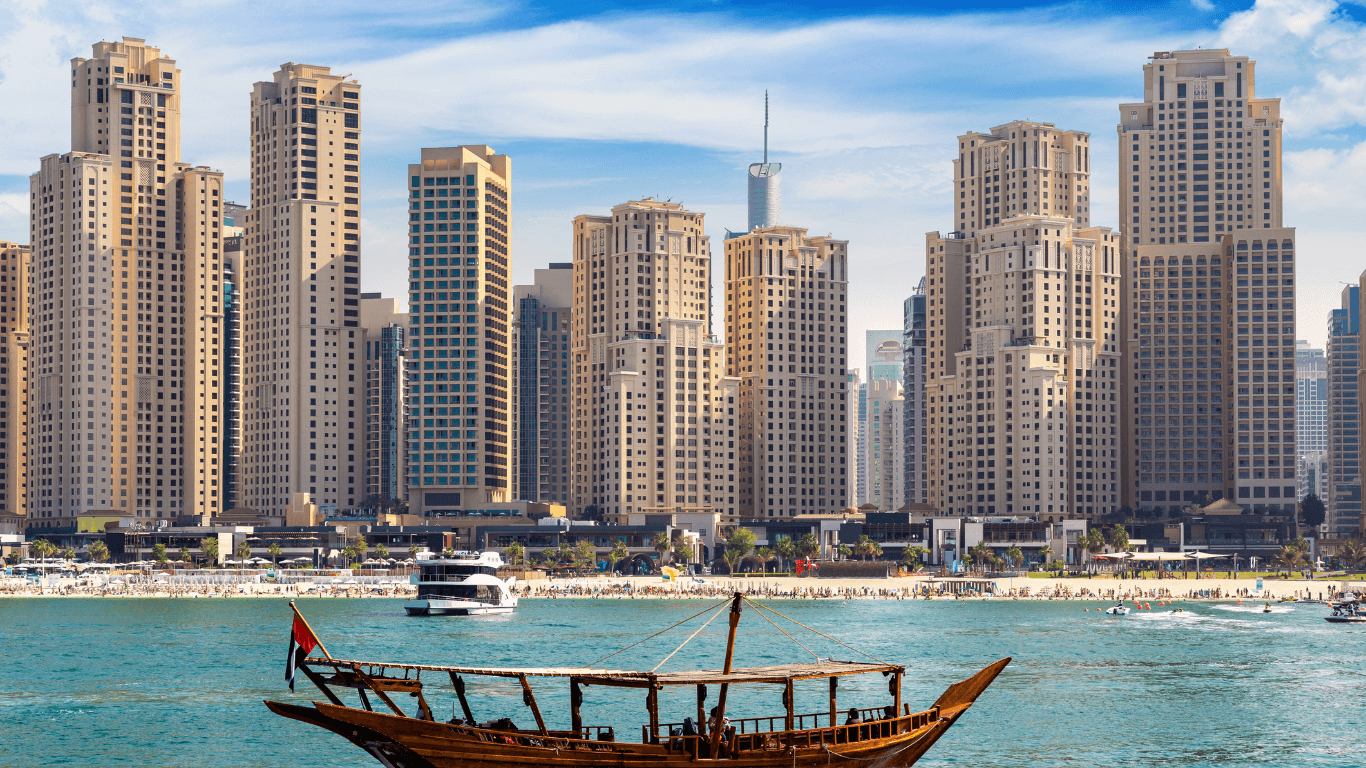
Buying property in Dubai is a structural process, clearer in some ways than equivalent transactions in older European markets, more involved in others. The Dubai Land Department's electronic registration, the Real Estate Regulatory Agency's framework, and the established conventions of the emirate's prime-residential market produce a transaction layer that is recognisable to international buyers and consistent in its requirements. This is our editorial overview of the principal routes to ownership for an international buyer.
Mansion Global's Dubai coverage and Knight Frank's Dubai market commentary both describe Dubai as one of the most internationally accessible major prime-residential markets, with a structural framework that has evolved purposefully over the past two decades to support international ownership. The principal routes, secondary-market resale, primary-launch off-plan, fractional ownership through certain structures, each fit a slightly different buyer profile.
- Dubai property purchase routes include direct cash, mortgage financing through local or international banks and off-plan installment plans tied to construction milestones.
- We see freehold ownership available across designated areas including Downtown Dubai, Dubai Marina, Palm Jumeirah and Business Bay, with leasehold structures elsewhere.
- Off-plan installment plans typically spread payments across two to four years with a final balance at handover, which can fit cash flow planning for some buyers.
- Mortgage financing for non-resident buyers is available from several local banks, typically capped at fifty to seventy percent loan-to-value with rates in the four to six percent range.
- Golden Visa eligibility for property investors above the AED two million threshold has shaped buyer behaviour in the prime segment, particularly at the entry-level Golden Visa price point.
- For first-time Dubai buyers we recommend engaging RERA-registered brokers and local counsel alongside the Dubai Land Department portal for transaction verification.
- Who is this for?
- International buyers considering Dubai property acquisition, alongside the brokers, lawyers and private bankers coordinating cross-border purchases into the United Arab Emirates.
- What is happening?
- A practical guide to the different ways to buy property in Dubai, covering cash, mortgages, off-plan installments, freehold designations and the Golden Visa pathway.
- When did this emerge?
- The article reflects Dubai market practice through 2025 and 2026, including current Golden Visa thresholds, RERA broker requirements and the latest off-plan installment structures.
- Where is this happening?
- The piece focuses on Dubai, with reference to broader UAE practice in Abu Dhabi and the surrounding emirates where similar but distinct rules apply.
- Why does it matter?
- Dubai purchase routes carry materially different risk and capital flexibility profiles, which is why choosing the right structure at the outset shapes the entire ownership experience.
The legal framework
The Dubai market has matured to the point where major institutional research desks cover it directly. Knight Frank publishes a flagship Dubai-residential report each year, and Savills overlays it with regional capital-markets coverage that fills in the cross-border picture.
The deal-mechanics layer comes from the international brokerages. CBRE and JLL both maintain Dubai desks, while Mansion Global and The Financial Times property coverage track how the buyer mix has shifted across recent cycles.
Dubai's property law has been progressively refined over the past two decades. Law No. 7 of 2006 established the principal framework for foreign ownership in designated freehold areas; subsequent regulations have refined the operating layer (the Real Estate Regulatory Agency, the Dubai Land Department, the Dubai International Financial Centre Courts where relevant). For international buyers, the framework is structurally clear: defined freehold areas where international ownership is permitted, established procedures for transactions, and a regulatory layer that enforces transactional standards.
The Dubai Land Department fee on resale transactions runs 4 percent of purchase price. Plan for this as part of the standard transaction-cost layer.
The principal ownership routes
Secondary-market resale
Buying a property from an existing owner. The familiar pattern: identify the property, agree price and terms, exchange contracts, complete via the Dubai Land Department. Timeline typically 4 to 8 weeks for a standard transaction.
Properties in the established prime areas (Palm Jumeirah, Downtown Dubai, Dubai Hills Estate, Emirates Hills) tend to have active secondary markets.
Primary-launch off-plan
Buying a property from the developer at launch, before construction is complete. Off-plan is a structural feature of how Dubai's prime market operates, many of the most-watched prime developments are sold predominantly off-plan, with completion typically 2 to 4 years after launch. Payment is structured through staged instalments aligned to construction milestones.
The principal Dubai developers, Emaar, Damac, Sobha Realty, Nakheel, Dubai Holding, Meraas, each operate distinct launch programmes.
Off-plan transactions carry structural considerations: timeline risk (completion can slip), the structural draw of buying at launch pricing in growing markets, payment-plan flexibility that staged instalments provide, and reliance on the developer's delivery capability.
Inheritance and family transfer
For Dubai-resident families and Gulf nationals, properties transfer through established inheritance procedures aligned to Sharia law. International owners need to understand how Dubai's inheritance framework interacts with their home-jurisdiction estate planning, for many, a Dubai will registered through the Dubai International Financial Centre framework provides clearer estate-planning certainty.
Corporate and structured ownership
For higher-value transactions, ownership through a corporate structure (typically a free-zone company or a foreign holding company) is one of several approaches. The structural choice has implications for inheritance, tax in the buyer's home jurisdiction, and operational management. This is structural-finance work and intersects with our YMYL Wealth coverage rather than this lifestyle-side overview.
The buyer profile
Mansion Global's Dubai coverage describes one of the most internationally diverse prime-residential buyer pools of any major city. The structural mix: meaningful flows from the United Kingdom, Russia, India, China, the broader Gulf, and an expanding European, North American and Southeast Asian cohort. Knight Frank's reporting has tracked the post-2020 acceleration of international interest particularly closely.
The principal Dubai prime addresses
- Palm Jumeirah — the iconic waterfront. Both villa and apartment inventory across the spine and the fronds.
- Downtown Dubai — the high-rise prime market anchored by the Burj Khalifa-adjacent towers and the Address-branded developments.
- Dubai Hills Estate — the prime villa-community market, anchored by Emaar's masterplan.
- Emirates Hills — established prime-villa community.
- Dubai Marina — high-rise apartment market with strong rental and primary-residential demand.
- Jumeirah Beach Residence and Bluewaters — alternative waterfront communities.
- Dubai Creek Harbour — Emaar's emerging prime masterplan east of Downtown.
- City Walk and Jumeirah — the more architecturally distinctive contemporary inventory.
The Golden Visa pathway
The UAE Golden Visa programme, long-term residency tied to property ownership above defined thresholds, has been a structural feature of how Dubai's prime market operates since its 2019 introduction. Property purchases above defined values qualify the buyer (and family) for ten-year renewable residency. The programme has been one of the principal drivers of the structural growth in international interest over recent years.
The transaction cost layer
Plan for the standard layer:
- Dubai Land Department fee: 4 percent of purchase price
- Agency fee (typically buyer-side): 2 percent of purchase price
- Conveyancing or legal fees
- Mortgage processing fees (if financing): 1 percent of loan amount typical
- NOC (no-objection certificate) fees from developer for resale
- Title deed transfer fees
Total transaction costs typically run 6 percent to 8 percent of purchase price for a standard resale transaction.
Financing in Dubai
Dubai's mortgage market is well-developed. Resident buyers typically access LTV up to 80 percent on first properties; non-resident financing is available with stricter LTV ceilings (typically 50-60 percent) and additional documentation requirements. International private banks (UK, Swiss, Singapore-headquartered) handle a meaningful share of upper-end Dubai prime-residential financing, often through structures that cross-collateralise against the buyer's broader holdings.
Frequently asked
What's the simplest route to Dubai property ownership?
For an international buyer, the secondary-market resale through an established brokerage is typically the cleanest. The transaction layer is well-defined and the timeline is reasonably predictable.
Is off-plan worth considering?
For buyers with the timeline flexibility and willingness to accept developer-delivery dependence, off-plan can deliver structural advantages: payment-plan flexibility, primary-launch pricing, and access to inventory in the most-watched new developments.
What's the typical timeline for a Dubai resale transaction?
4 to 8 weeks for a standard transaction. Faster than many European prime markets.
Does the Golden Visa programme apply to all property purchases?
Above defined property-value thresholds, yes. The programme has been one of the structural draws of the Dubai prime market over recent years.
We last reviewed this analysis in May 2026.


Savvas Agathangelou
Savvas Agathangelou co-founded The Luxury Playbook and has spent years reporting from the prime postcodes the magazine covers — Mayfair, Knightsbridge, the Athens Riviera, Dubai's Palm crescents, and the southern Mediterranean coastlines where the world's wealthy keep coming back. His background is in international hospitality, and that frame shapes how he writes about property: the developer's choices, the architect's signature, the agency's bench of named brokers, the building's service standard once the buyer moves in. He files developer spotlights, agency profiles, and the seasonal "Properties That Defined" listicles, and he hosts the magazine's founder-and-leadership interviews on the Voices side.