No matter where you’re based, staying ahead in forex trading starts with one thing: knowing which sessions are active, what time zones they cover, and what the market actually does during those hours. That knowledge is your edge. It tells you when to strike and when to sit on your hands.
In this guide, you’ll get a full breakdown of forex market sessions, how time zones shape your trading opportunities, and the best windows to trade if you’re serious about maximizing profitability.
- Forex market hours span 24 hours across five trading days weekly, with the Sydney, Tokyo, London and New York sessions defining the major liquidity windows globally.
- We see the London and New York session overlap from approximately 12:00 to 16:00 UTC as the deepest liquidity window, with major pair spreads typically tightest during this period.
- European session opening including the London 7:00 UTC open often generates meaningful directional momentum, particularly across EUR, GBP and CHF crosses.
- Asian session conditions including Tokyo and Sydney typically support range-bound trading, with JPY, AUD and NZD crosses offering the highest activity.
- Session timing affects spread costs materially, with the lowest spreads typically available during peak liquidity windows and widest spreads during low-liquidity transitions.
- For most considered retail traders we view session timing discipline as a meaningful contributor to both execution quality and strategy effectiveness.
- Who is this for?
- Retail forex traders evaluating session timing decisions, alongside the brokers, educators and trading platforms framing those choices.
- What is happening?
- A read of forex market hours and what the best hours to trade are and why, covering the Sydney, Tokyo, London and New York sessions and their liquidity profiles.
- When did this emerge?
- The article reflects current global session conditions through 2025 and 2026, with reference to the broader 24-hour forex market structure.
- Where is this happening?
- The piece covers the global forex market complex, including the Sydney, Tokyo, London and New York session windows.
- Why does it matter?
- Session timing shapes execution quality and strategy effectiveness, which is why understanding the framework matters for serious retail forex trading.
Forex Market Hours and Trading Sessions
The four-session model is documented in detail in the Bank for International Settlements triennial survey, which tracks global FX turnover by venue and currency. The cycle from Sydney to Tokyo to London to New York is the structural backdrop every retail trader needs in mind.
Liquidity research from Reuters and Bloomberg consistently shows that the London-New York overlap concentrates the deepest spreads of the day. Trading inside that window is not a guarantee of better fills, but it does narrow the gap between quote and execution.
The forex market is unlike anything else you’ll trade. It runs 24 hours a day, five days a week, following the sun around the globe as financial centers open and close. No centralized exchange, no single bell ringing to start or stop the action.
Sounds like pure freedom, right? But trading whenever you feel like it isn’t a strategy. It’s a recipe for getting caught in the wrong conditions.
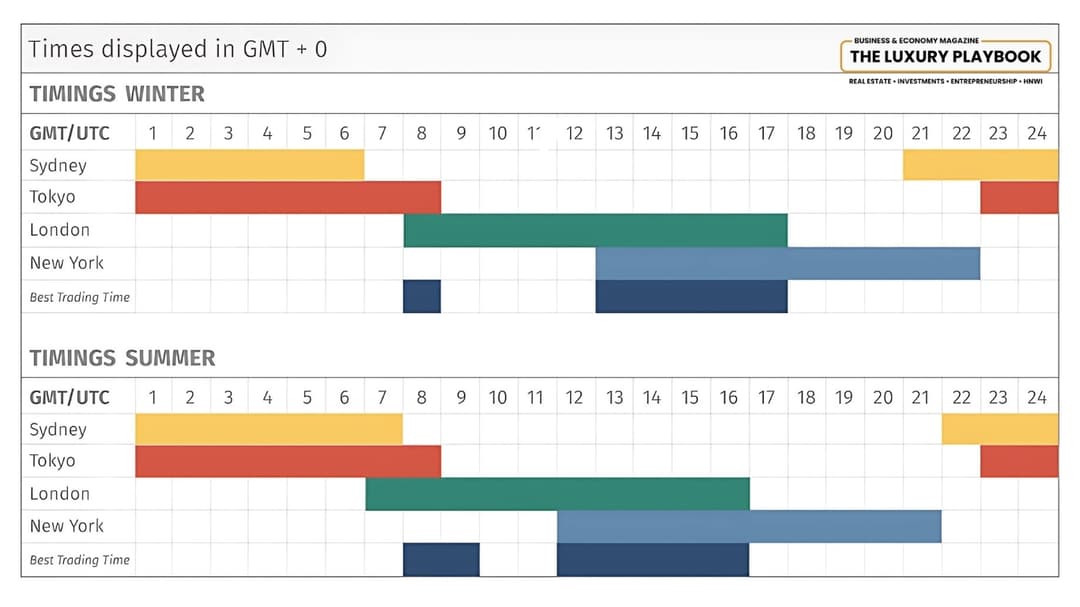
The forex market breaks down into four major trading sessions, each tied to a different region of the world.
- Sydney Session: Kicking off the trading week, the Sydney session starts at 10:00 PM GMT (5:00 PM EST) and runs until 7:00 AM GMT (2:00 AM EST). The Sydney session is crucial, especially for those trading in the Asia-Pacific currencies like AUD and NZD.
- Tokyo Session: Starting at 12:00 AM GMT (7:00 PM EST) and ending at 9:00 AM GMT (4:00 AM EST), the Tokyo session is when trading volume in Asian currencies such as JPY, HKD, and SGD picks up. While not the most volatile session, it sets the stage for what’s to come.
- London Session: The busiest and most volatile session begins at 8:00 AM GMT (3:00 AM EST) and ends at 5:00 PM GMT (12:00 PM EST). The London session represents the bulk of global trading, covering major currency pairs such as GBP/USD, EUR/USD, and USD/JPY. More than 30% of forex transactions occur during this session.
- New York Session: The final session of the day, the New York session starts at 1:00 PM GMT (8:00 AM EST) and closes at 10:00 PM GMT (5:00 PM EST). The overlap between the London and New York sessions provides some of the highest trading volumes, particularly for USD pairs, which make up nearly 70% of all forex transactions.
Getting familiar with each of these sessions matters more than most traders realize. Every session carries its own personality, its own liquidity profile, its own volatility tendencies. Miss that, and you’re trading blind.
Relationship Between Currency Pairs, Trading Volume, and Time Zones
For deeper context, the breakdown in how fundamental analysis maps to each trading session is worth reading alongside this analysis.
Once you understand the four sessions, the next step is seeing how currency pairs, trading volume, and time zones all work together. Each session puts a spotlight on different pairs, and trading the right pair at the right time makes a real difference to your results.
Take the Sydney and Tokyo sessions. If you’re drawn to pairs like AUD/USD, NZD/USD, or JPY/USD, these are your hours. Those currencies are most alive during Asian trading time, which means better price movement and far less risk of wading into a thin, illiquid market.
As Investopedia’s breakdown of the three-session system shows, aligning your pairs with the right session is one of the simplest ways to sharpen your edge.
A few numbers worth keeping in mind: the London session accounts for roughly 35% to 40% of total daily forex volume, while the New York session handles around 16% to 20%. When those two sessions overlap, you’re looking at the single most active window in the entire trading week.
- Sydney Session: Roughly 4-6% of the daily forex trading volume happens during the Sydney session. It’s a relatively calm session, which can offer excellent opportunities for newer traders to practice with smaller trades.
- Tokyo Session: The Tokyo session sees approximately 6-8% of daily trading volume. This might seem small, but it’s a crucial period for Asian currency pairs. Additionally, Tokyo session overlaps with the Sydney session for a few hours, adding liquidity.
- London Session: Here’s where things get exciting. The London session, accounting for around 35-40% of daily trading volume, is the heavyweight champion.
With both European and American financial centers awake, most of the world’s currency transactions happen here, leading to volatile price movements. The overlap with the New York session is when the market hits its stride, with trading volumes reaching peak levels.
- New York Session: As the second-largest forex session, New York sees around 15-20% of the daily volume. The overlap with London is considered the “golden hours” for trading, particularly for USD-based pairs like EUR/USD, GBP/USD, and USD/JPY. During this time, liquidity surges, and traders can capitalize on major market movements.
Why You Should Trade During Certain Forex Trading Hours
You know the market is open around the clock, so the real question becomes when you should actually be trading. Sitting at your screen all day and night won’t give you an advantage. The honest truth is that certain hours offer a dramatically better setup because of how liquidity, spreads, and volatility stack up together.
- The Overlap Between London and New York: This period, from 1:00 PM GMT to 5:00 PM GMT (8:00 AM to 12:00 PM EST), is when the magic happens. Both the London and New York sessions are active, meaning massive liquidity and volatile price swings. More than 50% of the total daily trading volume occurs during these hours. If you’re after big moves, this is when you want to trade.
- The Asian-European Overlap: While less exciting than the London-New York overlap, the Tokyo-London overlap (7:00 AM GMT to 9:00 AM GMT) is an excellent time to trade if you’re focused on Asian and European pairs. The overlap provides increased liquidity for pairs like EUR/JPY and GBP/JPY.
- Avoid the Sydney Session (Unless You Know What You’re Doing): Because the Sydney session represents the start of the trading week, liquidity can be thin. The price movements are often more subdued, so unless you’re focused on AUD or NZD, you might want to skip trading during these hours.
Why Some Forex Trading Hours Are More Active Than Others
The energy behind any given session comes down to which economies are awake and doing business. As major financial centers come online around the world, the forex market never fully sleeps. But some sessions punch well above their weight, and knowing why helps you decide where to focus.
1. Time Zones and Economic Activity
Forex trading mirrors the rhythm of global economic life. When a country or region with serious financial weight comes online, whether that’s the UK, the US, or Japan, the currency pairs tied to that economy wake up with it. Banks, hedge funds, institutions, and retail traders all pile in at once, pushing volume higher.
The London session is the most active of them all, and the size of the European economy explains why. With major financial centers in London, Frankfurt, and Zurich all operating at the same time, volume surges. Then the New York session opens and overlaps with London, and the market goes into overdrive.
If you want to understand how broader macro forces shape your forex strategy, that overlap is where most of those forces play out in real time.
2. News Releases and Market Sentiment
Economic news is a major driver of volatility, especially during the New York and London sessions. Non-Farm Payrolls, inflation prints, and central bank decisions all land during these windows, and they can move markets fast. Traders who position themselves around these releases are chasing the kind of rapid price action that creates genuine short-term opportunity. Reuters currency markets coverage is one of the sharpest places to track these releases as they hit.
3. Liquidity Providers and Market Makers
The big players, institutional traders and the major banks, dominate the market during the London and New York sessions. Their presence keeps liquidity deep, which means your trades execute cleanly and spreads stay tight. Step outside those hours into the quieter Sydney session, and the picture shifts.
Liquidity thins out, spreads widen, and conditions get less forgiving for active traders.
4. Geopolitical Events and Local Market Sensitivities
Geopolitics can move currency pairs hard and fast, and the impact often depends on which session is active. During Asian hours, the Japanese yen and the Australian dollar are particularly sensitive to regional developments, from trade agreements to political shifts to natural disasters. Traders who stay close to those local stories can catch price moves that the rest of the market is slow to react to.
The European and American sessions carry their own geopolitical exposure. Brexit fallout, US election cycles, and major trade deals have all triggered sharp swings during these hours. Staying informed isn’t optional here.
It’s part of the job. The traders who prep for these moments tend to capitalize on them, while everyone else is scrambling to catch up.
5. Trader Behavior and Human Psychology
Never underestimate the human element. Traders show up when they’re alert and focused, which is why the London session tends to hit its stride early as European markets open and professionals settle in for the day. Energy, attention, and decision-making all peak during active business hours, and the market reflects that.
The London to New York overlap creates what you could think of as rush hour for forex. Traders on both sides of the Atlantic are active simultaneously, competing for the same opportunities and pushing volume to its daily peak. For day traders and scalpers, this window is where the real action lives.
6. The Impact of Central Banks and Economic Policies
Central banks are among the most powerful forces in forex. Interest rate decisions, quantitative easing programs, and bond-buying announcements can reshape currency behavior overnight, and those decisions almost always drop during active market hours when the relevant bank is operating.
When the Federal Reserve signals a rate hike during the New York session, expect the US dollar to move sharply. When the European Central Bank releases key economic guidance during the London session, the euro and its related pairs feel it immediately. Bloomberg’s currency markets desk tracks these central bank signals as closely as anyone, and it’s worth having that feed open on decision days.
Traders who track central bank calendars and economic forecasts through the active sessions put themselves in a far better position to respond when the market moves.
Best Times to Trade the Forex Market
Maximizing profitability isn’t just about picking the right pairs. It’s about being in the market at the right moment. Some windows are built for trading, others are better left alone.
Here’s where your focus should go, based on actual market activity.
1. The Overlap Between London and New York (1 PM GMT to 5 PM GMT)
This is the prime window. The London to New York overlap delivers the highest liquidity, the tightest spreads, and the most significant price movements of the entire trading day. If you trade major pairs like EUR/USD or GBP/USD, this is your core session.
Around 70% of total daily forex volume flows through during this period, which tells you everything you need to know about where the opportunity sits.
2. The Early London Session (8 AM GMT to 12 PM GMT)
The early London session deserves serious attention even before New York comes online. European markets are fully active, market-moving news drops regularly during these hours, and EUR and GBP pairs see strong activity. If European currencies are your focus, this four-hour window can be just as rewarding as the overlap itself.
3. Asian to European Overlap (7 AM GMT to 9 AM GMT)
If you prefer trading Asian currency pairs, the crossover between the Tokyo and London sessions is worth watching. Liquidity picks up for crosses like EUR/JPY and GBP/JPY during this window, and you can often catch early directional moves as European traders enter and start reacting to overnight price action.
4. Late New York Session (5 PM GMT to 7 PM GMT)
The late New York session isn’t as electric as the overlap period, but it still has its moments, especially for USD-focused traders. US economic data often drops during this window, and pairs like USD/JPY or EUR/USD can see sharp moves in response. Worth watching if your strategy centers on dollar pairs.
5. Avoiding Low-Volume Periods
The forex market may never close, but not all hours are worth your time. The stretch between the New York close and the Sydney open, roughly 10 PM GMT to 12 AM GMT, tends to be the thinnest part of the day. Spreads widen, slippage increases, and price action gets erratic.
Most experienced traders use this time to rest, review, and prepare rather than push trades into a market that isn’t cooperating.
Factors That Affect Forex Market Hours
Beyond the standard session structure, a few other forces can shift when and how the market behaves. Holidays, market closures, and daylight saving time all deserve a spot on your radar.
1. Holidays and Market Closures
Public holidays in major financial centers can drain the market of liquidity fast. During Christmas and New Year, large chunks of Europe and the US go quiet, trading volumes drop, and spreads widen considerably. Price action in that environment can look strange and unpredictable.
Tracking the holiday calendar is a smart habit. If you’re trading USD/EUR during a US federal holiday, expect thinner conditions and be prepared to adjust your position sizing or stay out altogether. You can check the Forex Factory economic calendar to stay on top of these dates across major markets.
2. Daylight Saving Time
Daylight saving time quietly disrupts session timing for a few weeks each year. When the US moves its clocks forward, the New York session opens an hour earlier relative to GMT, which shifts the London overlap window slightly. It’s a small change, but it can catch you off guard if you’re trading on a fixed schedule.
Most forex brokers adjust their platforms automatically when DST kicks in, but don’t assume. Double-check your session times after clock changes, especially if you’re coordinating trades across multiple regions. Choosing the right broker setup also matters here, since a well-designed platform will surface these adjustments clearly rather than leaving you to figure it out on your own.
Key Takeaways for Forex Traders
Getting a handle on forex market hours is one of the foundational skills of serious trading. Timing shapes everything. The difference between a profitable trade and a losing one often comes down to whether you were in the right session, at the right moment, with the right pair.
Keep these principles close as you build your approach.
- The Forex Market Never Sleeps: The forex market operates 24 hours a day, five days a week, but not all hours are created equal. Some sessions provide better liquidity, narrower spreads, and more volatility, while others are quieter.
- Focus on the Overlaps: The most active periods occur during session overlaps, particularly between the London and New York sessions. These are the best times to trade, offering the highest trading volume and volatility.
- Know Your Currency Pairs: Each trading session is more active for specific currency pairs. For example, the Asian session favors JPY and AUD, while the European and American sessions focus more on EUR and USD pairs.
- Avoid Thin Liquidity Periods: Trading during periods of low liquidity, such as the late Sydney session or during public holidays, can lead to wider spreads and less favorable trading conditions.
We last reviewed this analysis in May 2026.


Alex Tzoulis
Alex Tzoulis is Co-Owner and Markets Analyst at The Luxury Playbook, specializing in equities, crypto, forex, and global financial markets. His work focuses on analyzing macroeconomic trends, geopolitical developments, and monetary policy, translating them into actionable insights across both traditional and digital asset classes. He leads the platform's financial market coverage, providing structured analysis across stock market investing, trading strategies, and cryptocurrency markets. His expertise strengthens the publication's authority in financial markets and capital allocation, bridging traditional finance with emerging digital investment ecosystems.