The Seville property market in 2026 reads as one of the most architecturally distinctive prime conversations in southern Europe. The capital of Andalusia carries the heritage of the Moorish, Christian and Renaissance layers that made the Cathedral, the Alcázar and the Archivo de Indias UNESCO touchstones since 1987. Average residential pricing now reads near EUR 2,250 per square metre, up roughly 3 percent year on year, with prime central districts trading between EUR 2,800 and EUR 3,400.
Knight Frank's southern European tracking and Engel & Völkers's Andalusian coverage both note Seville as a market international buyers from the United States, Northern Europe and Latin America have been steadily reweighting toward. JLL Iberia and Christie's International Real Estate both describe the same picture.
We track Seville as the most heritage-led entry point into the southern Spanish prime conversation. The Casco Antiguo (Spain's largest old town by surface area) concentrates the Moorish-Mudéjar palaces, the Gothic Cathedral with its Giralda tower and the Plaza de España alongside the Parque de María Luisa.
- Seville offers the most accessible major Andalusian property market, with the historic centre, Los Remedios and Triana anchoring the upper end of the local segment.
- We see INE and Idealista data confirming steady Seville residential appreciation through 2025 and 2026, with pricing well below comparable Madrid and Barcelona benchmarks.
- International tourist demand supports both short-term rental yields and steady residential investor interest, particularly in the historic centre arc.
- Lifestyle infrastructure including cultural depth, climate appeal and improving connectivity supports steady relocation flows from northern Europe and the Americas.
- Catalan-style rental controls have not been applied in Andalusia, which has supported the relative attractiveness of Seville for buy-to-let-focused investors.
- For most considered Spanish buyers we view Seville as offering a distinctive combination of lifestyle, culture and accessible entry pricing in the broader Spanish prime complex.
- Who is this for?
- International and Spanish buyers evaluating Seville property acquisition, alongside the advisers, brokers and family office staff framing those decisions.
- What is happening?
- A market read of Seville property in 2026, covering the historic centre, Los Remedios, Triana, tourist demand dynamics and the rental yield landscape.
- When did this emerge?
- The article reflects 2026 market conditions through INE, Idealista and Knight Frank Spain data alongside our observations.
- Where is this happening?
- The piece focuses on Seville, including the historic centre, Los Remedios and Triana.
- Why does it matter?
- Seville offers a distinctive Andalusian entry point in the Spanish market, which is why understanding the lifestyle and yield combination matters before any acquisition.
The Seville market today
The market in 2026 is moderately growing, supply-constrained at the centre, and supported by an unusually domestic buyer base. Roughly 70 percent of purchases are mortgage-financed, reflecting strong local demand and bank confidence in Seville's housing fundamentals.
International buyers are increasing in share, particularly in heritage districts and the lifestyle neighbourhoods of Triana, Los Remedios and Casco Antiguo. The Spanish Golden Visa property-based pathway ended in April 2025, but Seville's accessible pricing and architectural depth have continued to draw international buyers.
New construction in the historic core remains tightly limited. Preservation regulations in Casco Antiguo and the heritage perimeter constrain almost all greenfield development, so most central-district turnover is renovation-led rather than new-build.
- Average residential price around EUR 2,250 per square metre
- Annual price movement around 3.0 percent (2024 to 2025)
- Prime district pricing EUR 2,800 to EUR 3,400 per square metre
- Accessible zones EUR 1,700 to EUR 2,100 per square metre
Neighbourhoods defining Seville in 2026
Casco Antiguo
Casco Antiguo is the historic core. Narrow Moorish-pattern streets, courtyard houses and the densest concentration of heritage architecture in any Spanish city of comparable size define the district. Prices range between EUR 3,000 and EUR 3,400 per square metre depending on renovation quality.
Los Remedios
Just southwest of the centre, Los Remedios offers wide boulevards, mid-twentieth-century apartment blocks and proximity to schools and parks. Average prices hover around EUR 2,900 per square metre. Spacious three- and four-bedroom apartments command EUR 350,000 to EUR 600,000.
Nervión
Nervión is the modern business and residential district, with strong transit links and a dense corporate footprint. Prices typically run EUR 2,600 to EUR 3,100 per square metre. The buyer profile is white-collar professional and long-term tenant.
Triana
Triana, across the Guadalquivir River, blends historic flamenco heritage with a steady contemporary refresh. Small galleries, ceramic studios and the Calle Pureza riverfront anchor the lifestyle layer. Pricing varies between EUR 2,100 and EUR 2,700 per square metre.
Macarena
Macarena has been transitioning from working-class district to a more diverse mixed neighbourhood. Prices average between EUR 1,700 and EUR 2,100 per square metre, and the area has seen the most consistent rental absorption in the city's value tier.
The architectural and cultural register
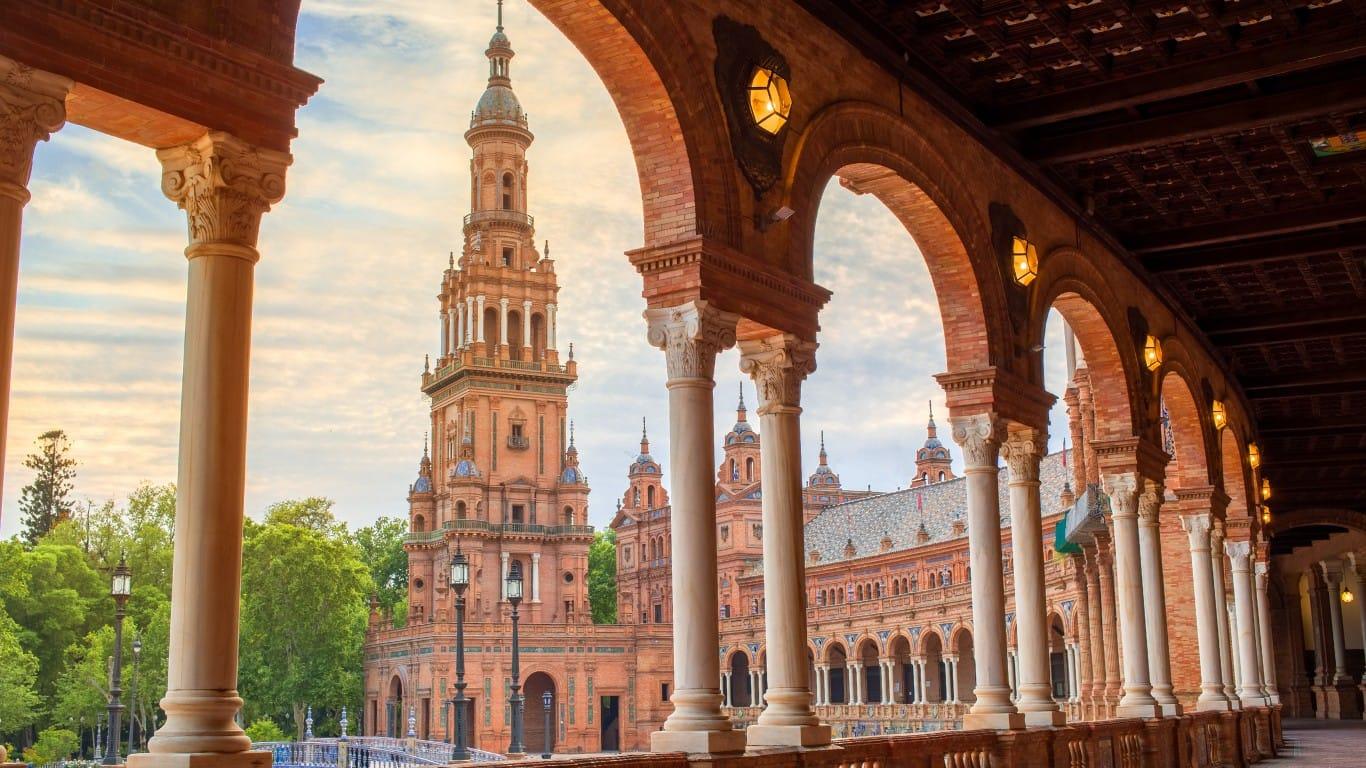
The architectural depth is exceptional. The Cathedral with the Giralda, the Alcázar (still a working royal residence), the Hospital de los Venerables and the Archivo de Indias anchor the UNESCO inscription. The Plaza de España (Aníbal González, 1928) and the Parque de María Luisa give the city its instantly recognisable Regionalist register.
The 1992 Universal Exposition produced the Cartuja island redevelopment that anchors the contemporary axis. The Jürgen Mayer H. Metropol Parasol on Plaza de la Encarnación (one of the largest wooden structures in the world) sets the contemporary architectural tone in the historic core.
Mansion Global has covered Seville through the lens of Mudéjar architectural restoration. JLL Iberia, Engel & Völkers and Christie's International Real Estate all describe a market where the architectural register matters more to the buyer than headline pricing.
The Seville rental landscape
The Seville rental market in 2026 is supported by robust local demand, growing international interest and a broad tenant base of professionals, students and remote workers. Rent growth has been moderate, with stable occupancy across submarkets.
One-bedroom apartments rent between EUR 600 and EUR 850 per month, two-bedrooms between EUR 850 and EUR 1,150, three-bedrooms between EUR 1,100 and EUR 1,500. Premium units in Casco Antiguo and Nervión exceed EUR 1,700.
Short-term tourist rentals are subject to Andalusian regional licensing. Casco Antiguo has been the focus of tighter control. No formal rent-control caps are in place as of 2026.
How Seville compares with European prime markets
Seville prime at EUR 3,400 per square metre sits well below Madrid (above EUR 8,500 per square metre at the central prime tier) and Barcelona (around EUR 7,000 per square metre). Mayfair sits around GBP 30,000 to GBP 40,000 per square metre, an entirely different category.
Monaco prime trades near EUR 55,000 per square metre according to Savills's World Cities Prime tracker. Dubai Marina prime trades near AED 22,000 per square metre (around EUR 5,500), above Seville prime.
The comparison readers find more useful is Seville against Valencia (EUR 3,200 to EUR 3,800 per square metre at the prime tier) and Lisbon (EUR 6,500 to EUR 8,000 per square metre). The Greek Golden Visa (EUR 250,000 in qualifying regions, EUR 800,000 in central Athens, Thessaloniki, Mykonos and Santorini from August 2024) sits in a different category. Seville is now a heritage-led, accessible-pricing play, no longer a residency-by-investment pathway.
What we expect through year-end 2026
Property prices are projected to rise 3. 5 to 5. 0 percent through 2026.
The strongest movement is expected in well-located districts (Nervión, Triana, Los Remedios) where renovated, move-in-ready properties remain undersupplied.
Macarena, San Pablo-Santa Justa and Sevilla Este are projected to track 4. 5 to 6. 5 percent as infrastructure improvements continue.
Citywide average prices are expected to reach EUR 2,350 to EUR 2,400 per square metre by year-end.
Rental prices are projected to grow 2. 5 to 4. 0 percent.
The Metro de Sevilla expansion (Line 3 currently advancing), the modernisation of public-transit corridors and the redevelopment of Bellavista and Sevilla Este suburbs have raised connectivity in previously secondary districts.
What this means for buyers
Seville rewards the buyer drawn to Andalusian heritage architecture, the Moorish-Renaissance layered urban core, and one of the most distinctive cultural calendars in southern Europe. The neighbourhoods responding most distinctly to the design-led buyer shift (the restored heritage stock of Casco Antiguo, the Triana riverfront, the Los Remedios family-buyer corridor) are quietly outperforming the citywide averages.
The end of the Golden Visa removes the residency-pathway sweetener but leaves the architectural and lifestyle cases intact. The price differential to Madrid and Barcelona (Seville trades at roughly 40 to 50 percent of central Madrid pricing) remains the durable accessibility advantage.
We last reviewed this analysis in May 2026.
Frequently asked
What is the average property price per square metre in Seville in 2026?
Around EUR 2,250 per square metre citywide, with central districts exceeding EUR 3,000.
Can international buyers purchase property in Seville?
Yes. Spain imposes no restrictions on foreign property ownership. The Golden Visa property pathway ended in April 2025, but ownership itself remains open.
Are short-term rentals permitted?
Yes, with Andalusian regional licensing. Casco Antiguo is the most regulated zone.
Are rent caps in effect?
Not currently. The Andalusian government has not implemented formal rent-control caps as of 2026.
Which neighbourhoods are seeing the most buyer attention?
Casco Antiguo, Triana, Nervión, Los Remedios and the Macarena / San Pablo value corridors draw the most consistent demand from buyers tracking heritage architecture and lifestyle proximity.