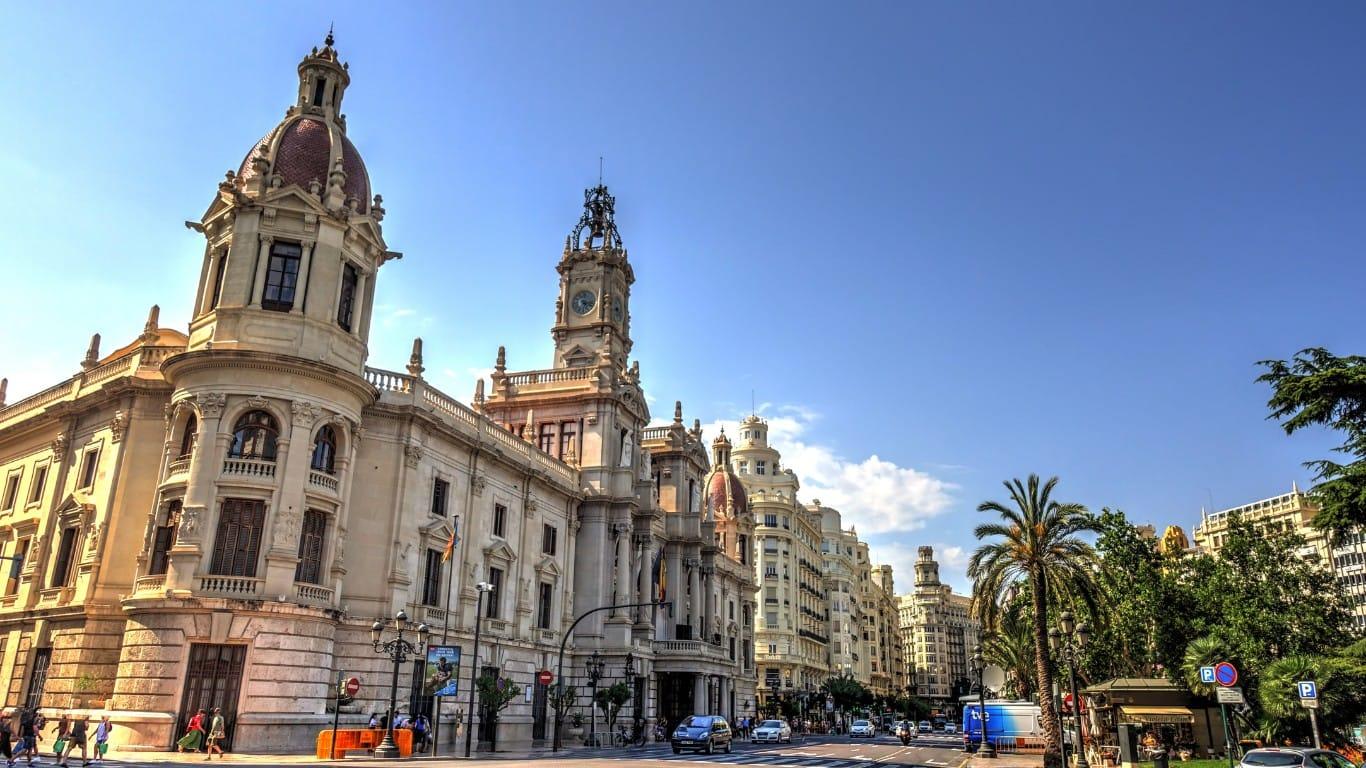
The Valencia property market in 2026 has earned a place in the European prime-residential conversation that would have surprised observers a decade ago. Spain's third-largest city has built its current profile on an unusually liveable Mediterranean urbanism: a Gothic and Modernist core, Santiago Calatrava's City of Arts and Sciences and a former Turia riverbed turned into a 9-kilometre linear park. Average residential pricing now sits near EUR 2,510 per square metre, well below Madrid or Barcelona, with prime central districts trading between EUR 3,200 and EUR 3,800.
Knight Frank's European Cities tracking and Engel & Völkers's Iberian coverage both note Valencia as the southern European secondary city drawing the most consistent international relocation interest. The buyer pool runs from Germany, the Netherlands, France and the United States.
Mansion Global has covered Valencia through the lens of architectural heritage and lifestyle relocation. The America's Cup hosting in 2024 confirmed Valencia as a city the international yachting and sailing communities now treat as a primary destination.
- Valencia has emerged as a credible alternative to Madrid and Barcelona, with materially lower pricing, attractive lifestyle infrastructure and a deepening international buyer base supporting accelerated appreciation.
- We see central neighbourhoods including El Pla del Real, Ruzafa and the seafront arc anchoring the upper end of the local market.
- INE and Idealista data confirms Valencia residential appreciation outpacing Madrid in percentage terms through recent cycles, although absolute pricing remains materially lower.
- International remote workers and digital nomads have meaningfully reshaped the Valencia demand picture, with year-round rental demand supporting attractive yields.
- The Beckham Law remains accessible for qualifying international professionals, with Valencia attracting steady relocation flows from the technology and creative sectors.
- For most considered Spanish buyers we view Valencia as offering the best entry-level Spanish prime market exposure, with lifestyle and yield both supporting the proposition.
- Who is this for?
- International and Spanish buyers evaluating Valencia property acquisition, alongside the advisers, brokers and family office staff framing those decisions.
- What is happening?
- A market read of Valencia property in 2026, covering El Pla del Real, Ruzafa, the seafront arc, digital nomad demand and the rental yield landscape.
- When did this emerge?
- The article reflects 2026 market conditions through INE, Idealista and Knight Frank Spain data alongside our observations.
- Where is this happening?
- The piece focuses on Valencia, including El Pla del Real, Ruzafa and the seafront arc.
- Why does it matter?
- Valencia occupies a distinctive position in the Spanish prime complex, which is why understanding the value proposition matters before any acquisition conversation.
The Valencia market today
The 2026 market is supply-constrained in the centre and rapidly evolving in the periphery. New construction remains modest within the core districts, with strict zoning, height restrictions and heritage protections in Ciutat Vella and El Pla del Remei keeping most turnover concentrated in the second-hand market.
The buyer composition has been shifting steadily international. Roughly 60 percent of central-district purchases are local, with the remaining 40 percent international, drawn from Germany, the Netherlands, France, Italy and Latin America.
The Spanish Golden Visa property-based pathway ended in April 2025. Valencia has continued to attract international buyers despite the end of the residency-by-investment route, with the EUR 2,510 entry point making the city accessible to a broader buyer base than Madrid or Barcelona.
- Citywide average around EUR 2,510 per square metre
- Prime district pricing EUR 3,200 to EUR 3,800 per square metre
- Value districts EUR 1,800 to EUR 2,200 per square metre
- Local / international buyer mix around 60 / 40 in central zones
- Annual price movement around 6.4 percent citywide (2024 to 2025)
Neighbourhoods defining Valencia in 2026
El Pla del Remei
El Pla del Remei is the city's most prestigious district. Eixample-style avenues of the late nineteenth century, modernista detailing and proximity to the Carrer Colón luxury retail axis anchor the prime tier. Average pricing runs around EUR 3,800 per square metre, with renovated apartments trading between EUR 450,000 and EUR 1 million.
Ciutat Vella
The historic heart (Gothic and Baroque architecture, the Llotja de la Seda UNESCO World Heritage site, the Cathedral) draws both lifestyle buyers and the design-led international segment. Prices average around EUR 3,500 per square metre, with significant scope for renovation-led work in older buildings.
Russafa (Ruzafa)
Ruzafa has been transformed over the past decade. Independent retail, design studios, contemporary cafés and a young creative-class demographic have made the neighbourhood Valencia's answer to Madrid's Malasaña or Barcelona's Gràcia. Properties typically trade around EUR 3,200 per square metre.
Benicalap
Benicalap in the city's north has become a target for buyers priced out of the centre. Average prices sit around EUR 1,850 per square metre. The area carries a balance of green space, residential towers and a steady transit upgrade pipeline.
Patraix
Patraix combines suburban character with central connectivity. Pricing averages EUR 2,000 per square metre, with two-bedroom apartments often priced between EUR 180,000 and EUR 250,000.
The architectural and cultural register
The Ciutat Vella's Gothic and Baroque core (the Llotja de la Seda, the Cathedral, the Mercado Central) gives the city a heritage register matched in southern Europe only by Seville and parts of Granada. The Eixample-style nineteenth-century blocks of El Pla del Remei carry modernista detailing comparable to Barcelona's.
Santiago Calatrava's City of Arts and Sciences, completed in stages between 1998 and 2009 on the southern edge of the old riverbed, anchored the contemporary axis. The Turia park (a 9-kilometre linear green spine where the Turia river once ran) remains one of the most distinctive urban green-infrastructure projects in Europe.
JLL Iberia, Engel & Völkers Valencia and Christie's International Real Estate all describe a market where the architectural and lifestyle register matters as much as the entry-pricing differential. Bloomberg's lifestyle coverage and the FT have used the America's Cup and the Calatrava complex as the journalistic entry points into the broader Valencia conversation.
The Valencia rental landscape
The Valencia rental market in 2026 is one of Spain's most stable. Unlike Catalonia, the Valencian regional government has not implemented formal rent-control caps as of 2026, though policy discussions continue.
One-bedroom apartments rent between EUR 650 and EUR 900 per month, two-bedrooms between EUR 850 and EUR 1,200, three-bedrooms between EUR 1,200 and EUR 1,600. Luxury units in El Pla del Remei and Ciutat Vella exceed EUR 1,800.
Short-term tourist rentals are permitted with proper licensing. Central-district licensing has tightened, but the regime remains substantially less restrictive than Barcelona's.
How Valencia compares with European prime markets
Valencia prime at EUR 3,800 per square metre sits at roughly half the Madrid prime line (above EUR 8,500 per square metre) and at half the Barcelona prime band (around EUR 7,000 per square metre). Mayfair prime sits around GBP 30,000 to GBP 40,000 per square metre, an entirely different category.
Monaco prime trades near EUR 55,000 per square metre according to Savills's World Cities Prime tracker. Dubai Marina prime trades near AED 22,000 per square metre (around EUR 5,500), above the Valencia prime line.
The comparison readers find more useful is Valencia against Lisbon (EUR 6,500 to EUR 8,000 per square metre) and Athens (EUR 5,500 to EUR 7,500 per square metre). The Greek Golden Visa (EUR 250,000 in qualifying regions, EUR 800,000 in central Athens, Thessaloniki, Mykonos and Santorini from August 2024) sits in a different category. Valencia is now a lifestyle-led, accessible-pricing play, no longer a residency-by-investment pathway.
What we expect through year-end 2026
Property prices are projected to rise 4. 0 to 6. 0 percent through 2026.
High-demand districts (Ruzafa, El Pla del Remei, Ciutat Vella) are expected to post stable growth, with average prices reaching EUR 2,700 to EUR 3,000 per square metre depending on building quality.
More affordable outer districts (Patraix, Benicalap, La Olivereta) are projected to track 5. 5 to 7. 5 percent as buyers priced out of the centre move outward.
Citywide average prices are expected to reach EUR 2,700 to EUR 2,750 per square metre by year-end.
Rental prices are projected to grow 3. 0 to 4. 5 percent.
The fibre-optic and broadband infrastructure (among the most consistent in southern Europe) continues to support the remote-worker demographic.
What this means for buyers
Valencia rewards the buyer drawn to Mediterranean urbanism, the architectural depth of the Gothic and Modernist core and one of the most consistently liveable secondary cities in southern Europe. The Calatrava-anchored contemporary axis, the restored Turia park and the ongoing infrastructure works have created an urban offer the international relocation community has been steadily migrating toward.
The end of the Golden Visa removes the residency-pathway sweetener but leaves the lifestyle and accessible-pricing cases intact. For buyers comparing southern European secondary cities, Valencia reads as one of the most defensible positions we cover.
We last reviewed this analysis in May 2026.
Frequently asked
What is the average property price per square metre in Valencia in 2026?
The citywide average sits near EUR 2,510 per square metre. Prime areas exceed EUR 3,800.
Can international buyers purchase property in Valencia?
Yes. There are no restrictions on Spanish property ownership for non-residents. The Golden Visa property pathway ended in April 2025, but ownership itself remains open.
Are rent caps in effect?
Not currently. Rent regulation has been under regional discussion but no formal cap is implemented as of 2026.
Are short-term rentals permitted?
Yes, with proper municipal licensing. The framework has tightened in central districts but remains less restrictive than Barcelona's.
Which neighbourhoods are seeing the most buyer attention?
El Pla del Remei, Ciutat Vella, Ruzafa and the Patraix / Benicalap value corridors draw the most consistent demand from buyers tracking architectural depth and lifestyle proximity.