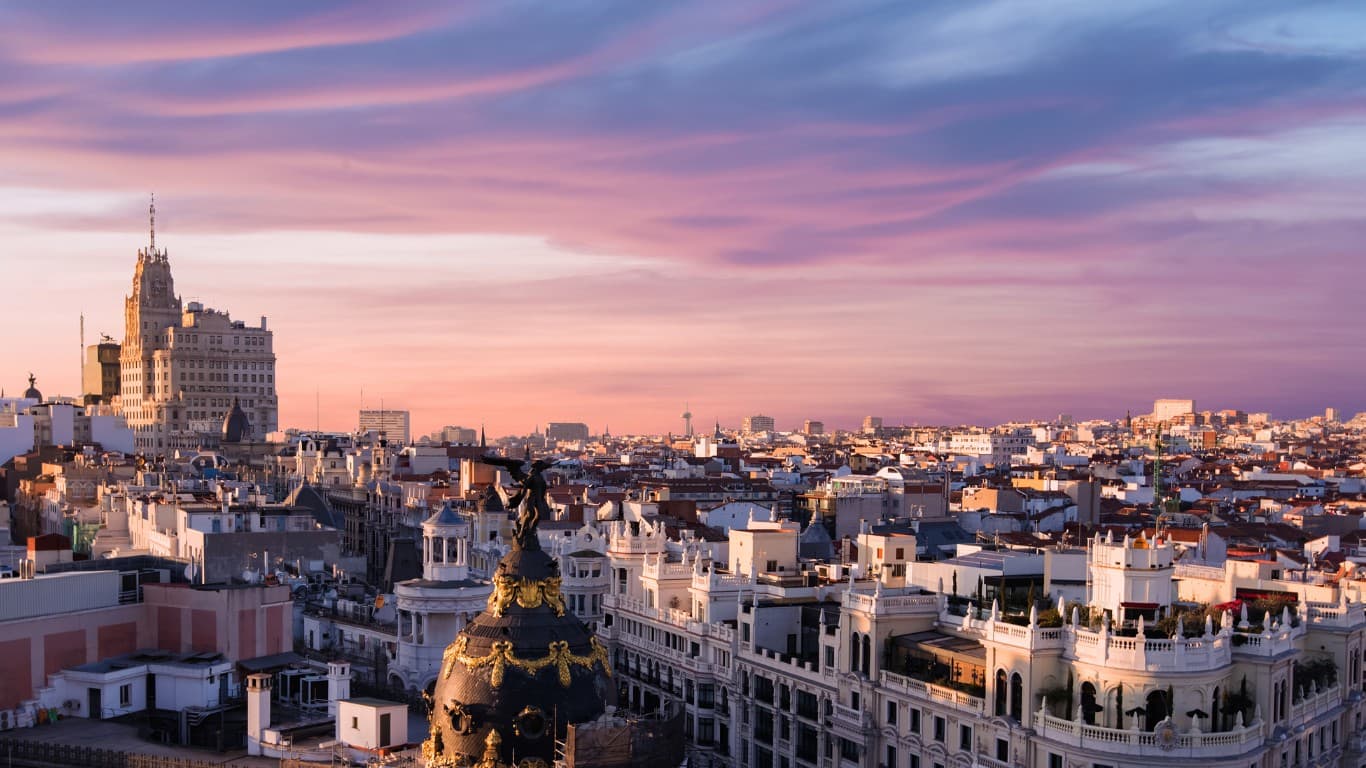
The Madrid property market in 2026 has finished its quiet three-year ascent and now sits as Spain's most expensive prime residential market. The Spanish capital has overtaken Barcelona definitively and now reads alongside Lisbon, Berlin and Athens as one of southern Europe's most consequential property stories. Prime central districts (Salamanca, Chamberí, Almagro) routinely exceed EUR 8,500 per square metre, with trophy stock along Paseo de la Castellana and the Salamanca prime band trading above EUR 11,000 per square metre.
Knight Frank's Wealth Report and Mansion Global have devoted increasing coverage to Madrid's structural emergence. The drivers are clear: Latin American capital flows, tax-driven international relocations under the Beckham Law, and one of the most active prime-residential development pipelines in continental Europe.
Engel & Völkers Madrid, JLL Iberia and Sotheby's International Realty all describe a buyer composition shaped by Mexican, Venezuelan and Argentine capital, established Spanish wealth, and French and Northern European tax-driven relocations. The FT Property pages have used the Cuatro Torres Business Area and the Madrid Nuevo Norte project as the journalistic entry points into the broader prime conversation.
- Madrid has emerged as one of the most dynamic European capital property markets, with La Moraleja, Salamanca and Chamberi anchoring the upper end of the prime segment.
- We see INE and Idealista data confirming sustained residential appreciation through 2025 and into 2026, with the gap to Paris and Milan continuing to narrow on prime stock.
- Knight Frank Spain and Savills Spain reports place Madrid at the upper tier of European secondary capitals, with international buyer interest deepening materially.
- The Beckham Law continues to support international resident interest in Madrid, with qualifying foreign professionals accessing favourable income tax treatment for the relevant period.
- Yields on prime Madrid rental stock have compressed with the price recovery, although well-located buy-to-let stock continues to deliver attractive cash flow versus comparable European capitals.
- For most considered Spanish buyers we view Madrid as offering the strongest combination of liquidity, lifestyle and appreciation potential in the broader Spanish prime complex.
- Who is this for?
- International and Spanish buyers evaluating Madrid property acquisition, alongside the advisers, brokers and family office staff framing those decisions.
- What is happening?
- A market read of Madrid property in 2026, covering La Moraleja, Salamanca, Chamberi, sustained appreciation, the Beckham Law dynamic and the rental yield landscape.
- When did this emerge?
- The article reflects 2026 market conditions through INE, Idealista, Knight Frank Spain and Savills Spain data alongside our observations.
- Where is this happening?
- The piece focuses on Madrid, including La Moraleja, Salamanca and Chamberi.
- Why does it matter?
- Madrid has crossed an important threshold in international buyer perception, which is why understanding the structural dynamics matters before any acquisition decision.
The Madrid property market today
Foreign buyers account for more than 30 percent of all 2024 transactions in central Madrid, with Latin American purchasers leading the share. The Spanish Golden Visa programme ended in April 2025 after the Sánchez government's announcement, removing the EUR 500,000 property-based residency pathway. Existing holders retain their permits.
The market has continued to attract international capital despite the Golden Visa ending. Time on market for centrally located prime apartments has compressed sharply since 2023.
- Prime central pricing above EUR 8,500 per square metre
- Trophy Salamanca and Castellana stock above EUR 11,000 per square metre
- Foreign-buyer share above 30 percent in central Madrid
- Spain ended the property-based Golden Visa in April 2025
Neighbourhoods defining Madrid in 2026
Salamanca
Salamanca remains the most prestigious central district. The grid of late-nineteenth-century mansions, the proximity to the Paseo del Arte and the dense designer-retail cluster around Calle Serrano define the neighbourhood's character.
Chamberí
Chamberí, adjacent to Salamanca, is now the most active restoration district in central Madrid. Period nineteenth-century buildings draw both Spanish and international buyer interest.
Almagro and Recoletos
Almagro and Recoletos extend the prime central band. Restored Belle Époque architecture and proximity to the Museo Sorolla anchor established Spanish and international buyer demand.
La Moraleja and Pozuelo
La Moraleja and Pozuelo represent the established prime suburban communities. Gated villa stock draws established families and international buyers seeking lower-density living.
Madrid Río and the south bank
The Manzanares riverfront redevelopment continues to reshape demand around the Madrid Río park (designed by West 8). Adjacent contemporary developments now draw a younger design-led buyer demographic.
The architectural and institutional register
The Paseo de la Castellana, Madrid's grand axial boulevard, anchors the contemporary architectural conversation. The Cuatro Torres Business Area includes Foster + Partners' Torre Cepsa, the Norman Foster-designed Torre Caja Madrid and the Pelli Clarke Pelli-designed Torre Espacio.
The Reina Sofía, the Prado and the Thyssen-Bornemisza form the Paseo del Arte cultural axis. The restored nineteenth-century mansions of Salamanca and Chamberí represent some of the best-preserved Belle Époque residential architecture in Europe.
Christie's International Real Estate, Engel & Völkers Madrid and JLL Iberia all describe a market where the architectural register matters as much as headline pricing growth. The Madrid Nuevo Norte project around Chamartín station represents the most ambitious urban regeneration pipeline in any continental European capital.
The Madrid rental landscape
Madrid's rental market remains tight and increasingly regulated. Average prime central rents have risen sharply over the past three years, with one-bedroom apartments in Salamanca and Chamberí routinely exceeding EUR 1,800 per month.
Short-term rental regulation has tightened, particularly in central districts. The Madrid municipal framework continues to evolve under the broader Spanish housing law (Ley por el Derecho a la Vivienda).
Bloomberg has covered the Madrid rental conversation through the lens of tax-driven relocations and the broader European housing-affordability debate. The Beckham Law tax framework continues to underwrite the international professional relocation pipeline.
How Madrid compares with European prime markets
Madrid trophy stock at EUR 11,000 per square metre sits below Mayfair (around GBP 30,000 to GBP 40,000 per square metre, or roughly EUR 35,000 to EUR 46,000) and well below Monaco (Savills's World Cities Prime tracker places Monaco near EUR 55,000 per square metre).
The comparison readers find more useful is Madrid against Lisbon and Athens. Lisbon prime now sits around EUR 6,500 to EUR 8,000 per square metre, Athens prime around EUR 5,500 to EUR 7,500 per square metre. Madrid prime has pulled clear of both at the trophy tier.
Dubai Marina prime trades near AED 22,000 per square metre (around EUR 5,500), below Madrid prime. The Greek Golden Visa programme (EUR 250,000 in qualifying regions, EUR 800,000 in central Athens, Thessaloniki, Mykonos and Santorini from August 2024) sits in a different category. Madrid is now a primary-residence and architectural-heritage play, no longer a residency-by-investment pathway.
What we expect through year-end 2026
Prime pricing is projected to climb 5 to 8 percent through 2026, outpacing the broader Spanish market. Growth is expected to concentrate in Salamanca, Chamberí, the Madrid Nuevo Norte adjacent submarkets and the redeveloping Madrid Río band.
Knight Frank's Prime Index tracker and Engel & Völkers Madrid both support the trajectory. The Latin American capital flow and the tax-driven international relocation pipeline continue to anchor demand.
The end of the Golden Visa has not dampened activity at the prime tier. The architectural depth and the tax framework remain the durable assets.
What this means for buyers
Madrid rewards the buyer who values architectural heritage, dense cultural infrastructure and a tax framework that supports professional relocation. The Beckham Law continues to underwrite the international professional pipeline.
For buyers who value Salamanca's Belle Époque inheritance, the Cuatro Torres contemporary axis and the deepening cultural calendar, Madrid prime reads as one of the most defensible southern European positions we cover. The end of the Golden Visa removes the residency-pathway sweetener but leaves the architectural and tax cases intact.
We last reviewed this analysis in May 2026.
Frequently asked
How is the Madrid property market evolving in 2026?
Prime pricing is projected to climb 5 to 8 percent through the year, supported by Latin American capital flows, the Beckham Law tax framework and the Madrid Nuevo Norte redevelopment.
Which areas are seeing the most buyer attention?
Salamanca, Chamberí, Almagro, La Moraleja and the Madrid Río redevelopment band draw the most consistent prime demand.
Can foreign nationals buy property in Madrid?
Yes. There are no restrictions on foreign ownership of Spanish property. The Golden Visa property-based residency pathway ended in April 2025, but ownership itself remains open to non-Spanish nationals.
How does Madrid compare against Barcelona?
Madrid has overtaken Barcelona as Spain's most expensive prime residential market. The drivers are political stability, the absence of Catalan regional tensions and stronger Latin American capital flows.


Savvas Agathangelou
Savvas Agathangelou co-founded The Luxury Playbook and has spent years reporting from the prime postcodes the magazine covers — Mayfair, Knightsbridge, the Athens Riviera, Dubai's Palm crescents, and the southern Mediterranean coastlines where the world's wealthy keep coming back. His background is in international hospitality, and that frame shapes how he writes about property: the developer's choices, the architect's signature, the agency's bench of named brokers, the building's service standard once the buyer moves in. He files developer spotlights, agency profiles, and the seasonal "Properties That Defined" listicles, and he hosts the magazine's founder-and-leadership interviews on the Voices side.