Pablo Picasso's eight most valuable works at auction define the deepest single-artist market in twentieth-century art. The career produced an unusual combination of breadth (over 50,000 documented works across painting, sculpture, ceramics, drawings, and prints) and concentration at the top (a small number of canonical pictures whose value sits at the very peak of the broader modern art conversation). When a top-tier Picasso comes to evening sale, the room behaves differently, and the prices reflect what serious modern collectors are willing to pay for the strongest work of the most consequential European artist of the twentieth century.
Picasso anchors the auction-tier conversation in modern art the way Warhol and Basquiat anchor the post-war and contemporary side. The eight works that follow are the public benchmarks; the broader Picasso market trades around them in patterns that are now well understood by the major-house specialists and the senior collector base.
- Pablo Picasso anchors the deepest single-artist market in twentieth-century art, with his most valuable works defining the top of the modern auction tier.
- Les Femmes d’Alger Version O cleared one hundred and seventy-nine point four million dollars at Christie’s New York in May 2015.
- Le Reve sold privately for around one hundred and fifty-five million dollars in 2013 from Steve Wynn to Steven Cohen in a notable secondary transaction.
- Nude Green Leaves and Bust made one hundred and six point five million dollars at Christie’s New York in May 2010 in another canonical evening sale.
- Garcon a la Pipe cleared one hundred and four point one million dollars at Sotheby’s New York in May 2004, setting an early benchmark for the artist.
- Picasso’s top tier behaves like its own asset class, with prices set by a small group of senior collectors and institutions across multiple cycles.
- Who is this for?
- Modern art collectors, advisors and observers of the global market who want a clear reference list of Picasso’s eight most valuable works at auction and private sale.
- What is happening?
- An editorial overview of Picasso’s eight most valuable works, covering Les Femmes d’Alger, Le Reve, Nude Green Leaves and Bust, Garcon a la Pipe and the canonical benchmark sales.
- When did this emerge?
- Most relevant around the May and November Impressionist and Modern evening sales at Christie’s and Sotheby’s in New York and London each year.
- Where is this happening?
- Centred on the New York and London salesrooms at Christie’s and Sotheby’s, with major institutional holdings across MoMA, the Musee Picasso, the Tate Modern and the Centre Pompidou.
- Why does it matter?
- Understanding the deepest Picasso sales clarifies how the top of the modern market actually behaves and provides essential context for any serious modern collecting programme.
Les Femmes d'Alger (Version O), 1955, $179.4 million
Sold at Christie's New York in May 2015, "Les Femmes d'Alger (Version O)" remains one of the highest auction prices ever paid for any painting. The work is the final version of Picasso's 1954-1955 series responding to Delacroix's 1834 "Femmes d'Alger dans leur appartement" at the Louvre. The series of fifteen canvases reworks the Delacroix composition through Picasso's mid-1950s synthetic vocabulary, with this final version generally considered the most fully realized.
The provenance is exceptional: the work passed through the Ganz family collection in New York, one of the most consequential American Picasso collections of the twentieth century, before its 1997 sale at Christie's and its eventual 2015 return to auction.
Le Rêve, 1932, $155 million (private sale, 2013)
"Le Rêve" was sold privately in 2013 for $155 million by Steve Wynn to Steven A. Cohen, in one of the most public private sales of the twenty-first century. The painting depicts Marie-Thérèse Walter, Picasso's mistress and muse through the 1930s, and is one of the canonical works from the year that produced his most coveted MT cycle.
The work had been at the center of a 2006 incident in which Wynn accidentally damaged it by putting his elbow through the canvas during a viewing in his Las Vegas office; the painting was subsequently restored.
Nu au Plateau de Sculpteur, 1932, $106.5 million
Sold at Christie's New York in May 2010, "Nu au Plateau de Sculpteur" is another Marie-Thérèse work from the same 1932 cycle. The 1932 paintings are widely considered Picasso's most coveted single year, with the MT cycle and the parallel sculptor's studio work both reaching career peaks in that twelve-month window.
The provenance ran through the Sidney F. Brody collection, one of the most consequential American modern collections of the mid-twentieth century.
Garçon à la Pipe, 1905, $104.2 million
Sold at Sotheby's New York in May 2004, "Garçon à la Pipe" was the first painting at auction to break $100 million. The work is from Picasso's Rose Period (1904-1906), the brief window between his Blue Period and his proto-Cubist experiments that produced "Les Demoiselles d'Avignon."
The work passed through the Whitney family collection (John Hay Whitney) and is one of the most documented Rose Period paintings outside museum holdings.
Dora Maar au Chat, 1941, $95.2 million
Sold at Sotheby's New York in May 2006, "Dora Maar au Chat" is one of the canonical Dora Maar portraits from the early 1940s. Maar (the Surrealist photographer who was Picasso's partner through the late 1930s and into the war years) appears in a long series of paintings; this version, with the cat perched on Maar's shoulder, is one of the most ambitious in the cycle.
Femme à la Montre, 1932, $139.4 million
Sold at Sotheby's New York in November 2023, "Femme à la Montre" was another Marie-Thérèse painting from the 1932 cycle. The work came to auction from the Emily Fisher Landau estate, in one of the most consequential single-owner sales of the past decade. The 1932 vintage continues to define the very top of the Picasso market.
Femme Assise près d'une Fenêtre (Marie-Thérèse), 1932, $103.4 million
Sold at Christie's New York in May 2021, "Femme Assise près d'une Fenêtre" is another 1932 Marie-Thérèse work. The triangulation across multiple top-tier Marie-Thérèse paintings from 1932 makes the point that this single year produced more nine-figure paintings than any other in Picasso's career.
Provenance ran through Picasso's estate to the Maya Widmaier Picasso (the artist's daughter with Marie-Thérèse) collection, which has supplied several of the strongest recent Picasso lots.
Femme Nue Couchée, 1932, $67.5 million
Sold at Sotheby's New York in May 2022, "Femme Nue Couchée" is a further 1932 Marie-Thérèse work, reinforcing the position of that single year at the peak of the Picasso market. The work's somewhat lower price (compared to the other 1932 paintings discussed) reflects scale, composition, and provenance variations within the same vintage.
What the top of the Picasso market actually values
Several patterns run through the eight works. The 1932 vintage dominates: five of the highest-priced Picasso paintings at auction are 1932 Marie-Thérèse works. The Ganz, Brody, Whitney, and Maya Widmaier Picasso provenance lines run through multiple top lots.
The major Cubist period is somewhat under-represented at the very top, with most of the canonical Cubist work in museum collections rather than circulating.
Scale, ambition, and the named subject (Marie-Thérèse Walter, Dora Maar) drive much of the premium. The strongest works combine large-format ambition, the named muse subject, and provenance through a canonical American or European collection.
How the broader Picasso market trades
Beneath the top eight, the Picasso market is unusually deep. Strong canvases from across the career (Blue and Rose periods; the Analytic and Synthetic Cubist phases; the 1920s neoclassical work; the 1930s Marie-Thérèse cycle; the wartime Dora Maar paintings; the post-war Vauvenargues and Mougins work) all have established secondary markets.
The works on paper market (drawings, gouaches, watercolors) is exceptionally active and offers serious entry below the painting tier. The prints market (etchings, lithographs, linocuts) is the most accessible part of the Picasso conversation, with major works (the Vollard Suite, the Suite 347) trading at consistent levels.
The ceramics market is a separate and unusually deep segment. Picasso's Vallauris ceramics, produced from the late 1940s through the 1960s in editions at the Madoura workshop, have an established secondary market and are one of the more accessible ways to engage with his late-career production.
What this means for collectors
The top of the Picasso market behaves with the discipline of any other deep blue-chip segment. Provenance, period, subject, scale, and condition combine to set price, with the 1932 Marie-Thérèse cycle currently anchoring the very peak. Serious entry to the top requires advisor, dealer, and major-house relationships; the works at this tier are placed through irrevocable bids, guarantees, and pre-arranged buyer engagements.
For collectors approaching the broader Picasso market, the practical starting points are the prints market and the strong drawings tier, plus selective access to mid-career painting through the named modern-art dealer network. Engagement with the Picasso catalogue raisonné scholarship and with the Maya Widmaier Picasso and Bernard Ruiz-Picasso archives is part of the discipline.
What we'll watch next
The 1932 vintage continues to define the very top of the market. The Emily Fisher Landau estate sale in November 2023 placed "Femme à la Montre" at $139.4 million; the next single-owner Picasso sale of comparable depth will likely produce further top-tier results.
We are also watching the strong Cubist-period market. The Synthetic Cubist work from 1914-1919 has had selective but consistent top-tier activity through the past several cycles, and the supply at that level remains thin. Any major Synthetic Cubist work at evening sale will be a meaningful market moment.
We last reviewed this analysis in May 2026.

Frequently Asked Questions
- What is Pablo Picasso’s most famous painting?
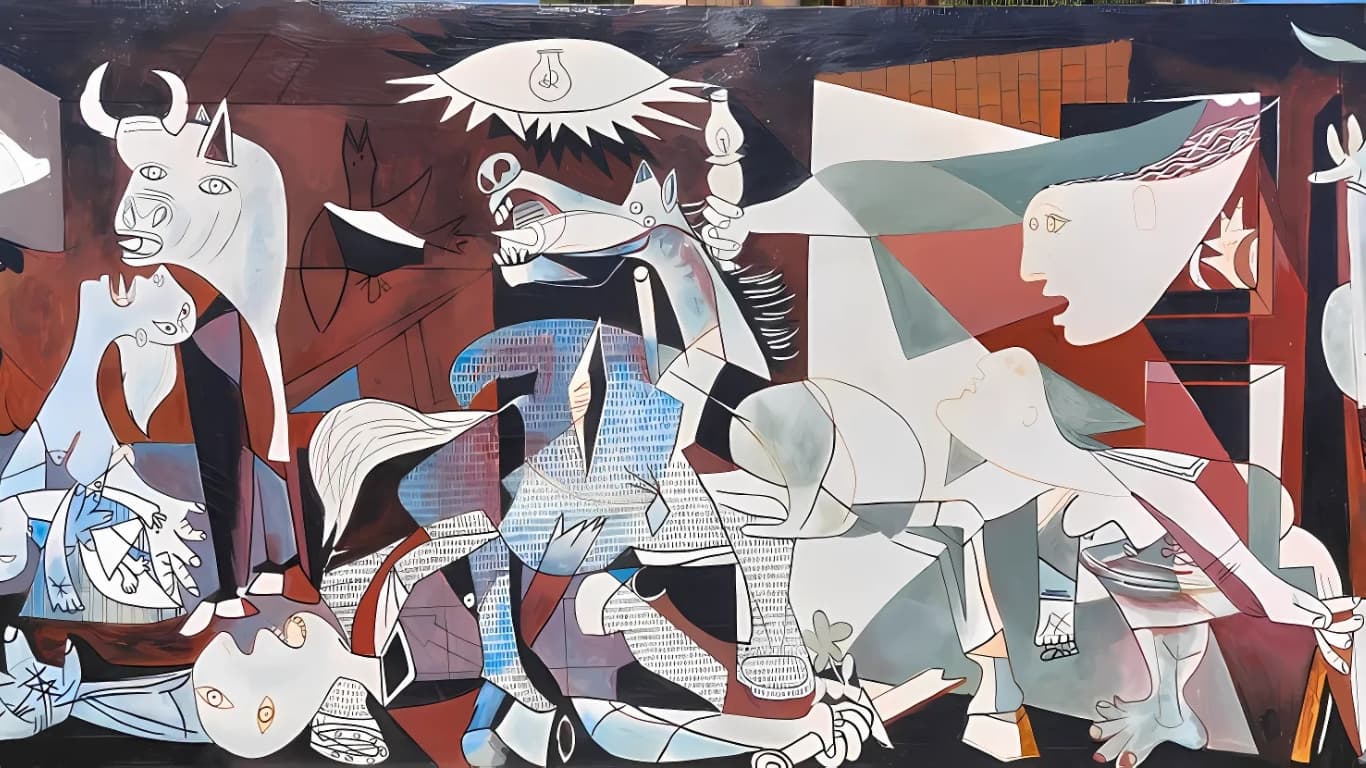
- Most experts agree it’s <strong>Guernica</strong>, a monumental anti-war piece from 1937, widely viewed as one of the most important paintings of the 20th century.<br><br>
- Which of Picasso’s paintings is the most expensive?
- Privately, Les Femmes d'Alger (Version O) holds the top auction price at $179 million. But culturally, works like Les Demoiselles d’Avignon are valued at over $1 billion, though they’ll never be sold.<br><br>
- Why are Picasso’s Blue Period paintings so valuable?
- They’re rare, deeply emotional, and mark the first time Picasso revealed his mature artistic vision. Blue Period works often achieve $50 million to $100 million, reflecting both scarcity and critical importance.<br><br>

Stefanos Moschopoulos
Stefanos Moschopoulos founded The Luxury Playbook in Athens and has spent the better part of a decade following the auction calendar, the en primeur releases, and the watchmakers, gallerists, and shipyards the magazine covers. He writes the field guides and listicles that anchor the Connoisseur section — pieces built on Phillips and Christie's results, Liv-ex movements, and conversations with collectors he has met across Geneva, Bordeaux, Basel, and Monaco. His own collecting habits sit closer to watches and wine than art, and it shows in the level of detail in the magazine's coverage of those categories. Under his direction, The Luxury Playbook now publishes long-form field guides, market-defining year-end listicles, and the Voices interview series with the founders behind the houses and the brands.