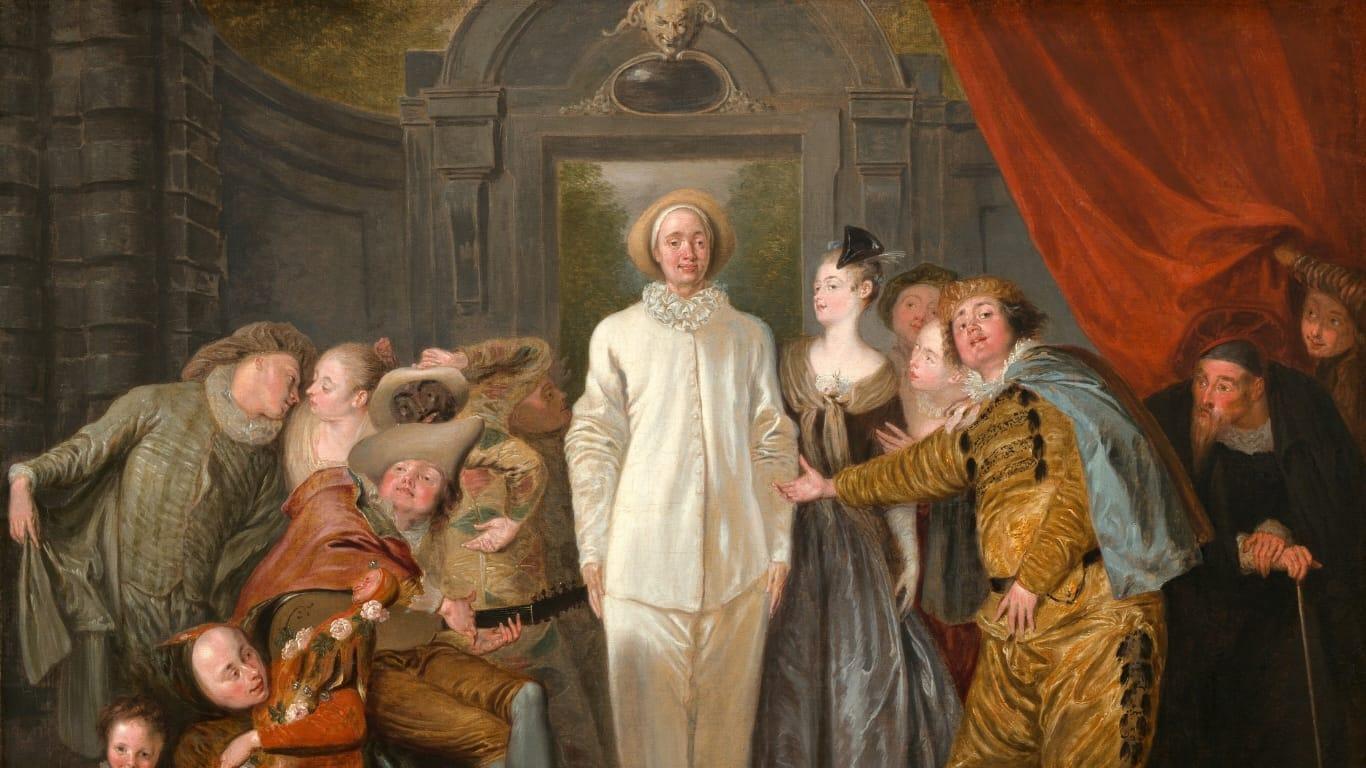
Rococo art is one of the most distinctive chapters in the European canon and one of the most consistently undervalued at auction relative to its institutional standing. The movement runs from roughly 1715 to 1780, anchored in France under Watteau, Boucher, and Fragonard, with significant production in Italy (Tiepolo), Germany, and Austria. The work is intimate in scale, ornamental in palette, and erotic or theatrical in subject matter.
It sits between the rigor of Baroque and the seriousness that returned with Neoclassical painting after 1780.
For collectors, Rococo offers something the broader Old Masters market often does not: scarcity at the top, deep institutional record, and prices that lag the historical and cultural weight of the work itself. The category does not move at trophy speed. But its leading names appear consistently at Christie's, Sotheby's, and the European Old Masters fairs, and the serious collector base for the segment has been building quietly for decades.
- Rococo emerged in early eighteenth-century France as a lighter, more decorative reaction to the formal Baroque of the previous century.
- The movement is anchored by Antoine Watteau, Francois Boucher and Jean-Honore Fragonard, with the genre paintings of fete galante defining its core visual vocabulary.
- Rococo flourished across France, Bavaria and parts of Italy through roughly 1730 to 1780, before fading into the more disciplined Neoclassicism that followed.
- Major Rococo paintings are held primarily in the Louvre, the Wallace Collection and a small number of other European institutions, which constrains auction supply at the top.
- Decorative arts including Sevres porcelain, French furniture and gilded interior decoration form an inseparable part of the broader Rococo collecting market.
- For Old Master collectors, Rococo remains a coherent eighteenth-century chapter that rewards focused engagement with its specific aesthetic and material culture.
- Who is this for?
- Old Master and eighteenth-century collectors, advisors and curators interested in Rococo as a coherent decorative and pictorial movement within the broader European tradition.
- What is happening?
- A collector field guide to Rococo art, covering Watteau, Boucher and Fragonard, the fete galante tradition, the geographic spread of the movement and the realistic auction supply environment.
- When did this emerge?
- Most active around the January and July Old Master sales at Christie’s, Sotheby’s and Bonhams in New York and London, and around major loan exhibitions on the period.
- Where is this happening?
- Centred on the Paris and London salesrooms historically, with major institutional holdings across the Louvre, the Wallace Collection and selected German and Italian museums.
- Why does it matter?
- Rococo is a coherent and often underrated chapter of European painting, and a clear field guide helps collectors engage with both the pictorial and decorative-arts dimensions of the period.
The shape of the Rococo canon
The French triumvirate anchors the movement. Antoine Watteau (1684-1721), whose fêtes galantes invented the visual vocabulary that defined the period. François Boucher (1703-1770), the court painter whose work shaped the visual world of Louis XV's France.
Jean-Honoré Fragonard (1732-1806), whose major works ("The Swing," "The Progress of Love" series) are now treated as canonical European painting.
Beyond the French core, the Italian Rococo is dominated by Giovanni Battista Tiepolo (1696-1770) and his son Giovanni Domenico Tiepolo. Both worked extensively in fresco and on canvas, and the Tiepolo market is among the most active in the broader Rococo category.
The German and Austrian Rococo includes Franz Anton Maulbertsch, Daniel Gran, and the brothers Asam. The pastoral and genre tradition includes Jean-Baptiste-Siméon Chardin (often grouped with Rococo despite his quieter palette) and Jean-Baptiste Greuze.
How the Rococo market actually trades
Rococo works appear at the Old Masters evening sales at Christie's, Sotheby's, and Bonhams, with the major sales taking place in London (January and July) and New York. TEFAF Maastricht in March is the parallel fair venue, where senior Old Masters dealers bring the highest-grade Rococo material for private sale.
Watteau works are the rarest at the top of the market. His career was brief (he died at thirty-six), and most of his major paintings are in museum collections (the Louvre, the Wallace Collection, Charlottenburg). When a confirmed autograph Watteau appears, the market behavior is closer to that of a Renaissance Master: thin supply, deep institutional interest, prices in the high seven and eight figures.
Boucher and Fragonard appear more frequently. Their strongest works (the major mythological and allegorical scenes, the prepared works for major commissions) have priced into the high seven and eight figures over the past two decades. Tiepolo at the top tier moves in similar territory.
The broader Rococo market, including secondary figures and workshop works, trades at much more accessible levels. Strong Boucher drawings, Fragonard works on paper, Tiepolo bozzetti (oil sketches), and the broader genre and pastoral tradition price into the six figures with regularity.
The institutional record that supports the market
Rococo's institutional record is exceptionally deep. The Louvre, the Wallace Collection in London, the Frick Collection in New York, the Norton Simon Museum in Pasadena, the Getty in Los Angeles, the National Gallery in Washington, the Mauritshuis in The Hague, and the major European royal residences (Charlottenburg, Sanssouci, Schönbrunn, Versailles) hold the foundational Rococo collections.
Major retrospectives in the past two decades (the Boucher retrospective at the Met and the Detroit Institute of Arts in 1986-1987; the Fragonard retrospectives at the Grand Palais; the Watteau anniversary exhibitions at the Royal Academy and the National Gallery in Washington) consolidated the scholarly position of each artist. The Tiepolo retrospectives in Venice, Würzburg, and Madrid through the 2010s have done the same for the Italian Rococo.
The Wallace Collection in London is perhaps the single most consequential institutional reference for Rococo. The Hertford-Wallace family acquired the deepest private Rococo collection in the world in the nineteenth century, and the Wallace's holdings of Watteau, Boucher, and Fragonard remain the calibration point for scholarship in the field.
The collectors building serious Rococo depth
The serious Rococo collector base is small and unusually committed. American collectors include several major museum trustees with deep eighteenth-century French and Italian holdings. European collectors operate primarily in France, Italy, and the UK, often through long-tenure relationships with the senior Old Masters dealer network.
The named dealer tier in the segment includes Colnaghi (with longstanding Rococo specialization), Robilant + Voena, Otto Naumann (more focused on Northern European but engaging Rococo), Adam Williams, and Daniel Katz Gallery. The relationships between these dealers and their senior collectors typically run for decades.
What distinguishes the segment is patience. Rococo at the top is not a category for speed. The right Watteau or Fragonard might appear once a decade.
Serious collectors track specific works for years, sometimes decades, before the right opportunity surfaces. That patience is the discipline that defines the segment.
Where Rococo sits in the broader pre-modern conversation
Rococo bridges the Baroque tradition and the Neoclassical reaction that followed. The category sits adjacent to Renaissance Masters at Auction: A Collector's Read and Baroque in the Old Masters conversation, with overlapping buyer pools and overlapping dealer networks.
Many serious Old Masters collectors hold both Baroque and Rococo material, treating them as connected chapters of a longer European painting tradition. The major-house Old Masters specialists handle both. The institutional record holds them together: most major European museums show Baroque and Rococo galleries as a continuous historical sequence.
What distinguishes serious Rococo collecting
Three disciplines define serious Rococo acquisition. First, attribution. The market is sensitive to autograph status, with workshop attributions, school works, and follower-of attributions priced at orders-of-magnitude discounts to confirmed autograph paintings.
Technical analysis, catalogue raisonné scholarship, and major-house specialist engagement are part of the process.
Second, condition. Most Rococo works are now between 250 and 300 years old. Cleaning, varnish removal, and restoration history matter.
The major-house specialists, the senior conservators in Paris, London, and New York, and the museum conservation networks are the reference standards.
Third, provenance. The strongest Rococo works carry documented chains of ownership back through eighteenth-century royal and aristocratic collections. The Wallace Collection's holdings, the Hermitage's eighteenth-century French paintings, the Pushkin's collection, and the Russian aristocratic provenance lines are all relevant reference points.
What this means for collectors
Rococo is a serious category with deep institutional support and a small, committed collector base. The supply is thin at the top, the scholarship is mature, and the prices have lagged the cultural and historical weight of the work itself for some time.
For collectors interested in the category, the practical starting points are drawings and works on paper, Tiepolo bozzetti, and the broader French and Italian eighteenth-century genre tradition. The senior dealers (Colnaghi, Robilant + Voena, the Old Masters specialist tier at the major houses) are the access points. Engagement with the Wallace Collection, the Frick, the Louvre, the Pompidou, and the major retrospectives is the standard discipline.
What we'll watch next
The Rococo market has been one of the quieter Old Masters segments for several years, with selective trophy moments but limited mid-market activity. We are watching to see whether the renewed institutional interest (recent Watteau and Fragonard exhibitions, the continued Tiepolo programme) translates into broader market depth.
The 2026 Old Masters evening sales in January and July will be the next major calendar moments. We expect selective top-tier activity and continued price stability at the upper end, with the broader segment continuing to offer access at levels well below those of the modern and contemporary markets for work of comparable institutional standing.
We last reviewed this analysis in May 2026.