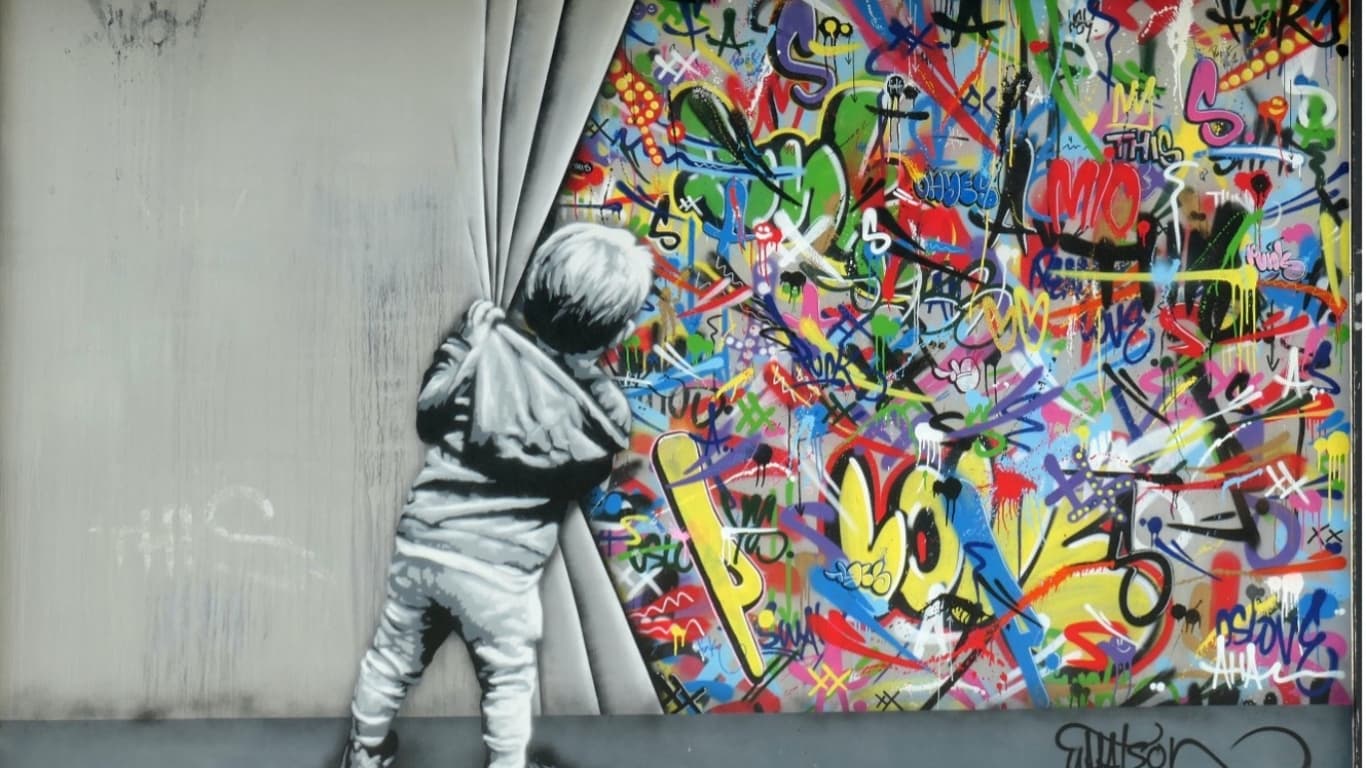
Street art's move from wall to museum is one of the more consequential transitions in the contemporary art conversation over the past three decades. The work began on subway cars, building facades, and public surfaces; it now hangs in museum collections, anchors major-house contemporary catalogues, and occupies an institutional position that the founding figures of the tradition would have considered unimaginable in the early 1980s.
What follows is our editorial read on how this transition actually happened, which artists have moved most cleanly across the boundary, and what the institutionalization of street art means for the broader contemporary market. The story is not a single moment; it is a forty-year shift in how curators, collectors, and institutions read public-surface practice.
- Street art has moved from subway cars and building facades into permanent museum collections and major auction-house contemporary catalogues over the past four decades.
- The founding generation, anchored by Jean-Michel Basquiat and Keith Haring in early-1980s New York, broke the wall between graffiti practice and the commercial gallery system.
- The international generation, led by Banksy, Shepard Fairey, JR and Os Gemeos, then built parallel institutional and market positions across Europe, the Americas and beyond.
- Banksy operates through Pest Control as his authentication channel and has refused commercial gallery representation while consistently commanding top contemporary auction prices.
- Basquiat anchors the segment at the trophy tier, with Untitled 1982 clearing one hundred and ten point five million dollars at Sotheby’s New York in May 2017.
- Conservation of wall-to-museum work has become a serious institutional discipline, with curators and conservators now treating original surfaces as preservation problems in their own right.
- Who is this for?
- Contemporary collectors, curators and advisors tracking how the street-art tradition has been absorbed into serious institutional collecting and the major auction-house contemporary calendars.
- What is happening?
- An editorial read on street art’s move from public surface to museum wall, covering the founding New York generation, the international cohort and the institutional uptake of the past two decades.
- When did this emerge?
- Most active around the May and November contemporary sales at Christie’s, Sotheby’s and Phillips and during major street-art surveys at museums in New York, London, Paris and Hong Kong.
- Where is this happening?
- Centred on the New York, London and Paris salesrooms, with major institutional holdings now spread across MoMA, the Tate, the Brooklyn Museum and a growing cohort of Asian and Middle Eastern museums.
- Why does it matter?
- Understanding how street art crossed into the institutional canon clarifies how the contemporary market actually absorbs new categories and helps collectors place the segment correctly within a serious programme.
The founding generation: SAMO, Keith Haring, Crash, and the early-1980s New York scene
The contemporary street art tradition begins in late-1970s and early-1980s New York. Jean-Michel Basquiat tagged "SAMO" across Lower Manhattan in 1977-1980 before moving fully into the gallery system. Keith Haring drew his subway chalk drawings between 1980 and 1985.
The graffiti writers of the same period (Crash, Daze, Lady Pink, Lee Quiñones, Futura 2000, Rammellzee, A-One) shaped the surface vocabulary that would define the tradition.
The early gallery shows (Sidney Janis's "Post-Graffiti" exhibition in 1983, the Fun Gallery in the East Village, the Tony Shafrazi Gallery's representation of Haring) brought the practice into the commercial art system. By the mid-1980s, Basquiat and Haring were both major contemporary artists with major-gallery representation, museum interest, and significant secondary-market activity.
Basquiat's posthumous market trajectory has been documented extensively; his "Untitled" (1982) made $110.5 million at Sotheby's New York in May 2017. The Keith Haring market has built consistent secondary-market depth through major-house contemporary sales over the past two decades.
The international generation: Banksy, Shepard Fairey, JR, Os Gêmeos
The international generation of street art emerged in the late 1990s and 2000s. Banksy in Bristol and London. Shepard Fairey through the Obey Giant project. JR's large-format photo installations in Paris and globally.
Os Gêmeos in São Paulo. Invader's pixel mosaics across European and global cities.
Each artist navigated the gallery-museum-market system on different terms. Banksy has refused commercial gallery representation and has operated through Pest Control as his authentication channel; his work nonetheless commands top contemporary auction prices. Shepard Fairey works through gallery representation.
JR has built major museum institutional positions (the Pyramide du Louvre intervention, the Vatican wall projection).
The Banksy market in particular has shifted what street art's institutional position looks like. The 2018 Sotheby's London salesroom moment ("Love is in the Bin"), the 2021 record price for the same work, and the steady appearance of Banksy lots in major-house contemporary evening sales placed the artist firmly inside the broader contemporary market rather than in a separate street-art category. He sits alongside contemporary street art figures who have moved through similar trajectories.
The institutional uptake: the museum decade
The major museum acquisitions of street artists started slowly in the 1980s and accelerated significantly through the 2010s. MoMA holds Basquiat and Haring. The Whitney holds Basquiat. The Brooklyn Museum, the Bronx Museum, and the Studio Museum in Harlem have built deeper holdings of the early New York generation.
The Banksy institutional position is more complicated. His refusal of commercial gallery representation and his complex relationship with traditional authentication channels has slowed some institutional acquisitions, but major museum holdings now include works at Tate Modern, MOCA Los Angeles, and other institutions. The 2023 Banksy retrospective at the Glasgow School of Art and other UK institutions formalized the institutional reading further.
The Shepard Fairey institutional position is also significant. The Smithsonian's National Portrait Gallery acquired his "Hope" Obama poster. Major American museums have built broader Fairey holdings.
JR's institutional record is the most actively built of the international generation. The Vatican Museums, the Louvre (through commissioned intervention), MoMA, the Brooklyn Museum, and major European institutions all hold or have shown his work.
The market consequences of the museum decade
Two market patterns have followed the institutional uptake. First, the strongest street artists have moved into the same secondary-market structure as the broader contemporary canon. Basquiat and Haring at the top, Banksy at the next tier, Shepard Fairey and the international generation at mid-tier.
Each name has established catalogue placement, dealer representation, and major-house secondary-market depth that matches their institutional position.
Second, the broader street art market has stratified. The original New York graffiti writers (Crash, Daze, Lady Pink, Quiñones, Futura 2000) have built modest but consistent secondary markets through specialist galleries and the broader contemporary auction calendar. The international street art tradition has produced names with serious gallery and institutional positions, alongside a wider market of works that trade at more accessible levels.
The named market for street art that has built through the past two decades sits comfortably inside the broader contemporary market rather than parallel to it. That integration is the institutional uptake's most consequential outcome.
The conservation challenge for wall-to-museum work
Street art presents conservation challenges that most contemporary work does not. Many original works were made on building facades, subway cars, or other public surfaces that cannot be moved into institutional collections. The work that has entered museum holdings is often work that the artist made on portable surfaces (canvas, panel, paper) parallel to the public-surface work.
Where original wall work has been preserved (the Berlin Wall fragments, the cut sections of Banksy walls that have moved into private and institutional collections), the conservation infrastructure has had to develop new techniques. The major museum conservation departments have built capacity in this area; the named independent conservators specializing in urban-surface material handle most of the meaningful private-collection work.
The authentication and provenance challenges are also distinctive. Pest Control handles Banksy authentication; other street artists work through gallery and foundation authentication channels. Documentation of original public-surface placement (photographs, dates, site verification) is part of any serious acquisition.
What the institutionalization actually means
The wall-to-museum transition has been a forty-year process, and it is now substantially complete for the major figures. The foundational generation (Basquiat, Haring) sits inside the canonical contemporary canon. The international generation (Banksy, Shepard Fairey, JR, Os Gêmeos) sits across major-house contemporary evening sales and major museum collections.
The transition has also reshaped what counts as serious contemporary work. The institutional barrier between gallery-based contemporary practice and public-surface practice has effectively dissolved. The next generation of artists working in the broader urban-intervention and public-surface tradition does not need to navigate the same wall-to-gallery transition that defined the founding generation.
What the collectors building serious positions actually do
The senior collector base for street art operates with the same discipline as the broader contemporary market. Authentication channels (Pest Control for Banksy; gallery and foundation channels for other artists). Provenance documentation.
Condition and conservation engagement. Gallery and major-house specialist relationships.
The named gallery tier handling street art at the senior level includes specialist galleries (Sotheby's and Christie's contemporary departments handle the secondary market; specialist galleries like the Allouche Gallery, the Beyond the Streets organization, and others handle the broader primary market) and the mainstream contemporary galleries that have absorbed individual artists into their rosters.
For collectors interested in the founding New York generation, the practical entry points are the specialist galleries handling the original graffiti writers, the prints and editions markets across the Basquiat and Haring catalogues, and the broader contemporary auction calendar.
For collectors interested in the international generation, the practical entry points are the Pest Control-certified Banksy prints market, the gallery representation channels for Fairey and JR, and the major-house secondary market.
What this means for collectors
Street art's move from wall to museum has changed what serious contemporary collecting looks like. The work that began on public surfaces in the 1970s and 1980s now sits at the top of the contemporary canon. The international generation has built parallel institutional positions over the past two decades.
The market has restructured to accommodate the integration.
For collectors building serious contemporary positions in 2026, street art is now part of the broader contemporary conversation, not an adjacent category. The discipline that applies to any serious contemporary acquisition (authentication, provenance, condition, gallery and specialist engagement) applies here just as fully.
What we'll watch next
The continued institutional uptake at the museum level is the trend to watch. Major retrospectives across the founding and international generations have continued to appear at major institutions globally. Each significant retrospective consolidates the canonical position of the artist further and feeds into market behavior.
We are also watching the next generation of artists working in the broader urban-intervention and public-surface tradition. The artists who have built credible practices over the past decade (working across photography, video, public installation, and traditional studio practice) are increasingly being read as part of the same lineage. That continuity is the institutional uptake's most interesting downstream consequence.
We last reviewed this analysis in May 2026.

Stefanos Moschopoulos
Stefanos Moschopoulos founded The Luxury Playbook in Athens and has spent the better part of a decade following the auction calendar, the en primeur releases, and the watchmakers, gallerists, and shipyards the magazine covers. He writes the field guides and listicles that anchor the Connoisseur section — pieces built on Phillips and Christie's results, Liv-ex movements, and conversations with collectors he has met across Geneva, Bordeaux, Basel, and Monaco. His own collecting habits sit closer to watches and wine than art, and it shows in the level of detail in the magazine's coverage of those categories. Under his direction, The Luxury Playbook now publishes long-form field guides, market-defining year-end listicles, and the Voices interview series with the founders behind the houses and the brands.