

When headlines shout about tariffs and trade wars, most investors instinctively brace for impact. But for some, especially those with a longer time horizon, moments like these unlock new opportunities, particularly in places known for stability, precision, and long-term performance. One of those places is Switzerland.
In 2026, the US tariff regime, especially the unexpected 39% levy targeting Swiss imports, has sent ripples through global markets. While the immediate response was a dip in the Swiss Market Index (SMI), a growing number of investors are now revisiting Swiss blue-chip stocks as a safe and resilient play in a more unpredictable global economy.
From household names like Nestlé, Roche, and Novartis to luxury icons like Richemont, Swiss blue-chip companies have long been prized for their global reach, reliable earnings, and low volatility. As the US applies pressure through protectionist policies, these companies are becoming even more attractive, not despite the tariffs, but in some ways, because of them.

“Periods of global tension often shift investor behavior from growth chasing to capital preservation,” notes a recent strategy update from UBS Global Wealth Management. “And Switzerland, neutral, regulated, and export-driven, stands out as a haven for exactly that.”
What you’re seeing now isn’t just a reaction to headlines. It’s a reallocation of capital toward firms that can weather economic shocks, maintain global credibility, and continue delivering long-term value.
The tariff-policy backdrop is mapped in detail by mainstream financial coverage. Reuters and Bloomberg both track the US-Switzerland trade dynamics tied to the latest tariff cycle, and The Financial Times covers the corporate-response side as Swiss exporters adjust.
The institutional view fills out the equity implications. Morgan Stanley and JP Morgan both publish Swiss-equity research, and the OECD's Switzerland country reports add the macro framework these company-level views sit inside.
What Are Swiss Blue-Chip Stocks and Why They Matter
For deeper context, the breakdown in how currency shifts feed into the European-equity story is worth reading alongside this analysis.
Swiss blue-chip stocks are the heavyweights of the country’s financial market, large, established companies with solid reputations, consistent earnings, and global footprints. Most of them are listed on the Swiss Market Index (SMI), which includes just 20 companies but accounts for over 90% of the total market capitalization of Swiss equities.
Names like Nestlé, Roche, Novartis, Zurich Insurance, and Richemont dominate the index. These companies aren’t just national champions, they’re global players. Nestlé alone operates in over 180 countries and generated more than CHF 94 billion in revenue in 2024.
Roche and Novartis are frontrunners in pharmaceuticals and biotech, while Richemont carries Switzerland’s historic strength in luxury and watchmaking.
What sets these companies apart isn’t just size, it’s resilience. Most of them generate a significant share of their revenues from outside Switzerland, often in US dollars and euros, which helps buffer domestic shocks.
Take Roche as one example. Over 95% of its revenue flows in from foreign markets.
That global orientation means that even when Switzerland faces local pressures like tariffs, currency fluctuations, or low inflation, these companies keep performing because of their diversified exposure.
As Mark Haefele, Chief Investment Officer at UBS Global Wealth Management, recently explained,
“Swiss blue chips offer a unique blend of quality and defensiveness, particularly appealing in times of global policy uncertainty.”
And that’s precisely what’s happening now. As US tariffs add short-term noise to the market, the fundamentals of Swiss blue-chip firms are beginning to shine even more brightly for investors looking beyond the headlines. If you’re the kind of investor who thinks in years rather than weeks, this is worth paying close attention to.
How US Tariffs Are Impacting the Swiss Stock Market
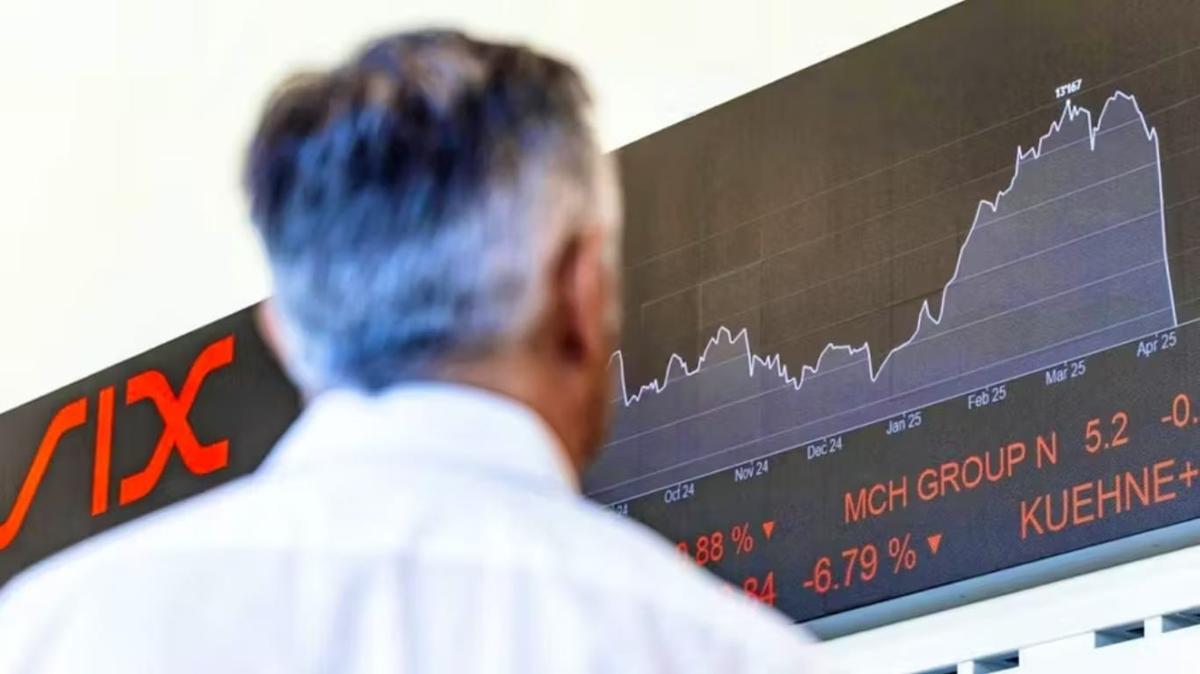
The new 39% US import tariff on Swiss goods sent a shock through the Swiss financial markets. When trading resumed after the national holiday, the SMI dipped nearly 2% in early hours before settling slightly down by 0.2%, a modest drop that masked deeper unease beneath the surface.
Stocks like UBS and Richemont felt the immediate weight. UBS dropped 3.3% at one point before regaining ground, and Richemont closed 1.3% lower. Roche, one of the most prominent Swiss pharmaceutical companies, lost 0.8% amid broader uncertainty tied to US trade policy and demands for lower drug prices.
This isn’t just headline noise. According to Lombard Odier, a leading Swiss private bank, the tariffs could reduce Swiss GDP growth from 1.1% to 0.9% in 2026. If pharmaceutical exports, Switzerland’s second-largest export sector, face even steeper regulatory or pricing pressure in the US, that figure could drop further.
The pharmaceutical industry is critical to the Swiss economy. In 2024 alone, Switzerland exported over CHF 100 billion worth of pharma goods, with the US as a top destination. Any disruption to that flow can have knock-on effects on earnings, employment, and investor sentiment.
What makes this more complex is the Swiss franc, which has appreciated sharply against the dollar in response to unpredictable US policy moves. While that may reflect investor confidence in Switzerland’s stability, it also hurts exports by making Swiss goods more expensive abroad.
To counter the strong franc and sluggish inflation, the Swiss National Bank cut interest rates to zero and may even consider negative rates if disinflationary pressures grow. The two-year Swiss government bond yield recently dropped to minus 0.17%, reflecting market expectations that rates will stay low, or go lower.
But here’s the thing. While all of this might sound like a reason to stay away, many seasoned investors are seeing opportunity, especially in Swiss blue-chip stocks with international exposure and strong fundamentals.
Why Long-Term Investors Are Still Confident in Swiss Equities
Despite the short-term market jitters, long-term investors are not backing away from Swiss equities. In fact, some are quietly increasing their exposure to Switzerland’s blue-chip giants, viewing the current climate not as a threat, but as a window of opportunity.
Here’s why.
First, many Swiss companies are deeply global in their operations. Nestlé, for instance, generates more than 40% of its sales from North America and another 30% from emerging markets. Even if tariffs impact a portion of exports to the US, these companies are not dependent on any single market.
That global diversification helps stabilize earnings and makes them far less sensitive to localized policy shocks.
Second, Swiss companies tend to maintain healthy balance sheets and strong dividend records. As of mid-2026, the average dividend yield for the SMI sits around 2.8%, with firms like Zurich Insurance and Swiss Re consistently offering yields above 4%. For income-focused investors navigating volatile markets, that kind of stability is increasingly appealing.
If you’re weighing your options, it’s also worth comparing how stable, boring investments are quietly outperforming the flashier alternatives right now.
Third, Swiss equities have historically acted as defensive assets. During global sell-offs, such as the COVID-19 crash or the 2022 energy crisis, Swiss stocks tended to fall less and recover faster than their European peers. According to data from MSCI, the MSCI Switzerland Index outperformed the MSCI Europe Index by more than 6 percentage points between 2020 and 2024.
That pattern could repeat in the wake of tariff-driven volatility. Investors are betting that Swiss companies’ pricing power, strong brands, and operational resilience will allow them to weather this storm, just as they’ve done before.
A report from Credit Suisse Private Banking noted,
“Swiss multinationals are well-positioned to navigate global headwinds. For investors with a multi-year horizon, the current market dislocation may offer an attractive entry point.”
And with Swiss interest rates at zero and bond yields slipping deeper into negative territory, equities are becoming the default choice for capital deployment. Institutional investors like pension funds and insurance companies are under pressure to find reliable, yield-generating assets, and Swiss blue-chip stocks check many of those boxes.

Which Swiss Stocks Are Attracting the Most Investor Interest Right Now
In times of policy shocks like new tariffs or geopolitical tension, institutional and high-net-worth investors often gravitate toward companies with consistent earnings, global exposure, and resilient fundamentals.
That’s exactly what many Swiss blue-chip firms offer, particularly in sectors like healthcare, consumer goods, and financial services.
Pharmaceutical giants like Roche and Novartis are cornerstones of Swiss equity portfolios. These companies generate a large portion of their revenue outside Switzerland, especially in the US, Asia, and Europe. Despite concerns around new US policies demanding lower drug prices, long-term investors still view these firms as durable plays because of their robust pipelines, innovation budgets, and strong margins.
According to a 2026 market outlook from UBS Global Wealth Management,
“Swiss pharma continues to be a preferred overweight for global equity allocators. These companies offer pricing power, recurring revenue from chronic therapies, and geographic diversification, traits that are valuable in an uncertain macro backdrop.”
In the consumer staples sector, Nestlé stands out. The company’s brand portfolio spans more than 180 countries, covering household names in food, beverage, and pet care. Because Nestlé operates in essential goods and controls a wide supply chain network, it’s less sensitive to short-term tariff shocks and currency fluctuations.
Its strong presence in both developed and emerging markets makes it a strategic hedge for investors worried about regional instability.
The insurance and financial sector is also drawing renewed interest. Zurich Insurance and Swiss Re are seen as stable cash-flow generators with disciplined underwriting practices and global exposure.
In a low-rate environment where fixed income yields are limited, these companies offer predictable income streams and capital resilience. Their conservative risk frameworks have historically allowed them to outperform during financial turbulence.
Luxury goods players like Richemont are also under watch, not because of short-term sales shifts, but because of their long-term brand equity and affluent customer base. Investors who follow the global luxury cycle understand that ultra-high-net-worth consumption tends to be sticky, even during macroeconomic adjustments.
Richemont’s diversified presence across Europe, Asia, and the Middle East makes it a potential long-term hold in the face of US trade noise.
So investors aren’t just hunting for bargains amid the tariff disruptions. They’re seeking quality and consistency. What draws them to Swiss equities right now is the same thing that always has, global footprint, strong governance, predictable earnings, and reputational strength.
These aren’t stocks that promise meteoric growth overnight. They are, instead, the backbone of long-term investment strategies, especially when global risk is on the rise. And if you’re already thinking about how Switzerland fits into your broader wealth picture, the Zurich real estate market tells a similar story about durable value in uncertain times.
Why US Tariffs Might Boost Long-Term Demand for Swiss Equities
At first glance, the idea that tariffs could increase investor appetite for Swiss stocks might seem counterintuitive. But when you look beneath the surface, there’s a compelling logic driving this shift, especially if you’re a global investor looking for long-term stability.
The US tariffs announced in 2026 hit Swiss exports hard, especially in sectors like pharmaceuticals and luxury goods. While that’s a short-term concern for trade volume, the long-term effect could be quite different. It’s prompting investors to re-evaluate where value lies in the European equity market, and Switzerland keeps coming out ahead.
One key factor is supply chain control and pricing power. Swiss blue-chip companies, especially in healthcare and high-end manufacturing, tend to operate with tight control over their production lines and maintain strong brand equity. This allows them to absorb trade shocks better than competitors who rely heavily on third-party suppliers or operate on thinner margins.
A report by JP Morgan Private Bank puts it plainly,
“Swiss multinationals have the ability to maintain margins even under pressure because they dominate niche segments. Their market power acts as a cushion against external shocks like tariffs.”
Beyond that, tariffs often create defensive capital flows. When uncertainty rises, whether from policy changes, inflation fears, or geopolitical risk, investors rotate into markets with strong fundamentals and low political risk. Switzerland fits that profile almost perfectly.
It’s not in the EU, which gives it more autonomy, and its long-standing neutrality makes it less vulnerable to bloc-based trade tensions.
Data from Morningstar shows that after major tariff announcements in previous cycles, including the 2018 to 2019 US-China trade tensions, funds with Swiss equity exposure saw steady inflows. That pattern is repeating in 2026. Investors are betting on Switzerland’s ability to weather global disruptions while still delivering steady returns.
Swiss corporate balance sheets are another major draw. Swiss companies tend to carry lower debt levels and higher cash reserves compared to their eurozone peers. That gives them more flexibility to invest in innovation, acquisitions, or shareholder returns, even if revenue growth slows temporarily due to tariffs.
And then there are the currency dynamics. The Swiss franc often strengthens when the US dollar is under pressure, giving you a built-in hedge if you hold Swiss assets. Since many Swiss companies report earnings in multiple currencies, they’re better equipped to manage foreign exchange swings than most of their global peers.
How Wealth Managers Are Positioning Around Switzerland’s Tariff Situation
According to UBS’s 2026 Global Family Office Report, 34% of ultra-high-net-worth clients have increased their allocation to Swiss equities and bonds this year, up from just 22% in 2023. The primary motivation is twofold.
“Resilience during systemic shocks” and “multi-currency protection”, both core strengths of the Swiss market, are driving that shift.
Private banks are also encouraging clients to lean into sector-specific Swiss exposure, particularly in areas like pharmaceuticals, med-tech, and precision engineering. These are industries where Switzerland has long-standing global leadership and where short-term trade disruptions tend not to weaken long-term demand.
Julius Baer recently noted in its mid-year strategy memo,
“We see strong interest in Swiss defensive plays, especially those with diversified export footprints and limited reliance on US revenues. These businesses are better insulated from tariffs and benefit from strong balance sheets.”
Another trend gaining ground is the preference for dividend stability over speculative growth. In times of economic uncertainty, consistent payouts from cash-rich companies are attractive. Swiss firms are known for maintaining conservative payout ratios and strong dividend continuity, which appeals to investors growing cautious about the unpredictability of US tech or emerging markets.
If you’re building a portfolio with that kind of resilience in mind, it’s worth understanding how index funds compare to mutual funds as entry points into Swiss equity exposure.
Multi-asset portfolio managers are also using Swiss allocations as a currency diversification tool. With the Swiss franc historically seen as a safe-haven currency, wealth managers view it as an indirect way to hedge against potential dollar depreciation, especially relevant given the inflation volatility and fiscal policy swings coming out of the US right now.
We last reviewed this analysis in May 2026.