Carbon credits sit at the heart of the global fight against climate change, giving governments and businesses a structured way to manage greenhouse gas emissions. Think of them as permits, each one granting the holder the right to emit a certain amount of CO2. Shaped by international agreements like the Kyoto Protocol and the Paris Agreement, the system pushes toward real environmental accountability.
Through cap-and-trade programs, companies face tightening emissions targets, and that pressure gives them a genuine financial reason to cut their carbon output rather than simply pay lip service to sustainability.
The clever part of the system is that it creates a market. Companies that emit less than their allowed limit can sell their surplus credits to heavier polluters, turning clean behavior into a revenue stream. The voluntary carbon market was worth roughly $400 million just a few years ago, and projections put it anywhere between $10 billion and $25 billion by 2030.
As the climate crisis sharpens, the mechanics of carbon credits are becoming more sophisticated, and for the right investor or business, that complexity carries real opportunity alongside the obvious challenges.
- Carbon credits represent the right to emit one tonne of carbon dioxide or equivalent greenhouse gas, traded in regulatory or voluntary markets globally.
- Compliance markets such as the EU Emissions Trading System operate under government caps, with prices set by supply and demand among regulated emitters.
- Voluntary carbon markets allow companies and individuals to offset emissions through projects ranging from forest conservation to direct-air capture facilities.
- Carbon credit prices have shown significant volatility, with the EU ETS price climbing from below 10 euros per tonne in 2017 to over 90 euros in recent years.
- Investors can access carbon credit exposure through specialised ETFs, futures contracts on major exchanges and select equity holdings in pure-play firms.
- Quality varies widely across voluntary credits, with verification standards, additionality and permanence remaining central questions for serious carbon-market investors.
- Who is this for?
- Investors, ESG-focused allocators and corporate sustainability professionals who want to understand carbon credits, the markets that trade them and the investment opportunities they present.
- What is happening?
- A primer on carbon credits, covering compliance versus voluntary markets, pricing dynamics, investment access points and the quality issues that affect credit valuation across project types.
- When did this emerge?
- Increasingly relevant as climate regulations tighten globally and as more corporations adopt net-zero commitments that require carbon credit purchases to offset residual emissions.
- Where is this happening?
- Most developed in the EU under the ETS, with growing markets in California, the UK, China and various voluntary platforms operating across multiple continents.
- Why does it matter?
- Carbon credits represent a structural growth market driven by climate policy and corporate commitments, offering investors exposure to a distinct asset class with its own pricing dynamics.
How Carbon Credits Work
The carbon-credit market sits inside a regulatory and disclosure framework that has matured quickly. S&P Global publishes detailed pricing data on compliance and voluntary carbon markets, and MSCI covers the same exposures inside its ESG and climate-risk methodology.
The multilateral institutions provide the macro backdrop. The OECD publishes carbon-pricing research used by policymakers, and IMF staff papers cover how border-adjustment mechanisms could reshape cross-border flows.
A carbon credit is a financial tool built around a single idea: one credit equals the removal or reduction of one metric ton of CO2, or its equivalent in other greenhouse gases, from the atmosphere. Projects that generate these credits range from utility-scale renewable energy installations and reforestation programs to industrial efficiency upgrades that cut emissions at the source. The result is a tradable asset with measurable environmental impact, which is exactly what makes it attractive both to regulators and to investors who prioritize disciplined, values-aligned capital allocation.
To really grasp how carbon credits function, you need to understand the two markets they live in. Compliance markets are driven by legal obligation, while voluntary markets are driven by corporate ambition and consumer pressure. Both have their own rules, their own pricing dynamics, and their own cast of players.
- Compliance Markets: These are established by governments or multi-government bodies. The European Union’s Emissions Trading System (EU ETS), for instance, is the largest and oldest compliance market, covering around 10,000 facilities in sectors like energy and manufacturing.
In 2021, the global compliance market was valued at approximately $850 billion. In these markets, companies must hold enough credits to cover their emissions; if they exceed their cap, they must buy additional credits, incentivizing them to reduce emissions to avoid extra costs.
- Voluntary Markets: These markets are not regulated by governments but are driven by companies and individuals looking to offset their carbon footprint. Voluntary markets are smaller, valued between $1 billion and $2 billion in 2021, but they are rapidly growing.
In these markets, companies purchase credits to meet environmental, social, and governance (ESG) goals or in response to consumer pressure. Major buyers include tech giants like Microsoft and automotive companies like Tesla.
Cap-and-Trade System
For deeper context, the breakdown in how impact investing intersects with carbon-credit allocations is worth reading alongside this analysis.
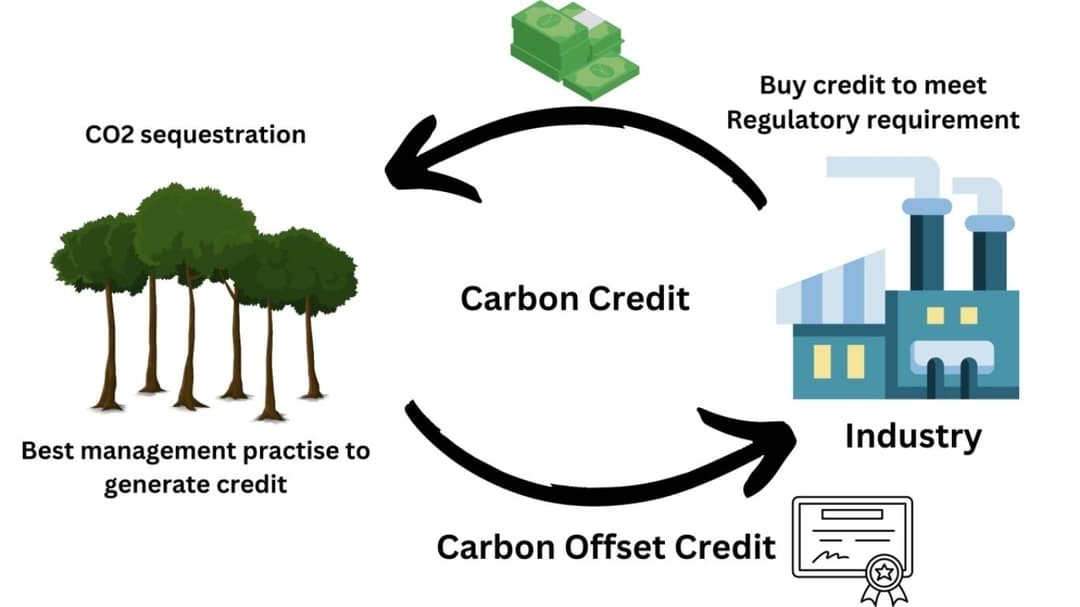
The cap-and-trade system is one of the most effective market-based tools governments have for cutting pollution. A regulatory body sets a firm ceiling on total allowable emissions across a sector or economy. Companies then receive or buy allowances up to that cap. If you stay under your limit, you can sell what you don’t use. If you go over, you buy from someone who did. The cap tightens over time, which keeps the pressure on and the market moving.
- Setting the Cap: The government sets a cap on the total amount of a specific pollutant that can be emitted by all companies covered by the system.
This cap is often reduced over time to decrease total emissions. For example, California’s cap-and-trade program, initiated in 2013, targets large emitters like power plants and fuel distributors, progressively tightening the cap to encourage reductions in emissions.
- Trading Allowances: The cap is divided into allowances, each permitting the holder to emit a certain amount of the pollutant (typically one ton of CO2 equivalent). Companies that reduce their emissions below their allowance can sell their excess allowances to other companies that exceed their limits.
This creates a financial incentive for companies to invest in cleaner technologies to reduce their emissions and potentially profit from selling their unused allowances.
Real-world results back up the theory. The European Union’s Emissions Trading System has been a cornerstone of the bloc’s climate strategy, driving measurable cuts across power and industry. China’s national carbon market, launched in 2021, was already the world’s largest by covered emissions at launch, with more than 2,600 companies brought under its umbrella from day one.
Both show that when the framework is credible, the market responds.
How Carbon Credits Are Created and Traded
Carbon credits do serious work in the global climate effort, but understanding where they come from and how they change hands is essential before you consider any exposure to this market. Creation and trading happen across two primary arenas: regulatory and voluntary. Each one attracts different participants, operates under different rules, and moves to its own rhythm.
Regulatory Markets
Regulatory carbon markets are government-mandated, binding, and non-negotiable for the entities that fall under them. The EU Emissions Trading System is the world’s largest, covering more than 11,000 installations across power and industrial sectors in 31 countries. By 2023, the EU ETS had already helped cut the bloc’s greenhouse gas emissions by 43% below 2005 levels, a genuinely impressive track record.
In the United States, California’s Cap-and-Trade program tells a similar story of tightening ambition, with prices climbing from $34 per ton in 2023 to an expected $46 per ton in 2026 as caps tighten and demand for allowances grows.
Voluntary Markets
Voluntary carbon markets give businesses and individuals the freedom to offset their emissions beyond what the law requires. The motive is usually to hit net-zero targets or respond to investor and consumer pressure.
Major corporations like Shell and Microsoft have been active buyers here, using offsets to close the gap between their operational emissions and their public climate commitments. The voluntary market is projected to reach $10 billion by 2030, powered by a wave of corporate sustainability pledges.
Unlike compliance markets, voluntary credits are governed not by legislation but by third-party standards like the Verified Carbon Standard and the Gold Standard, which are designed to ensure every credit reflects a real, measurable climate benefit.
Role of Government and International Agreements
Governments and international frameworks set the rules that determine whether carbon markets function or flounder. The Kyoto Protocol laid the early groundwork, but the Paris Agreement supercharged the expansion of carbon pricing globally. Today, more than 80 countries have implemented some form of carbon pricing, whether through a carbon tax or an emissions trading system, according to World Bank data from 2024.
That kind of momentum shapes both the compliance and voluntary markets, and it’s a signal worth paying attention to if you’re thinking about this space as part of a broader alternative investment strategy.
China’s Emissions Trading System is a case study in ambition at scale. Launched in 2021 with a focus on the power sector, it already covers more emissions than any other cap-and-trade program on earth. Plans to expand into additional sectors are moving forward, and the architecture mirrors the EU ETS in its basic logic while being calibrated to China’s own industrial and economic realities.
The sheer size of that market means its pricing signals will eventually reverberate globally.
Examples from the U.S. and Worldwide
In the United States, the Regional Greenhouse Gas Initiative links 12 Northeastern and Mid-Atlantic states in a coordinated effort to cap power sector emissions.
Alongside California’s Cap-and-Trade program, these state-level systems create real financial consequences for large emitters. They turn emission reduction from a nice idea into an economic imperative.
With energy demand rising and state regulations tightening, the U.S. carbon credit market is on track for meaningful growth over the next decade.
The EU ETS has been setting the global standard since 2005, covering roughly 45% of the EU’s total greenhouse gas emissions across more than 11,000 entities. Meanwhile, Singapore is positioning itself as the carbon trading hub of Southeast Asia, using its financial infrastructure and geographic advantage to attract regional carbon market activity. For investors watching where the smart capital flows, understanding how emerging asset classes get institutionalized is half the battle.
Future Trends and Challenges in Carbon Credits
The carbon credit market is heading toward a period of rapid, potentially turbulent growth. Some analysts project the market could exceed $4.4 trillion by 2031, driven by tightening regulations, advancing technology, and an accelerating wave of corporate net-zero commitments. But the path there is not smooth.
Supply constraints, price swings, and persistent doubts about credit integrity all create friction that serious participants need to understand and price in.
Demand Surge and Supply Constraints
Demand is building fast. Annual credit demand could hit 1.6 billion credits by 2030 and climb to 5.1 billion by 2050. But supply is struggling to keep pace.
Credit issuance fell by 25% in 2023, the lowest output in three years, largely due to a slowdown in nature-based and renewable energy projects. That gap between what buyers want and what the market can deliver creates volatility, and volatility creates both risk and opportunity depending on how you’re positioned. You can dig deeper into how supply shocks move alternative asset prices by exploring how disciplined traders exploit market dislocations.
Price Volatility and Credibility Issues
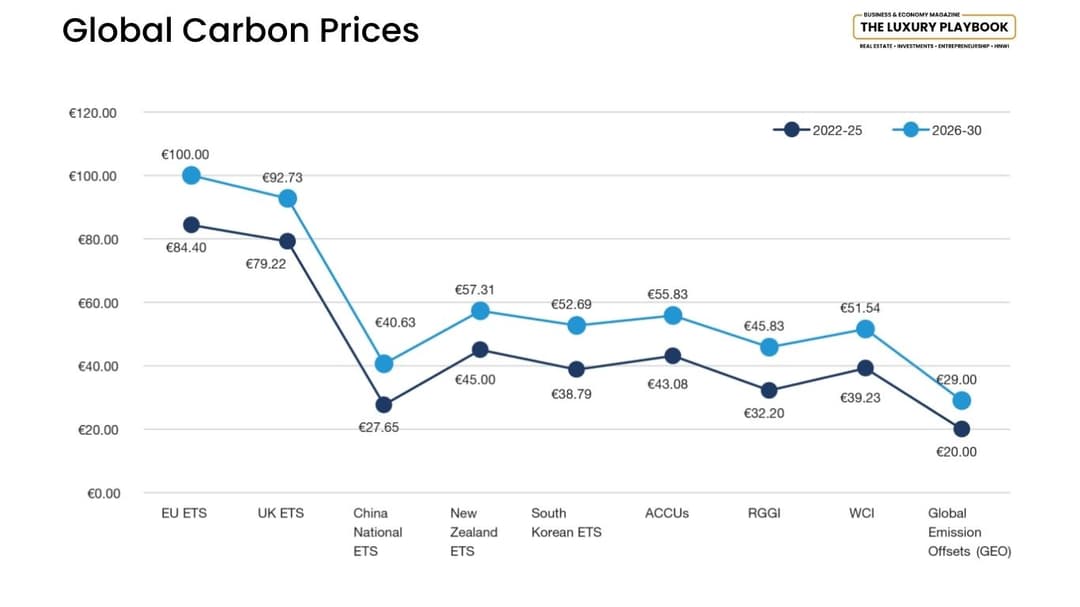
Carbon credit prices move sharply, and the direction over the long term is unmistakably upward. California prices are forecast to rise from $46 per ton in 2026 to around $93 by 2030, while EU prices could reach $163 per ton by the same year, according to Reuters energy market analysis. But price appreciation alone doesn’t tell the whole story.
Greenwashing accusations and credibility concerns about the underlying projects continue to erode confidence in parts of the market. Buyers who do not scrutinize the provenance and verification of their credits are exposing themselves to real reputational and financial risk.
Technological and Policy Developments
Blockchain and AI are emerging as the tools most likely to clean up the credibility problem. Blockchain can create an immutable audit trail for each credit, from its origin project through every transaction, making it far harder to double-count or misrepresent. AI brings sharper monitoring and verification at scale.
On the policy side, new compliance programs and the spread of carbon border taxes across major economies are set to tighten supply further while pulling more demand into the market. If you follow how the Financial Times covers carbon market policy shifts, the direction of travel is clear, and getting ahead of these regulatory catalysts is where the real edge lies.
We last reviewed this analysis in May 2026.


Alex Tzoulis
Alex Tzoulis is Co-Owner and Markets Analyst at The Luxury Playbook, specializing in equities, crypto, forex, and global financial markets. His work focuses on analyzing macroeconomic trends, geopolitical developments, and monetary policy, translating them into actionable insights across both traditional and digital asset classes. He leads the platform's financial market coverage, providing structured analysis across stock market investing, trading strategies, and cryptocurrency markets. His expertise strengthens the publication's authority in financial markets and capital allocation, bridging traditional finance with emerging digital investment ecosystems.