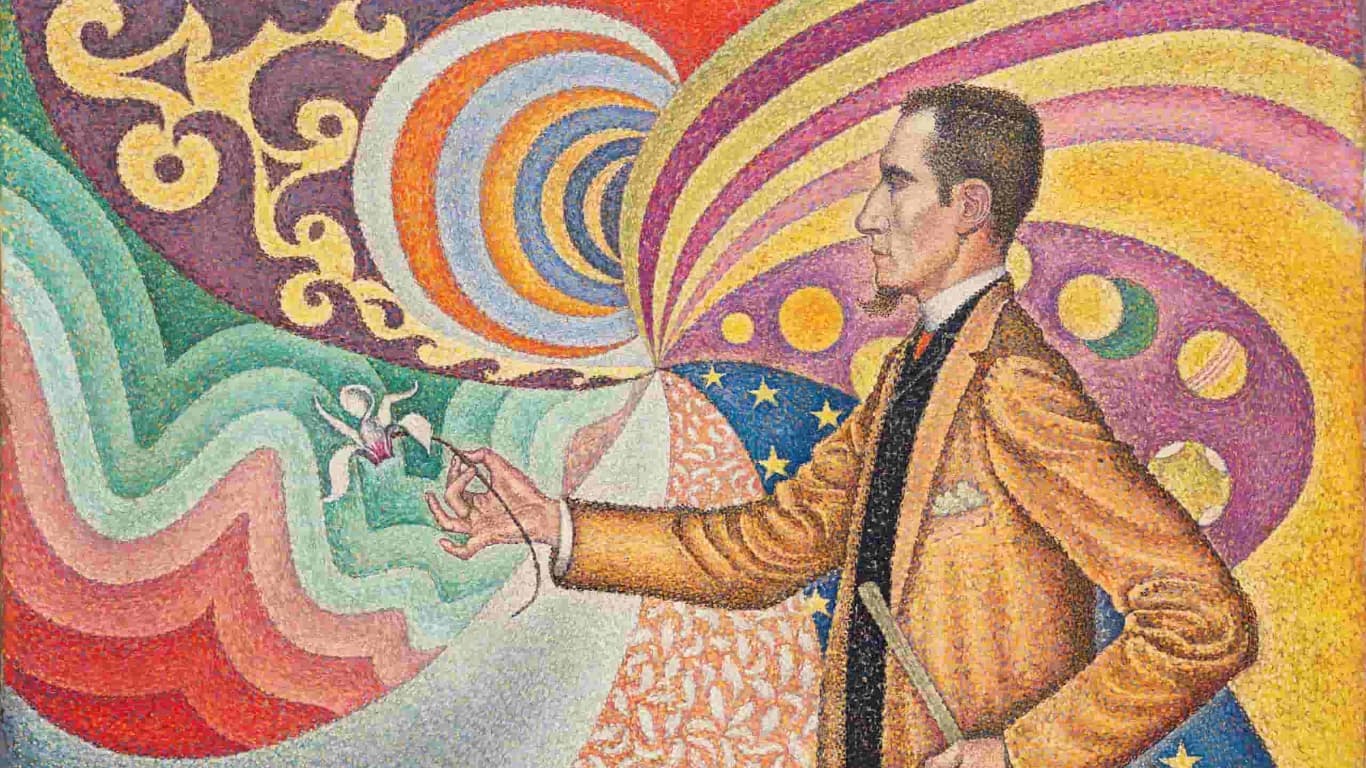
Fauvism is one of the shortest-lived movements in modern art history and one of the most consequential for the century that followed. The core period runs from roughly 1904 to 1908. The named cohort is small: Matisse, Derain, Vlaminck, Marquet, Manguin, Camoin, Friesz, Dufy, Van Dongen, Braque (in his pre-Cubist phase), and Rouault.
The movement broke up by 1910, with most of its leading figures moving on to Cubism, classicism, or their own mature personal idioms. Yet the work made in those few years carries weight in the market well beyond what its brief duration would suggest.
The reason is that Fauvism resolved one of the central questions modern painting was working through after Impressionism: how to make color autonomous from description. The Fauves took the post-Impressionist lessons of Van Gogh, Gauguin, and Cézanne and pushed color to a level of independent intensity that nothing in Western painting had reached before. Almost everything in twentieth-century color usage, from German Expressionism through Abstract Expressionism, traces back through this small group.
- Fauvism emerged in Paris in 1905 around Henri Matisse, Andre Derain and Maurice de Vlaminck, and became the first major modernist movement of the twentieth century.
- The name fauves, French for wild beasts, came from critic Louis Vauxcelles at the 1905 Salon d’Automne and stuck as the defining label for the group.
- The movement was short, running roughly from 1904 to 1908, but its emphasis on pure colour and expressive freedom reshaped the trajectory of modern painting.
- Matisse anchors the canon, with major Fauvist works held in MoMA, the Centre Pompidou and the Tate among other leading institutional collections.
- Auction supply of canonical Fauvist work is genuinely limited, with most major paintings held in museums and only occasional lots coming to public sale.
- For serious modern collectors, Fauvism remains a pivotal early-twentieth-century moment that any credible programme should understand and selectively pursue.
- Who is this for?
- Modern art collectors, family offices and advisors building positions in early-twentieth-century European painting, alongside curators interested in the Fauvist canon.
- What is happening?
- A collector field guide to Fauvism, covering Matisse, Derain and Vlaminck, the 1905 Salon d’Automne, the short duration of the movement and the realistic auction supply environment.
- When did this emerge?
- Most relevant around the May and November Impressionist and Modern sales at Christie’s and Sotheby’s and during major loan exhibitions on Matisse and the Fauvist circle.
- Where is this happening?
- Centred on the Paris and New York markets historically, with major institutional holdings across MoMA, the Centre Pompidou, the Tate and the Hermitage in Saint Petersburg.
- Why does it matter?
- Fauvism is a structural pivot in early modernism, and a clear field guide helps collectors engage with the movement’s scarcity, scholarship and pricing with appropriate discipline.
The shape of the Fauvist canon
Matisse is the dominant figure and the one whose mature career most fully justifies the movement's historical position. His 1905 Salon d'Automne works, including "Femme au chapeau" (now at SFMOMA) and "La Raie verte" (Statens Museum for Kunst, Copenhagen), defined the movement's public arrival. The works he made at Collioure in the summers of 1905 and 1906 remain the canonical Fauvist paintings.
Derain ranks second in the canon. His Collioure paintings (1905) and the London Bridge series (1906) sit alongside Matisse's work as the highest-tier Fauvist production. Vlaminck's Chatou period (1904-1906), with its dense impasto and saturated color, completes the inner triangle of the movement.
The wider cohort produced significant work as well. Marquet's harbor and street scenes from 1905-1906. Dufy's Sainte-Adresse beach paintings.
Van Dongen's Paris café and nightlife scenes. Braque's L'Estaque and La Ciotat work before he turned to Cubism. Each of these strands sits inside the broader Fauvist conversation, though only the Matisse-Derain-Vlaminck core sits at the very top of the market.
How the Fauvist market actually trades
Fauvist work appears at the Impressionist and Modern evening sales at Christie's, Sotheby's, and (selectively) Phillips. The strongest Matisse Fauvist canvases have made eight figures consistently over the past two decades. "Odalisque couchée aux magnolias" (a 1923 work, post-Fauvist but in the same career arc) made $80.8 million at Christie's New York in May 2018; the high Fauvist period works have priced in similar territory in private sale.
Derain at the top tier prices in the high seven and low eight figures for his strongest 1905-1906 work. Vlaminck Chatou-period landscapes have made into the seven figures consistently. The wider Fauvist cohort (Marquet, Dufy, Van Dongen) typically trades in the high six and low seven figures for top-quality work.
The market is unusually condition-sensitive. Many Fauvist works used experimental palettes and unstable color combinations that have not aged uniformly. Conservation records and technical documentation are part of standard due diligence on serious lots.
The major-house specialists and the named modern-art conservation departments handle the technical reads.
Why the supply is so thin at the top
The Fauvist canon is small for two reasons. First, the movement itself was brief. Most of the canonical work was made in roughly four years (1904-1908).
Second, the leading artists abandoned the idiom relatively quickly. Matisse moved on by 1908. Braque moved into Cubism with Picasso.
Derain shifted toward classicism after 1910. The total volume of canonical Fauvist work is modest compared to longer-running movements.
Most of the major Fauvist works are in museum collections. The Pompidou in Paris, the Musée d'Art Moderne de la Ville de Paris, the Hermitage in St. Petersburg, the Pushkin in Moscow (both holding the Shchukin and Morozov collections), MoMA, the Met, the National Gallery in Washington, the Tate, and the Statens Museum in Copenhagen hold the bulk of the surviving top-tier material.
What circulates at auction is what remained in private hands, often through the Russian collector lines (Shchukin and Morozov family material), the early French and Swiss collectors, and the American collectors who bought into the movement through the 1910s and 1920s.
The Russian collector inheritance and its market impact
The Shchukin and Morozov collections, formed in Moscow in the first decade of the twentieth century, hold a meaningful share of the highest-grade early Matisse and the broader Fauvist canon. Both collections were nationalized after the Russian Revolution and split between the Hermitage and the Pushkin Museum.
The Fondation Louis Vuitton in Paris staged landmark exhibitions of both collections (Shchukin in 2016-2017, Morozov in 2021-2022), which were among the most-attended modern art shows in recent European museum history. Those exhibitions reshaped the public conversation around Fauvism and established a deeper institutional position for the movement than the standalone canon would suggest.
Where Fauvism fits in the broader modern canon
Fauvism sits at the hinge between post-Impressionism and twentieth-century modern art. It is the moment color stopped describing the world and started constructing it independently. The German Expressionists picked up that lesson directly.
The Abstract Expressionists were working with its consequences fifty years later.
For collectors approaching modern art, Fauvism functions as a bridge category. It connects the broader Impressionist and post-Impressionist market to the early-twentieth-century modern conversation. Many serious modern collections hold one or two strong Fauvist works (most often a Matisse or a Derain) as the anchor between their late-nineteenth-century and early-twentieth-century material.
What distinguishes serious Fauvist collecting
The serious Fauvist collector engages with the catalogue raisonné scholarship and the technical record. The Matisse catalogue raisonné (in active development by the Matisse Archives and the Wildenstein Plattner Institute) is the foundational reference. The Vlaminck and Derain catalogues raisonnés provide the secondary depth.
Exhibition history matters. Works that appeared in the Salon d'Automne of 1905, the Salon des Indépendants of 1906, or the major Fauvist retrospectives of the past sixty years carry an institutional record that supports their market position. The major retrospectives at the Pompidou, MoMA, the Royal Academy, and the National Gallery of Art are part of standard provenance reading.
Technical analysis has become standard. Pigment analysis, X-ray, and infrared examination help establish authenticity and condition. The Wildenstein Plattner Institute, the Centre de Recherche et de Restauration des Musées de France (C2RMF), and the major museum conservation departments are the senior reference points.
What this means for collectors
Fauvism is a small but consequential category in the modern art market. The closed canon, the thin supply at the top, the strong institutional record, and the bridge position between Impressionism and twentieth-century modernism combine to support consistent demand from senior collectors and institutions.
For collectors entering the category, the practical starting points are the Matisse and Derain markets, with works on paper and prints offering more accessible entry below the painting tier. Engagement with the named modern-art dealer tier (Acquavella, Helly Nahmad, Marlborough) and with the major-house Impressionist and Modern specialists is the standard discipline. Our broader survey of The Categories of Art Worth Collecting in 2026 places Fauvism inside the wider modern conversation.
What we'll watch next
The Matisse market remains the most active part of the Fauvist conversation, with strong evening-sale results through the past several cycles. We expect that pattern to continue, with the named museum-board collector tier maintaining the demand for top-grade material.
We are also watching the Derain market. His critical reputation has shifted upward through the past decade, with major retrospectives at the Pompidou (2017) and other European institutions consolidating his position. The price gap between Matisse and Derain at the top tier has narrowed accordingly, and we expect that trend to continue.
We last reviewed this analysis in May 2026.

Frequently Asked Questions
- What is Fauvism in simple terms?
- Fauvism is an early 20th-century art movement known for its bold, non-naturalistic color, expressive brushwork, and emotional impact. It rejected realism in favor of vibrant color and simplified forms.<br><br>
- Who started Fauvism?
- Henri Matisse is considered the leading figure of Fauvism. Alongside André Derain and Maurice de Vlaminck, he helped launch the movement at the 1905 Salon d'Automne in Paris.<br><br>
- What are the key characteristics of Fauvism?
- Fauvism features bold color usage, flat composition, simplified forms, expressive brushwork, and emotional intensity. Artists often used arbitrary colors to convey feeling rather than reality.<br><br>
- How much do Fauvist paintings sell for at auction?
- Prices vary widely. Top-tier Fauvist works by Matisse or Derain can sell for over $20 million, while mid-tier works by artists like Raoul Dufy or Albert Marquet range from $300,000 to $1 million.<br><br>
- What makes a Fauvist painting valuable?
- Market value depends on artist recognition, condition, provenance, exhibition history, and whether the work was created during the movement’s peak (1905–1908).<br><br>
- Is Fauvism a liquid market segment?
- Fauvism has moderate but growing liquidity, especially for works with strong curatorial backing. Increased museum interest and auction sales are improving secondary market performance.

Stefanos Moschopoulos
Stefanos Moschopoulos founded The Luxury Playbook in Athens and has spent the better part of a decade following the auction calendar, the en primeur releases, and the watchmakers, gallerists, and shipyards the magazine covers. He writes the field guides and listicles that anchor the Connoisseur section — pieces built on Phillips and Christie's results, Liv-ex movements, and conversations with collectors he has met across Geneva, Bordeaux, Basel, and Monaco. His own collecting habits sit closer to watches and wine than art, and it shows in the level of detail in the magazine's coverage of those categories. Under his direction, The Luxury Playbook now publishes long-form field guides, market-defining year-end listicles, and the Voices interview series with the founders behind the houses and the brands.