Pain trade is one of those financial market phenomena that can blindside even seasoned investors. It’s what happens when the majority of market participants get caught on the wrong side of a move, all at once, all suffering together. Usually, it kicks in when the market does the exact opposite of what most people expected, or when a sudden shift wipes out a crowded position.
You don’t have to look far for proof. The tech stock collapse in the early 2000s is one of the most painful examples in modern investing history. Then came 2008, when the global equity crash erased over $35 trillion in market value and hit roughly 60% of worldwide markets at the same time.
- A pain trade is the market move that would cause maximum loss to the largest number of leveraged or consensus-positioned investors at a given moment.
- The phenomenon reflects market structure rather than mysticism, with crowded positioning creating asymmetric vulnerability when sentiment or fundamentals shift.
- Short squeezes, particularly in heavily shorted small-cap stocks, are classic pain trades where forced covering drives prices sharply higher against bearish positioning.
- Long squeezes happen when widely held momentum names sell off rapidly, forcing leveraged longs to unwind into a tape with limited natural buyers available.
- Positioning surveys, options skew data and futures commitment-of-traders reports help identify potential pain trades before they actually develop into forced moves.
- A disciplined trader avoids consensus positioning at extremes and considers pain-trade dynamics when sizing positions in crowded or heavily watched names.
- Who is this for?
- Active traders and tactical investors who want to understand pain-trade dynamics and how crowded positioning creates the conditions for sharp, painful moves against the consensus view.
- What is happening?
- A focused look at the pain-trade concept in markets, covering the mechanics, real examples and the positioning indicators that help identify potential pain trades before they develop.
- When did this emerge?
- Most relevant when sentiment indicators reach extremes, when positioning data shows heavy concentration in one direction or when widely held narratives become increasingly difficult to question.
- Where is this happening?
- Applicable across global equity, futures and FX markets, with the clearest pain-trade case studies typically emerging in US small-cap stocks, popular ETFs and concentrated factor trades.
- Why does it matter?
- Recognising pain-trade conditions helps investors avoid the worst losses associated with crowded positioning and occasionally provides asymmetric opportunities for those positioned on the right side.
Understanding the Concept of Pain Trade
The pain-trade concept is anchored in institutional positioning data. Goldman Sachs and Morgan Stanley both publish prime-brokerage reports that track hedge-fund crowding, and those datasets are what professionals use to identify where the next painful reversal is most likely to occur.
Mainstream financial media maps the same pattern from the outside in. Bloomberg and Reuters have both documented how consensus trades quietly accumulate before they unwind, and that historical record gives newer allocators a baseline for what to watch.
At its core, a pain trade is any market movement that causes widespread losses across a large group of investors. What makes it so brutal is the setup. When a strategy or asset gets overhyped, money floods in from every direction.
Everyone is positioned the same way, leaning on the same bet. Then the market reverses, and the crowd gets caught off guard all at once. Understanding the Fear and Greed Index is one of the clearest ways to spot when a market is primed for exactly this kind of reversal. Crowded trades are the most vulnerable, and markets have a way of punishing the majority.
Markets tend to inflict the most damage on the largest number of people holding similar positions. This ties directly into stock market psychology, where fear and greed push traders into copying each other’s moves without questioning the fundamentals. When you understand this dynamic, you start to see how investor behavior, market momentum, and trading outcomes are all deeply connected.
Examples from Historical Market Events
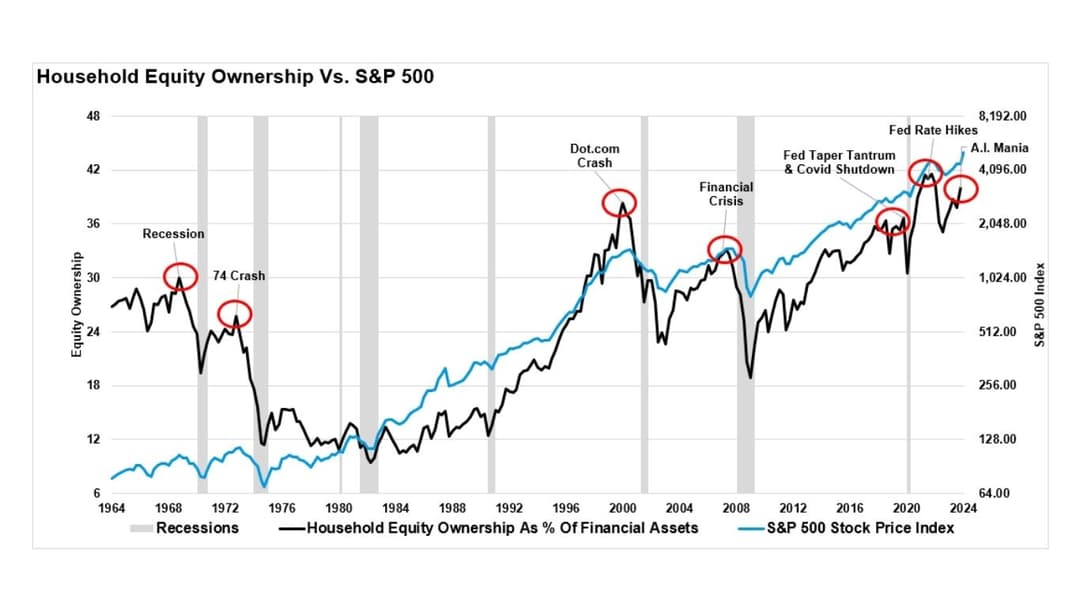
History gives you plenty of case studies to learn from. The dot-com bubble is the classic example. Investors piled into technology stocks, convinced the rally would never end.
When the market turned, those who had bet everything on continued gains walked away with devastating losses. The 2008 financial crisis followed a similar script. A widespread belief in the unshakeable health of global equities dragged millions of investors into a painful bear market they never saw coming.
The bear market that kicked off in early January 2022 gave us another sharp reminder of how pain trades work in practice. Optimism was running high at the time. According to the American Association of Individual Investors survey, 44.5% of investors were bullish on stocks, the highest reading since November 2021.
Then came the reversal, catching that exact crowd off guard. It showed once again how shifting market sentiment can set the stage for pain trades, especially when most investors are leaning the same direction at the same time.
The best defense against future pain trades is studying these historical patterns closely. When you understand how and why these events unfolded, you put yourself in a much stronger position to navigate the next one.
The Psychology Behind the Pain Trade
For deeper context, the breakdown in how to find a trading strategy that survives a pain trade is worth reading alongside this analysis.
Pain trade is really a psychology story as much as a market story. Investor sentiment and collective behavior drive the kind of unexpected market movements that define a pain trade. Emotional and cognitive biases push investors into positions that feel safe because everyone else is there too, and those same biases create the conditions for things to go wrong all at once.
For the contrarian, these inefficiencies are where the opportunity lives.
Market Sentiment and Emotional Trading
Market sentiment sits at the heart of every pain trade. Fear and greed pull investors toward irrational decisions, and the research backs this up. Behavioral finance, which gained serious traction in the 1990s, showed that investors consistently deviate from rational decision-making under the influence of emotional and cognitive bias.
Much of that thinking built on the Prospect Theory developed by Daniel Kahneman and Amos Tversky in the 1970s, which revealed how people respond to gains and losses in deeply asymmetric ways.
Key biases that fuel the pain trade include
- Fear of Loss: Investors may panic and sell their holdings during market downturns, often locking in losses unnecessarily.
- Overconfidence: During market highs, investors might hold onto assets too long, believing they can predict market movements better than they can.
- Control Illusion: This bias leads investors to believe they have more control over their investments’ outcomes than they actually do, resulting in poor decision-making.
These biases create real openings for the prepared investor. When the majority is selling in a panic, the contrarian who buys can profit handsomely when the market finds its footing again. And when overconfidence drives a buying frenzy, those who anticipated the correction end up on the right side of the trade.
Herding Behavior in Financial Markets
Herding is one of the most powerful forces behind a pain trade. When investors stop trusting their own analysis and simply follow the crowd, asset prices get pushed far beyond any rational valuation. You saw this play out during the dot-com bubble of the late 1990s.
Money flooded into tech stocks, valuations lost all connection to reality, and when the bubble finally burst, everyone who had followed the herd paid for it. Financial Times market coverage documented the devastation in real time.
Contrarian investors flip this dynamic to their advantage. By buying undervalued assets when the market is gripped by fear and selling overvalued ones when euphoria peaks, they position themselves to profit from the corrections that almost always follow periods of irrational exuberance. It takes conviction and patience, but the math tends to work in their favor.

The Impact of the Pain Trade in Bull and Bear Markets
In a bull market, pain trades build slowly and then break fast. Optimism pushes prices higher and higher until valuations stretch well beyond what the fundamentals can support. At that point, even a small piece of bad news can trigger a sharp sell-off as investors scramble to lock in gains or cut losses.
You saw this clearly in August 2024, when the S&P 500 dropped 3% on August 5th alone, driven by disappointing U.S. economic data and a surprise policy shift in Japan. Investors who had been betting on continued strength got hit hard and fast. Bloomberg’s market data captured the scale of the selloff in real time.
Bear markets take pain trades to a different level entirely. Fear and pessimism take over, and the spiral feeds on itself. During that same stretch in August 2024, global equity markets dropped sharply across the board.
The Cboe Volatility Index, known as the VIX, spiked from 17 all the way above 65, a signal of extreme market anxiety. Investors rushed toward safer ground, pulling money out of equities and pushing it into gold and treasuries. Those who had stayed heavily exposed to stocks absorbed losses that, for many, took months to recover from.
If you want to understand how wealth holders protect themselves during these moments, the way some investors use tangible assets as a hedge is worth knowing about.
We last reviewed this analysis in May 2026.


Alex Tzoulis
Alex Tzoulis is Co-Owner and Markets Analyst at The Luxury Playbook, specializing in equities, crypto, forex, and global financial markets. His work focuses on analyzing macroeconomic trends, geopolitical developments, and monetary policy, translating them into actionable insights across both traditional and digital asset classes. He leads the platform's financial market coverage, providing structured analysis across stock market investing, trading strategies, and cryptocurrency markets. His expertise strengthens the publication's authority in financial markets and capital allocation, bridging traditional finance with emerging digital investment ecosystems.