
Tax-loss harvesting is one of those quietly powerful moves that investors use to keep more money in their pockets. The idea is straightforward: you sell investments that are sitting at a loss to offset the gains you’ve made elsewhere. Done right, it trims your tax bill on investment gains, reduces your taxable income, and frees up capital to put back to work.
Your portfolio keeps moving forward, your growth trajectory stays intact, and the IRS gets a smaller cut.
- Tax-loss harvesting involves selling investments at a loss to offset realised gains elsewhere, reducing the current-year tax bill in taxable accounts.
- Losses can offset gains dollar for dollar and, in many jurisdictions, can also offset a limited amount of ordinary income with remainder carried forward.
- Wash-sale rules in the US prevent investors from claiming losses if they repurchase the same or substantially identical security within thirty days.
- Tax-loss harvesting works best in volatile markets and taxable accounts, with limited or no benefit inside tax-advantaged structures like IRAs and 401(k) plans.
- Robo-advisers and modern wealth management platforms automate the harvesting process, capturing losses systematically without requiring constant investor attention.
- Used consistently across decades, tax-loss harvesting can add meaningful incremental after-tax returns without changing the underlying investment strategy in any way.
- Who is this for?
- Self-directed investors and wealth management clients with taxable brokerage accounts who want to systematically reduce their annual tax bills through deliberate harvesting of investment losses.
- What is happening?
- A practical guide to tax-loss harvesting, covering the mechanics, wash-sale rules, the situations where it adds the most value and the platforms that automate the process for investors.
- When did this emerge?
- Most active at year-end during tax-planning season and during periods of significant market volatility when temporary losses across positions create opportunities for productive harvesting.
- Where is this happening?
- Most developed in the US under IRS rules, with similar but distinct tax-loss frameworks available under HMRC in the UK and various European jurisdictions with capital-gains taxation.
- Why does it matter?
- Tax-loss harvesting is one of the few risk-free sources of incremental return in investing, and consistent application can meaningfully improve after-tax wealth over multi-decade horizons.
Understanding Tax-Loss Harvesting
Tax-loss harvesting sits inside a precise federal-tax framework, and the implementation guidance comes from the major brokerages. Fidelity, Schwab, and Vanguard all publish detailed playbooks on how to harvest losses while respecting wash-sale rules.
The research-side perspective sharpens the math. Morningstar's tax-aware investing research quantifies the after-tax alpha across multi-year horizons, and the SEC covers the disclosure framework for advisors offering automated harvesting services.
At its core, tax-loss harvesting means deliberately selling securities at a loss to counterbalance gains you’ve already realized. Think of it as a tax management tool that lets you defer capital gains taxes rather than pay them immediately. If your losses outpace your gains in a given year, you can offset up to $3,000 of regular income, or $1,500 if you’re married and filing separately.
For anyone sitting in a higher tax bracket, that kind of relief adds up fast.
The real power of this strategy comes from applying losses against both short-term and long-term gains. Short-term gains are taxed as ordinary income, which means rates as high as 37% depending on your bracket. Long-term gains are taxed at a gentler rate, typically between 15% and 20%.
So when you have losses to deploy, targeting short-term gains first is almost always the smarter play.
One thing worth knowing is how the yearly limits and carryforward rules work. If your capital losses exceed your gains in any given year, you can use up to $3,000 of that excess to offset ordinary income. Any remaining losses don’t disappear.
They carry forward indefinitely, ready to offset future gains whenever you need them.
That said, timing and strategy matter enormously here. You need to stay sharp about the wash-sale rule, which blocks you from claiming a deduction if you buy a substantially identical security within 30 days before or after selling the loss-generating investment. Ignore that rule and you lose the tax benefit entirely.
How Tax-Loss Harvesting Works
For deeper context, the breakdown in how tax-lot selection works alongside harvesting decisions is worth reading alongside this analysis.
Tax-loss harvesting gives you a way to use the natural ups and downs of your portfolio to your advantage. The mechanics are simple: capital losses offset capital gains, which lowers the amount of tax you actually owe. Understanding how to trade stocks strategically makes this approach even more effective, because knowing when to exit a position is just as important as knowing when to enter one.
Capital Gains and Losses
A capital gain happens when you sell an asset for more than you paid for it. That difference between your purchase price (the cost basis) and the sale price is what gets taxed in the year you sell. Say you bought a stock for $25,000 and sold it for $27,000.
You’ve just realized a $2,000 capital gain, and that gain is subject to capital gains tax based on your income level and how long you held the asset.
A capital loss is simply the reverse. If that same stock sold for $23,000 instead of $27,000, you’ve realized a $2,000 loss. That loss becomes a tool you can use to offset gains elsewhere in your portfolio.
Implementing Tax-Loss Harvesting
Putting tax-loss harvesting into practice means being intentional about which positions you exit. If you’ve realized a $2,000 gain from one stock, you scan your portfolio for underperformers. Say you bought another stock for $30,000 and its value has fallen to $25,000.
You sell it, harvest that $5,000 loss, and suddenly your $2,000 gain is fully covered, with $3,000 of loss still left to work with.
That leftover $3,000 can offset other gains or even reduce your ordinary income, up to the IRS limit of $3,000 per year ($1,500 if married filing separately). Any losses beyond that don’t vanish. They carry forward into future tax years, giving you an ongoing advantage. Knowing how to read financial statements helps you identify those underperforming positions before the opportunity slips past you.
Timing and Strategic Considerations
You can technically harvest losses at any point during the year, but most investors ramp up their focus as December 31 approaches, since that’s the hard deadline for losses to count toward that year’s tax return. The catch with waiting? An asset you could have sold at a loss in July might recover by November, wiping out the opportunity entirely.
The smarter move is to monitor your portfolio throughout the year. Bloomberg’s personal finance coverage consistently makes the case for proactive portfolio management rather than year-end scrambles. If a stock drops sharply in the middle of summer, selling then and locking in that loss is often far better than waiting and hoping the dip sticks around.
Compliance with IRS Regulations
The wash-sale rule is the one regulation you absolutely cannot afford to ignore. The IRS put it in place to stop investors from selling a position at a loss and immediately buying back the same thing. If you sell a security at a loss and then repurchase the same or a substantially identical security within 30 days before or after that sale, the loss is disallowed.
Worse, it gets added to the cost basis of the new position, deferring the benefit but not letting you claim it now. The IRS Publication 550 lays out the full details of this rule and is worth reviewing with your advisor.
Practical Example
Picture an investor who had a strong year of trading and realized $10,000 in capital gains from several high-performing stocks. To offset that tax hit, they scan their portfolio and find a stock they bought for $40,000 that’s now worth just $30,000. They sell it, harvest the $10,000 loss, and completely zero out their capital gains for the year.
The tax bill on those gains drops to nothing.
If that same investor also had a separate position with a $5,000 loss, they could use the first $3,000 of it to reduce their ordinary taxable income for the year, then carry the remaining $2,000 forward into the next tax year. Small moves like this, compounded year after year, make a real difference to your overall wealth position.
Important Considerations for Tax-Loss Harvesting
Tax-loss harvesting is genuinely useful, but it’s not a plug-and-play solution. A few key factors can shape how much it actually benefits you, and overlooking them can turn a smart strategy into an expensive mistake. Here’s what deserves your full attention before you start selling positions.
1. Short-Term vs. Long-Term Tax Rates
Not all gains are treated equally by the IRS, and that distinction matters a lot when you’re deciding how to deploy your losses. Gains on assets held for less than a year are short-term and taxed as ordinary income. Gains on assets held for more than a year are long-term and taxed at preferential rates.
- Short-Term Capital Gains: These are taxed as ordinary income, with tax rates that can reach up to 37%, depending on your income bracket. This makes short-term gains more expensive from a tax perspective.
- Long-Term Capital Gains: For most taxpayers, long-term capital gains are taxed at a lower rate, typically 15% to 20%. If your income is below certain thresholds—$44,625 for single filers or $89,250 for married couples filing jointly in 2024, your long-term gains may be taxed at 0%.
Because short-term gains can be taxed as high as 37%, using your harvested losses to offset those first makes the most financial sense. For high-income investors, even trimming taxable income by a few thousand dollars at a top marginal rate translates into meaningful savings. Forbes Advisor’s guide to tax-loss harvesting breaks down how these rate differences play out in real portfolios.
2. Delayed Tax Obligation
Here’s something investors sometimes gloss over: tax-loss harvesting doesn’t eliminate your tax liability. It defers it. You’re pushing the tax bill into the future, not erasing it.
This strategy works in taxable investment accounts and mirrors the kind of tax-deferral logic you see with IRAs and 401(k)s.
- The Benefit of Deferral: By deferring taxes, investors can reinvest the saved money, potentially allowing it to grow over time. The idea is that the compounded returns from reinvesting tax savings will outweigh the eventual tax bill when the investment is sold.
The strategy rests on an assumption that future tax rates and market conditions will remain at least as favorable as today. That’s not guaranteed. So while deferring taxes can absolutely be beneficial, especially if you expect to be in a lower bracket later, you need to weigh that against the long-term picture rather than just chasing the immediate savings.
3. Impact on Cost Basis
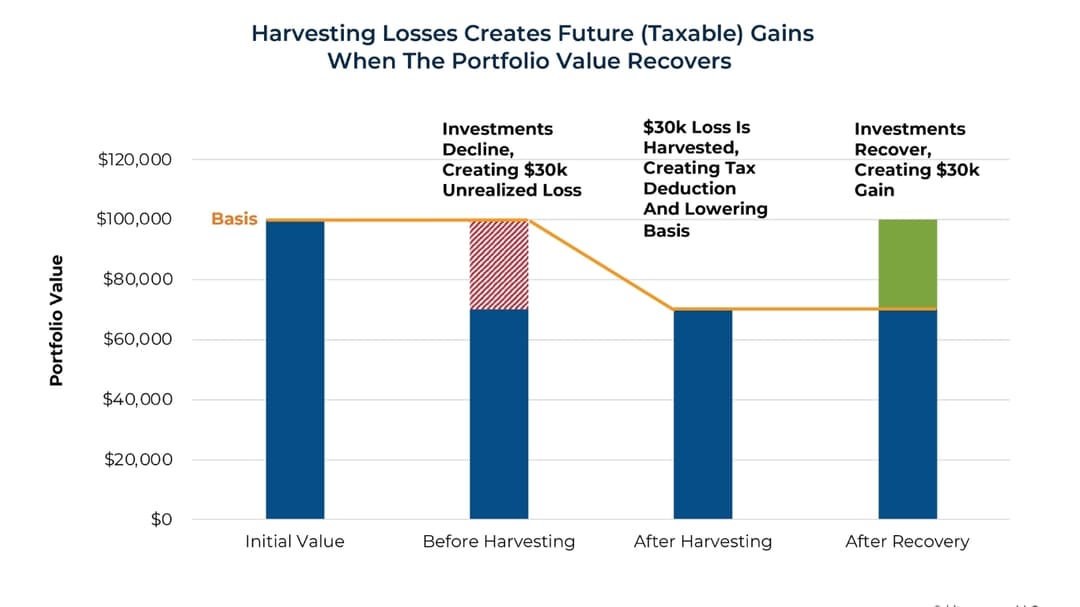
When you harvest a loss, you lower the cost basis of your portfolio. That sounds fine in the moment, but it has downstream consequences you need to plan for. A lower cost basis means a higher taxable gain when you eventually sell the replacement investment.
- Lowering the Cost Basis: When you sell an asset at a loss and reinvest in a new security, the cost basis of the new investment will be lower than the original. This means that while you might save on taxes this year, you could face a higher tax bill in the future if the new investment appreciates.
Here’s a concrete example. You sell a stock with a $30,000 cost basis for $25,000, locking in a $5,000 loss. You reinvest that $25,000 in a similar asset that climbs back to $30,000.
Your capital gain on the new position is $5,000. At a 15% tax rate, the $750 you saved today becomes a $750 bill tomorrow. And if that new investment keeps rising to $35,000, your future tax exposure grows even larger. The Financial Times personal finance desk covers exactly these kinds of compounding tax dynamics for long-term investors.
This is the trade-off at the heart of tax-loss harvesting. You lower your cost basis now, which could mean a higher tax liability down the road. Understanding that dynamic is what separates investors who use this tool wisely from those who use it blindly.
4. Market and Tax Rate Changes
You’re also making a bet on the future when you harvest losses today. The benefit you get from deferring taxes depends on what tax rates look like when those deferred gains eventually come due, and on how the market performs between now and then. Neither of those things is within your control.
- Market Fluctuations: The market value of reinvested assets can increase or decrease, affecting future capital gains or losses. A significant market downturn could provide additional opportunities for tax-loss harvesting, but relying on market timing is risky.
- Tax Rate Changes: Future changes in tax policy could alter the effectiveness of your tax-loss harvesting strategy. If tax rates increase, your deferred tax bill could be higher than anticipated, reducing the net benefit of the strategy.
That’s why tax-loss harvesting works best as part of a broader, long-term investment strategy rather than a standalone tactic you pull out once a year to cut your tax bill. Build it into your overall wealth management approach, review it with a qualified advisor, and treat it as one piece of a much larger plan. The investors who get the most out of it are the ones who think in decades, not just tax years.
We last reviewed this analysis in May 2026.


Alex Tzoulis
Alex Tzoulis is Co-Owner and Markets Analyst at The Luxury Playbook, specializing in equities, crypto, forex, and global financial markets. His work focuses on analyzing macroeconomic trends, geopolitical developments, and monetary policy, translating them into actionable insights across both traditional and digital asset classes. He leads the platform's financial market coverage, providing structured analysis across stock market investing, trading strategies, and cryptocurrency markets. His expertise strengthens the publication's authority in financial markets and capital allocation, bridging traditional finance with emerging digital investment ecosystems.