Record Tudor sales at Phillips and Sotheby's are drawing collector attention in a way the brand has not seen before, and the cause is more interesting than the headline numbers suggest. Bezel's platform data places Tudor at roughly 12 percent of sales share through 2026. That isn't the loudest figure, but it is a meaningful one for a name that, until recently, mostly turned up in the conversation as the Rolex alternative for buyers who couldn't get a Submariner.
- Tudor's recent auction records have shifted collector perception, turning the brand from Rolex understudy into a credible reference in its own right.
- Black Bay and Pelagos secondary prices have firmed, and the new in-house calibres explain why pre-2016 ETA models are quietly being reappraised.
- Heritage Tudor military pieces, especially Snowflake Submariners with French Navy provenance, now command Patek-adjacent results when the paperwork is right.
- We read the Tudor rally as a genuine repricing of overlooked watchmaking, not a speculative bubble propped up by hype around a single reference.
- Limited Black Bay collaborations and the Pelagos FXD line have given Tudor the kind of waitlist scarcity that historically lifts an entire catalogue.
- Buyers entering now should still anchor decisions on movement type, condition, and dial originality rather than the colourway of the moment.
- Who is this for?
- Collectors weighing Tudor as their next acquisition, Rolex owners diversifying without leaving Geneva, and dealers tracking sister-brand momentum.
- What is happening?
- A documented step-change in Tudor's secondary-market results, with auction houses dedicating standalone catalogues and dealers building deeper inventory.
- When did this emerge?
- The shift has played out across the last several auction seasons, with Phillips and Christie's posting consecutive Tudor records into 2026.
- Where is this happening?
- Geneva and New York auction rooms set the headline numbers, while Chrono24 and Subdial 50 data confirm the trend across everyday dealer flow.
- Why does it matter?
- Tudor pairs Rolex-grade manufacturing standards with prices that still sit a tier below, which makes the brand a structural value for serious collectors.
Watches & Wonders 2026 brought a credible run of releases: a Black Bay 43 with Master Chronometer certification, refreshed BB58 variants, the Black Bay Pro Opaline, and the genuinely over-engineered Pelagos Ultra rated to 1,000 metres. The brand's sibling-brand era is over.
What's interesting isn't simply that Tudor is selling well. It's that the brand has finally built the kind of independent technical case, METAS Master Chronometer certification across the upper end of the range, in-house calibres, vertical manufacturing, that lets it be talked about on its own merits. Hodinkee, Esquire and GQ have been writing about Tudor on those terms for the past two years.
How Tudor moved from sibling brand to standalone case
The Tudor history is straightforward enough. Hans Wilsdorf set up the Tudor trademark in 1926 with the explicit idea of offering Rolex-grade reliability at more accessible prices. That deliberate two-brand structure ran for decades, with Tudor handling the working-tool segment of the market while Rolex took the prestige tier.
The Submariner heritage on the Tudor side is genuinely deep. The Snowflake-handled references that came out of the 1960s and 1970s were issued to the French Marine Nationale and the US Navy SEALs, and they're the references that vintage Tudor collectors hunt for now at Phillips and Sotheby's.
For most of its history Tudor traded on that working-tool credibility without claiming much technical independence. The transformation happened from 2015 onwards, when Tudor started moving in-house calibres into the Black Bay and Pelagos lines. It accelerated sharply between 2021 and 2024 as METAS Master Chronometer certification rolled across most of the upper-end catalogue.
The 2026 releases that anchored the year
The 2026 Watches & Wonders releases, particularly the Black Bay 43 MC and the Pelagos Ultra, read as confident statements rather than family-tree compromises. They don't need to reference Rolex to justify themselves, and the auction houses are responding accordingly.
The Pelagos Ultra's 1,000-metre rating and the Black Bay 43's chronometer certification both came with retail pricing that undercuts Rolex by significant margins. That positioning has held the secondary market firm even as the broader luxury watch field corrected after 2022.
The Black Bay, Pelagos and Ranger families
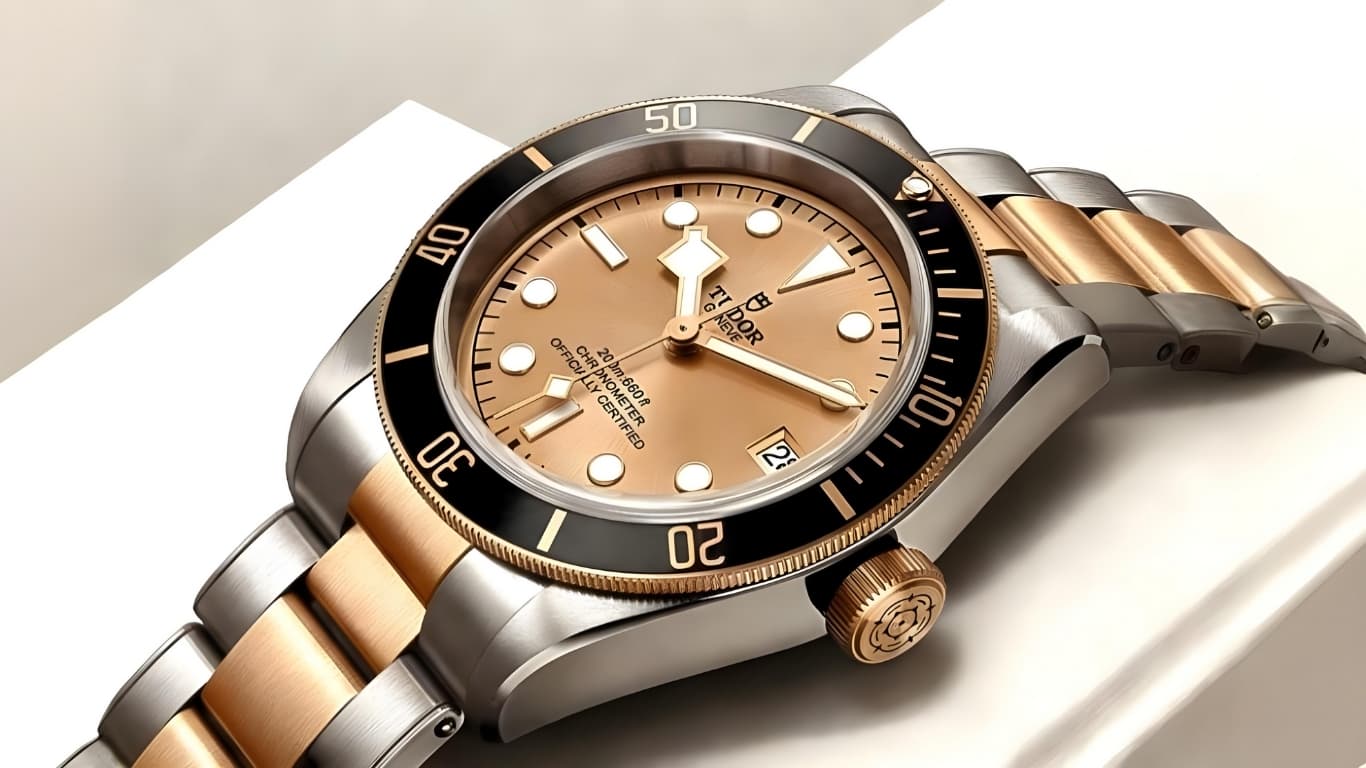
The current Tudor catalogue splits cleanly. The Black Bay is the heritage line: diving DNA, vintage-styled cases, the most recognisable Tudor product. Tudor's official site lists the Black Bay range from roughly $4,750 to $6,825 in the United States.
The Pelagos is the technical line: titanium construction, helium escape valves, serious depth ratings, sized and pressure-tested for actual divers. The Ranger is the field-watch line, drawing on the British North Greenland Expedition heritage from the 1950s. The 39mm Ranger lists from $3,375 to $3,725 depending on bracelet or strap.
The Royal collection, opening from $2,625 in steel, sits below the sport pieces as the entry tier. WatchCharts places the brand-wide median secondary-market price between €2,600 and €3,000, with most current models trading in the €2,000 to €3,000 band.
Why Tudor trades below MSRP and what it means
Average secondary pricing runs at around 59 percent of MSRP. Tudor is firmly a brand that trades below retail in the pre-owned market, which is the natural state of a brand that supplies its dealers reliably and avoids the multi-year waitlist games that distort Rolex secondary pricing.
For collectors, that pricing pattern actually rewards patience. Buying clean pre-owned Tudor at the right reference, with full set documentation, has consistently been the strongest entry into modern Tudor for the past five years.
What the record Tudor secondary market actually shows
The Pelagos family is the most interesting current-production data point. The Pelagos 39 trades around €2,963 against €4,850 retail. The newer Pelagos Ultra clears around €4,401 against €5,950 retail per WatchCharts and GQ figures.
Newer, more technically distinctive references hold value better than long-running standard production, which is a pattern that holds across most modern watch brands. The Black Bay 58 reference 79030N is the liquidity benchmark for the entire brand.
WatchCharts logs 2,019 secondary-market sales over the past twelve months, with median time-to-sell around 17 days. That's the kind of trading depth that means a clean Black Bay 58 finds a buyer quickly at a market-clearing price, useful context for collectors weighing accessibility against pieces that need a specialist dealer to move.
The discontinued references doing the heavy lifting
The discontinued North Flag, Tudor's short-lived in-house attempt at a more technical, industrial-styled sport watch from the mid-2010s, is the standout discontinued reference. Post-discontinuation interest has firmed prices on clean examples.
Collectors who picked one up in 2018 are looking at meaningful upward movement now. That pattern tends to follow Tudor references that get pulled from the catalogue before they've had time to saturate the secondary market.
Where the vintage record sales sit
Vintage is where the most dramatic numbers show up. Sotheby's cleared a Snowflake Submariner reference 9411 at $6,096 in a 2026 sale. Broader vintage Submariner references trade routinely between $5,000 and $9,000 depending on condition, military provenance, and originality of dial and hands.
The historical benchmark remains the Christie's online sale where a reference 7924 "Big Crown" cleared $75,000. That's the ceiling for what a serious collector will pay for an exceptional vintage Tudor with the right condition and provenance. WatchCharts confirms the Snowflake references now sit in the top tier for popularity within Tudor Submariner collecting.
What serious collectors look for in Tudor
For modern Tudor, condition and discontinuation status are doing most of the work. Standard Black Bay and Ranger production trades steadily but doesn't move dramatically. The value play is in the references that get pulled, the North Flag being the cleanest recent example, and in the limited-run dial and case variants that turn up in Watches & Wonders releases.
Box-and-papers documentation is straightforward to come by for modern Tudor and is now standard expectation for any clean secondary-market sale. Vintage is a different conversation entirely.
The Snowflake Submariner references, particularly the Marine Nationale and US Navy issued examples, are where the most considered vintage Tudor collecting happens. Originality of dial, hands, bezel insert and case finish all matter substantially. Refinished cases drop a piece's price meaningfully.
Big Crown references at the top
The Big Crown references, early Submariners with the oversized winding crown, are the ones at the top of the vintage hierarchy. They turn up at the major auction houses and command Patek-adjacent numbers for exceptional examples.
Below them, the broader Submariner catalogue gives vintage Tudor an accessible entry point that comparable Rolex Submariners simply can't match on price. Provenance documentation is rare for vintage Tudor, but military issue numbers and credible service histories carry significant weight.
Where Tudor sits in the broader 2026 market
The current reading is that Tudor is the most credible Swiss tool watch on offer below the $7,000 retail line, and the only one of that group with both METAS Master Chronometer technical credentials and a vintage line that the auction houses take seriously. Morgan Stanley's Q2 2026 watch-market analysis and Hodinkee's coverage of the broader pre-owned market both point to a stabilising secondary market after the post-2022 correction.
In that environment, brands with genuine technical credentials and accessible pricing tend to find buyers faster than the speculative tier above them. Tudor is the cleanest example of that pattern in the current market.
Further reading
- The Most Coveted Tudor References of 2026
- What Tudor Watches Will Be Released In 2026 And Should Collectors Pay Attention?
What this means for collectors next
The Snowflake auctions and the Big Crown numbers feed back into modern Tudor as brand lore, the kind of historical depth that supports a collector base over the long term rather than a hype cycle that exhausts itself. Whether the brand can keep the Watches & Wonders cadence credible across the next three or four years is the open question.
So far, on the evidence, the discipline has held. The collectors we hear from at the auction previews are no longer treating Tudor as a Rolex consolation, and the record sales suggest the wider market has caught up.
We last reviewed this analysis in May 2026.

Frequently Asked Questions
- Is Tudor as good as Omega?
- Tudor matches Omega in build quality, movement performance, and reliability with METAS Master Chronometer certification across many models, while offering similar collector appeal at 20-30% lower price points in the sub-$7,000 market.<br><br>
- Why is Tudor called the 'poor man’s Rolex'?
- Tudor was deliberately founded by Rolex's Hans Wilsdorf in 1926 to offer Rolex-level quality at a lower price, but the outdated label "poor man Rolex" no longer applies as Tudor now has in-house movements, METAS certification, and independent prestige.<br><br>
- Are Tudor watches considered luxury?
- Yes, Tudor is a Swiss luxury watch brand owned by Rolex, featuring high-quality materials, METAS-certified movements, and professional-grade engineering, positioned in the accessible luxury segment at $3,000-$7,000 retail.<br><br>
- Is Tudor owned by Rolex?
- Yes, Tudor is owned and operated by Rolex SA, but maintains its own manufacturing, design, and distribution infrastructure with increasing technical independence through in-house movements and METAS certification.<br><br>
- Do vintage Tudor watches increase in value?
- Yes, vintage Tudor Submariners and chronographs have seen strong appreciation, especially military-issued models, with the rare "Big Crown" ref. 7924 reaching $75,000 and Snowflake refs consistently trading $5,000-$9,000.<br><br>

Stefanos Moschopoulos
Stefanos Moschopoulos founded The Luxury Playbook in Athens and has spent the better part of a decade following the auction calendar, the en primeur releases, and the watchmakers, gallerists, and shipyards the magazine covers. He writes the field guides and listicles that anchor the Connoisseur section — pieces built on Phillips and Christie's results, Liv-ex movements, and conversations with collectors he has met across Geneva, Bordeaux, Basel, and Monaco. His own collecting habits sit closer to watches and wine than art, and it shows in the level of detail in the magazine's coverage of those categories. Under his direction, The Luxury Playbook now publishes long-form field guides, market-defining year-end listicles, and the Voices interview series with the founders behind the houses and the brands.