Vacheron Constantin belongs in a serious watch collection for a reason that has held since 1755: the brand has produced unbroken classical watchmaking for 270 years without ever leaving family hands beyond Richemont's stewardship. Vacheron is one third of what the trade calls the holy trinity, alongside Patek Philippe and Audemars Piguet, and the only one of the three with that kind of continuous operational record.
- Vacheron Constantin holds the longest continuous watchmaking lineage in Switzerland, and that institutional depth shows in finishing standards across every reference tier.
- The Overseas and Patrimony lines anchor the modern catalogue, while Historiques and Les Cabinotiers releases serve the high-complication and unique-piece collectors.
- Secondary-market liquidity sits a step below Patek and AP, which means patient buyers can still find genuine value on Vacheron references in strong condition.
- We see the brand's Métiers d'Art and Les Cabinotiers commissions as the most undervalued segment in high horology, where the artistry justifies the asking premiums.
- Vacheron movement finishing, particularly on hand-wound and perpetual calendar references, rewards collectors who study the work under a loupe rather than only through catalogues.
- Heritage Vacheron complicated pieces from the 1950s through 1970s have appreciated steadily, with auction visibility growing as collector education catches up to the work.
- Who is this for?
- Established collectors looking beyond the Holy Trinity's most visible names, high-horology students, and buyers who value finishing over headline scarcity.
- What is happening?
- The case for Vacheron Constantin as a structural pillar in a serious collection, covering modern lines, vintage references, and high-complication opportunities.
- When did this emerge?
- The brand has rewarded long-term collectors for two centuries, and the modern Overseas era has reinvigorated dealer demand and secondary-market depth.
- Where is this happening?
- Geneva and New York auction rooms host the most active Vacheron secondary trade, with authorised dealers handling new Overseas and Patrimony references.
- Why does it matter?
- Vacheron pairs unmatched institutional pedigree with finishing standards and complication work that still trades at a relative discount to its closest peers.
What separates Vacheron from its trinity peers, in the room where serious collectors actually decide what to buy, isn't market noise. It's the depth of the craft work and the discipline of the catalogue.
Annual production sits at around 20,000 watches across the entire global range, which is a fraction of what Rolex produces. That number does most of the structural work for the brand's place in serious collecting. The catalogue splits into a small number of defining lines: the Patrimony for classical dress watchmaking, the Overseas for the integrated-bracelet sport-luxury register, the Traditionnelle for the most considered classical pieces, the FiftySix for the more accessible entry into the brand, the Historiques for vintage-inspired re-creations, the Métiers d'Art for the dial-craft showcase, and Les Cabinotiers for the bespoke and one-off pieces that anchor the upper end.
The Patrimony, the Overseas and the Traditionnelle
The Patrimony is the cleanest expression of Vacheron's classical instinct. Round case, applied gold indices, a dial with no extraneous text, the brand's Maltese cross at six o'clock and almost nothing else.
Sizes run from 36mm through 42. 5mm. Pricing currently lists from around €18,000 in the basic time-only steel reference up to roughly €71,800 for the more complicated and precious-metal pieces.
The Patrimony is the watch most often worn by people who already own three or four other things and want to step away from visible complication.
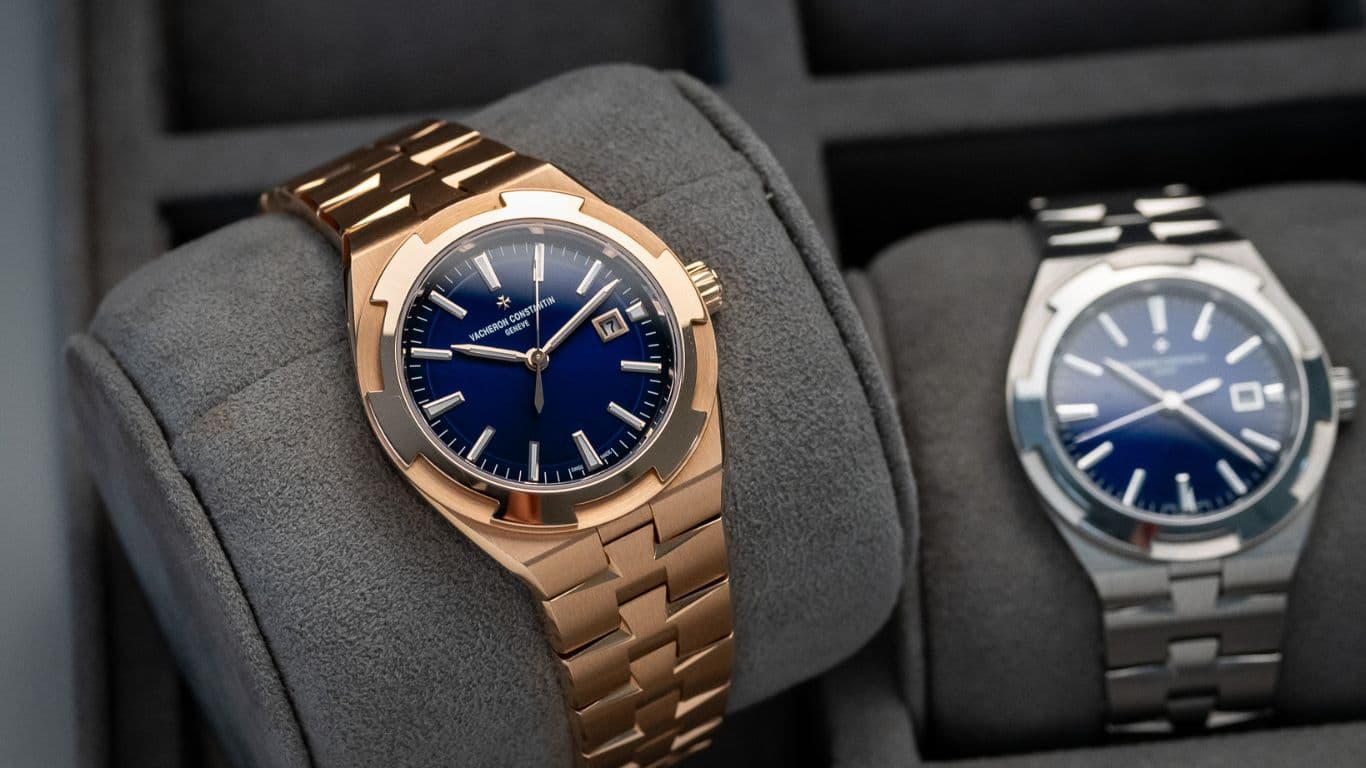
The Overseas is Vacheron's answer to the Royal Oak and the Nautilus, the integrated-bracelet sport-luxury register that has defined the upper tier of modern Swiss watchmaking. The current generation, designed under Vincent Kauffmann with the changeable strap system, retails from roughly €13,500 in the time-only steel reference up to bespoke and complicated pieces priced on application.
Why the Overseas is drawing trinity collectors
Hodinkee and the major auction houses have noted the Overseas drawing serious collector attention through 2024 and 2025 as the trinity's quieter sport reference. It's increasingly chosen by collectors who already own a Royal Oak or a Nautilus and want a third register that speaks the same language but with different design intelligence.
The Traditionnelle is where the brand's classical movement-finishing instinct is most visible. Geneva Seal certification on most references, hand-finished movement components visible through display casebacks, and the geometric purity of a movement designed for traditional watchmaking display. Pricing opens around €15,640 and runs into bespoke territory.
Métiers d'Art and Les Cabinotiers at the upper end
The Métiers d'Art is the line that demonstrates what Vacheron's atelier can actually do when given full creative latitude. Hand-engraved guilloché dials, miniature enamel painting, Grand Feu enamel work, hand-applied gold appliqués: the dial-craft processes that define the upper end of Swiss decorative arts.
Each piece in the Métiers d'Art line is essentially a small commission. Pricing opens at around €85,000 and runs significantly higher for the more elaborate dial work and complicated movements.
Les Cabinotiers is the bespoke programme: entirely commissioned pieces, often single-of-a-kind, with collectors working directly with the atelier on movement, dial and case specifications. The reference Cabinotiers piece that's most cited is the unique watch that sold at Christie's in 2011 for roughly €292,400. The broader Cabinotiers programme has produced pieces that have moved at considerably higher numbers in private sales since.
The auction record context
The 2016 sale of a vintage Vacheron Constantin at €406,725 sat in similar territory. Phillips and Christie's have continued to handle Vacheron lots at meaningful estimates across recent watch sales, which is part of how the brand maintains its position in serious collecting conversations.
The Reference 57260, Vacheron's record-setting one-of-a-kind commission with 57 complications and an estimated value above $10 million, represents the ceiling of what the brand can build. Most serious collectors will never see it in person, but its existence anchors the upper end of how Vacheron's craft is understood.
Where Vacheron sits versus the rest of the trinity
The most useful comparison is with Patek Philippe and Audemars Piguet. Patek leads on market recognition. The brand's name carries the strongest cultural premium in Swiss watchmaking, and recent Bloomberg estimates put the brand value at roughly €1.
94 billion against Vacheron's estimated €834 million. Patek also leads on complication ambition. The Calibre 89 with its 33 complications remains the technical reference point.
Vacheron sits closer to Patek's classical register than to Audemars Piguet's contemporary one. The Patrimony and Traditionnelle lines speak the same design language as Patek's Calatrava and Complications references, where AP's Royal Oak speaks a more architectural, contemporary language.
Where the brand identity splits across lines
Where AP has built its modern identity around the Royal Oak (and to a lesser extent the Royal Oak Offshore and Code 11.59), Vacheron's identity is split across multiple lines that each express a different part of the classical tradition. The Patrimony for dress, the Overseas for sport, the Métiers d'Art for craft, the Historiques for vintage references.
The pricing register is broadly similar across the trinity at the top end. In the entry tier, Vacheron's FiftySix starts around €10,370, which is the most accessible new-watch entry point into the trinity available on the current market. That accessibility is one of the practical reasons Vacheron is increasingly turning up in collections that previously skewed Patek- or AP-heavy.
What serious collectors look for in Vacheron Constantin
For modern Vacheron, the play is reference-specific. The Overseas in steel, particularly the discontinued earlier-generation references and the limited-edition variants from the current generation, is the most actively traded modern Vacheron in the secondary market.
The Patrimony in precious metal trades at a meaningful premium over its steel siblings. The Métiers d'Art and Les Cabinotiers pieces trade case-by-case at the major auction houses and through specialist dealers, and reading those lots in detail is part of how serious collectors build their working knowledge of the upper end.
Vintage condition discipline
For vintage Vacheron, condition discipline matters substantially. Original case, original dial, credible service history, and full set documentation are the baseline for the major auction houses (Phillips, Christie's, Sotheby's, Antiquorum) to take a piece seriously.
Vintage Vacheron complications, including perpetual calendars, minute repeaters and tourbillons from the 1950s and 1960s, are the references that move at the upper end of the vintage market. They're the references where reading auction catalogues for several seasons before bidding pays the most dividends.
What this means for collectors next
The longer story collectors are watching is whether Vacheron maintains the craft discipline that has, so far, kept the upper-end pieces credible against the trinity's two more-famous peers. The Métiers d'Art programme in particular has been steadily building in ambition across the past decade. The Cabinotiers commissions have produced some of the most considered single pieces in modern Swiss watchmaking.
So far, on the evidence of how Phillips, Christie's and Sotheby's have been handling Vacheron's lots across recent watch sales, the work is being read with the attention it deserves. For collectors building a trinity-level collection, Vacheron remains the quietest of the three names and, for that reason, often the most considered.
We last reviewed this analysis in May 2026.


Stefanos Moschopoulos
Stefanos Moschopoulos founded The Luxury Playbook in Athens and has spent the better part of a decade following the auction calendar, the en primeur releases, and the watchmakers, gallerists, and shipyards the magazine covers. He writes the field guides and listicles that anchor the Connoisseur section — pieces built on Phillips and Christie's results, Liv-ex movements, and conversations with collectors he has met across Geneva, Bordeaux, Basel, and Monaco. His own collecting habits sit closer to watches and wine than art, and it shows in the level of detail in the magazine's coverage of those categories. Under his direction, The Luxury Playbook now publishes long-form field guides, market-defining year-end listicles, and the Voices interview series with the founders behind the houses and the brands.