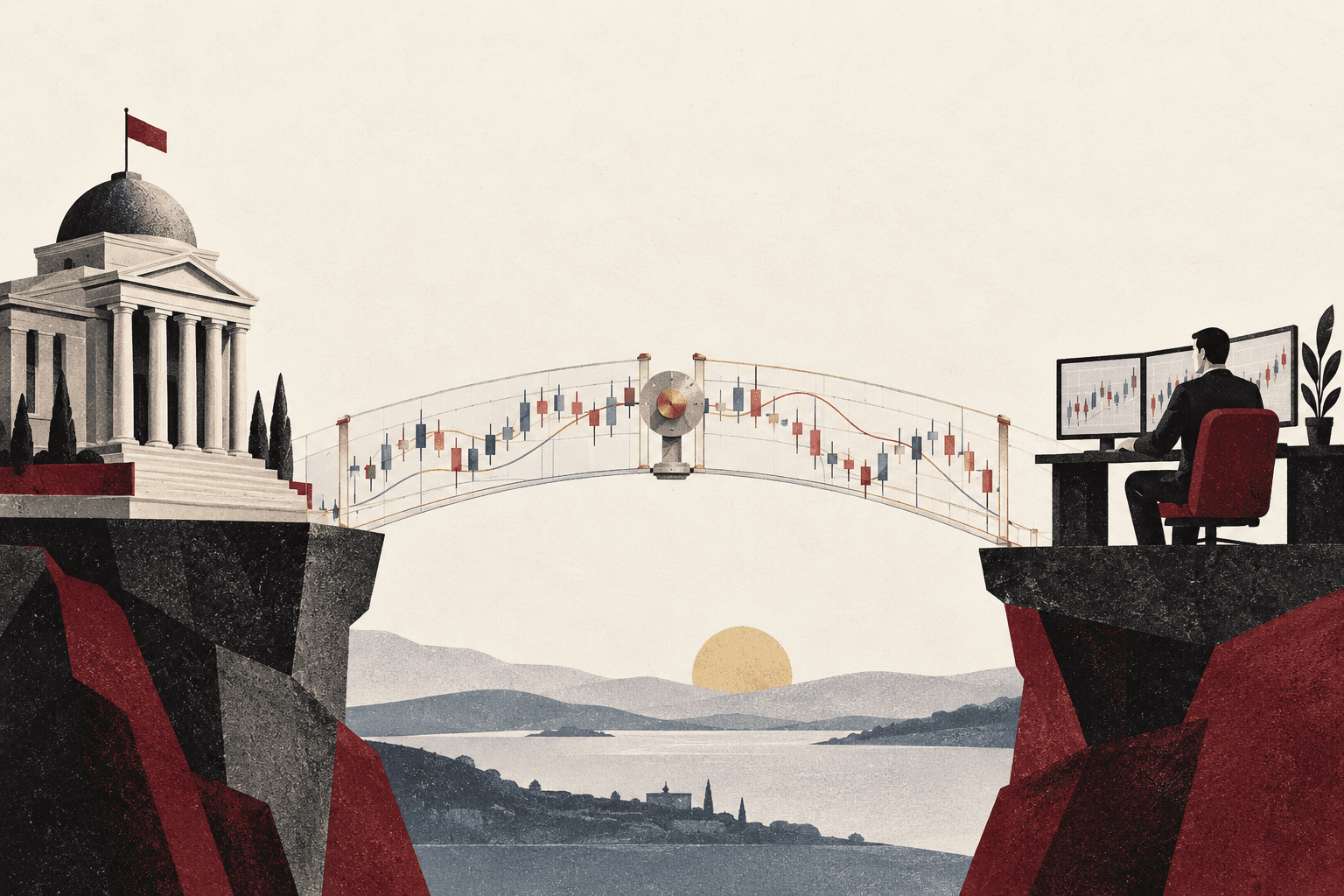

Every major technological revolution in history arrived packaged with a speculative bubble.
The railroad boom of the 1840s bankrupted thousands of investors while permanently transforming commerce. The dot-com era wiped out companies with zero revenue and billion-dollar valuations, yet the infrastructure they funded became the foundation of the digital economy you live in today.
Speculation and genuine value creation coexist during transformational technology adoption. The question isn’t whether some AI companies will fail. It’s whether the underlying transformation is real.
And on that question, the evidence is harder to dismiss than the skeptics want you to believe.
The diagnostic framework for separating mania from revolution is actually straightforward. Are valuations detached from any plausible revenue trajectory? Are companies selling actual products or just promising future business models?
Can current prices be justified by real cash flows under reasonable assumptions?
These markers reliably identified tulip mania, the South Sea bubble, dot-com excess, and crypto speculation at their respective peaks.
Apply them to AI today and the picture looks meaningfully different.
Bears argue that trillion-dollar capital deployment into AI infrastructure mirrors late-1990s overinvestment in fiber optic networks, building capacity far ahead of demand and setting up inevitable write-downs. Bulls counter that AI companies generate substantial real revenue, demonstrate measurable productivity gains, and require physical infrastructure that prevents the pure speculation you saw in software-only bubbles. Both sides have evidence.
But the criteria that actually matter are productivity gains, revenue generation, and irreversible enterprise integration. If those are present, you’re watching a technology revolution regardless of whether individual companies fail along the way.
If you want a deeper look at how to identify stock market bubbles and protect your assets, the same fundamental tests apply here. And right now, AI is passing most of them.
Key Takeaways & The 5Ws
- Every tech revolution includes speculation, but not every bubble lacks substance. From railroads to the dot-com era, capital excess coexisted with real infrastructure buildout that later powered lasting economic transformation.
- AI investment is backed by real revenue, not just narrative. Companies like NVIDIA, OpenAI, and hyperscalers such as Microsoft are generating substantial AI-driven cash flows tied to enterprise demand.
- Physical infrastructure limits pure speculation. AI requires data centers, GPUs, semiconductor fabs, and energy capacity, constraints that reduce the risk of unlimited overbuilding seen in prior software-only bubbles.
- Enterprise adoption remains early. With AI penetration still below full saturation, institutional capital sees a multi-decade adoption curve similar to early cloud computing expansion.
- Productivity gains signal structural change. Measurable efficiency improvements across coding, customer service, and data workflows indicate irreversible enterprise integration rather than short-term hype.
- Who is this for?
- Institutional investors, enterprise leaders, and technology giants allocating capital toward AI infrastructure and deployment.
- What is it?
- A debate over whether the current AI boom represents a speculative bubble or a long-term technological revolution backed by real revenue and productivity gains.
- When does it matter most?
- Early-stage mass adoption phase, with enterprise AI penetration still developing and infrastructure spending accelerating through the mid-2020s.
- Where does it apply?
- Primarily in the United States, Europe, and China, where regulatory frameworks and hyperscale infrastructure investment support rapid AI expansion.
- Why consider it?
- Because AI demonstrates tangible revenue growth, measurable enterprise ROI, and irreversible integration into business operations, key markers that historically separate transformational revolutions from purely speculative manias.

The Trillion-Dollar Infrastructure Reality
The scale of physical investment is the first thing that separates this moment from previous bubbles. Microsoft, Google, Amazon, and Meta collectively spend more than $200 billion annually on AI infrastructure, covering data centers, GPUs, and energy facilities with multi-year buildout timelines.
The capex case shows up clearly in coverage from Bloomberg and the Financial Times. Hyperscaler infrastructure spend is now measured in hundreds of billions per year, and the customer base for those buildouts is largely composed of cash-generative enterprises rather than speculative balance sheets.
Macro context from BIS matters here. Today’s AI buildout is being financed from operating cash flow and investment-grade debt rather than the leveraged equity issuance and consumer-credit-fueled retail flows that defined the late-1990s bubble. The risk profile is genuinely different.
These are not liquid positions you can unwind quickly. You’re talking about constructing physical facilities that require land acquisition, permits, utility connections, and years of construction. That irreversibility signals conviction rooted in long-term demand projections, not short-term speculation.
Speculative bubbles concentrate in assets you can exit overnight. These investments cannot be reversed at all.
OpenAI’s annualized revenue reportedly exceeds $3 billion and is growing fast. NVIDIA’s data center revenue, predominantly AI-driven, reached $47 billion in fiscal 2024. Anthropic is securing billion-dollar enterprise contracts with major corporations.
These are current cash flows from customers deploying AI in production environments and renewing subscriptions, not promises of future monetization. The revenue composition matters too. Fortune 500 companies signing multi-year AI infrastructure agreements generate sticky, predictable income.
API usage fees from developers integrating AI into applications scale directly with adoption.
That is exactly the kind of revenue structure that justifies premium valuations.
Fortune 500 companies are reporting measurable efficiency improvements of 20% to 40% in specific workflows. Customer service automation is cutting response times while improving satisfaction scores. AI coding assistants are accelerating software development across teams of thousands of engineers.
Content creation and data analysis are scaling without proportional headcount growth.
These are documented ROI calculations, not aspirational projections. Companies aren’t running small pilots in isolated departments. They’re deploying AI across entire operations in ways that create switching costs and dependencies that would be expensive and disruptive to undo.
Physical constraints add another layer that software-only bubbles never had. Unlike the dot-com era where unlimited websites could be launched with minimal capital, AI requires GPU manufacturing capacity constrained by semiconductor fab construction timelines, energy generation limited by utility infrastructure, and cooling systems dependent on physical facilities. The Financial Times has documented how these physical bottlenecks are reshaping the global energy and construction industries.
You cannot manufacture more NVIDIA GPUs overnight regardless of demand or available capital. Expanding production means TSMC building additional fabs, which are multi-year, multi-billion-dollar projects with complex approval processes.
This natural scarcity creates a ceiling on infrastructure deployment that prevents the kind of speculative overbuilding that destroyed fiber optic investors in 2001.

Why Institutional Capital Sees Decades of Growth Ahead
Despite the scale of current investment, fewer than 20% of enterprises have deployed AI at scale. That number is critical to understanding why institutional capital stays committed rather than cautious.
If AI penetration had already reached 80% of the addressable market, growth would necessarily slow and valuation skepticism would be warranted. At sub-20%, you’re looking at the beginning of a multi-decade adoption curve similar to cloud computing’s 15-year transformation from novelty to enterprise standard.
Between 2010 and 2026, cloud went from minimal adoption to the default infrastructure choice for enterprise workloads despite early skepticism about whether the capital investment was justified. According to Bloomberg’s analysis, AI is likely sitting at the 2010 moment on that same timeline.
Companies investing billions in foundational models are building advantages that smaller competitors simply cannot replicate. The compute requirements, data curation, and algorithmic expertise needed to train frontier models present massive barriers to entry.
More importantly, companies with unique proprietary datasets, customer interactions, specialized domain knowledge, and content libraries can build AI capabilities that competitors cannot match regardless of capital availability. Unlike software features that can be reverse-engineered, these data moats deepen continuously as AI deployment generates additional proprietary data that improves model performance, widening the advantage gap over time. This is the same moat dynamic that smart institutional money has been chasing across asset classes for years.
Regulatory clarity adds another advantage that other transformational technologies lacked at comparable stages. Cryptocurrency investors still face fundamental uncertainty about whether their assets will be classified, taxed, or restricted in ways that destroy value. AI operates within frameworks that are imperfect but knowable.
US executive orders promote development while addressing safety concerns. The EU AI Act creates compliance requirements businesses can actually plan around. China’s regulations encourage development with oversight.
This clarity allows pension funds, endowments, and sovereign wealth funds to invest with defined risk parameters, attracting institutional capital that would never enter a regulatory grey zone.
The presence of that capital is itself a signal worth paying attention to.
The deepest case for AI as revolution rather than bubble is the replacement cycle thesis. Every customer service operation, software development team, content creation process, data analysis function, and decision support system will incorporate AI or eventually get outcompeted by those that do.
This isn’t optional efficiency improvement. It’s competitive necessity forcing adoption regardless of individual company preferences.
The capital being deployed today builds the infrastructure enabling this transition, the same way electrical infrastructure enabled factories to reorganize around power in the early twentieth century and internet infrastructure enabled digital transformation in the 2000s. In both cases, early investment looked excessive until the full adoption wave validated the build-out. Robb Report’s wealth coverage and the questions you should ask before backing any emerging technology play both point to the same conclusion: the underlying demand curve is what separates revolutions from manias, and AI’s demand curve is only getting steeper.
We last reviewed this analysis in May 2026.

Stefanos Moschopoulos
Stefanos Moschopoulos founded The Luxury Playbook in Athens and has spent the better part of a decade following the auction calendar, the en primeur releases, and the watchmakers, gallerists, and shipyards the magazine covers. He writes the field guides and listicles that anchor the Connoisseur section — pieces built on Phillips and Christie's results, Liv-ex movements, and conversations with collectors he has met across Geneva, Bordeaux, Basel, and Monaco. His own collecting habits sit closer to watches and wine than art, and it shows in the level of detail in the magazine's coverage of those categories. Under his direction, The Luxury Playbook now publishes long-form field guides, market-defining year-end listicles, and the Voices interview series with the founders behind the houses and the brands.