
Long-term stock investing is one of the most powerful tools you have for building real, lasting wealth. The core idea is simple, you hold assets like stocks and bonds for more than a year, let compounding returns do the heavy lifting, and keep trading costs to a minimum. The track record backs this up.
The S&P 500 posted annual gains in 37 of the last 50 years, which tells you something important about where patient capital tends to end up.
From 1928 to 2023, the S&P 500 delivered a geometric average return of 9.80% per year. That figure leaves Treasury bills and gold in the dust. And beyond raw growth, you also get the advantage of lower tax rates on long-term capital gains, plus the quiet wealth-building power of reinvesting your dividends year after year.
- Long-term stock investing harnesses compounding, dividend reinvestment and the historical upward drift of broad equity markets.
- Time in the market consistently beats time spent trying to time the market, especially after costs and behavioural drag are accounted for.
- Dollar-cost averaging into broad indices over decades has historically delivered strong real returns, even through severe drawdowns.
- Holding through volatility allows investors to access the small handful of best days that drive much of cumulative long-term performance.
- Tax-efficient structures such as ISAs in the UK and 401(k) and IRA accounts in the US amplify long-term returns by reducing leakage.
- The principal cost of long-term investing is patience, but the historical reward has been disproportionate to almost any other accessible asset class.
- Who is this for?
- Patient retail investors and savers who want a clear case for treating equities as a multi-decade compounding engine rather than a short-term trading market.
- What is happening?
- An overview of the structural benefits of long-term stock investing, including compounding, dividend reinvestment and the impact of staying invested through cycles.
- When did this emerge?
- Relevant at any age, but most powerful when started early in a career, when the runway for compounding and dividend reinvestment is at its longest possible.
- Where is this happening?
- Applicable across global equity markets, with US indices providing the longest reliable data set for long-term equity performance studies dating back well over a century.
- Why does it matter?
- Long-term investing has done more to build household wealth than almost any other widely accessible strategy, and the case for it is reinforced by every market cycle.
Better Long-Term Returns on Equity Investments
Long-horizon equity returns are one of the most-studied datasets in modern finance. Vanguard's research desk has tracked the math of multi-decade compounding for years, and the Federal Reserve publishes ownership-side data showing how household wealth correlates with equity-holding duration.
The institutional view sharpens the picture. JP Morgan's long-term capital-market assumptions and Morgan Stanley's equity-strategy desk both publish multi-year return projections that consistently reward investors who stay invested across cycles rather than try to time them.
When you look at the full picture of asset classes, equities stand out as the clearest path to serious long-term wealth. The performance data is compelling, and the logic behind it is straightforward, you own a share of growing businesses, and over time, that growth shows up in your portfolio.
The Outperformance of Stocks
Over the long haul, stocks have put every other major asset class in the shade. Since 2000, the S&P 500 climbed 287%, far ahead of the 215% gain seen in real estate over the same stretch. That kind of outperformance comes down to one thing, companies keep expanding, keep innovating, and keep generating earnings.
As an equity investor, you get to ride that growth. The S&P 500’s long-term trajectory has proven remarkably resilient even through periods of serious volatility.
Comparison with Other Asset Classes
Put equities side by side with bonds, savings accounts, or gold, and the gap is hard to ignore. T-bills have averaged about 3.30% annually. Gold has done better at around 6.55% per year.
But the S&P 500 averaged 9.80% annually from 1928 to 2023, according to data compiled by NYU Stern’s Aswath Damodaran. That gap, compounded over decades, is the difference between a comfortable retirement and a genuinely wealthy one.
Here’s a detailed comparison of annual returns across various asset classes.
| Asset Class | Annual Return (%) |
|---|---|
| Stocks (S&P 500) | 9.80 |
| T-bills | 3.30 |
| Gold | 6.55 |
| Real Estate (since 2000) | 5.58 |
Historical Returns Data
The historical data makes a strong case for staying invested in equities. Over the past decade, the Russell 1000 index, which tracks large-cap stocks, returned 12.39%. The Russell 2000, covering small-cap stocks, delivered 7.08%.
Spreading your exposure across different sectors and market capitalizations isn’t just diversification for its own sake, it actively reduces your risk while keeping your growth potential intact.
A portfolio split 60% into the Vanguard Total Stock Market Index and 40% into the Vanguard Total Bond Market Index returned 8.74% over 37 years, from 1987 to 2023. A fully equity-driven portfolio did even better over that same window, delivering 10.62%. Those numbers make the case for why working with the right wealth management team to dial in your allocation really matters at the higher end of the wealth spectrum.

Buy-and-Hold Keeps You in the Game
For deeper context, the breakdown in how rebalancing complements a long-term hold strategy is worth reading alongside this analysis.
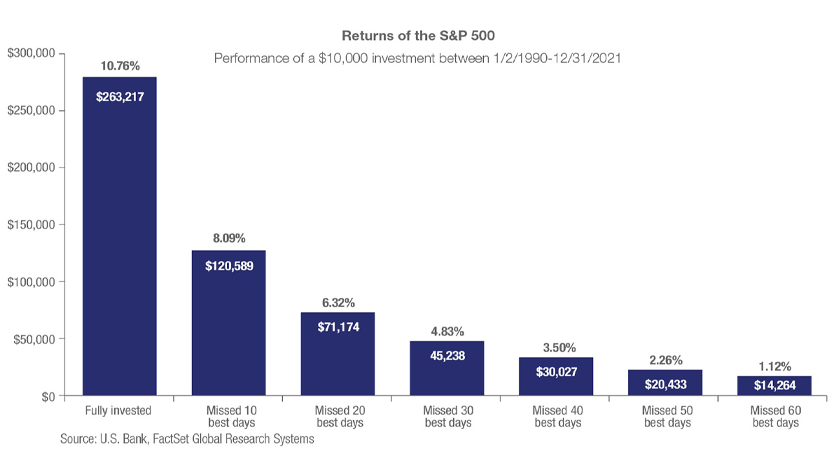
The biggest risk in investing isn’t a market crash. It’s missing the days when the market surges. A buy-and-hold strategy keeps you present for those moments.
Missing just the best five days of the S&P 500 over the past 20 years could cut your returns roughly in half. Data from J.P. Morgan Asset Management shows that missing the 10 best days between 2001 and 2020 pulled your annual return down from 7.47% to just 3.35%. Trying to time your way in and out of the market consistently enough to beat that?
The odds are not in your favor.
What buy-and-hold really does is keep you steady through the noise. Short-term volatility feels urgent when you’re watching your portfolio daily, but zoom out and the picture changes completely. The S&P 500 has averaged roughly 10% annually over the past century.
That long-term upward drift rewards the patient investor who stays the course rather than second-guessing every dip.
Think back to 2008. Investors who held through that brutal downturn saw substantial recoveries in the years that followed. Those who sold at the bottom locked in their losses and then often missed the snapback entirely.
And throughout it all, compounding quietly did its work. Reinvesting dividends and staying invested means your earnings start generating their own earnings, which financial experts at Forbes frequently highlight as one of the most underappreciated forces in wealth building. Albert Einstein reportedly called compound interest the eighth wonder of the world, and when you see the numbers play out over decades, it’s hard to argue.
Emotional Discipline
A buy-and-hold approach does something that’s easy to underestimate, it protects you from your own worst instincts. Panic selling when markets drop and piling in during a peak are two of the most reliable ways to destroy long-term returns. Sticking to a plan and ignoring the noise forces a kind of emotional discipline that most active traders simply can’t maintain.
That discipline, combined with the power of compounding and the market’s natural upward bias over time, gives you a genuinely strong foundation for building serious long-term wealth.
Faster Losses Recouperation
Faster Loss Recovery with a Buy-and-Hold Strategy
One of the less obvious advantages of a buy-and-hold approach is how much faster it gets you back to whole after a downturn. Bear markets, when major indexes like the S&P 500 fall more than 20% from their recent highs, feel brutal in the moment. But history tells a consistent story, staying invested means you recover.
Exiting the market often means you don’t.
Here’s a concrete example. Say you put $1,000 into the S&P 500 on January 1, 2008. That year was one of the worst on record, with the index losing 37% of its value.
By year-end, your investment sat at $630. Now compare two paths forward, staying put with a buy-and-hold strategy versus moving that $630 into a savings account paying 3% annual interest, compounded monthly.
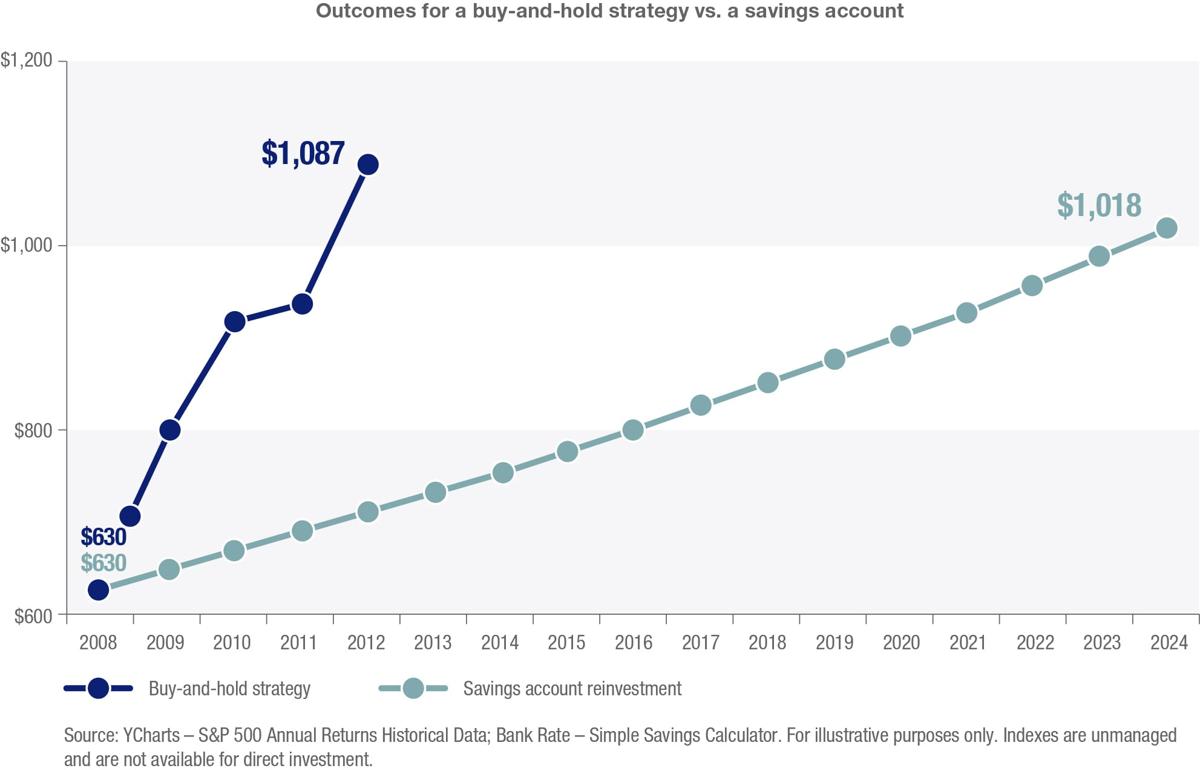
If you stayed in the market, your investment had fully recovered its losses by 2012, without adding a single dollar. The S&P 500’s average annual return of roughly 10% over the past century is what makes that kind of recovery possible. You just had to have the patience to wait for it.
The savings account tells a very different story. At 3% annual interest compounded monthly, it would take you roughly 16 years just to get back to $1,000. That’s not wealth building.
That’s barely keeping pace with inflation while the market charges ahead without you.

Tax Benefits
Understanding how your investments get taxed is one of the most overlooked parts of building a smart long-term strategy. Long-term assets benefit from meaningfully lower capital gains tax rates compared to short-term assets, and that difference adds up to real money over time. Getting this right can genuinely change how much of your growth you actually keep.
Taxation of Short-Term vs. Long-Term Gains
Sell a position you’ve held for less than a year and the IRS treats that gain as ordinary income, which means you could be paying up to 37% on it. Hold for more than a year and your rate drops to 0%, 15%, or 20%, depending on your income level. That spread is enormous.
It’s one of the clearest structural advantages the tax code offers long-term investors, and it alone is a compelling reason to resist the urge to trade in and out of positions. For those with international exposure, exploring tax-efficient structures can push those advantages even further.
Here are the federal long-term capital gains tax brackets for single filers in 2023 and 2024.
| Year | 0% Rate | 15% Rate | 20% Rate |
|---|---|---|---|
| 2023 | Up to $44,625 | $44,626 – $492,300 | Over $492,300 |
| 2024 | Up to $47,025 | $47,026 – $518,900 | Over $518,900 |
Those brackets make the math straightforward. The longer you hold, the smaller the slice the government takes from your gains.
Additional Tax Strategies
Beyond the basic rate differential, you have several additional moves worth discussing with your advisor to sharpen your tax position further.
- Tax-Deferred Accounts: Utilizing tax-deferred accounts such as 401(k)s and IRAs can defer taxes on investment gains until withdrawals are made, usually during retirement when income may be lower, resulting in a lower tax rate.
- Capital Loss Harvesting: By selling losing investments, investors can offset capital gains from winning investments, reducing taxable income by up to $3,000 annually. Any excess losses can be carried forward to future tax years.
- Avoiding Wash Sales: To maintain the benefits of capital loss harvesting, investors must avoid wash sales, which occur if the same or substantially identical asset is repurchased within 30 days before or after the sale. This rule ensures that the tax benefits of realizing a loss are not negated.

Cost-Effectiveness of Long-Term Investment
Keeping costs down is just as important as chasing returns, and long-term investing wins on both fronts. Every time you trade, there’s a cost attached to it, sometimes visible, sometimes not. The longer you hold your positions, the fewer of those costs you absorb, which quietly but meaningfully boosts your net returns over time.
Frequent trading racks up transaction fees that chip away at your portfolio with every move. The exact cost depends on your brokerage and how your portfolio is managed. Commissions, markups when trades run through a broker’s inventory, and other charges all add up.
The rise of online platforms like E*TRADE and Charles Schwab has made commission-free trading far more accessible since 2024, which helps. But even in a fee-light environment, the long-term investor who barely trades still comes out ahead by avoiding the compounding drag of repeated small costs. Platforms like Fidelity have built strong reputations specifically for cost-conscious, long-term investors.
The hidden costs of active trading go beyond the fees on your statement. Monitoring positions constantly, analyzing market trends, and executing frequent trades takes real time and mental energy. And after all that effort, the results rarely justify it.
A 2020 study by Dalbar, Inc. found that the average equity investor earned an annualized return of just 5.04% over a 20-year period, compared to the S&P 500’s 7.68% over the same window. That gap exists almost entirely because of poor market timing and excessive trading. The disciplined long-term investor, doing very little, consistently wins.
And if you’re thinking about how stocks fit within a broader wealth strategy, it’s worth reading about smart frameworks for trading stocks online to sharpen your approach.
We last reviewed this analysis in May 2026.