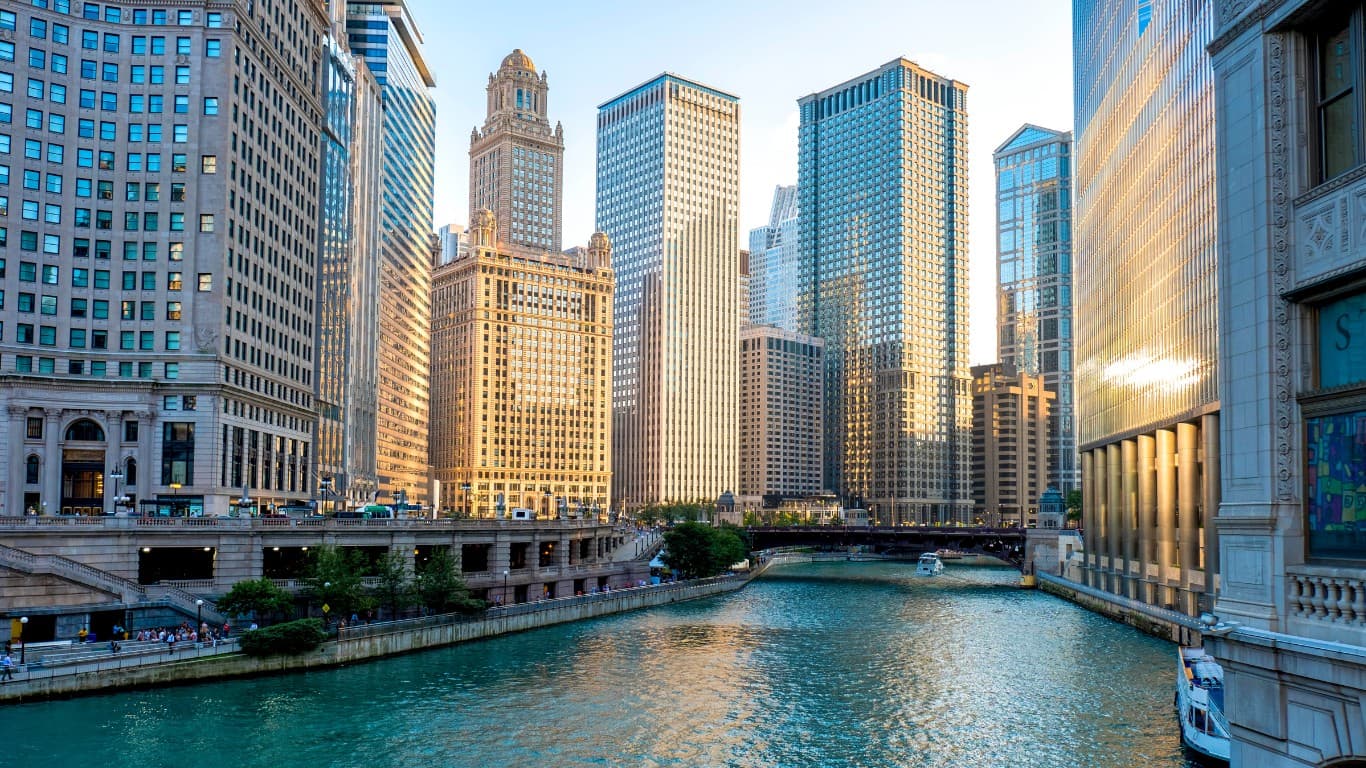
The 2026 Chicago real estate market is doing what no coastal US metro has been able to do: combine top-tier institutional employment, walkable urban fabric and a structurally lower price floor. The median sale price across the metro sits at $345,000, up 3. 2 percent year-on-year, with the prime North Side and Near North corridors materially higher.
Knight Frank's 2026 US Cities Prime Index flags Chicago as the most undervalued major US metro relative to peer-city employment depth.
The Chicago Association of Realtors and the brokerages dominating the prime side (Compass, Coldwell Banker, Berkshire Hathaway HomeServices Chicago, Sotheby's International Realty) describe a market that has stabilized through the rate cycle while continuing to attract value-driven capital. The contrast against Los Angeles and San Francisco pricing is now the migration story.
Anchor institutional employment (the University of Chicago, Northwestern, the financial-services sector, McDonald's and Boeing's downtown headquarters footprint, the medical district) sustains a stable demand floor. Mansion Global has profiled the Gold Coast and Lincoln Park corridors as among the most resilient mid-priced US prime submarkets.
- Chicago continues to offer significant relative value compared with other major US urban markets, with median prices well below those in New York, San Francisco and Los Angeles.
- We see population trends having stabilised after the recent decline, with the city now showing modest growth and the broader metropolitan area continuing its slow expansion.
- Lincoln Park, the Gold Coast and Streeterville continue to anchor the prime urban segment, with North Shore suburbs including Winnetka and Kenilworth holding the broader luxury market.
- Inventory has improved through 2025 and 2026, with months-of-supply moving toward balanced conditions and giving buyers more negotiating leverage than in recent years.
- Property tax burden remains a structural drag on Chicago ownership economics, with effective rates among the highest in the country offsetting the relative affordability of the housing stock.
- For most considered buyers we view Chicago as a relative-value play that warrants careful attention to the property tax structure before committing to acquisition decisions.
- Who is this for?
- Buyers and investors evaluating Chicago for primary residence or income property, alongside relocation clients and the brokers, lenders and tax advisers supporting Chicagoland transactions.
- What is happening?
- A market overview and 2026 forecast for the Chicago real estate market, covering price levels, inventory dynamics, the city versus suburb split and the property tax considerations.
- When did this emerge?
- The article covers conditions through 2025 and 2026, with reference to the recent population trend stabilisation and the latest property tax framework developments.
- Where is this happening?
- The piece focuses on the Chicago metropolitan area, including Lincoln Park, the Gold Coast, Streeterville, the North Shore suburbs and the broader Cook County submarket landscape.
- Why does it matter?
- Chicago offers significant relative value among major US urban markets in 2026, which is why understanding the offsetting property tax structure matters before any acquisition.
The Chicago housing market today
The median sale price of $345,000 obscures the wide range across neighborhoods. Prime North Side corridors (Gold Coast, Lincoln Park, Lakeview, Bucktown) trade meaningfully above the citywide median, while the South Side carries the value end. Days on market average 41 across the metro, with the prime corridor moving meaningfully faster.
The sale-to-list ratio of 98.4 percent confirms that quality stock continues to trade close to asking. Realtor.com's 2026 absorption tables place Chicago in the upper-middle range of large-metro buyer activity, with materially improved year-on-year momentum.
- Median sale price: $345,000, up 3.2 percent YoY
- Median list price: $385,000
- Average days on market: 41
- Sale-to-list price ratio: 98.4 percent
- Strongest demand: Gold Coast, Lincoln Park, Lakeview, Bucktown, Logan Square
Chicago neighborhoods defining 2026
Chicago operates as several distinct property markets stacked across the metro. The North Side prime corridor anchors the high end, while the West Loop and Logan Square redevelopment stories carry the mid-market. The brokers tracking the prime side flag five neighborhoods carrying the citywide narrative.
Gold Coast and Streeterville
Gold Coast and Streeterville remain the city's most coveted submarkets. Median sale prices on the prime condo and townhome stock clear $1. 35 million, with the trophy stock running materially higher.
Compass and Berkshire Hathaway HomeServices Chicago track these as the most resilient prime Chicago submarkets through the 2022-2024 rate cycle.
Lincoln Park
Lincoln Park remains the city's deepest family-buyer prime tier. Median home prices clear $1. 15 million, with restored 19th-century single-family stock and the larger townhome and condo product trading at premiums.
Christie's International Real Estate affiliate Berkshire Hathaway HomeServices publishes the cleanest segment data.
Lakeview
Lakeview, the broader corridor extending north from Lincoln Park to Wrigleyville, carries the city's strongest urban-walkable mid-market. The median home price sits at $725,000, up 3. 7 percent year-on-year.
Strong restaurant culture, transit access and the architectural depth of the building stock sustain demand.
Bucktown and Wicker Park
Bucktown and Wicker Park, the design-driven Near Northwest corridor, anchor the city's strongest gentrification arc. Median home prices sit between $625,000 and $735,000, with restored 1890s graystones trading materially higher. The buyer profile skews toward design-oriented professionals and creative-sector employees.
Logan Square and the West Loop
Logan Square and the West Loop carry the city's most active urban-redevelopment story. Median prices sit at $545,000 and $685,000 respectively. The West Loop's restaurant and tech-sector concentration, alongside Logan Square's family-buyer absorption, sustains demand in both submarkets.
Median prices and price per square foot
| Neighborhood | Median Listing Price | Price per SqFt |
|---|---|---|
| Lincoln Park | $925,000 | $540 |
| West Loop | $640,000 | $480 |
| Hyde Park | $320,000 | $280 |
| Logan Square | $515,000 | $360 |
| South Shore | $190,000 | $160 |
| Bucktown | $775,000 | $495 |
| Bronzeville | $350,000 | $270 |
| Wicker Park | $725,000 | $460 |
| Rogers Park | $240,000 | $220 |
| Avondale | $460,000 | $350 |
Chicago rental market in 2026
Average rent across the metro sits at $1,895 per month, up 3.4 percent year-on-year. One-bedrooms in the prime North Side corridor lease between $2,200 and $2,800, while the West Loop and Logan Square run from $1,750 to $2,300.
Vacancy stands at 5.4 percent, slightly tighter than the broader Midwest average. JLL's 2026 Midwest Multifamily Outlook flags Chicago as one of the more resilient large-metro rental markets through the second half of the decade.
What is shaping the Chicago map in 2026
Three structural forces drive the market. Anchor institutional employment (the University of Chicago, Northwestern, the medical district, financial services, McDonald's and Boeing's downtown headquarters) provides a stable demand floor. Value relocation from higher-cost coastal metros sustains the inbound capital flow.
Mortgage rates in the 6.5 to 7 percent range have rebalanced first-time buyer activity but not the prime tier, where cash-buyer share regularly exceeds 30 percent. Bloomberg has tracked the divergence between rate-sensitive sub-$500K activity and the relatively rate-insulated North Side prime corridor.
The city's ongoing transit and urban-redevelopment investment continues to reshape the West Loop, Logan Square, Pilsen and the Near West Side. Buyer attention has shifted meaningfully toward these corridors over the past three years.
What this means for buyers
Chicago in 2026 reads as a structurally undervalued major US prime market with improving absorption. Home prices are projected to rise 3 to 4. 5 percent through 2026, with the strongest gains in the prime North Side corridor and the West Loop and Logan Square redevelopment stories.
Rents are forecast to climb 3 to 4 percent.
For buyers comparing the broader picture in our US Real Estate Market Overview (2026), Chicago continues to read as the cleanest major US prime value play, particularly relative to its peer-city employment depth.
We last reviewed this analysis in May 2026.
Frequently asked questions
Is Chicago real estate undervalued in 2026?
Yes, materially. Median sale prices at $345,000 against peer-city employment depth at New York, Boston and Los Angeles levels make Chicago the most undervalued major US prime market per Knight Frank's 2026 US Cities Prime Index.
Which Chicago neighborhoods are appreciating fastest?
Lakeview leads the citywide rate at 3.7 percent, followed by Bucktown-Wicker Park and Logan Square. The prime North Side corridor (Gold Coast, Lincoln Park, Streeterville) appreciates more slowly at higher absolute prices and remains the city's prime anchor per Compass and Berkshire Hathaway HomeServices Chicago.
How does Chicago compare to coastal US prime markets?
Median sale prices run at roughly one-quarter to one-third of New York or Los Angeles equivalents, with comparable institutional employment, walkability and transit. Mansion Global has tracked the Gold Coast and Lincoln Park corridors as among the most resilient mid-priced US prime submarkets through the 2022-2024 rate cycle.
Is Chicago a good rental market in 2026?
Yes. Average rent of $1,895 with vacancy at 5. 4 percent gives reasonable rent-to-price ratios.
The prime North Side corridor and the West Loop have the tightest absorption per JLL's 2026 Midwest Multifamily Outlook.


Savvas Agathangelou
Savvas Agathangelou co-founded The Luxury Playbook and has spent years reporting from the prime postcodes the magazine covers — Mayfair, Knightsbridge, the Athens Riviera, Dubai's Palm crescents, and the southern Mediterranean coastlines where the world's wealthy keep coming back. His background is in international hospitality, and that frame shapes how he writes about property: the developer's choices, the architect's signature, the agency's bench of named brokers, the building's service standard once the buyer moves in. He files developer spotlights, agency profiles, and the seasonal "Properties That Defined" listicles, and he hosts the magazine's founder-and-leadership interviews on the Voices side.