
Variance tells you how wildly a stock’s returns swing around its average, giving you a clear read on volatility and risk. Covariance, on the other hand, shows you how two assets move in relation to each other. Together, these two metrics are among the most useful tools you can have as an investor.
Understanding both concepts helps you build a genuinely diversified portfolio, one that balances risk against reward in a way that actually holds up under pressure. Get this right, and your decision-making sharpens considerably across every financial move you make.
- Variance measures how much an individual stock’s returns fluctuate around its average return, capturing volatility as a single statistical number.
- Covariance measures how two stocks’ returns move together, with positive values indicating they tend to rise and fall in tandem over the observation period.
- Standard deviation, which is the square root of variance, is the most commonly cited volatility metric in finance because it returns to the same units as price.
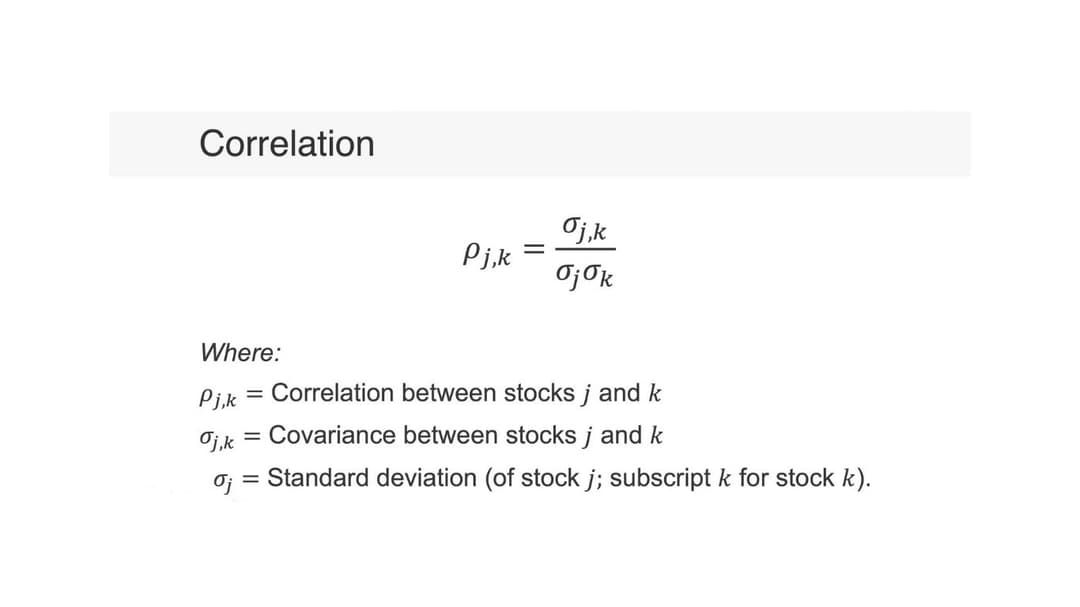
- Correlation is covariance normalised to a range between negative one and positive one, making it easier to interpret across stocks with very different volatilities.
- Modern portfolio theory uses covariance matrices to construct portfolios that minimise overall risk for a target return level across multiple assets.
- Understanding the distinction between variance and covariance is essential for any quantitative approach to portfolio construction, risk budgeting or factor analysis.
- Who is this for?
- Quantitative investors, finance students and self-directed individuals who want to understand the statistical building blocks behind portfolio construction and risk management in equity markets.
- What is happening?
- A clear explanation of variance, covariance, correlation and how each statistical measure is used in portfolio construction, risk analysis and modern investment theory across the markets.
- When did this emerge?
- Relevant whenever investors are building diversified portfolios, evaluating risk metrics or analysing the relationships between individual stocks within a sector or factor group.
- Where is this happening?
- Universal concepts applied across global equity, bond and commodity markets, with the most extensive academic and practitioner research drawn from US large-cap equity data sets.
- Why does it matter?
- Variance and covariance underpin the entire framework of modern portfolio theory, and clear understanding of both is essential for any investor moving beyond purely qualitative stock selection.
Understanding Variance in Stocks
The statistical machinery behind variance and covariance underpins almost every modern portfolio framework. Vanguard's research desk applies these tools across its model portfolios, and BlackRock's Aladdin platform is built on the same mathematical foundation at institutional scale.
The data inputs come from the major providers. S&P Global and MSCI publish the index returns most variance and covariance estimates draw from, and Morningstar covers how these statistics feed into fund-level risk metrics.
Variance is one of the most important concepts in finance, especially when you’re sizing up individual stocks. At its core, it measures how spread out a set of data points are around their average. For you as an investor, that means variance is your window into how volatile an asset really is and whether the risk profile matches your strategy.
When a stock carries high variance, you’re looking at big price swings and a rougher ride. Low variance signals stability, a stock that tends to stay close to its average return over time. Neither is automatically good or bad, but knowing which you’re dealing with changes everything about how you position it in your portfolio.
Variance Formula Explained
To calculate variance, you work out the mean of the squared differences between each possible return and the expected value. The standard variance formula used in financial analysis looks like this
σ² = Σ [(x, μ)² * P(x)]
Where:
σ²is the variance,xrepresents each number in the set,μis their mean, andP(x)estimates the probability ofx.
That formula is your foundation for quantifying volatility. Once you can put a number on risk, you can start making sharper, more confident calls about where to put your capital.
Key Applications of Variance in Financial Analysis
Variance shows up across financial analysis in more ways than most investors realize. It powers risk assessment, informs position sizing, and sits at the heart of modern portfolio theory. Every time a fund manager talks about volatility, variance is the math behind the conversation.
- Risk Assessment: It allows investors to measure stock risks, leading to better portfolio selection.
- Portfolio Diversification: Knowing variance aids in picking a mix of assets, reducing risk by combining varying volatility levels.
- Quantitative Trading: It’s used in algorithmic trading to predict price fluctuations and enhance profits.
Using variance in your analysis gives you a much deeper read on market behavior. You stop guessing and start making choices grounded in actual data about how an asset has moved and how it’s likely to move going forward.
And when you pair variance with covariance, the picture gets even clearer. These two measures working together are what allow you to build a diversified mix of cyclical and non-cyclical stocks that genuinely reduces your exposure to risk while keeping your return potential intact.
What is Covariance in Stocks
For deeper context, the breakdown in how variance and covariance feed into broader risk management is worth reading alongside this analysis.
Covariance is what tells you whether two stocks tend to rise and fall together or move in opposite directions. That relationship is everything for risk management. Professional portfolio managers at major institutions rely on covariance analysis daily to assemble portfolios that can absorb market shocks without falling apart.
Technically, covariance measures how the returns of two assets move in relation to each other over time. A positive covariance means the two stocks tend to move in the same direction. A negative covariance means when one goes up, the other tends to go down.
Getting your head around this distinction is one of the most practical steps you can take toward building a genuinely risk-reducing portfolio.
So here’s why it matters in practice. If you own two stocks with strong positive covariance, a bad day for one is likely a bad day for both. But if you hold assets with negative covariance, losses in one position can be cushioned by gains in another.
Portfolio managers use exactly this logic to assemble portfolios that hold up when markets get ugly.
How to Calculate Covariance
Calculating covariance requires a few clear steps. You start by finding the average return for each asset over your chosen time period. Then you calculate how much each individual return deviates from that average.
Multiply those deviations together for each time period, sum them all up, and divide by the number of periods. The Financial Times market data resources offer solid context for applying these calculations to real portfolio scenarios.
- First, find the average return for each stock within the period.
- Evaluate how far each return deviates from its average, for both stocks.
- Then, multiply these deviations together for corresponding times.
- Add these products together.
- Lastly, divide this sum by the total observations minus one.
The calculation captures how both assets interact with each other and reflects the magnitude of those interactions through their standard deviations. Done properly, it becomes the backbone of a diversification strategy that balances risk and return with real precision rather than guesswork.
Through careful covariance analysis, you start to see the hidden relationships between assets that aren’t obvious from looking at price charts alone. That insight is what separates reactive investors from strategic ones, and it’s central to understanding how mutual funds and managed portfolios are constructed for long-term stability.
Differences between Variance and Covariance in Stocks
Variance and covariance are two of the most foundational ideas in finance. They drive asset allocation decisions, shape diversification strategies, and give you a much sharper view of how financial markets actually behave. If you want to make truly informed investment decisions, these are the concepts worth mastering.
Purpose
Variance focuses on a single stock. It measures how much that stock’s returns spread out around their average, which tells you how volatile and risky that particular position is. High variance means you’re in for a bumpy ride.
Low variance means the stock tends to behave more predictably. Simple, but powerful.
Covariance, on the other hand, looks at two stocks at once and measures how their returns move in relation to each other. The relationship can go three ways. Positive covariance means both tend to move in the same direction.
Negative covariance means they tend to move in opposite directions. Zero covariance means the two assets move independently of each other with no meaningful relationship.
- Positive covariance indicates that the two stocks tend to move in the same direction.
- Negative covariance suggests that the stocks move in opposite directions.
- Zero covariance means there is no discernible relationship between the movements of the two stocks.
That distinction matters more than most investors give it credit for. Variance tells you about individual risk. Covariance tells you about how that risk behaves inside a larger portfolio. Portfolio theory is built on this difference, because real diversification isn’t just about owning many stocks. It’s about owning stocks that don’t all fall at the same time. You can read more about applying this thinking through understanding liquidity risk and how it interacts with portfolio construction.
Impact on Portfolio Diversification
Variance gives you the raw material for evaluating individual positions. It shows you how much risk each stock carries on its own, which helps you decide how much weight to give each one in your overall portfolio. That’s the starting point for any serious diversification effort.
Covariance takes that thinking to the next level. By examining how different assets move in relation to each other, you can identify combinations that genuinely reduce your overall exposure rather than just spreading capital around without purpose. According to Reuters markets analysis, this kind of deliberate portfolio construction consistently outperforms random diversification over longer time horizons.
- If the assets have high positive covariance, they are likely to increase and decrease together, which could amplify risk.
- Negative covariance is more desirable for diversification because it indicates that the assets move in opposite directions, which can reduce overall portfolio volatility.
Take a practical example. Say your portfolio holds Apple (AAPL) and Alphabet (GOOGL). Both are major tech names that tend to move together, meaning high positive covariance, which actually concentrates your risk rather than spreading it. Adding a utility stock with negative covariance to tech can act as a natural buffer when markets pull back, smoothing out the overall ride and protecting your capital when it counts most. That’s the real power of using disciplined portfolio strategies built around sound investment principles.
We last reviewed this analysis in May 2026.


Alex Tzoulis
Alex Tzoulis is Co-Owner and Markets Analyst at The Luxury Playbook, specializing in equities, crypto, forex, and global financial markets. His work focuses on analyzing macroeconomic trends, geopolitical developments, and monetary policy, translating them into actionable insights across both traditional and digital asset classes. He leads the platform's financial market coverage, providing structured analysis across stock market investing, trading strategies, and cryptocurrency markets. His expertise strengthens the publication's authority in financial markets and capital allocation, bridging traditional finance with emerging digital investment ecosystems.