
Knowing where money is moving is one of the smartest edges you can have as an investor. That’s exactly why so many serious players keep a close eye on ETF flows, which track the money going into or out of exchange-traded funds. These flows can show you where big institutional players, often called “smart money,” are putting their capital right now.
When you track them carefully, ETF flows reveal which parts of the market investors are favoring, what trends they expect to grow, and where they might be quietly pulling back.
In 2024, ETFs worldwide pulled in over $1.1 trillion in new money, the highest figure ever recorded. A large chunk of that went into funds focused on themes like artificial intelligence and clean energy, showing how investors are placing long-term bets on the stories they believe in most.
At the same time, some defensive sectors like consumer staples and utilities saw money leaving. That’s a signal that many investors were getting more comfortable taking on risk rather than hiding from it.
ETF flows aren’t just numbers on a screen. They’re real-time signals of what professional investors, including hedge funds, pension funds, and global asset managers, are doing with their money. Because these players often make moves ahead of broader market shifts, understanding the difference between smart positioning and speculation becomes much easier when you follow the flows.
And you also need to appreciate just how big the ETF market has become.
As of early 2026, ETFs hold more than $14 trillion globally, more than double what they held just five years ago. That means when money rushes into or out of ETFs, it can physically move the prices of the stocks, bonds, or commodities those funds hold. This is why following ETF flows isn’t just interesting.
It can actually give you a real edge over investors who aren’t paying attention.
In this article, we’ll break down exactly what ETF flows are, the different types of flows to watch for, how they reflect investor thinking, and how to analyze them properly. We’ll also weigh the pros and cons of tracking ETF flows and look ahead to trends and forecasts through 2026.
By the end, you’ll see why ETF flows are such a powerful way to understand where the market’s smart money is really headed.
ETF-flow data is one of the cleanest read-throughs into how institutional capital is positioning. BlackRock's iShares research and Vanguard's ETF reports both publish detailed flow data alongside fund methodology.
Independent and media coverage rounds out the picture. Morningstar tracks flows across the full ETF universe, and Bloomberg and The Financial Times both publish recurring features on what those flows signal about institutional sentiment.
What are ETF Flows?
For deeper context, the breakdown in how to translate ETF flow data into a portfolio strategy is worth reading alongside this analysis.
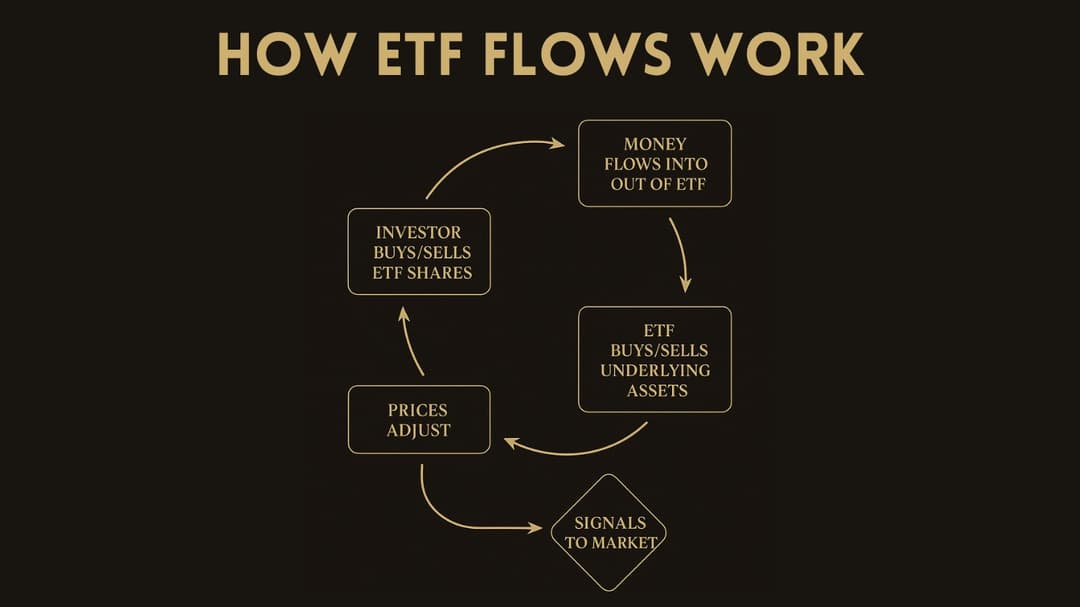
ETF flows simply show how much money is moving into or out of exchange-traded funds over a given period. When people or institutions buy shares of an ETF, money flows in. When they sell, money flows out. By tracking these flows across different funds, you can see which areas of the market are gaining momentum and which ones are quietly losing favor.
For instance, if large sums are flowing into ETFs focused on technology stocks, it suggests investors are growing more confident about the tech sector. On the flip side, if you’re seeing steady outflows from bond ETFs, it could mean investors expect interest rates to rise, making existing bonds less attractive to hold.
ETF flows are measured in net terms, meaning inflows minus outflows. That’s the number you want to focus on.
If an ETF sees $5 billion come in and $2 billion go out during the same period, the net flow is $3 billion in. Analysts track these net flows daily, weekly, and monthly to spot patterns before they become obvious to everyone else.
Why does this matter so much?
Because ETFs have become one of the primary tools investors use to quickly shift money between markets or strategies. Whether it’s moving into emerging markets, pulling money out of small caps, or chasing a megatrend like clean energy, ETF flows make those moves visible. That gives you a real-time glimpse of what the big players are doing, often before the headlines catch up.
You can find the best stock market investing tools to help you track these signals more efficiently.
Types of ETF Flows
When people talk about ETF flows, they usually group them into different types based on what they reveal. Getting familiar with these types makes it much easier to figure out what’s really happening behind the scenes.
Sector and Industry Flows show where money is moving among different parts of the stock market. If there’s a big inflow into healthcare ETFs alongside an outflow from energy ETFs, it suggests investors think healthcare will outperform in the near term. This is one of the most closely watched flow types because it highlights sector rotation, the process of moving money from one sector to another to chase better returns.
Asset Class Flows track money moving between broad categories like stocks, bonds, commodities, or real estate. In early 2026, for instance, equity ETFs saw roughly $460 billion in net inflows, while bond ETFs pulled in around $300 billion. That mix tells you whether investors are chasing growth through equities or looking for safety and income through bonds.
Regional Flows show where investors want geographic exposure. Global data from Q1 2026 showed strong inflows into European equity ETFs, up around 28% compared to the same period the prior year, driven by improving economic data and lower energy prices. Meanwhile, emerging market flows were more mixed, with some countries seeing outflows tied to political risk.
Thematic and Strategic Flows cover money moving into ETFs following specific trends or strategies like clean energy, artificial intelligence, or dividend growth. In 2024, thematic ETFs attracted nearly $270 billion globally, a clear sign of how investors are using ETFs to place long-term bets on the trends they believe will define the next decade.
Defensive vs. Risk-On Flows give you another lens. By comparing money moving into defensive areas like utilities or consumer staples against risk-on plays like tech or small caps, you can gauge the overall mood of the market. When money floods into low-volatility ETFs, that’s usually a sign rising caution is spreading through investor ranks.
Breaking down flows this way lets you see not just where money is going, but also why it’s moving in that direction.
How ETF Flows Reflect Investor Sentiment
ETF flows give you one of the clearest windows into what investors are thinking and feeling about the markets right now. When big sums start pouring into certain ETFs, it usually means investors are either chasing an opportunity or seeking safety. Either way, it’s a real-time signal of sentiment that’s hard to fake or ignore.
Look at 2024 and early 2026 as a prime example. As inflation pressures eased and central banks hinted at cutting rates, money started moving out of defensive sectors like consumer staples and into growth areas like technology and industrials.
Global tech-focused ETFs saw over $120 billion in net inflows in 2024 alone, the highest figure for any sector that year. That told you, in plain terms, that investors were becoming more confident about the economic outlook. According to Bloomberg’s ETF markets data, this kind of sector-level flow concentration is increasingly being used by professional traders as a leading indicator.
ETF flows can also reveal fear when it takes hold. During periods of uncertainty like geopolitical flare-ups or surprise economic data, investors often rush into bond ETFs or funds holding gold. In just two weeks during March 2026, U.S. Treasury ETFs gathered nearly $25 billion, a direct reflection of investors moving fast to protect their portfolios.
Then there’s the “crowded trade” angle. Sometimes huge inflows into a specific area can actually be a warning sign that too many investors are piling onto the same side.
When the story changes and everyone tries to get out at once, markets can get fragile fast. During the AI boom in late 2024, flows into AI-themed ETFs surged over 150% compared to the prior year, raising real concerns among analysts that those trades were getting dangerously overheated. This is also where understanding your own psychological biases as an investor becomes critically important.
Because ETFs are so widely used by institutional investors like hedge funds and pension funds, the flows often reflect decisions by professionals with deep research teams and fast information access. Watching where this money moves gives you genuine clues about the market’s overall mood, often before it shows up in prices.
In short:
- Heavy inflows into riskier ETFs = growing optimism or “risk-on” mood.
- Surges into bonds, gold, or defensive sectors = rising caution or “risk-off” mood.
- Extreme flows into popular themes = watch for potential reversals if sentiment shifts.

How to Analyze ETF Flows
Knowing that ETF flows can reveal investor sentiment is powerful. But the real value comes from learning how to analyze them yourself. The good news is you don’t need complicated tools. You just need a clear process and attention to a few key details.
1. Look at Net Flows Over Time. Start by tracking net inflows and outflows across different time frames, from daily and weekly to monthly and quarterly.
Large, sustained inflows into a sector ETF often point to growing conviction. Seeing consistent net inflows into financial ETFs over three straight months, for example, might signal that investors believe rising rates or loan growth will lift bank earnings.
2. Compare Flows to Total Assets. A $500 million inflow sounds impressive, but it means something very different if the ETF only has $2 billion in total assets versus $50 billion.
By looking at flows as a percentage of an ETF’s total assets, you get a much sharper sense of how significant the move really is.
This is often called the flow-to-AUM ratio. A spike above 5% in a single week can indicate a meaningful shift in investor positioning worth paying close attention to.
3. Watch for Unusual Spikes. Sudden surges in flows, up or down, often signal a change in sentiment or a reaction to fresh news.
In early 2026, a surprise rate cut by the European Central Bank led to $18 billion in new money flowing into European equity ETFs in just two weeks, showing how fast professional investors can reposition when the macro picture shifts. The Financial Times covers these kinds of macro-driven ETF moves in real time.
4. Pay Attention to Themes. Flows into thematic ETFs tied to clean energy, robotics, or AI can highlight where investors are seeing long-term opportunity.
Tracking these consistently can help you spot major trends before they become crowded.
5. Check Cross-Asset Flows. Seeing how flows move between stocks, bonds, and commodities at the same time is equally important.
If money is leaving equity ETFs and moving into bond ETFs simultaneously, that’s usually a caution flag for the stock market worth taking seriously.
6. Use Flow Dashboards and Summaries. Many financial research platforms offer free or subscription-based ETF flow dashboards that break down where money is moving by region, sector, or asset class.
Checking these summaries each week makes it far easier to spot the bigger picture without getting lost in daily noise. ETF.com’s fund flows tool is one of the most widely used free resources for this.
By following these steps, tracking net flows, measuring them relative to fund size, watching for spikes, and seeing how money moves across asset classes, you can start using ETF flows as a real and repeatable part of your investment research process.
Pros and Cons of Tracking ETF Flows
Keeping an eye on ETF flows can be a smart way to understand where the market is heading. But like any tool, it has both strengths and real weaknesses you need to know about.
| ✅ Pros | ❌ Cons |
|---|---|
| ✅ Shows real money moves: ETF flows reveal actual buying and selling, not just opinions or forecasts. | ❌ Can lag prices: Often by the time flows are large, prices have already moved. |
| ✅ Highlights big investor trends: Because ETFs are used by institutions, flows often show where professional investors are positioning. | ❌ Sometimes misleading: Big inflows might be driven by short-term traders, not long-term conviction. |
| ✅ Easy to track: Many platforms publish flow data daily and weekly, making it simple to monitor. | ❌ Doesn’t explain “why”: Flows tell you money is moving, but not always the reasons behind it. |
| ✅ Helps spot sector rotation: Watching flows can reveal when investors shift from one sector to another, like from tech to energy. | ❌ Prone to short squeezes or herding: Sharp inflows can create crowded trades that quickly reverse. |
| ✅ Useful for confirming market mood: A jump into defensive ETFs can back up other signs that investors are getting cautious. | ❌ May overstate impact: Big flows into large ETFs often don’t move the market much by themselves. |
ETF Trends and Forecasts Through 2026
Looking ahead, ETF flows are set to keep growing at a strong pace through 2026, driven by both professional and retail investors who want low-cost, flexible ways to move capital across markets.
1. Total Assets Likely to Pass $14 Trillion. As of early 2026, global ETF assets already sit at about $14 trillion, up from $12.8 trillion in early 2025.
Based on current growth rates of roughly 15% per year, the market could push toward $16 trillion by the end of 2026. Much of this growth is being fueled by investors moving money out of traditional mutual funds and into ETFs for their lower fees and simpler trading mechanics. You can see how this shift connects to broader wealth management trends in our coverage of why HNWIs are rethinking their public market allocations.
2. Thematic ETFs Will Keep Gaining Share. In 2024, thematic ETFs pulled in nearly $270 billion, making up about 24% of all net flows globally.
That trend shows no sign of slowing. Sectors like AI, cybersecurity, green energy, and space exploration are attracting new ETF launches almost every month. Analysts expect thematic ETFs could capture close to 30% of net inflows by the end of 2026.
3. Fixed Income ETFs Growing Even Faster. Bond ETFs are seeing a strong surge as well.
In Q1 2026, bond ETFs gathered roughly $80 billion, up around 18% compared to the same quarter the prior year. With interest rates stabilizing, many investors are using ETFs to lock in yields without having to pick individual bonds. Some forecasts put global fixed income ETF assets topping $3 trillion by the end of 2026, up from about $2.3 trillion at the start of the year. Reuters covers these fixed income flow trends closely as part of its broader funds reporting.
4. More Institutional Adoption. Pension funds, insurance companies, and sovereign wealth funds are steadily increasing their use of ETFs.
This institutional wave is expected to push ETF market share even higher through 2026. By year end, some estimates suggest that 1 in every 4 dollars managed by large institutions could be sitting in ETF structures.
The data paints a clear picture. ETFs aren’t just growing. They’re reshaping how money moves through the world’s markets.
Watching ETF flows over the next two years will likely become even more essential for anyone serious about spotting early market shifts before they become obvious to everyone else.
FAQ
Can ETF flows be misleading?
A big inflow doesn’t always mean lasting interest, it could just be traders piling in for a quick trade. That’s why it helps to watch flows over longer periods and compare them to total fund size.
How can I track ETF flows?
Most large financial news sites and data platforms have ETF flow dashboards. These show net flows by day, week, month, sector, or region. Many are free or low-cost, making it easy to follow money trends without advanced tools.
Are ETF flows the best indicator of where the market is going?
They’re one of the most useful tools, but not the only one. It’s smart to combine ETF flow data with fundamentals, earnings, interest rates, and macro trends to build a clearer view.
We last reviewed this analysis in May 2026.


Alex Tzoulis
Alex Tzoulis is Co-Owner and Markets Analyst at The Luxury Playbook, specializing in equities, crypto, forex, and global financial markets. His work focuses on analyzing macroeconomic trends, geopolitical developments, and monetary policy, translating them into actionable insights across both traditional and digital asset classes. He leads the platform's financial market coverage, providing structured analysis across stock market investing, trading strategies, and cryptocurrency markets. His expertise strengthens the publication's authority in financial markets and capital allocation, bridging traditional finance with emerging digital investment ecosystems.