Fine Wine’s €30 Billion Market Offers What Equities Can’t
By Stefanos Moschopoulos··9 min
Alternative assets promise something public markets simply cannot deliver through any combination of diversification or active management: tangible scarcity, genuinely finite supply, and returns that don’t live or die based…
AuthorStefanos Moschopoulos
Published11 April 2026
Read9 min
SectionFine Wine
Alternative assets promise something public markets simply cannot deliver through any combination of diversification or active management: tangible scarcity, genuinely finite supply, and returns that don’t live or die based on the next Federal Reserve meeting or quarterly earnings season.
Fine wine has become the clearest example of what separates real assets from financial securities. It has moved from collector hobby into a recognized institutional investment category with measurable performance characteristics and established infrastructure behind it.
The latest Bain and Company and Altagamma Fine Wines and Restaurants Market Monitor puts the global fine wine market at €30 billion in 2024, making it a small but strategically significant slice of the €1.48 trillion global luxury sector.
What makes that valuation worth paying attention to is this: fine wine accounts for merely 1.5% of total wine volume yet captures 11% of total value. That tells you exactly how much capital concentrates in an extremely narrow, high-quality tier where scarcity and quality command serious premiums.
The Moore Global Wine Report for 2026 reinforces the transition from niche to institutional asset class, finding that fine wine offers low correlation with traditional markets while delivering 8% to 10% average annualized returns over the past fifteen years with lower volatility than equities and minimal correlation to bond markets.
Table of Contents
Key Takeaways
Navigate tabs
The global fine wine market reached €30 billion in 2024, representing just 1.5% of worldwide wine volume but 11% of total value — highlighting its scarcity-driven pricing power.
Over the past 15 years, fine wine delivered 8–10% annualized returns with lower volatility and minimal correlation to equities and bonds, proving its role as a powerful diversifier.
The 2022 market shock exposed the failure of the traditional 60/40 portfolio as both stocks and bonds fell together, while fine wine stayed stable and protected capital.
Institutional adoption is accelerating thanks to bonded storage, insurance, digital provenance, and regulated wine funds offering professional-grade access.
The global “drink less, but better” trend is increasing long-term demand for premium wines despite falling consumption volumes, pushing the market toward €35–40 billion by 2030.
Fine wine’s supply naturally shrinks as bottles are consumed — creating a permanent and structural scarcity that traditional financial assets cannot replicate.
Who:
Institutional investors, family offices, and private collectors seeking tangible, inflation-resilient diversification.
What:
Fine wine as a regulated, yield-stable alternative asset with low correlation to traditional financial markets.
When:
Accelerating rapidly from 2022–2025 as the breakdown of the 60/40 model pushed investors into uncorrelated alternatives.
Where:
Concentrated in global fine wine hubs — Bordeaux, Burgundy, Champagne, Tuscany, and Napa Valley — supported by platforms such as Liv-ex and managed wine funds.
Why:
Because fine wine combines finite supply, consistent returns, and consumption-driven scarcity, offering a defensive and uncorrelated return profile equities cannot match.
The €30 Billion Market Built on What Stocks Lack
The correlation characteristics that matter most to portfolio construction show up consistently across independent research, not just in marketing materials from firms selling wine investment products.
Moore Global’s 2025 analysis states bluntly that fine wine is now “increasingly viewed as a stable, tangible asset” with low correlation to traditional markets and “consistent performance across multiple economic cycles.”
Cult Wines’ 2024 performance study reinforces this, showing wine investment has delivered roughly 10% average annual returns since 1988 with a noticeably smoother ride than equities experienced over the same period.
Goldman Sachs-aligned research cited by Cult Wines in 2026 extends this analysis further, demonstrating that fine wine stayed uncorrelated and often outperformed during major financial crises. That reinforces its role as a genuine diversifier rather than simply another risk-on asset that collapses the moment equities do.
Academic work, including research by Bouri and colleagues examining whether wine makes a sound investment choice, similarly finds that fine wine can function as a hedge or even a safe haven against equity downside risk in certain market regimes.
The contrast with traditional portfolio construction becomes painfully clear when you look at recent performance. In 2022, both stocks and bonds fell together, with classic 60/40 portfolios losing around 18% to 24% according to data from Morningstar, Nasdaq, and MarketWatch. That was the worst stretch in many decades for a strategy built entirely on the assumption that stocks and bonds move in opposite directions during stress periods.
Fine wine, by its fundamental nature and market structure, remained largely insulated from this kind of systematic macro beta that drove the synchronized collapse.
At the same time, supply constraints create structural advantages that equities can never replicate regardless of corporate governance or regulatory changes. Wine production faces inherent limits from vineyard acreage, vintage weather conditions, and minimum aging requirements that determine when bottles can even reach the market.
The International Organisation of Vine and Wine estimates global wine consumption at just 214 to 214.2 million hectoliters in 2024, the lowest level since 1961, while production fell to around 225 to 226 million hectoliters, also a six-decade low.
This means the total reservoir from which fine wine gets drawn is shrinking in absolute terms, even before you account for the bottles consumed each year that permanently exit available supply.
Stocks and bonds move in the opposite direction, with supply expanding rather than contracting over time. Companies routinely issue new shares through secondary offerings or convertibles, diluting existing shareholders. Governments continuously issue new debt to finance deficits, expanding bond supply with each budget cycle.
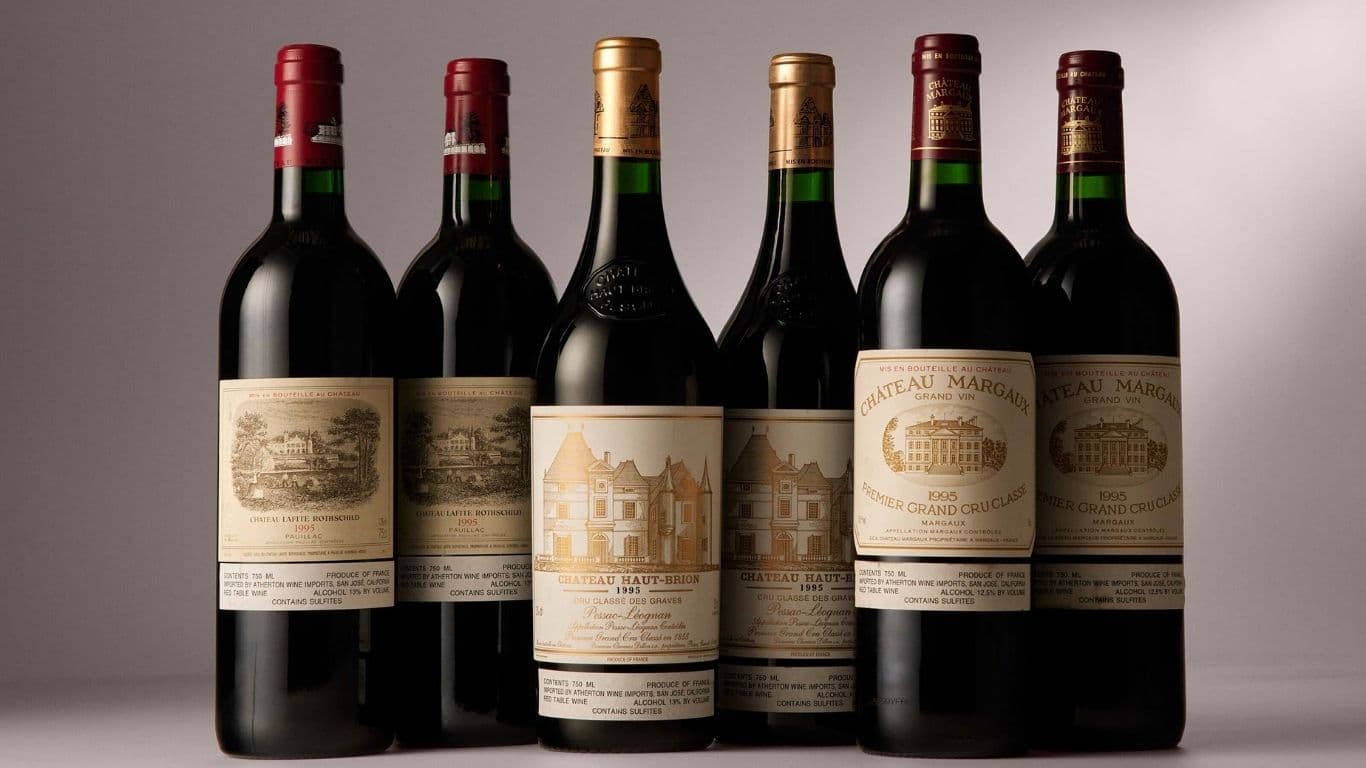
A bottle of Château Lafite 2015 is a fixed historical fact. Once bottled, supply only decreases as bottles get consumed or damaged. You will not find any equivalent of secondary stock issuance or debt refinancing in the wine cellar.
How Financial Uncertainty Drives Alternative Asset Demand
Recent years have brutally exposed a structural weakness in textbook 60/40 stock-bond portfolios that generations of financial advisors presented as reliable, diversified strategies for all market environments.
In 2022, both global equities and bonds fell sharply together, delivering the worst 60/40 performance in modern history at roughly negative 18% to 24% peak to trough depending on specific index construction. Reports from the CFA Institute and other professional bodies explicitly acknowledge that the assumed negative correlation between stocks and bonds broke down precisely when investors needed diversification most, during the inflation shock and aggressive rate hiking cycle.
That correlation breakdown explains why assets like fine wine are rapidly moving from “interesting hobby for wealthy collectors” toward strategic allocation tools that institutional portfolio managers take seriously. Goldman-aligned analysis and Cult Wines’ 2026 portfolio diversifier study demonstrate that fine wine stayed genuinely uncorrelated to equities and held up comparatively well across multiple crisis periods, from the Global Financial Crisis through COVID and the recent inflation shock. And it did this while still delivering consistently positive long-run returns rather than just providing crisis protection at the cost of performance drag.
Moore Global’s Future of Wine report documents global wine consumption falling to 214.2 million hectoliters in 2024, the lowest in sixty years, as wellness trends, health consciousness, and changing lifestyle preferences cut overall volume. Yet the same analysis, using Statista projections, forecasts global wine market revenues rising from $347.1 billion in 2026 to $412.9 billion by 2027, representing 18.9% growth despite volume declines.
This “drink less, but better” shift channels increasing amounts of money into premium and fine wine segments, exactly where you want your allocations concentrated, while mass market and entry-level wines face structural demand destruction.
At the pyramid’s apex, Bain and Altagamma show fine wine already at €30 billion with expectations to reach €35 billion to €40 billion by 2030, implying 4% to 6% compound annual growth. The segment has delivered more than twofold price appreciation over the past decade, outpacing other luxury asset categories including handbags and jewelry that receive far more media attention. If you want to explore which fine wine types make the strongest investment case, the opportunities are broader than most investors realize.
The institutional infrastructure supporting serious capital allocation has matured fast in ways that remove barriers that previously kept regulated funds and conservative portfolios from accessing the asset class. Moore Global and Bain both emphasize how quickly professional frameworks around fine wine have developed.
Bonded storage, comprehensive insurance, and digital provenance tracking have become standard expectations rather than premium features. Platforms like Liv-ex, specialist investment funds, and regulated collective schemes such as Oeno’s wine fund create established routes for institutional capital to enter the space with appropriate governance, custody, and liquidity provisions. That said, knowing how to spot and avoid wine fraud remains a critical part of protecting any serious allocation.
For portfolio managers and family offices evaluating allocation decisions, this infrastructure development moves wine from “interesting side bet for enthusiasts” toward a legitimately allocatable asset class with defined custody arrangements, transparent pricing mechanisms, and viable exit options comparable to what they expect from traditional alternatives like private equity or real estate.
The Investment Case Equities Structurally Cannot Match
As fine wine cements its position as a strategic asset class, the institutional infrastructure around custody, insurance, provenance verification, and liquidity platforms keeps maturing in ways that make allocation increasingly straightforward for investors. The combination of 8% to 10% historical returns, equity-uncorrelated performance, tangible physical scarcity, and consumption-driven appreciation creates an investment proposition that is simply unavailable in any stock portfolio, regardless of diversification strategy, sector allocation, or geographic exposure across public markets.
The structural differences here are not matters of degree but of kind. Fine wine operates under completely different supply dynamics, value drivers, and risk factors than financial securities. And that is precisely the point.
If you are seeking genuine diversification beyond correlation arithmetic and into fundamentally different return sources, fine wine delivers characteristics that equity markets structurally cannot replicate. No matter how your portfolio managers construct their holdings or which factors they target for exposure, the supply clock on a great vintage keeps ticking in only one direction.
Stefanos Moschopoulos is the Founder and Head of Editorial at The Luxury Playbook, specializing in fine assets and alternative investments. His work focuses on analyzing luxury asset classes such as art, watches, collectibles, and yachting as structured investment vehicles, aligning them with broader wealth-building strategies.
He leads the editorial direction of the publication, ensuring all content around alternative assets is data-driven, macro-aware, and investment-focused. His expertise lies in translating niche luxury markets into clear frameworks for portfolio diversification, long-term capital preservation, and asymmetric returns within non-traditional asset classes.