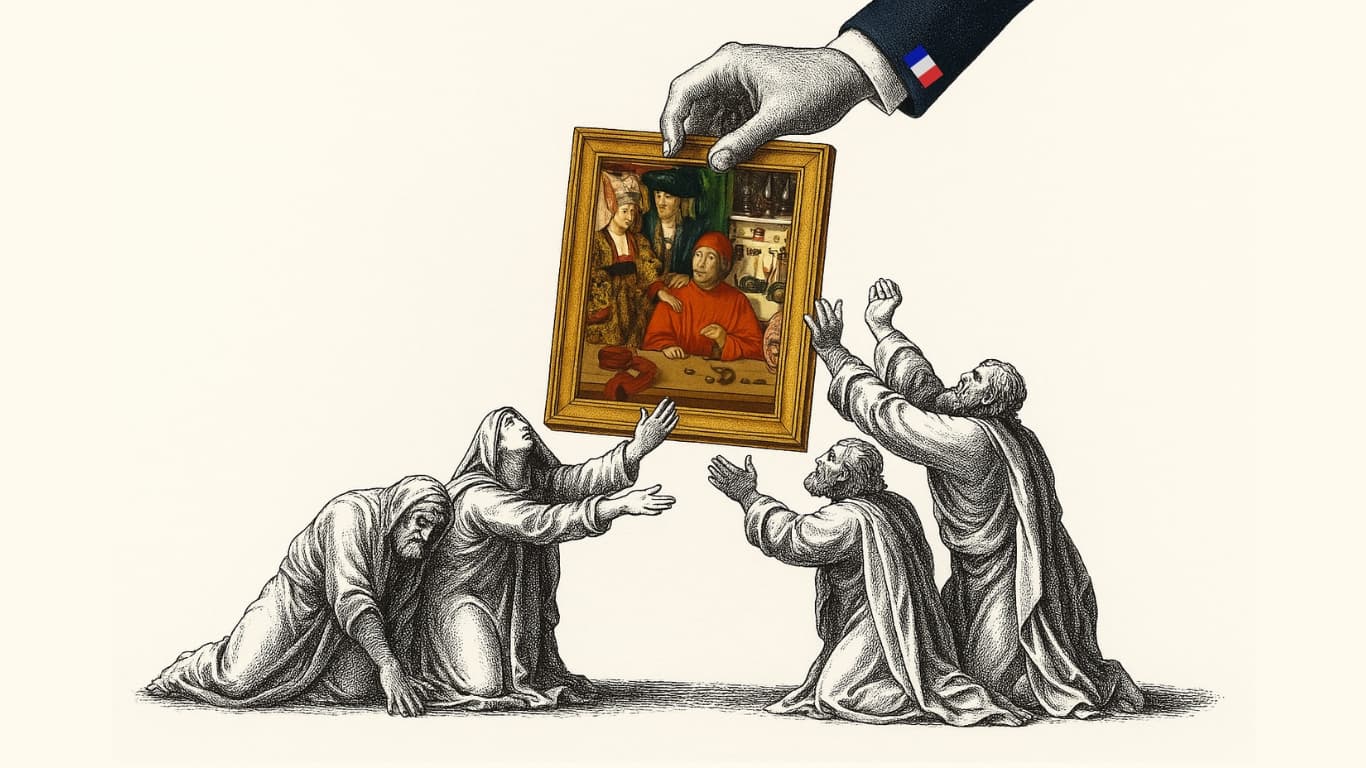
France's proposed wealth-tax extension to fine art has produced the most serious threat to the European Union's largest art market in a generation. The trade's reaction has been emphatic for a reason: France accounts for the largest single share of EU art-market activity, and the proposed structural change would reroute transactions to London, Switzerland, and the United States within a single cycle.
The proposal, in its current form, would extend France's existing impôt sur la fortune immobilière (IFI) framework to capture art and luxury collectibles above specific thresholds. The Comité Professionnel des Galeries d'Art, the FrenchAuctioneers federation, and Art Basel's France-resident gallery cohort have collectively flagged the structural risk. Christie's, Sotheby's, and Phillips have privately raised the same concern.
- France’s proposed wealth-tax extension to fine art has produced the most serious threat to the European Union’s largest art market in a generation.
- France accounts for the largest single share of EU art-market activity, and the proposed change would reroute transactions to London, Switzerland and the United States within a single cycle.
- The proposal would extend the existing impot sur la fortune immobiliere framework to capture art and luxury collectibles above specific net-worth thresholds.
- The Comite Professionnel des Galeries d’Art, FrenchAuctioneers and Art Basel’s France-resident gallery cohort have collectively flagged the structural risk.
- The structural drivers of France’s position include Paris’s institutional density, the Art Basel Paris revival and the cluster of mega-gallery operations in the Marais and the 8th arrondissement.
- If enacted in current form, the trade’s working expectation is a multi-cycle redistribution of transaction venue and resident collector base across London, Switzerland and beyond.
- Who is this for?
- French and international collectors, galleries and advisors tracking the proposed wealth-tax extension and its potential impact on the European Union’s largest art market.
- What is happening?
- An editorial read on France’s art-tax proposal and its potential to collapse the EU’s largest market, covering the legislative framework, the structural risk and the expected redistribution.
- When did this emerge?
- Most relevant as the French legislative cycle on the IFI extension evolves and during the major fair and auction cycles in Paris that the proposal would most directly affect.
- Where is this happening?
- Centred on the Paris market and the broader French institutional, gallery and auction-house network, with alternative venues anchored in London, Geneva, Luxembourg and the United States.
- Why does it matter?
- Reading the tax proposal correctly matters because the structural risk to the largest EU market is real and the response would reshape European collecting for at least a cycle.
What the proposal would actually do
The current French wealth tax (IFI) is restricted to real estate. The proposed extension would bring fine art, classic cars, wine collections, and other categories of luxury collectibles into the same valuation framework above specific net-worth thresholds, with the tax computed as an annual levy on holdings.
The trade's analysis is that the structural effect would be to push French-resident collectors to either restructure holdings through international entities, move material to free-port storage outside France, or simply relocate the underlying collection to jurisdictions with more art-friendly tax frameworks.
The Art Newspaper and Le Monde have both tracked the legislative cycle in detail. The political viability of the proposal varies with the broader fiscal context, but the trade is treating the structural risk seriously regardless of the immediate legislative timeline.
What France currently is in the EU market
France is the EU's largest art market by sales value, accounting for the dominant share of the segment's total activity. The Art Basel and UBS Global Art Market Report tracks the figure annually, and France has held first or second position in EU rankings for the past decade.
The structural drivers are Paris's institutional density, the resurgence of Art Basel Paris, the cluster of major mega-gallery operations in the Marais and the 8th arrondissement, and the cultural infrastructure that the Fondation Louis Vuitton, the Pinault Collection, and the Fondation Cartier collectively anchor. Our piece on private foundations reshaping European markets sets out the institutional context.
The 2025 Art Basel Paris results, which our coverage of trends defining 2026 traces in detail, confirmed France's structural lead within the EU segment. The proposed wealth-tax extension arrives precisely at the moment when the market is most visibly strong.
What the trade expects to happen
If the proposal is enacted in its current form, the trade's working expectation is a multi-cycle redistribution of transaction venue and resident collector base. London, Switzerland, Luxembourg, and the United States are the most likely beneficiaries, with each absorbing material that would otherwise have transacted in or through France.
The gallery segment would feel the effect first. The major mega-galleries operating in Paris, Hauser & Wirth, Pace, Zwirner, Gagosian, Lehmann Maupin, White Cube, Thaddaeus Ropac, would likely shift sale activity to their London, Geneva, or international operations. The independent French galleries, which depend on a French-resident collector base, would face more acute pressure.
The auction-house response would be staggered. Christie's, Sotheby's, and Phillips would likely retain their French sale calendars but at lower volumes, with major consignments routing toward London or other venues where the tax exposure is materially lower.
The free-port and entity-structuring response
The mature collectors we cover are already mid-cycle in restructuring their holdings against the regulatory risk. The pattern is consistent: holdings move to free-port storage in Geneva or Luxembourg, ownership routes through entities domiciled in art-friendly jurisdictions, and the underlying collection becomes geographically separated from the resident collector.
For collectors managing the operational complexity, our art collecting tax guide sets out the broader framework. The trade strongly advises specialist counsel for any French-resident collector with material above a meaningful threshold.
The structuring is not new. French collectors have used Swiss free ports for decades, and the operational machinery is mature. What is new is the urgency: collectors who had been on multi-year restructuring timelines are now accelerating to single-cycle deadlines.
The institutional and foundation effect
The Fondation Louis Vuitton, the Pinault Collection, the Fondation Cartier, and the Lafayette Anticipations all operate within structured legal frameworks that the proposed tax extension is intended not to affect. The foundation segment's institutional protections are robust.
The private collector base supporting those foundations is more exposed. Collectors who lend to foundation exhibitions, sponsor acquisitions, and operate within the broader institutional infrastructure are typically wealth-tax-exposed in their personal capacity. The proposed extension would change their cost-benefit calculation materially.
The longer-term institutional risk is that the cultural infrastructure that has built up around Paris over the past decade depends on a French-resident wealth base that the proposed tax could partially displace.
The political context
The French wealth-tax debate is a structural fixture of the country's political cycle, and the periodic proposals to extend the IFI framework to collectibles have surfaced before. The current iteration is more legislatively advanced than prior proposals, which is why the trade is treating it with more concern.
The structural argument the trade is making, that the tax would redirect activity rather than raise revenue, is consistent with the IFI's historical performance: the original 2018 ISF-to-IFI transition produced meaningful capital flight in the relevant categories without sustained revenue gains.
The Comité Professionnel des Galeries d'Art and the broader trade infrastructure are lobbying actively against the extension. The outcome of the legislative cycle will be visible across the 2025 and 2026 calendar.
The contagion question
If France enacts the extension, the question for the broader EU segment is whether Germany, Italy, Spain, or the Nordic jurisdictions follow. The trade's working assumption is that the political viability varies by country, but the precedent effect would be meaningful.
The countries most likely to follow are those with similar wealth-tax frameworks and similar art-market profiles. The Spanish wealth tax does not currently cover fine art at the relevant thresholds, but the political climate could change. The Italian segment has its own structural fragility that the trade has been tracking.
For US-resident collectors, the parallel concern is the tariff and customs landscape. Our piece on how US tariffs are reshaping the market covers the comparable structural pressure from a different angle.
The connection to the broader market
The France question sits within the broader market reset that our coverage of the 2024 sales decline and collector optimism tracks. Regulatory friction is one of the multiple forces redistributing transaction activity across jurisdictions.
The cumulative effect is a more geographically distributed market, more reliance on free-port storage and entity structuring, and more institutional coordination across foundations and major collectors. The France proposal would accelerate trends that are already in motion.
What this means for collectors
The French wealth-tax extension is a structural risk that the trade is taking seriously regardless of the immediate legislative outcome. Collectors with French exposure should be talking to specialist counsel now about restructuring, free-port storage, and the operational machinery that supports a more internationally distributed holding.
For non-French collectors, the proposal is a useful reminder that the regulatory environment is now a first-order factor in collection structuring rather than an afterthought. The collectors who emerge well-positioned from the current cycle are the ones treating jurisdiction, structuring, and storage as integral to acquisition decisions.
We last reviewed this analysis in May 2026.
Frequently Asked Questions
What is France's proposed wealth tax extension on art?
The proposal would extend France's existing impôt sur la fortune immobilière (IFI) framework to capture fine art, classic cars, wine collections, and other categories of luxury collectibles above specific net-worth thresholds. The tax would be computed as an annual levy on holdings rather than a transaction tax.
How would the tax affect the French art market?
The trade's expectation is a multi-cycle redistribution of transaction venue and resident collector base. London, Switzerland, Luxembourg, and the United States would absorb material that would otherwise have transacted through France. The mega-galleries operating in Paris would likely shift sale activity to their London or international operations.
Are French collectors already restructuring?
Yes, in significant volume. The pattern is consistent: holdings move to free-port storage in Geneva or Luxembourg, ownership routes through entities domiciled in art-friendly jurisdictions, and the underlying collection becomes geographically separated from the resident collector. The structuring infrastructure is mature; what has accelerated is the urgency.
Could other EU countries follow France?
Politically uncertain, but the precedent effect would be meaningful if France enacts the extension. Germany, Italy, Spain, and the Nordic jurisdictions all have wealth-tax frameworks that could be extended to include collectibles, though political viability varies by country. The trade is treating the contagion risk seriously.


Stefanos Moschopoulos
Stefanos Moschopoulos founded The Luxury Playbook in Athens and has spent the better part of a decade following the auction calendar, the en primeur releases, and the watchmakers, gallerists, and shipyards the magazine covers. He writes the field guides and listicles that anchor the Connoisseur section — pieces built on Phillips and Christie's results, Liv-ex movements, and conversations with collectors he has met across Geneva, Bordeaux, Basel, and Monaco. His own collecting habits sit closer to watches and wine than art, and it shows in the level of detail in the magazine's coverage of those categories. Under his direction, The Luxury Playbook now publishes long-form field guides, market-defining year-end listicles, and the Voices interview series with the founders behind the houses and the brands.