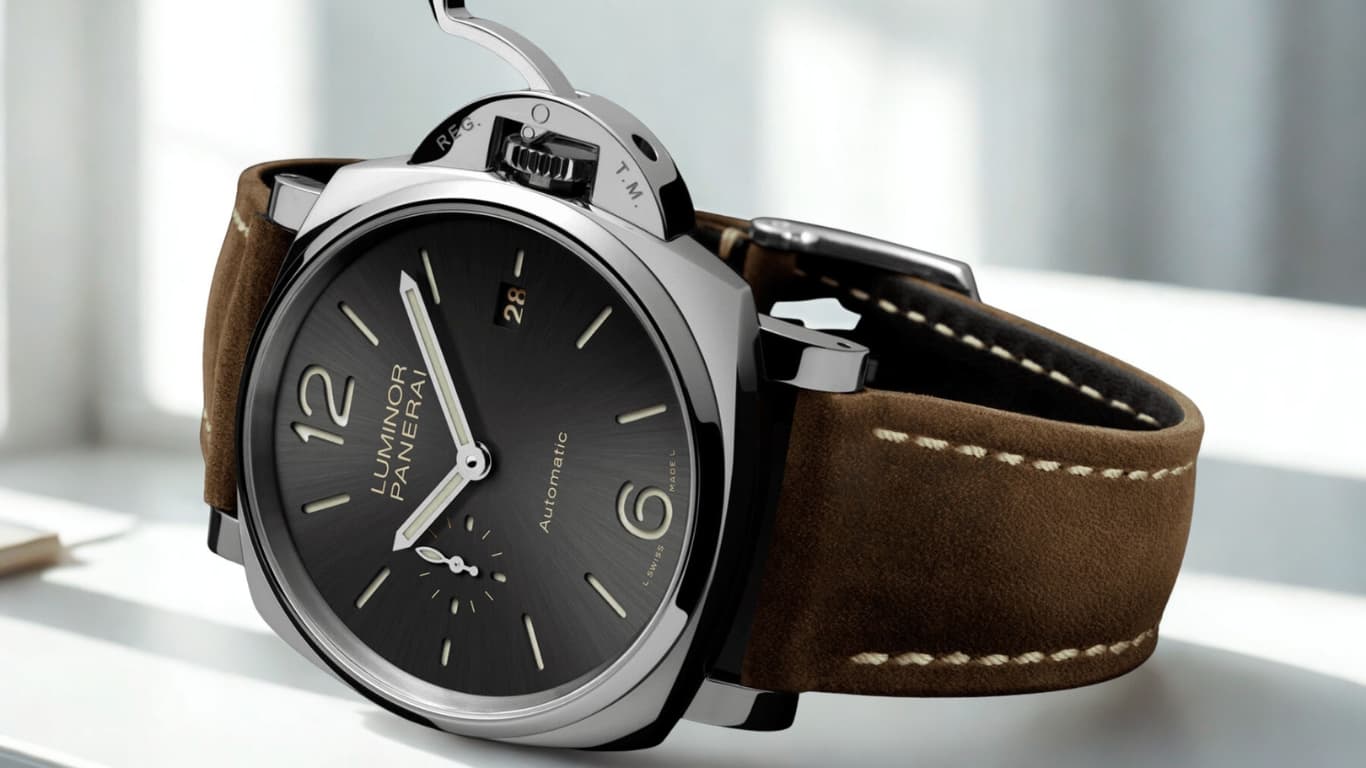
How Panerai evolved from Italian naval issue to luxury maker is one of the more interesting brand-history arcs in modern watchmaking. The original Panerai operated as a small Florentine watchmaker producing instruments and watches for the Italian Royal Navy from the 1930s through the post-war period. The wartime Radiomir Pre-Vendome models worn by Italian frogmen remain some of the most documented military diving watches in horological history.
- Panerai evolved from Italian naval issue watchmaker into a modern luxury brand through the 1990s Vendome acquisition and the subsequent Richemont stewardship that continues today.
- The original 1936 Radiomir, the 1950 Luminor, and the modern PAM00111 Luminor Marina anchor the historic-to-modern evolution, with the cushion-case architecture remaining throughout.
- Pre-Vendome Panerai references from the 1990s, including the original PAM 5218-201/A and PAM 5218-205/A, draw serious collector competition with documented provenance leading.
- We see the modern Luminor Marina PAM00111 as the strongest single Panerai entry available, with the in-house P.5000 calibre and Italian-naval heritage combined at meaningful pricing.
- Limited-edition Panerai Submersible Bronzo and Mare Nostrum references continue to outperform the broader catalogue on the secondary market, with material innovation driving demand.
- Manufacturer pricing discipline has held on the most coveted references, with Panerai secondary values stabilising after the broader post-2022 reset across the luxury watch category.
- Who is this for?
- Panerai collectors at every tier, Italian naval-heritage enthusiasts, and serious students of late-twentieth-century luxury watch brand evolution.
- What is happening?
- A grounded read on how Panerai evolved from Italian naval issue to modern luxury, covering the Radiomir, Luminor, pre-Vendome 5218, and modern PAM00111.
- When did this emerge?
- Panerai evolved from naval issue to modern luxury across the 1990s and 2000s, with the modern Richemont catalogue continuing to anchor the brand position through 2026.
- Where is this happening?
- Authorised Panerai boutiques globally stock the modern catalogue, while Phillips, Christie's, and dedicated Italian specialists handle the pre-Vendome market.
- Why does it matter?
- Panerai offers architectural cushion-case originality and documented Italian naval heritage at pricing that supports serious long-term collector positioning across the catalogue.
The post-war Panerai continued operating at modest scale until 1993, when the brand was relaunched as a contemporary luxury maker. The 1997 acquisition by Richemont gave the modern Panerai its current institutional infrastructure. Across the three decades since, the brand has navigated a long arc from civilian curiosity to credible mid-tier Swiss watchmaker.
The collectors we hear from tend to weight three eras differently. The wartime references anchor the upper tier of vintage Panerai. The 1993-1997 Pre-Vendome production sits as the second collecting tier.
The post-Richemont catalogue is the contemporary brand most current buyers actually engage with.
The wartime references and the Decima Flottiglia MAS heritage
The original wartime Radiomir references anchor the upper tier of vintage Panerai collecting. Produced for the Decima Flottiglia MAS frogman unit during World War II, the references combined the cushion case, the wire lugs, the sandwich dial construction (the radium-coated lower disc glowed through the cut-out upper disc), and the original Rolex movements supplied to Panerai under sub-contract.
Clean wartime references with credible provenance trade between $50,000 and $500,000-plus at Phillips and Christie's, depending on documented military issue. The Decima MAS frogmen used Panerai instruments in some of the most documented underwater military operations of the period, including the December 1941 attack on the British battleships HMS Valiant and HMS Queen Elizabeth in Alexandria harbour.
That historical anchor is not marketing reconstruction. The Royal Italian Navy archive, the various post-war military histories, and the documented surviving examples all confirm the operational record. Serious collecting treats documented military-issue provenance as the upper-tier consideration across the broader vintage market, and the Panerai wartime references sit firmly in that tier.
The Pre-Vendome 1993-1997 references
The Pre-Vendome production run from 1993 to 1997 sits as the second tier of vintage Panerai collecting. Produced after the 1993 relaunch but before the 1997 Richemont acquisition, the PAM 002, PAM 005, and the various early Pre-Vendome references in single-digit annual production anchored the brand's transition from military supplier to civilian luxury maker.
Clean Pre-Vendome examples trade between $30,000 and $80,000 depending on reference and condition. The rarer Pre-Vendome variants, particularly the gold-cased references and the documented limited editions from the period, can clear $100,000 at the specialist dealers. Phillips' Geneva sales have handled Pre-Vendome references in dedicated lots more than once across recent years.
The Pre-Vendome era matters because it represents the brand's transition from military supplier to civilian maker without the institutional support that Richemont later provided. The watches read as transitional objects: the cushion case, the sandwich dial, and the over-engineered diving credentials all anchor to the wartime heritage; the civilian execution and the modest annual production reflect the brand's pre-institutional scale.
The modern Panerai catalogue and the 2010s drift
The post-Richemont catalogue evolved gradually across the 2000s and 2010s into the contemporary Panerai. The brand briefly drifted through the 2010s with too many releases and too many marketing-led variants. The past five years have seen substantial discipline tightening, with the contemporary Submersible, Luminor Marina, and Radiomir lines anchored around the brand's authentic Italian-Navy heritage rather than the broader marketing register.
The current contemporary references, the Submersible PAM 1305, the Luminor Marina PAM 1312, the Radiomir PAM 1334, the various P.9000-series in-house movements, represent the most considered modern Panerai watchmaking in years. The cushion case, the sandwich dial construction, and the over-engineered diving credentials all read as authentic to the brand's military-supplier heritage.
The P.9000-series manufacture movements are the most credible technical work the brand has produced. The architecture earns the comparison to the better mid-tier Swiss manufactures. Pricing across the contemporary catalogue runs from roughly $8,500 in the entry Luminor references through $25,000 and beyond in the upper Submersible and Radiomir variants.
The Submersible and the contemporary diving register
The Panerai Submersible anchors modern dive-watch collecting from the brand. The Submersible PAM 1305 and the various current references extend the line. The over-engineered diving credentials, the screw-down crown bridge that has been a Panerai signature since the wartime period, and the cushion case construction all read as authentic to the brand's heritage.
For collectors weighting the diving register, the Submersible is the contemporary Panerai we would actually recommend. The execution earns the comparison to the better Swiss diving propositions. The brand's authentic naval heritage gives the reference a foundation few competitors in the price band can match.
The serious-collector subset and what holds attention
For modern Panerai, the references that come up most consistently in serious collector conversation are the Submersible and Luminor Marina references with the contemporary in-house movements, the Radiomir for collectors weighting the historical case construction, and the various P.9000-movement variants. The serious collector tier within Panerai sits in a particular subset of the broader catalogue.
For vintage, the Pre-Vendome references and the wartime Radiomir pieces with credible documented provenance anchor the considered vintage tier. Box-and-papers documentation matters. Service-network access through Panerai's authorised facilities is the practical baseline.
Original bracelets and straps matter, particularly on the wartime and Pre-Vendome references where original components are rare.
What this means for collectors
The longer story collectors recognise is that Panerai's evolution has been substantial across nearly a century. The brand's transition from Italian naval supplier to modern luxury maker has been handled credibly across the past three decades. The contemporary catalogue's renewed focus on the brand's authentic heritage represents the most considered modern Panerai watchmaking in years.
The collectors who navigate the Panerai catalogue well tend to weight the heritage references, the wartime Radiomirs and the Pre-Vendome production, alongside the contemporary in-house-movement work. That combination delivers a credible Panerai collecting register that earns the brand's place in serious collections.
For buyers entering the brand today, the contemporary Submersible, Luminor Marina, and Radiomir lines with the P.9000-series movements are the references we would actually recommend. The marketing-led variants of the 2010s drift are a different conversation. We last reviewed this analysis in May 2026.


Stefanos Moschopoulos
Stefanos Moschopoulos founded The Luxury Playbook in Athens and has spent the better part of a decade following the auction calendar, the en primeur releases, and the watchmakers, gallerists, and shipyards the magazine covers. He writes the field guides and listicles that anchor the Connoisseur section — pieces built on Phillips and Christie's results, Liv-ex movements, and conversations with collectors he has met across Geneva, Bordeaux, Basel, and Monaco. His own collecting habits sit closer to watches and wine than art, and it shows in the level of detail in the magazine's coverage of those categories. Under his direction, The Luxury Playbook now publishes long-form field guides, market-defining year-end listicles, and the Voices interview series with the founders behind the houses and the brands.