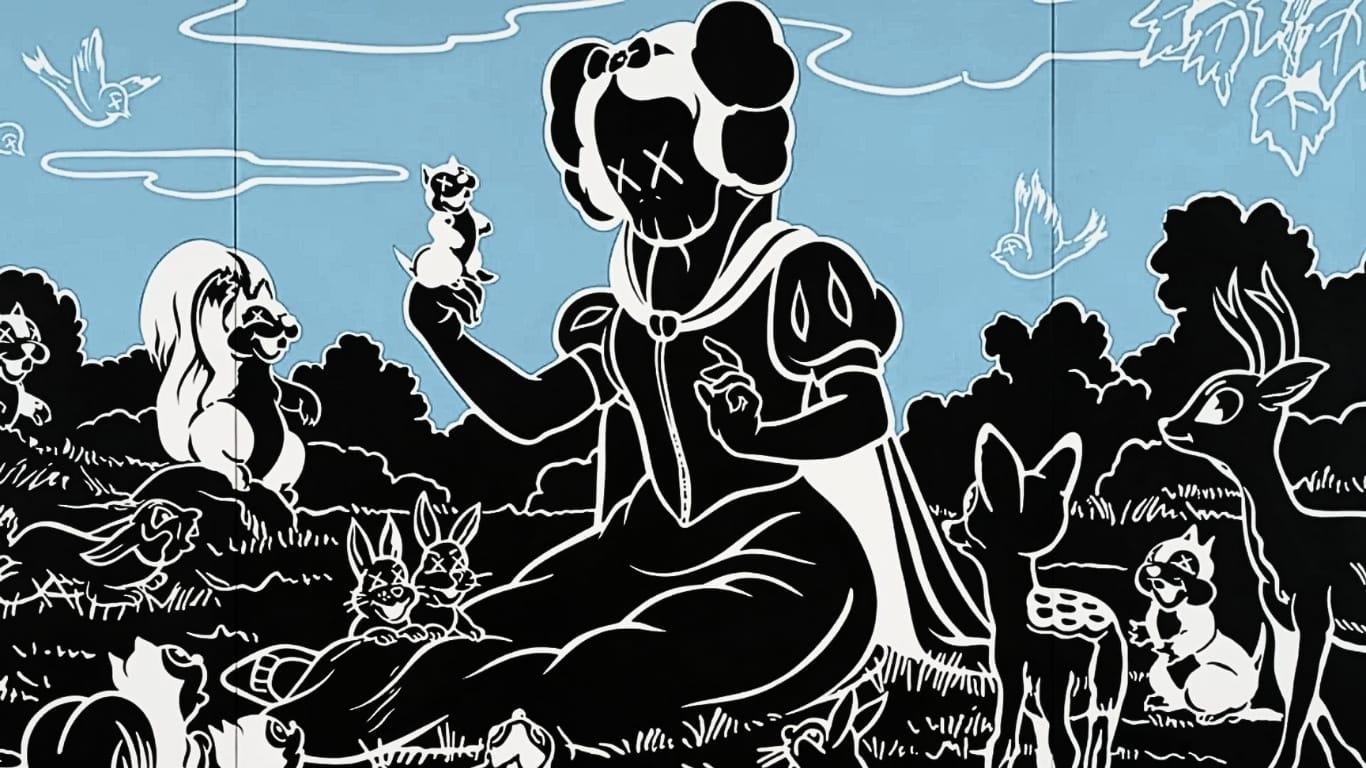
KAWS sits in an uncomfortable spot for serious collectors. The figures move freight: a 2019 Sotheby's Hong Kong sale of a KAWS canvas cleared $14. 7 million, well past pre-sale estimates, and the secondary market for the figures and editions has been deep enough to sustain real volume through three distinct market cycles.
The question is whether the work belongs in a long-horizon collection or whether the figures are a moment whose market memory will fade.
The 2024 Hiscox Online Art Trade Report tracked KAWS as one of the most-traded contemporary names by transaction volume, with the editions and figures accounting for a meaningful share of the activity. The conversation is not whether the market exists. It is what kind of market it actually is.
- KAWS sits in an uncomfortable spot for serious collectors, with the figures moving real volume and the broader question being what kind of market this actually is.
- A 2019 Sotheby’s Hong Kong sale of a KAWS canvas cleared fourteen point seven million dollars, well past pre-sale estimates and remaining the trophy benchmark.
- Brian Donnelly built his market across three distinct channels: the gallery-anchored canvas practice, the COMPANION and CHUM figure programme and the public-art programme.
- The institutional record has thickened past the point of accident, with Brooklyn Museum, the Modern Art Museum of Fort Worth, the Mori Art Museum and NGV Melbourne all engaged.
- The canvases trade with mid-six and low-seven-figure clearings consistently, while the figures and editions trade with depth that genuinely resembles a print market.
- Donnelly sits structurally within the lineage from Warhol through Murakami, with the market historically rewarding artists who blur fine art and broader cultural production.
- Who is this for?
- Contemporary collectors and advisors weighing KAWS as either a serious long-horizon inclusion or a speculative moment whose market memory may eventually fade.
- What is happening?
- An editorial read on KAWS figures as hype, cult or lasting collection, covering the three-channel market, the institutional record, the secondary depth and the speculative caution.
- When did this emerge?
- Most relevant around the contemporary editions sales at Phillips, Sotheby’s and Christie’s and during major KAWS public-art events and museum survey cycles.
- Where is this happening?
- Centred on the New York, London and Hong Kong salesrooms at the three major houses, with institutional anchors including Brooklyn Museum and the Mori Art Museum.
- Why does it matter?
- Reading the KAWS case correctly matters because the three-channel market is unusual and the long-horizon inclusion decision requires careful separation of the unique work from the editions.
What the KAWS market actually is
Brian Donnelly built his market across three distinct channels that, taken together, look like nothing else in contemporary art. The first is the gallery-anchored canvas practice, represented at Skarstedt, Perrotin and Pace at different points, with major institutional support including the recent Brooklyn Museum survey and museum acquisitions across Asia.
The second is the figure programme, manufactured at scale across the COMPANION and CHUM character families, sold in editions that range from the genuinely small to the deliberately large. The third is the public-art programme: the giant inflatables in Hong Kong harbour, Mount Fuji, Doha, Brooklyn Bridge Park, each one functioning as both an artwork and a marketing event.
That tri-channel structure is unusual. Most contemporary artists with serious secondary depth have not built parallel mass-market and trophy-tier channels in the same way.
The case for serious inclusion
The institutional record has thickened past the point of accident. Brooklyn Museum, Modern Art Museum of Fort Worth, the Mori Art Museum, NGV Melbourne and others have either acquired or staged surveys, and the catalogue scholarship has grown around the work in a way that early-career critics rarely predicted.
The auction depth is real. The 2019 Sotheby's Hong Kong record was an outlier, but the broader secondary market for the canvases has sustained mid-six and low-seven-figure clearings consistently. The figures and editions trade with depth that genuinely resembles a print market, with comparable lots clearing through the major editions specialists at Phillips, Sotheby's and Christie's repeatedly each season.
The cohort placement matters too. Donnelly sits structurally within the lineage that runs from Warhol through Murakami, and the market has historically rewarded artists who blur the line between fine-art practice and broader cultural production. Our coverage of luxury brands reshaping the contemporary art market and of street art's move from wall to museum covers the broader cultural shift.
The case for caution
The figure market has produced moments of speculative excess that look exactly like what speculative excess always looks like. Edition releases that cleared at single-digit multiples of issue price on the day of release, followed by sharp drawdowns in the secondary market, have happened multiple times across the COMPANION programme.
That volatility is not, by itself, an argument against the work. It is an argument for being honest about which segment of the KAWS market a buyer is actually entering. A canvas with strong institutional provenance behaves differently to a recent edition acquired through a primary-market drop.
The other caution is generational. KAWS is the rare contemporary artist whose primary collector base genuinely skews younger than the traditional contemporary-art buyer. Whether that base ages into the broader collecting cohort, or whether the next generation builds its own cohort, will determine the long-run depth of the market.
Reading the segments separately
Treating the KAWS market as one thing is the easiest mistake. The unique canvases, painted over years and held in deep institutional and private collections, trade with the depth of an established contemporary name. The series figures, manufactured at scale, trade with the depth of a print market.
The recent editions trade with the depth of a primary-market collectible.
Each segment has a different liquidity profile, a different relationship to institutional legitimation, and a different volatility footprint. The frameworks that apply to limited-edition prints are closer to the right lens for the figures than the frameworks that apply to single canvases.
What the secondary market data actually says
The major auction houses report KAWS results across both their post-war and contemporary day sales and their dedicated editions sales. The unique canvases have cleared consistently in the mid-six to low-seven-figure range with occasional outliers; the larger figures clear with similar depth in the editions context. The Hiscox Online Art Trade Report has tracked the volume across both segments at scale.
The conservative way to read those numbers is to anchor on the institutional record. Works with documented institutional provenance, museum exhibition history, and depth of comparables have held up structurally; the speculative end has not. The pattern is unsurprising.
What this means for collectors
KAWS belongs in a serious contemporary collection. The qualifying word is "serious": the buyer has to be specific about which segment of the market they are entering, why, and how it fits the rest of the collection. The unique canvases and the early figure work with documented institutional provenance can sit comfortably alongside the contemporary art movements that defined 2025 and the broader cohort of names with a deep institutional record.
The recent editions are a different conversation. They can be a legitimate point of entry into the artist's broader practice, but they should not be confused with the segment that drives the auction record. The contemporary art field guide sets out the framework for thinking about the difference.
Hype, cult, or lasting collection: KAWS is plausibly all three, depending on which segment of the work the collector engages. The collectors who understand the distinction tend to do well over time.
Frequently asked questions
How much do KAWS canvases typically sell for at auction?
Unique KAWS canvases have cleared consistently in the mid-six to low-seven-figure range at the major houses, with significant outliers including the 2019 Sotheby's Hong Kong $14.7 million result. The largest works with deep institutional provenance trade at the top of that range; smaller canvases anchor the middle.
Are KAWS figures considered fine art or collectibles?
The institutional answer is increasingly fine art: Brooklyn Museum, the Modern Art Museum of Fort Worth and others have accessioned KAWS work, and the major auction houses sell the figures alongside more conventional contemporary lots. The market answer is more nuanced: the unique canvases behave like fine art, the editions and figures behave like a print market.
Has the KAWS market peaked?
The 2019 Hong Kong peak in the canvas market has not been recently repeated, but the broader depth of the secondary market has held. The Hiscox Online Art Trade Report continues to track KAWS as one of the most-traded contemporary names by volume.
What should a first-time KAWS buyer look at?
Documented institutional or major-gallery provenance, full edition documentation including signature and edition number, condition reports for any work that has been on display, and a clear understanding of which segment of the market the work belongs to. The frameworks for limited-edition prints apply directly to the figures.
We last reviewed this analysis in May 2026.