
When most people think of McDonald’s, their mind goes straight to burgers and fries. Fair enough. But behind that familiar golden logo sits one of the most quietly powerful real estate empires on the planet, and if you’re a investor, that’s the part worth paying attention to.
By the end of 2024, McDonald’s was running 41,822 restaurants across 119 countries, with roughly 95% of them franchised. That franchising model is where the real magic happens, because it turns McDonald’s into a landlord at a global scale. The company owns around 45% of the land and 70% of the buildings that house its restaurants worldwide, collecting rent from franchisees whether the McFlurry machine is working or not.
McDonald’s Real Estate Snapshot, 2024 vs. Q1 2026
What you’re about to read isn’t the McDonald’s story you learned in business school. This is a look at the real estate engine powering one of the world’s most recognized brands, and the numbers will likely shift how you think about the company entirely. Whether you’re evaluating it as a stock, a business model case study, or a masterclass in asset strategy, there’s plenty here to dig into.
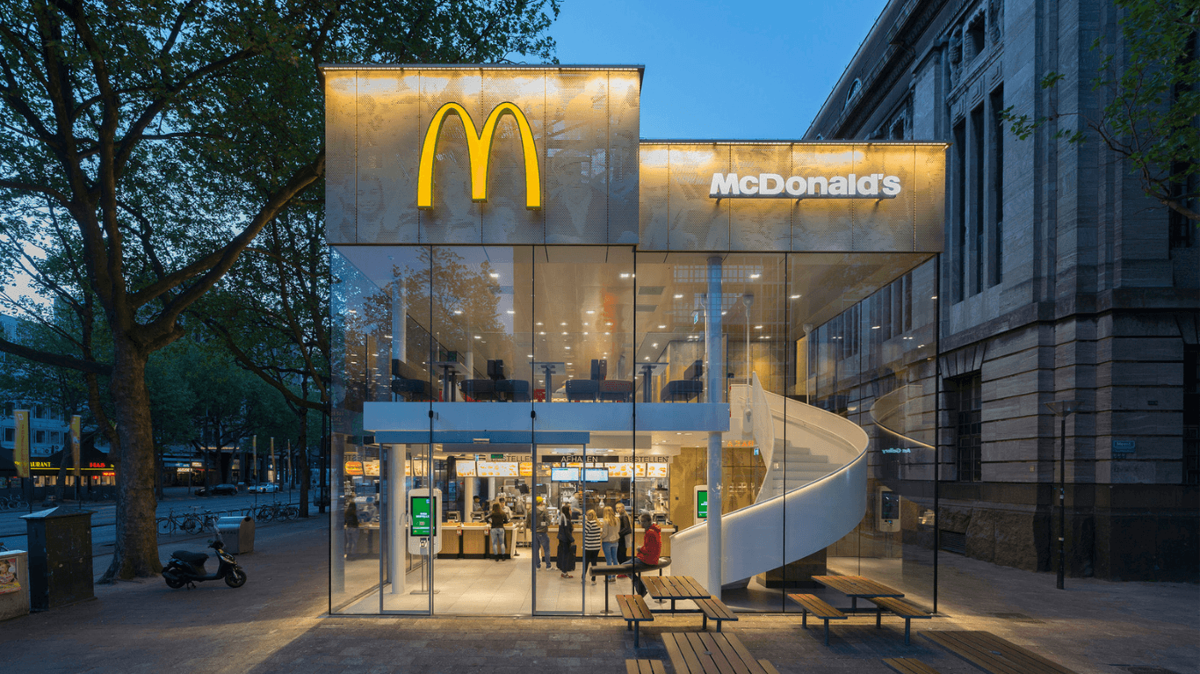
McDonald is among the 10 largest Real Estate holders in the world measured by total assets as per Sovereign Wealth Fund.
- McDonald’s economics rely as much on the underlying real estate footprint as on burger margins in any given quarter.
- The corporation typically owns or controls the land and building, then leases the location to the franchisee at a defined rent.
- Rent is the single most stable revenue line on the consolidated income statement, behaving more like an annuity than a restaurant business.
- The model lets McDonald’s capture both the inflation in real estate values and the operating energy of independent franchisees.
- For investors, the stock blends a global brand royalty stream with one of the largest single-tenant property portfolios on the planet.
- The structure is studied across single-tenant net-lease investing and franchise economics as a benchmark of disciplined capital deployment.
- Who is this for?
- Real estate investors, franchise operators and equity analysts who want to look past the consumer brand and see the property engine.
- What is happening?
- We are pulling apart the dual identity of McDonald’s as both a global quick-service brand and one of the largest landlord platforms in the world.
- When did this emerge?
- The real-estate-led model was crystallized in the 1950s and has compounded across more than six decades of unit growth.
- Where is this happening?
- The footprint covers roughly 100 countries, with the largest concentration of owned real estate sitting in the United States.
- Why does it matter?
- Understanding this model reframes how we value franchise operators and explains why McDonald’s commands a premium multiple over restaurant peers.
The Real Estate Powerhouse
The McDonald's franchise-and-real-estate hybrid is one of the most studied business models in modern finance. S&P Global credit research consistently flags the company's property portfolio as a structural credit positive, separate from same-store sales performance.
Bloomberg and the Financial Times have both traced how this dual-engine model influences corporate strategy across other quick-service franchises. Bloomberg coverage notes that the real-estate income alone underwrites a meaningful share of the company's cash-flow profile in any given year.
Here’s the thing most people miss. About 95% of McDonald’s restaurants around the world aren’t run by corporate at all. They’re operated by franchisees.
So who controls those prime corner lots and high-traffic locations? McDonald’s does. The company steps in as the landlord, acquiring the land and buildings, then leasing them directly to its franchise operators.
That single structural decision is what quietly elevated McDonald’s into the ranks of the world’s most formidable commercial real estate players, a status that gets almost no attention compared to its burger sales.
Key Facts and Figures
- A Slice of the Pie: As of September 2021, McDonald’s directly owns a substantial share of the land upon which their restaurants are situated, amounting to an impressive 45%. The remaining 55% is strategically leased from various landlords.
- A Revenue Goliath: In 2020, the company collected nearly $3.78 billion in rental income from their franchisees. This isn’t merely a percentage; it’s a staggering 27% of their total revenue for the year. An income stream of this magnitude is the envy of any real estate magnate.
- Strategic Prowess: McDonald’s doesn’t leave its real estate decisions to chance. Their locations are meticulously selected, often occupying high-traffic street corners and other prime spots. This strategic real estate portfolio ensures the perpetual desirability and value of their assets.
- Investor-Friendly Leases: Lease agreements for McDonald’s franchisees typically span 20 years, and they come with multiple renewal options. This enduring income stream offers a level of financial stability rarely found in other real estate investments.
- Economic Insulation: In times of economic turmoil, owning a McDonald’s franchise may suffer from a dip in profitability due to reduced consumer spending. However, the rental income from franchisees remains remarkably stable, providing McDonald’s with a robust financial buffer during challenging economic climates.
- Risk Mitigation: Owning valuable land and buildings shields McDonald’s from financial risks. In cases where a franchisee faces difficulties, McDonald’s can swiftly identify a new operator for the location, ensuring a consistent rent flow.
The Investor’s Perspective
For deeper context, the breakdown in why HNWIs treat real estate as a core allocation is worth reading alongside this analysis.
McDonald’s real estate model comes with a set of advantages that are genuinely hard to replicate. Here’s what makes it stand out from an investor’s point of view
- Diversified Income Stream: McDonald’s isn’t solely dependent on the prosperity of its restaurants. Their real estate income diversifies their revenue streams and safeguards against economic volatility.
- Capital Appreciation: Over time, the value of their real estate assets appreciates, adding a substantial layer of wealth creation. Investors have the opportunity to benefit from both steady income and capital appreciation.
- Operational Control: Owning the land and buildings affords McDonald’s control over the maintenance and appearance of their locations, allowing them to maintain a consistent and appealing brand image.
- Adaptability: With control over their real estate, McDonald’s can swiftly adapt to evolving market conditions by relocating or resizing their restaurants, ensuring they stay competitive and profitable.
- Risk Mitigation: Owning valuable real estate assets can act as a buffer against financial risks. If you own or invest in properties, ensure you have contingency plans in place to deal with tenant failures or economic downturns. Having a strategy for quick property turnover can help maintain steady income.
The world sees McDonald’s as a fast food giant. But once you understand the real estate layer underneath, the story gets a lot more interesting. Owning roughly 45% of the land its restaurants sit on, while pulling in a steady stream of rental income from thousands of franchisees, gives McDonald’s a kind of financial stability that pure restaurant operators can only dream about. It’s a model that blends predictable cash flow with long-term asset appreciation, and for investors thinking beyond the obvious, that combination is genuinely compelling. If you’re already thinking about real estate as a wealth-building tool, McDonald’s offers a fascinating lens on how large-scale property strategy can quietly anchor a global enterprise. The Financial Times coverage of McDonald’s financials and deep dives from Bloomberg’s McDonald’s analysis both point to the same conclusion, that the real estate portfolio is a core pillar of the company’s resilience. And as Forbes has noted, this isn’t accidental. It’s a deliberate, decades-long strategy that continues to pay off in ways the drive-through line will never reveal. For a broader look at how commercial real estate performs as an asset class, high-net-worth investors are already paying close attention to property strategies that hold up through volatility, and McDonald’s is quietly one of the best examples of that principle in action.
We last reviewed this analysis in May 2026.