The most expensive watches in the world are not really watches in the way most collectors understand the term. They are commissioned masterworks, one-of-a-kind feats of haute horlogerie that cross the line into wearable engineering art. The five pieces below represent the absolute ceiling of mechanical watchmaking and the kind of work that only a handful of manufactures can credibly attempt.
- The most expensive watches ever sold sit at the intersection of complication, provenance, and singular condition, with multi-million-dollar results now routine at Phillips and Christie's.
- Patek Philippe Grandmaster Chime Reference 6300A-010 set the modern auction high watermark, demonstrating how unique-piece status amplifies an already extraordinary complication.
- Vacheron Constantin Reference 57260 carries 57 complications and remains the most complicated wristwatch ever produced, with bespoke commissioning rather than auction defining its value.
- Vintage Rolex Daytonas tied to celebrity provenance continue to outperform comparable references in identical condition, which underlines how human story drives top-tier pricing.
- Independent makers, including F.P. Journe and Greubel Forsey, have entered the same conversation as the historic Swiss houses through unique pieces and high-complication work.
- We see top-of-market results as a separate ecosystem from collector-grade watches, driven by trophies rather than the day-to-day liquidity of the wider secondary market.
- Who is this for?
- Trophy-tier collectors, auction-watchers, and serious students of high horology who track the absolute peak of the market.
- What is happening?
- A guided look at the most expensive watches ever sold, covering the references, the complications, and the provenance stories that pushed each into record territory.
- When did this emerge?
- The current top-five list has stabilised after a series of post-2019 record-breaking sales at Phillips, Christie's, and Sotheby's.
- Where is this happening?
- Geneva and New York auction rooms host the headline sales, with private brand commissions accounting for the most complicated pieces that never reach public bidding.
- Why does it matter?
- These watches set the ceiling that anchors every other valuation in the market, and the stories behind them shape how collectors read complication and provenance.
What links them is not price alone. Each piece sits at the intersection of obsessive complication counts, rare materials and singular provenance, the three pillars that auction houses use to justify the extreme valuations the market has assigned them. Phillips, Christie's and Sotheby's have all dealt with watches in this tier over the past decade, and the sales records inform how serious collectors think about the upper end.
What follows is a closer read on the five most expensive watches we'd point a serious collector toward studying, from the Franck Muller Aeternitas Mega to the unique Vacheron Constantin Reference 57260. These pieces define the limits of what mechanical watchmaking can do.
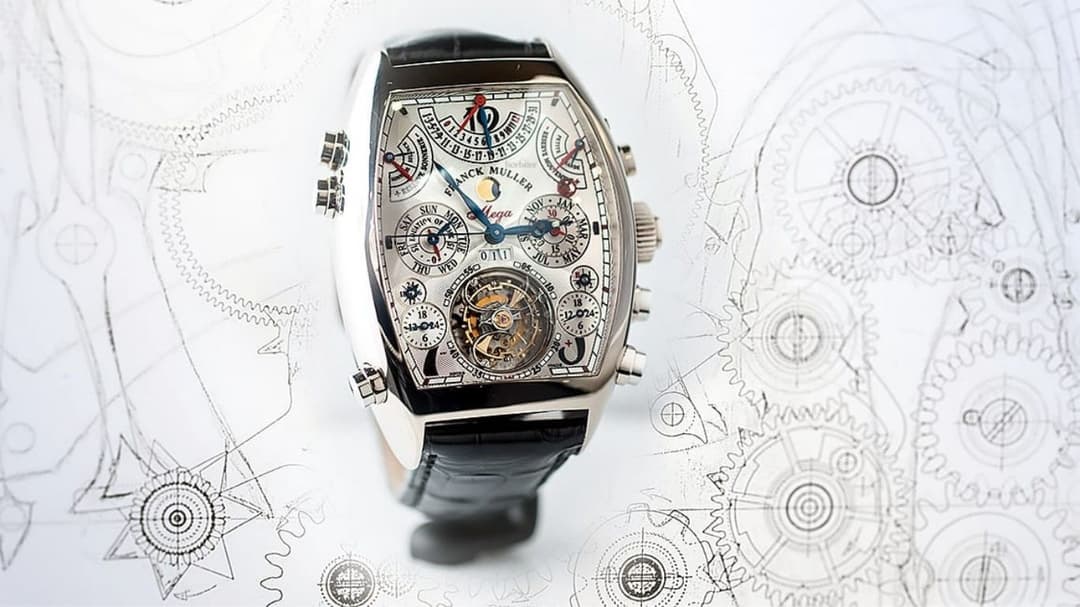
Franck Muller Aeternitas Mega: $2,580,000
The Franck Muller Aeternitas Mega is widely regarded as one of the most complex wristwatches ever created. With 36 complications and 1,483 individual components, it is a technical marvel and a clear statement of what Swiss watchmaking can achieve when ambition has no ceiling.
If a single watch captures the full spirit of haute horology, this is a strong contender. Every element of the piece reflects the Maison's commitment to mechanical excellence, traditional craftsmanship and contemporary design.
One of the most distinguished features of the Aeternitas Mega is its perpetual calendar. A perpetual calendar automatically accounts for the varying lengths of months and leap years, meaning the owner will never need to manually correct it for decades.
What sits inside the Aeternitas Mega
Building a single perpetual calendar is already a serious feat of engineering, often requiring expert watchmakers several weeks just to assemble the hundreds of minute components involved. In the Aeternitas Mega, that complexity is taken to another level entirely.
The watch integrates a full range of calendar functions, including a moon phase indicator, an equation of time display, and much more. It is an extraordinary example of horological micro-engineering that you simply will not find anywhere else at this level.
The architecture merges modern aesthetics with classical Swiss watchmaking tradition. Franck Muller, widely known as the "Master of Complications," has managed to capture both a futuristic vision and a deep respect for legacy within a single timepiece. The bold case design, the legible dial layout despite the dense complication display, and the signature curves all pay tribute to traditional forms while projecting a distinctly contemporary sensibility.
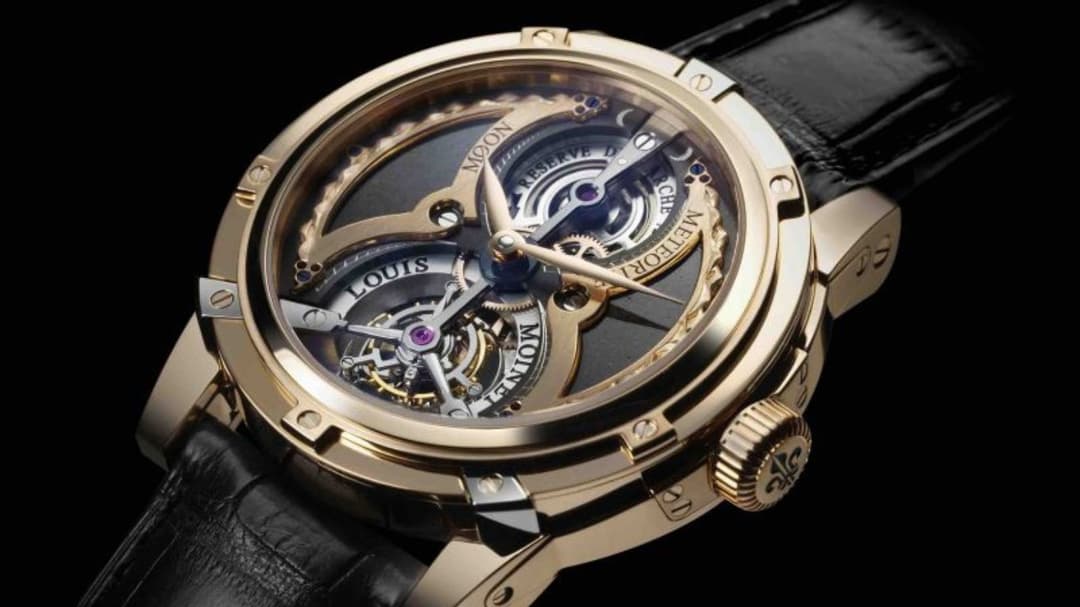
Louis Moinet Meteoris: $4,600,000
The Louis Moinet Meteoris collection is a remarkable union of haute horology and celestial mystique, and it stands as one of the most extraordinary achievements in modern watchmaking. Louis Moinet takes traditional craftsmanship into entirely new territory by embedding authentic meteorite fragments directly into each timepiece.
The result is something that feels less like a watch and more like a piece of the cosmos. This cosmic inspiration, paired with exceptional engineering, has placed the Meteoris collection at the very front of luxury watch innovation.
Each timepiece in the Meteoris series features a tourbillon, a highly sophisticated mechanical complication first developed to counteract the effects of gravity on a watch's accuracy. Louis Moinet has reimagined the tourbillon not merely as a feat of technical precision but as a dynamic visual centrepiece that embodies the balance between space and time.
Why the extraterrestrial materials matter
What truly sets the Meteoris collection apart is its use of genuine extraterrestrial materials. These are not decorative flourishes or vague cosmic themes. They are scientifically verified meteorite specimens, each carefully embedded into the watch dials.
Some of the rarest meteorites on Earth have been used here, including fragments from the Moon, from Mars, and from the ancient Allende meteorite. That means every model in this collection is a singular work of horological and cosmic art, carrying within it material that is billions of years old.
The collection spans several distinct models, each tied to a different celestial source material and crafted to highlight the unique visual character of each meteorite fragment.
- Lunar meteorites (21 pieces): Fragments ejected from the Moon's surface and recovered on Earth, lending a direct connection to Earth's only natural satellite.
- Martian meteorites (15 pieces): Incredibly rare Martian stones that lend an almost mythical quality to these watches.
- Gibeon and Toluca meteorites (10 and 5 pieces, respectively): Iron meteorites with unique crystalline structures, prized for their visual patterns.
- Allende meteorite (7 pieces): Considered one of the oldest known meteorites, dating back over 4.5 billion years.
- Other exotic materials include the Erg-Chech, Jbilet-Winselwan, Isheyevo, Aguas Zarcas, Enstatite Sahara 97093, Black Chondrite Sahara 97003, and the incredibly scarce Qatar 001 (only 1 piece).
The Meteoris watches are not produced in large numbers. Many are limited to fewer than a dozen units, and that extreme rarity, combined with the cosmic origin of their materials, makes them among the most collectible and valuable watches ever made.
Hublot Big Bang: $5,000,000
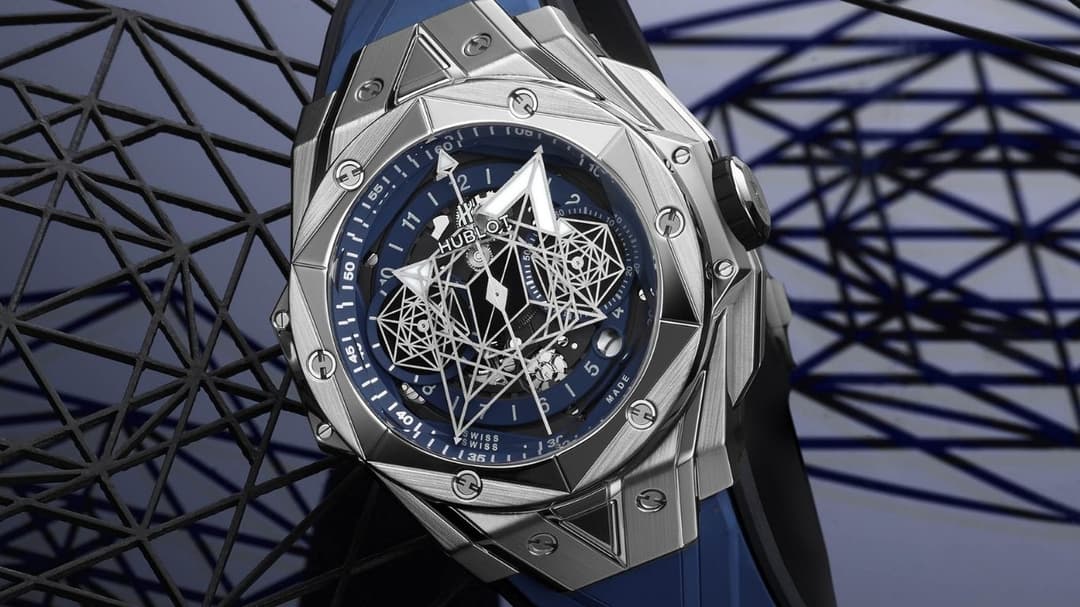
The Hublot Big Bang Diamond Edition is a striking example of how haute horology can merge seamlessly with high jewellery. This is not merely a timepiece. It is a bold statement of opulence and craftsmanship, and it has become an icon in the world of luxury diamond watches precisely because it pushes the boundaries of what a watch can be.
At the heart of its visual allure is a star-studded construction that showcases Hublot's dedication to uncompromising extravagance. Valued at approximately $5 million, this extraordinary timepiece features an 18k white gold case meticulously adorned with 1,282 diamonds totalling more than 100 carats.
Among those diamonds, six are emerald-cut stones weighing at least 3 carats each, further elevating the watch's prestige and brilliance. Every diamond is hand-selected and individually set by master gem setters, a process that took over 14 months of labour involving a team of twelve experts.
The mechanical case behind the jewellery
While its mechanics stay true to Hublot's high standards, with a self-winding HUB1100 movement housed beneath all that brilliance, the Big Bang in this form goes well beyond traditional watchmaking. It becomes a luxury art object designed to captivate both horological enthusiasts and connoisseurs of fine jewellery.
The cultural footprint matters too. High-profile collectors, including Jay-Z, who famously collaborated with Hublot on a limited edition model, have been seen wearing Big Bang timepieces, reinforcing their cultural weight. The piece doesn't simply sit in a collection: it moves through culture.
For collectors watching purchase timing across the Swiss range, our read on why Swiss watch collectors are buying ahead of price hikes is worth your time. Altogether, the Hublot Big Bang Diamond Edition is a bold celebration of craftsmanship, celebrity and extravagance, capturing the fusion of Swiss precision with high fashion in a way that very few watches ever have.
Patek Philippe x Tiffany & Co. Nautilus 5711/1A: $6,503,500
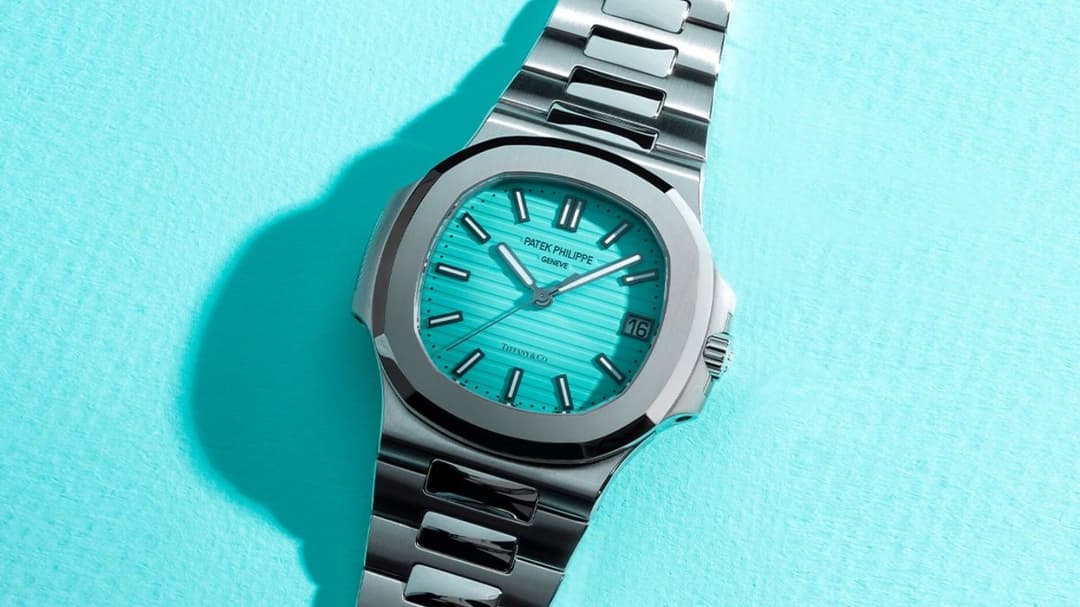
The collaboration between Patek Philippe and Tiffany & Co. is one of the most talked-about moments in modern watchmaking, culminating in the Nautilus 5711/1A Tiffany Blue Dial. This is a timepiece that blends technical mastery with timeless elegance in a way that few pieces ever achieve.
The partnership brings together two of the most revered names in horology and fine jewellery. What they produced together is not just a watch: it is a symbol of heritage, prestige and exclusivity that the collector community will be talking about for generations.
Unveiled in late 2021 as a farewell to the discontinuation of the standard Nautilus 5711, this limited edition was produced in just 170 pieces to mark the 170-year partnership between the two luxury houses. The defining feature is the Tiffany Blue lacquered dial, a colour instantly recognisable and deeply associated with luxury and refinement.
Why the auction result reset the market
Paired with the Tiffany & Co. signature printed at 6 o'clock and housed within the iconic stainless steel case designed by Gérald Genta, the result is a rare and powerful expression of what happens when two iconic brands share a vision. From a technical standpoint, the watch is powered by the self-winding Caliber 26-330 S C, known for its reliability, refined finishing and functionality, including a central seconds hand and date display.
Like all Patek Philippe movements, it carries the Patek Philippe Seal, which guarantees rigorous standards of precision, aesthetics and durability. The debut of this model generated an immediate frenzy among collectors, culminating in the sale of the first publicly auctioned piece by Phillips for $6,503,500.
That sale marked one of the highest prices ever achieved for a stainless steel watch and reaffirmed how much weight the collector community places on this piece. In the broader context of the luxury watch market, the Tiffany Blue Nautilus stands as a modern grail.
How the Tiffany Nautilus compares to other grails
Other iconic watches like the Rolex Daytona Paul Newman or Patek Philippe Grandmaster Chime command high prices for their own historic and technical reasons. The Nautilus 5711/1A Tiffany Edition uniquely combines scarcity, story and style into one of the most valuable modern releases of recent years.
With only 170 units in existence and an already proven record at auction, the Patek Philippe x Tiffany & Co. Nautilus 5711 has become a cultural milestone that continues to fascinate collectors. Its extreme rarity, cultural resonance and dual branding appeal set it apart even in a field filled with exceptional timepieces.
Vacheron Constantin Reference 57260: $10,000,000
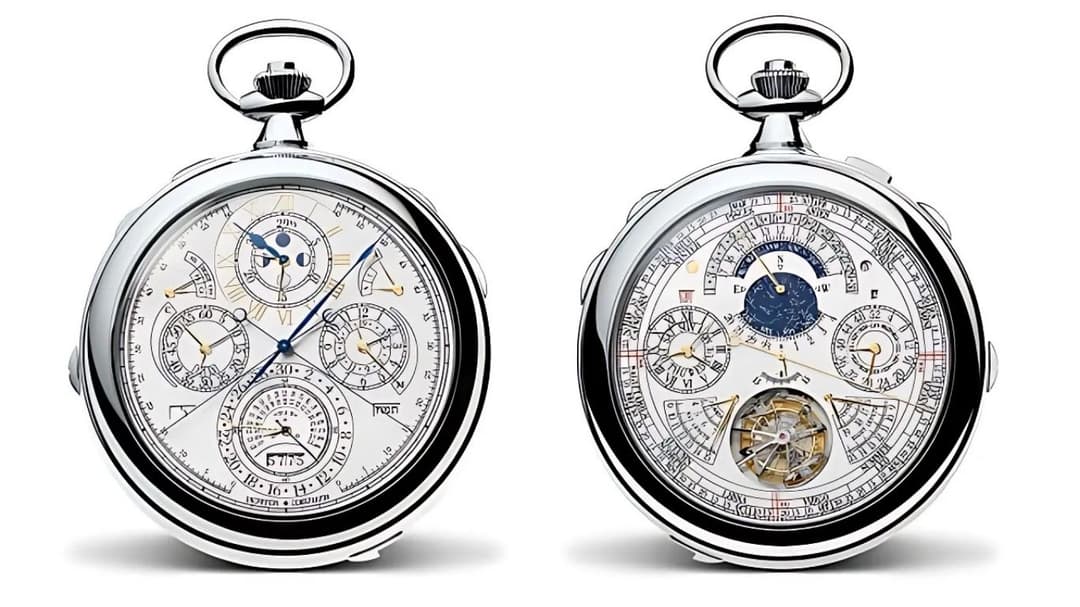
The Vacheron Constantin Reference 57260 is one of the most ambitious and technically advanced timepieces ever created. It is a horological masterpiece that redefines what mechanical watchmaking can achieve, and any serious collector studying the upper limit of the field will eventually need to study this piece.
With 2,826 components and 242 jewels, this bespoke creation holds the title of the most complicated watch in the world. Every part was designed and assembled entirely by hand.
Its imposing 957-gram case, crafted in white gold, contains not just exceptional mechanical artistry but a narrative of innovation and legacy that spans more than eight years of dedicated work by some of the finest watchmakers alive.
The 57 complications and what they do
This one-of-a-kind timepiece features 57 complications, a record in itself, and ten of those were invented specifically for this watch. Among the innovations is the first-ever fully integrated Hebraic perpetual calendar, capable of displaying traditional Jewish calendar information in alignment with astronomical calculations.
That had never been accomplished in mechanical watchmaking before this piece existed. The watch also includes three types of chiming complications: the Petite Sonnerie, the Grande Sonnerie, and a Minute Repeater, alongside a Westminster chime that can be adjusted to play different melodies, including a night mode that silences the chimes during rest hours.
The mechanical and aesthetic focal point is the triple-axis Armillary sphere tourbillon, a visually captivating and technically complex mechanism that improves timekeeping precision while demonstrating a level of micromechanical skill that borders on the extraordinary.
A Maltese cross rotation every 15 seconds, a crown position indicator, dual power reserve indicators, alarm functions with customisable tones, selectable strike sequences, and multiple time zone displays all add further layers to what is already an almost incomprehensible level of engineering complexity.
The hand-finishing and provenance behind the build
Equally awe-inspiring is the artistry behind the construction. Every component has been individually hand-finished, including polished bevels, chamfered bridges and satin-brushed surfaces. The technical drawings alone weighed 16 kilograms.
Over 85 prototype components were tested during development. Three of Vacheron Constantin's most senior watchmakers were assigned exclusively to this project, working in secrecy over nearly a decade to bring one collector's vision to life. The result is not only a monumental watch: it is a statement of human ingenuity and devotion to the craft that will likely never be surpassed.
Among its many hidden features are secret winding stems and manual selectors that allow personalised functionality in a way that almost no mechanical device on earth can offer. With ten patents granted and two more pending, the Reference 57260 is a historic landmark in the evolution of haute horlogerie. Commissioned by an anonymous collector with a passion for mechanical excellence, its estimated value exceeds $10 million.
What this means for serious collectors
The most expensive watches in the world sit in a category of their own, where one-of-a-kind commissions, extreme complication counts and rare materials converge with provenance that auction houses can authenticate decisively. The five pieces above are not entries into a portfolio. They are the references that define the upper ceiling of haute horlogerie, and studying them informs how collectors think about complication, finishing and rarity at every other tier.
For collectors building toward more attainable masterworks, the working lesson is consistent: the references that command lasting valuations combine technical ambition with documented provenance. That same pattern holds at the $50,000 tier, the $500,000 tier and the eight-figure tier above.
We last reviewed this analysis in May 2026.


Stefanos Moschopoulos
Stefanos Moschopoulos founded The Luxury Playbook in Athens and has spent the better part of a decade following the auction calendar, the en primeur releases, and the watchmakers, gallerists, and shipyards the magazine covers. He writes the field guides and listicles that anchor the Connoisseur section — pieces built on Phillips and Christie's results, Liv-ex movements, and conversations with collectors he has met across Geneva, Bordeaux, Basel, and Monaco. His own collecting habits sit closer to watches and wine than art, and it shows in the level of detail in the magazine's coverage of those categories. Under his direction, The Luxury Playbook now publishes long-form field guides, market-defining year-end listicles, and the Voices interview series with the founders behind the houses and the brands.