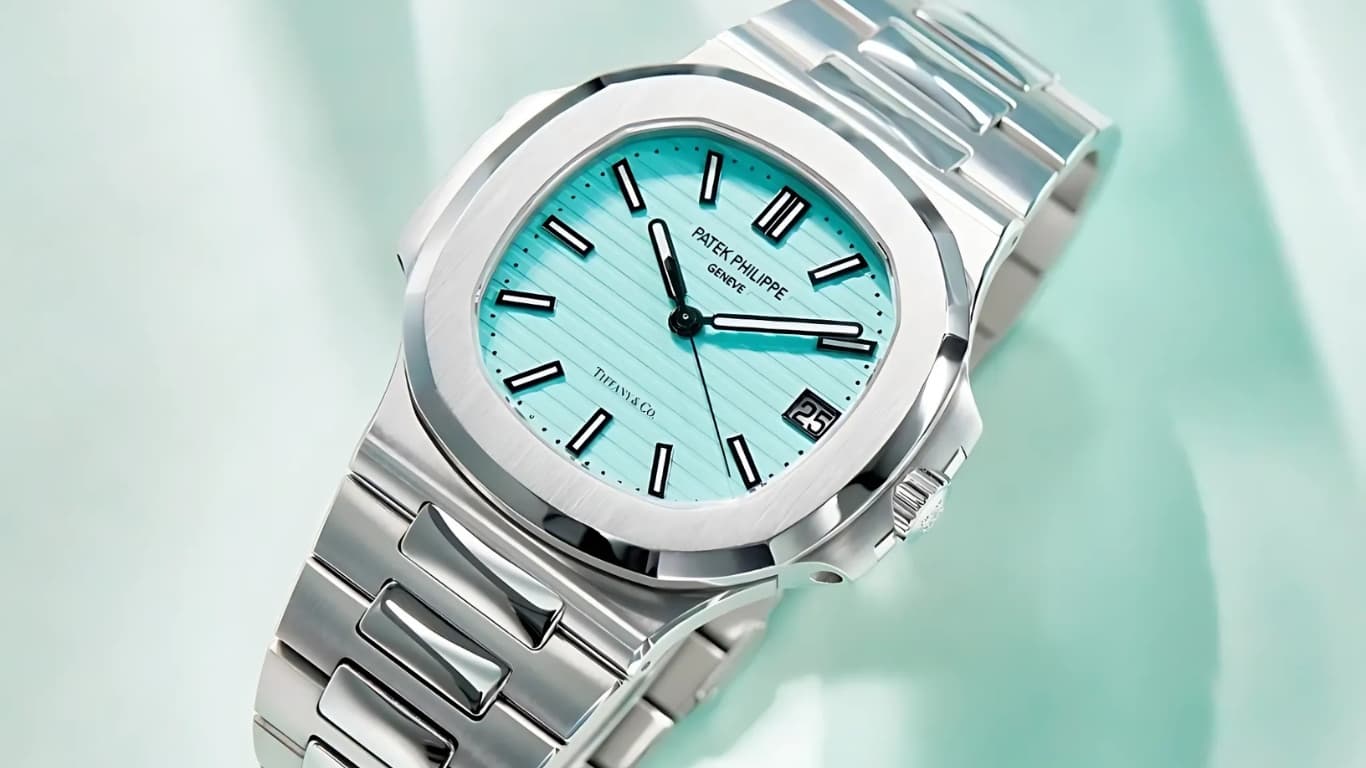
The Patek-Tiffany Nautilus reshaped serious watch collecting overnight in late 2021, and the market is still working out what to do with the consequences. The 5711/1A-018, produced in 170 pieces with a Tiffany Blue dial co-signed at six o'clock, was the most-discussed watch of the year and one of the most-debated of the decade. For collectors trying to read the modern market honestly, the lessons that piece left behind have aged better than the prices.
- The Patek-Tiffany Nautilus 5711/1A-018 reshaped luxury watch collaboration economics, with the Tiffany Blue dial driving a 6.5 million dollar sale at Phillips New York in December 2021.
- The 170-piece limited run, produced for the 170-year Patek-Tiffany partnership, transformed retail pricing of 52,635 dollars into auction results that few collectors could have predicted.
- The Tiffany Blue dial colour, originally trademarked in 1837, added a separate cultural-brand premium that the standard Nautilus 5711 had never approached at the same scale.
- We see the Patek-Tiffany Nautilus as the most influential modern watch collaboration, with the auction performance validating the kind of brand-pairing opportunity many manufacturers now actively pursue.
- Secondary-market pricing on the Patek-Tiffany Nautilus stabilised after the 2022 reset, with collector demand continuing to validate the premium pricing position.
- The wider influence on watch collaborations, including subsequent Tiffany-branded pieces from other brands, has reshaped how serious collectors and dealers approach limited partnership releases.
- Who is this for?
- Patek collectors, luxury collaboration enthusiasts, and serious students of modern watch auction dynamics.
- What is happening?
- A grounded read on how the Patek-Tiffany Nautilus 5711/1A-018 reshaped luxury watch collaboration economics through the 2021 Phillips New York auction.
- When did this emerge?
- The Patek-Tiffany Nautilus debuted in late 2021 and sold for 6.5 million dollars at Phillips New York in December 2021, with the impact continuing through 2026.
- Where is this happening?
- Phillips New York hosted the headline auction, with the Tiffany 5th Avenue and select global Patek dealers managing the original 170-piece distribution.
- Why does it matter?
- The Patek-Tiffany Nautilus legitimised collaboration premium pricing in modern luxury watch collecting, reshaping how brands approach limited partnership releases.
What that single collaboration exposed about the secondary market, the boutique allocation system and the speculative layer that had built up around Patek was the part that mattered. Phillips, Sotheby's and the wider trade have spent the years since calibrating against it. The story is worth telling in full because the structural shifts it set off are still working through the broader category.
How the Patek-Tiffany Nautilus collab landed in 2021
The collaboration was announced in December 2021 as a closing chapter for the discontinued steel sport-luxury reference Patek had been winding down. The 5711/1A-018 ran to 170 pieces, marked Patek's long retail relationship with Tiffany, and went out at a retail price reported around $52,635 to a curated buyer list.
The launch was conventional by Patek standards. The aftermath was not. The first piece to surface at auction sold at Phillips New York that same December for $6.
5 million, with proceeds directed to The Nature Conservancy. The result instantly reset every assumption about what a discontinued Nautilus, on a one-of-170 dial, could carry in a public sale.
The collectors and dealers we hear from on the floor at Geneva and New York still cite that single Phillips lot as the moment the modern Nautilus story changed. The point of inflection was visible in real time.
What the Tiffany Nautilus exposed about the boutique allocation system
The secondary-market premium that followed exposed how the boutique allocation system actually distributes the most-coveted pieces. Patek's allocation process was, and is, opaque by design, with the brand's small boutique network and authorised retailers operating on relationship-based criteria.
The 170 Tiffany Nautilus pieces went to a curated list that was never made public. Almost immediately, examples surfaced on the secondary market at multiples of retail. That visibility, the gap between the curated list and the open market price, made the dynamics of the allocation system newly visible to the wider collecting world.
The brand's response was telling. Patek and Tiffany have continued to operate their long retail partnership with deliberate quiet, and the Tiffany Blue dial has not returned across the catalogue. The Stern family's stewardship across the modern brand era has tended toward measured response, and the 2021 collaboration looks, in hindsight, like a closing-out moment rather than the start of a colour programme.
How the secondary market reacted across 2022 and 2023
The piece's secondary-market behaviour through 2022 was where most of the structural lessons surfaced. Multiple examples traded above $3 million across Christie's, Phillips and Sotheby's sessions through the first half of the year, anchoring the contemporary Patek upper band against a fixed reference point.
The 2022 to 2023 broader correction softened those numbers, with the Tiffany Nautilus tracking the wider Nautilus secondary-market move rather than holding above it. The piece is still a top-tier modern Patek by any reasonable measure, and the references continue to surface in major sales, but the speculative ceiling visible in early 2022 was a peak rather than a baseline.
What the Tiffany episode left behind
Three lessons stuck. The discontinued steel Nautilus is now treated as the closing chapter of an era, with collectors recognising that the steel sport-luxury category at Patek will not reopen on the same terms. The boutique allocation system carries real value beyond retail pricing, and the trade now reads waitlist access against that recognition.
And the speculative layer that had built up around the trinity through 2020 to 2022 was visible enough, after the Tiffany lot, that the broader category had to absorb the correction that followed.
What this means for collectors operating in modern Patek today
The Tiffany Nautilus is unlikely to be available outside private sales for most of the next decade. The upper end of contemporary Nautilus collecting still trades through Phillips, Christie's and Sotheby's sessions, and the discontinued 5711/1A in steel sits as the practical entry point to that conversation.
For collectors who came into Patek through the 2021 to 2022 cycle, the secondary-market reality is that the speculative layer has compressed. The references that hold up over the longer arc are the ones with credible technical credentials and clean documentation, which is the same lesson the older end of the Patek market has carried for decades.
The brand's broader catalogue, the Calatrava range, the perpetual calendar references, the complicated work, has continued to operate quietly on its own terms. The 2021 episode shifted the Nautilus story sharply; the rest of the Patek collecting world has had to absorb the spillover at a slower pace.
What we'll watch next on the Patek-Tiffany legacy
Two open questions sit on the table. First, whether the Tiffany retail partnership produces another collaboration on the same scale, which would, on present evidence, look unlikely given how quietly Patek has handled the post-2021 period. Second, whether the structural lessons the 2021 collaboration left behind, on allocation, on speculative layering, on discontinuation strategy, get carried forward through the brand's broader Nautilus and Aquanaut decisions.
The Tiffany Nautilus is no longer the most-discussed watch of any given month, but it remains the single piece that reshaped collector expectations across the trinity's structural position in modern collecting. The longer-term effects on how serious collectors read Patek's boutique allocation, its discontinuation discipline and its capacity for restraint are still settling in. The market is calmer now, and the lessons have aged better than the prices.
We last reviewed this analysis in May 2026.


Stefanos Moschopoulos
Stefanos Moschopoulos founded The Luxury Playbook in Athens and has spent the better part of a decade following the auction calendar, the en primeur releases, and the watchmakers, gallerists, and shipyards the magazine covers. He writes the field guides and listicles that anchor the Connoisseur section — pieces built on Phillips and Christie's results, Liv-ex movements, and conversations with collectors he has met across Geneva, Bordeaux, Basel, and Monaco. His own collecting habits sit closer to watches and wine than art, and it shows in the level of detail in the magazine's coverage of those categories. Under his direction, The Luxury Playbook now publishes long-form field guides, market-defining year-end listicles, and the Voices interview series with the founders behind the houses and the brands.