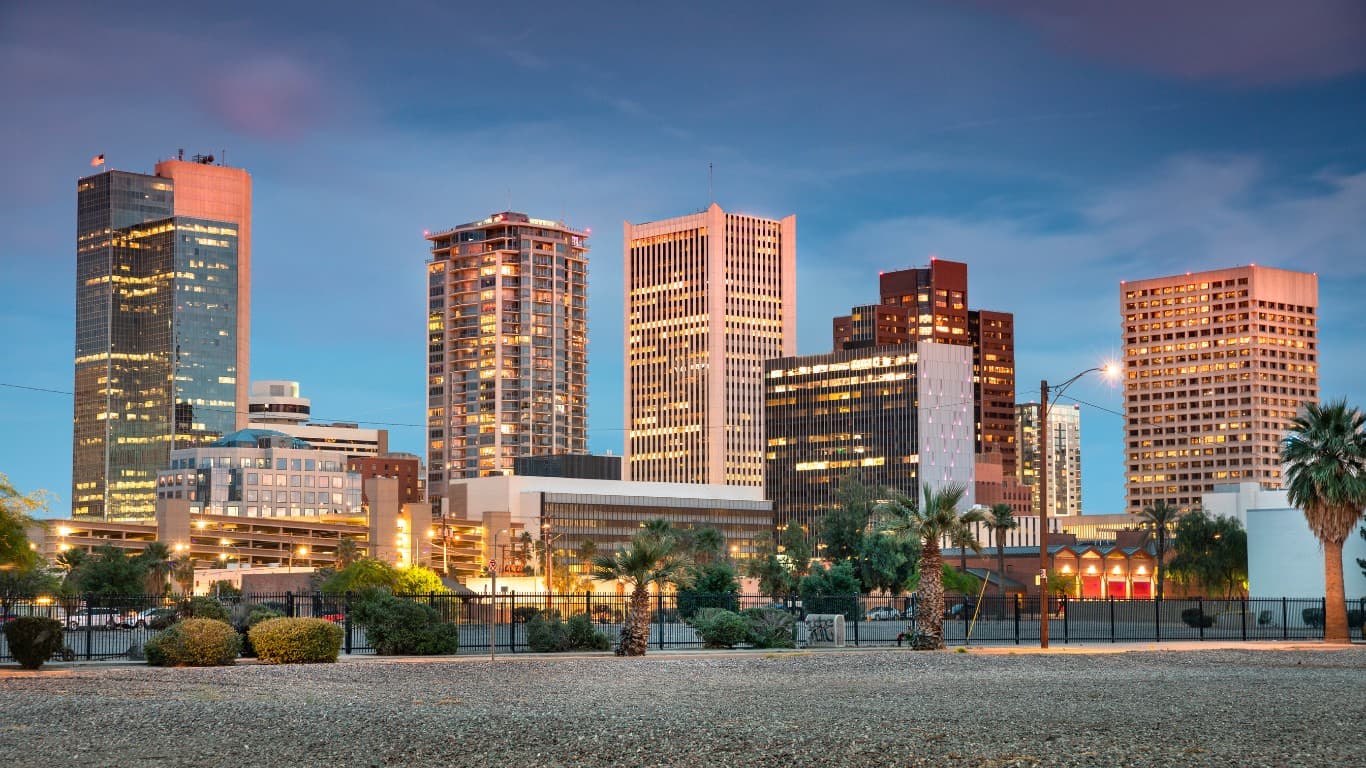
Phoenix has spent the past decade becoming one of the most consequential property markets in the American West, and the data heading into 2026 backs the story. The 2026 Phoenix real estate market opens with a median sale price of $413,083, up 3. 5 percent year-on-year, but the headline number understates what is happening underneath.
The metro added roughly 80,000 new residents in 2024, most arriving from California, the Midwest and higher-cost coastal markets.
The consequences ripple through every submarket, from South Phoenix's redevelopment surge to the Peoria Avenue Corridor's quiet outperformance. Knight Frank's 2026 Wealth Report flags Phoenix as one of the larger Sun Belt markets with a structural HNW inflow story. The picture brokers describe (Compass and Coldwell Banker on the prime side, Redfin and the Phoenix Realtors Association on the broader market) is measured stabilization rather than boom-cycle volatility.
Sales activity has cooled from its 2021-2022 peak. Home values remain firm, supported by population growth, limited central inventory, and a diversified employment base now spanning healthcare, logistics, finance, technology and construction.
- Phoenix continues to attract sun-belt migration from the more expensive coastal markets, with population growth supporting both new construction and resale demand into 2026.
- We see median prices having stabilised in the recent cycle after the sharp 2020 to 2022 appreciation, with the market now settling into a more sustainable growth trajectory.
- Inventory levels remain below the long-term average, with months-of-supply still tilting toward sellers across most price tiers in the metropolitan area.
- Scottsdale, Paradise Valley and Arcadia continue to anchor the luxury segment, with new build inventory expanding in the broader Phoenix and Tempe submarkets.
- Climate considerations including extreme summer heat and water security have moved from background concerns to active buyer-side questions for long-hold investors.
- For most considered buyers we view Phoenix as a credible long-term hold given the demographic tailwinds, although climate diligence warrants explicit weight in the underwriting process.
- Who is this for?
- Buyers and investors evaluating Phoenix for primary residence, second home or income property, alongside relocation clients and the brokers, lenders and advisers supporting metro Phoenix transactions.
- What is happening?
- A market overview and 2026 forecast for the Phoenix real estate market, covering price levels, inventory dynamics, submarket trends and the climate considerations shaping buyer behaviour.
- When did this emerge?
- The article covers conditions through 2025 and 2026, with reference to the post-2020 appreciation cycle and the latest migration data shaping current demand patterns.
- Where is this happening?
- The piece focuses on the Phoenix metropolitan area, including Scottsdale, Paradise Valley, Arcadia, Tempe and the broader Maricopa County submarket landscape.
- Why does it matter?
- Phoenix offers genuine demographic tailwinds in 2026, which is why understanding both the demand drivers and the rising climate risks matters before committing capital to the metro.
The Phoenix housing market today
The median sale price sits at $413,083, while the median list price stands at $469,667. That gap signals real negotiation room for buyers in the current cycle. Homes take an average of 32 days to go pending, slower than the pandemic-era sprint but well inside healthy market territory.
The sale-to-list price ratio of 98.8 percent and the fact that more than 60 percent of homes are closing below list confirm a market that has shifted, modestly, in the buyer's direction. Bloomberg's recent Sun Belt housing tracking puts Phoenix at the front of that shift.
- Median sale price: $413,083, up 3.5 percent YoY
- Median list price: $469,667
- Average days on market: 32
- Sale-to-list price ratio: 98.8 percent
- 60.1 percent of homes selling below list price
Phoenix neighborhoods defining 2026
Phoenix is a patchwork of distinct submarkets, each with its own buyer profile and price trajectory. Brokers tracking the market consistently flag five neighborhoods carrying the citywide narrative.
Arcadia
Arcadia remains one of Phoenix's most coveted neighborhoods. Mature trees, mid-century ranch architecture and a strong school footprint anchor the demand. The median sits at $1.
45 million, up 2. 9 percent year-on-year. Compass and Russ Lyon Sotheby's International Realty both track Arcadia as the city's most stable high-end submarket.
Biltmore
Biltmore pairs estate-scale homes with the resort culture that has defined this stretch of Camelback Mountain since the 1930s. The median price sits near $1. 15 million, up 3. 4 percent year-on-year.
Buyers here are typically out-of-state second-home buyers, and Engel and Voelkers maintains its strongest Arizona presence in this corridor.
Paradise Valley
Paradise Valley is the genuine prime tier of metro Phoenix. The median home price tops $3. 2 million, with a steady 4.
7 percent annual gain reflecting persistent ultra-high-net-worth demand. Christie's International Real Estate affiliate Russ Lyon publishes the cleanest data on the segment.
Ahwatukee Foothills
Ahwatukee Foothills, on the southern edge of the metro against South Mountain, draws families and remote-working professionals. The median sits at $610,000, up 3. 6 percent year-on-year.
Schools, hiking access and a strong sense of neighborhood continue to drive demand.
Downtown Phoenix
Downtown Phoenix has been remade by the light-rail expansion and mixed-use developments around Roosevelt Row and the Warehouse District. The median residential price hovers near $475,000, with stronger movement in newly delivered condo stock.
Median prices and price per square foot
| Neighborhood | Median Listing Price | Price per SqFt |
|---|---|---|
| South Phoenix | $465,000 | $272 |
| North Mountain | $375,500 | $258 |
| Alhambra | $349,700 | $240 |
| Sands Oasis | $423,600 | $266 |
| Peoria Avenue | $392,000 | $254 |
| Deer Valley | $405,000 | $261 |
| Encanto | $535,000 | $312 |
| Laveen | $385,000 | $248 |
| Maryvale | $315,000 | $220 |
| Camelback East | $515,000 | $325 |
Phoenix rental market in 2026
The rental side of the city has run hot for three consecutive years. Average rent sits at approximately $1,725 per month, up 4. 1 percent year-on-year.
Phoenix continues to lead the West on affordability against its closest peers, Los Angeles and San Francisco.
Vacancy is tight at 5.1 percent, particularly in the central submarkets where transit and employment cluster. JLL's 2026 Multifamily Outlook flags metro Phoenix as one of three Sun Belt markets with the most resilient rent growth into the second half of the decade.
What is shaping the Phoenix map in 2026
Population growth remains the structural driver. The US Census Bureau's 2025 estimates rank metro Phoenix in the top three large-metro net domestic in-migration tables, alongside Seattle and a small handful of Sun Belt peers.
Employment growth is broadening. The TSMC semiconductor build-out in north Phoenix, the expansion of Banner Health and the Mayo Clinic's Phoenix campus, plus the steady scale-up of financial-services back-office operations, have all extended the employment story beyond the historical construction-and-tourism base.
Mortgage rates in the 6.5 to 7 percent range have rebalanced the market without breaking it. Buyer concentration has shifted toward the $350,000 to $550,000 band, where mid-tier suburbs continue to absorb supply.
What this means for buyers
Phoenix in 2026 is a stabilizing market rather than a softening one. Home prices are projected to rise 3 to 5 percent, with the strongest gains in suburbs around new employment centers and the redevelopment corridors closer to downtown. Rents are forecast to climb 4 to 5 percent through 2026.
For buyers, the negotiation window is genuine. Below-list closing rates and longer days on market mean that disciplined offers stand a real chance of getting accepted on quality stock. We see the prime tier (Paradise Valley, Arcadia, Biltmore) continuing to behave as the most stable end of the cycle.
We last reviewed this analysis in May 2026.
Frequently asked questions
Is Phoenix a buyer's market or seller's market in 2026?
It tilts slightly buyer-friendly. With 60 percent of homes closing below list, a sale-to-list ratio of 98.8 percent and 32-day average market time, disciplined buyers have negotiation room on quality stock.
Which Phoenix neighborhoods are appreciating fastest?
Paradise Valley is leading the prime tier at 4.7 percent annual gains. Ahwatukee Foothills, Arcadia and the downtown redevelopment corridor are the most active mid-market segments tracked by Compass and Russ Lyon Sotheby's.
What is driving demand for Phoenix real estate?
Domestic in-migration (around 80,000 new residents in 2024) is the headline driver, alongside TSMC and Mayo Clinic-anchored employment growth, Sun Belt cost-of-living dynamics, and the absence of state-level capital gains complexity that affects coastal markets.
How does Phoenix compare to other Western markets?
Phoenix offers materially lower entry prices than Los Angeles, San Francisco or Seattle, with rent growth and population growth at the top end of the large-metro range. The diversification of the employment base into healthcare, semiconductors and finance has reduced the historical construction-cycle volatility.


Savvas Agathangelou
Savvas Agathangelou co-founded The Luxury Playbook and has spent years reporting from the prime postcodes the magazine covers — Mayfair, Knightsbridge, the Athens Riviera, Dubai's Palm crescents, and the southern Mediterranean coastlines where the world's wealthy keep coming back. His background is in international hospitality, and that frame shapes how he writes about property: the developer's choices, the architect's signature, the agency's bench of named brokers, the building's service standard once the buyer moves in. He files developer spotlights, agency profiles, and the seasonal "Properties That Defined" listicles, and he hosts the magazine's founder-and-leadership interviews on the Voices side.