The Datejust and the Day-Date sit very differently in a Rolex collection, and at very different price points. The Datejust is the working dress watch most considered Rolex collections include in some configuration. The Day-Date is the precious-metal upper-tier reference that anchors the brand's prestige register.
- The Datejust and Day-Date answer different Rolex collector questions, with one anchored on everyday versatility and the other on trophy-tier dress-watch status.
- Datejust references cover steel, two-tone, and gold configurations across accessible price points, while Day-Date production exclusively uses precious metals.
- The Day-Date 40 in platinum and gold remains the President reference that anchors most established Rolex collections, with secondary-market depth across decades.
- We see the Datejust 41 as the most reliably useful Rolex for daily wear, while the Day-Date earns its place through dress-watch presence and metal weight.
- Bracelet choice shapes wearing experience materially, with the Jubilee defining the Datejust character and the President defining the Day-Date.
- Pre-owned market depth favours the Datejust, while Day-Date pieces command stronger long-term value retention thanks to their precious-metal construction.
- Who is this for?
- Buyers weighing Datejust against Day-Date, established Rolex collectors planning their next acquisition, and dress-watch buyers comparing options.
- What is happening?
- A side-by-side comparison of the Rolex Datejust and Day-Date, covering metals, references, bracelet design, secondary-market dynamics, and collector profiles.
- When did this emerge?
- The current comparison reflects 2026 production and secondary-market data, with both references continuing to anchor the Rolex catalogue at different tiers.
- Where is this happening?
- Authorised Rolex dealers globally stock both references, while Chrono24, Subdial 50, and specialist auctions handle the comprehensive pre-owned market.
- Why does it matter?
- Choosing between these two references shapes both the watch you wear and the collection you build, so understanding the trade-offs rewards careful thought.
Both share the design language and the production discipline; they diverge on case material, on bracelet style, on day-of-the-week complication, and on what they're actually for in a serious collection. The collector who eventually owns both tends to use them for different occasions and different registers. The choice between them at any given moment depends on what role the watch is playing in the broader collection.
The Datejust: register and reach
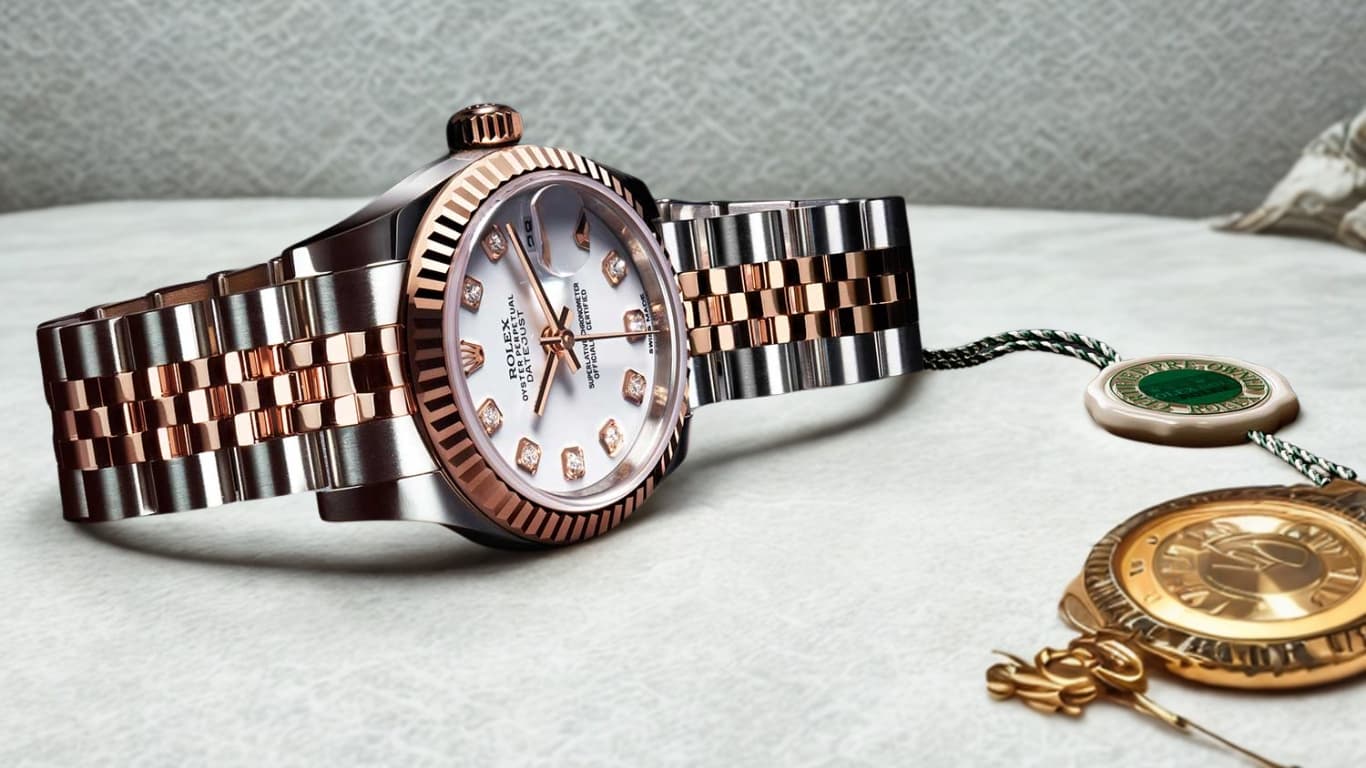
The Datejust catalogue spans 28mm through 41mm in steel, two-tone and precious metals. Current production runs from around $7,500 (steel 36mm reference 126200) through $14,000 to $20,000 in the more elaborate two-tone references and considerably higher in solid precious metals. The fluted bezel, the Cyclops magnifier, the Jubilee or Oyster bracelet, and the broad dial-and-bezel combinatorial depth define the catalogue.
The Calibre 3235 movement with the Chronergy escapement provides 70-hour power reserve and the technical platform standard across the upper Rolex catalogue. The Datejust's role in a collection is the working dress watch: the reference that wears across registers without being out of place anywhere. The 36mm references in steel-and-yellow-gold with the Jubilee bracelet are the classic configurations that anchor most considered Datejust collecting.
The 41mm references update the historical geometry for contemporary case-size preferences without abandoning the design language. The Datejust 41 reference 126300 in steel with the silver or champagne dial on the Oyster bracelet has become one of the more considered modern Rolex collecting tiers across the past five years. The reference does the heavy lifting in the working-dress register.
The Day-Date: the precious-metal upper tier
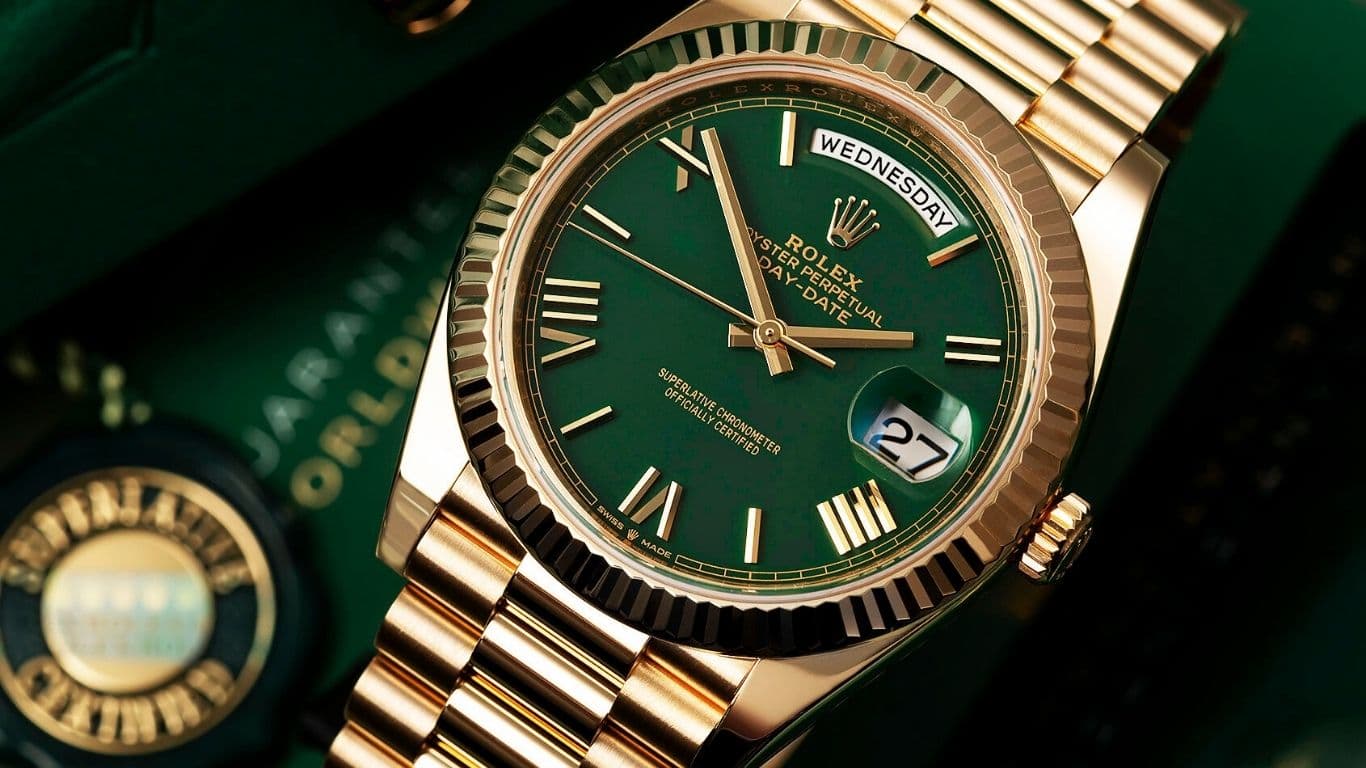
The Day-Date is exclusively produced in precious metals (yellow gold, white gold, Everose, platinum) and on the President bracelet. Current production runs from around $38,000 (36mm yellow gold reference 128238 with standard dial) through $60,000 to $80,000 in the more elaborate variants and well beyond in the platinum and gem-set references.
The day-of-the-week complication at twelve, the magnified date at three, the President bracelet with the concealed Crownclasp, and the precious-metal-only construction define the catalogue.
The Calibre 3255 movement carries the same Chronergy escapement and 70-hour power reserve as the Datejust's Calibre 3235. The vintage Day-Date catalogue is broad and historically significant. The 1803 (the first Day-Date with the manual-wind Calibre 1556, produced 1956 onward), the 18038 (the late-1970s reference with the Calibre 3055), and the 18238 (the 1990s reference with the Calibre 3155) all anchor different generations of vintage Day-Date collecting.
The various rare dial variants on the vintage Day-Date catalogue carry serious collector following. The original Stella enamel dials in red, blue, green and turquoise (produced 1960s-1970s in tiny numbers), the wood dials, the meteorite dials, the rare lapis lazuli and onyx dials all command meaningful premiums when they surface at auction.
Phillips and Christie's both handle vintage Day-Date regularly; the dedicated specialist vintage Rolex dealers handle the broader vintage market with the historical-archives access that anchors credible attribution.
Where the two diverge in a collection
The choice between Datejust and Day-Date is fundamentally about register. The Datejust is the watch a collector wears every day: to work, to weekend lunches, to most evening events. The Day-Date is the watch a collector wears for specific occasions where the precious-metal register and the brand's prestige tier earn their place.
The two coexist comfortably in serious Rolex collections; the Datejust does the daily-wear work, the Day-Date does the upper-register work. The pricing differential is real and reflects the catalogue logic. A steel Datejust 36 at $7,500 retail and a yellow-gold Day-Date 36 at $38,000 retail sit at very different points on the curve.
The precious-metal materials, the President bracelet construction (heavier and more elaborately finished than the Jubilee), and the production-volume difference all contribute to the gap. The collector building a serious Rolex collection from the entry tier upward typically reaches the Day-Date register only after years of relationship-building with a credible boutique.
The Day-Date is the watch the brand allocates to its established high-spend clients; the Datejust is the watch most credible Rolex collectors can acquire at retail with patience.
What collectors actually look for in each
For modern Datejust, the most considered configurations are the 36mm references in steel-and-yellow-gold with the Jubilee bracelet (anchored by the 126233 reference with the champagne dial and the fluted bezel), the 41mm references in steel with the silver or champagne dial on the Oyster bracelet, and the precious-metal references in white gold or Everose with the diamond-set bezel and dial.
The recently-introduced Datejust 31 references with the rare-dial configurations (the various marbled dials, the recent palm-pattern dials, the diamond-set indices) have built a particular following among collectors weighting dial-design execution.
For modern Day-Date, the most considered configurations are the 40mm reference 228238 in yellow gold with the champagne dial, the 40mm reference 228206 in platinum with the ice-blue dial (the reference that anchors contemporary Day-Date collecting at the upper end), the various precious-metal variants with the President bracelet, and the recent Sundust dial references in Everose. The 36mm Day-Date references hold their own collector following for buyers who prefer the original case proportions.
For vintage, the Datejust 1601 and the various 1803, 18038 and 18238 Day-Date references span the bulk of vintage collecting at this tier. The rare dial variants on both lines (Stella enamels, meteorite, wood, lapis lazuli, the rare onyx, the rare malachite green dials) command meaningful premiums when they surface.
The Phillips 2018 sale of a vintage 18038 Day-Date with the rare green Stella enamel dial cleared $375,000; the various Stella sales across Phillips and Christie's have established the rare-dial vintage Day-Date references as one of the more interesting vintage Rolex collecting categories.
Further reading
What this means for collectors choosing between Datejust and Day-Date
The longer story collectors recognise is that the Datejust and Day-Date aren't really alternatives. They're complementary references that serve different roles in a serious Rolex collection. The collector who eventually owns both tends to use the Datejust as the daily-wear pillar and the Day-Date as the upper-register specific-occasion piece.
That distribution holds across decades of collecting and is the structural reason both references continue to anchor the broader Rolex catalogue.
Our take: the more interesting reading is that the Datejust and Day-Date are the two references most clearly serving as the contemporary expressions of the early 1950s Rolex catalogue. The Datejust (introduced 1945) as the first wristwatch with an automatic date, and the Day-Date (introduced 1956) as the first wristwatch with both the day and the date in fully spelled-out form.
The continuity from those historical references through to current production is the structural anchor that keeps both lines credible at the most considered collector tier.
We last reviewed this analysis in May 2026.

Frequently Asked Questions
- Is the Rolex Day-Date worth the higher price tag?
- Yes, the Rolex Day-Date justifies its higher price through its exclusive use of precious metals, the iconic President bracelet, and the added day display complication. It’s also seen as a status symbol and often commands higher resale premiums, especially rare references.<br><br>
- Which Rolex holds its value better: Datejust or Day-Date?
- Both watches hold value exceptionally well. The Rolex Datejust benefits from steady and consistent demand, while the Rolex Day-Date often experiences higher appreciation, particularly for rare or vintage references and platinum models.<br><br>
- Which Rolex is more exclusive?
- The Rolex Day-Date is far more exclusive due to its limited production, precious metal-only construction, and higher price point. It’s often referred to as the “President’s Watch” due to its association with influential figures.

Stefanos Moschopoulos
Stefanos Moschopoulos founded The Luxury Playbook in Athens and has spent the better part of a decade following the auction calendar, the en primeur releases, and the watchmakers, gallerists, and shipyards the magazine covers. He writes the field guides and listicles that anchor the Connoisseur section — pieces built on Phillips and Christie's results, Liv-ex movements, and conversations with collectors he has met across Geneva, Bordeaux, Basel, and Monaco. His own collecting habits sit closer to watches and wine than art, and it shows in the level of detail in the magazine's coverage of those categories. Under his direction, The Luxury Playbook now publishes long-form field guides, market-defining year-end listicles, and the Voices interview series with the founders behind the houses and the brands.