The Rolex Milgauss stays a cult reference because it occupies a category of one in the modern Rolex catalogue. Originally launched in 1956 as the brand's antimagnetic specialist watch designed for laboratory and engineering environments, the name combined "mille" (thousand) and "gauss" to indicate magnetic resistance to 1,000 gauss. The line was discontinued in 1988 after roughly three decades of modest commercial success.
- The Rolex Milgauss remains a cult reference among serious collectors, with antimagnetic engineering and the distinctive lightning-bolt seconds hand anchoring devoted collector interest.
- Reference 116400GV in the Z-Blue dial configuration remains the most-coveted modern Milgauss, with secondary pricing firming after the 2023 catalogue discontinuation.
- The green sapphire crystal on the 116400GV defines the visual identity, with the optical character that no other modern Rolex reference replicates.
- We see the Milgauss as the strongest cult-collector Rolex in recent production, with discontinuation reinforcing the long-term value case for clean examples.
- Vintage Milgauss references, including the 1019, command serious collector premiums when documented examples surface with original tritium dials.
- Secondary-market depth on the Milgauss remains tighter than equivalent Submariner or GMT references, which means patient buyers should expect longer search timelines.
- Who is this for?
- Cult-reference Rolex collectors, antimagnetic engineering enthusiasts, and serious students of the brand's discontinued production.
- What is happening?
- A grounded read on the Rolex Milgauss as a cult reference, covering antimagnetic engineering, the Z-Blue dial, and the post-discontinuation collector dynamics.
- When did this emerge?
- The current cult status crystallised after the 2023 Milgauss discontinuation, with secondary pricing firming as collector demand caught up to the limited supply.
- Where is this happening?
- Authorised pre-owned dealers, Chrono24, Subdial 50, and specialist auctions handle the meaningful Milgauss secondary market.
- Why does it matter?
- The Milgauss offers distinctive design and engineering that no other Rolex reference matches, which sustains the cult collector following long after discontinuation.
Rolex revived the Milgauss in 2007 with the reference 116400 and the green-tinted-sapphire 116400GV, then discontinued the line again in 2023 with no announced replacement plans. The twice-discontinued production history is part of why the Milgauss has become one of the brand's most considered cult collector references, and the collectors who have followed the line across decades read its arc as one of the most interesting in modern Rolex history.
Why the Rolex Milgauss stays a cult reference
Three structural reasons hold the line together. The discontinuation discipline, pulled twice now in 1988 and 2023 with substantial gaps before any potential revival, creates the kind of production constraint that anchors collector interest. The technical positioning, with magnetic resistance designed for laboratory environments and the soft-iron Faraday cage around the movement, gives the Milgauss a genuine technical case that the broader Rolex catalogue doesn't quite duplicate.
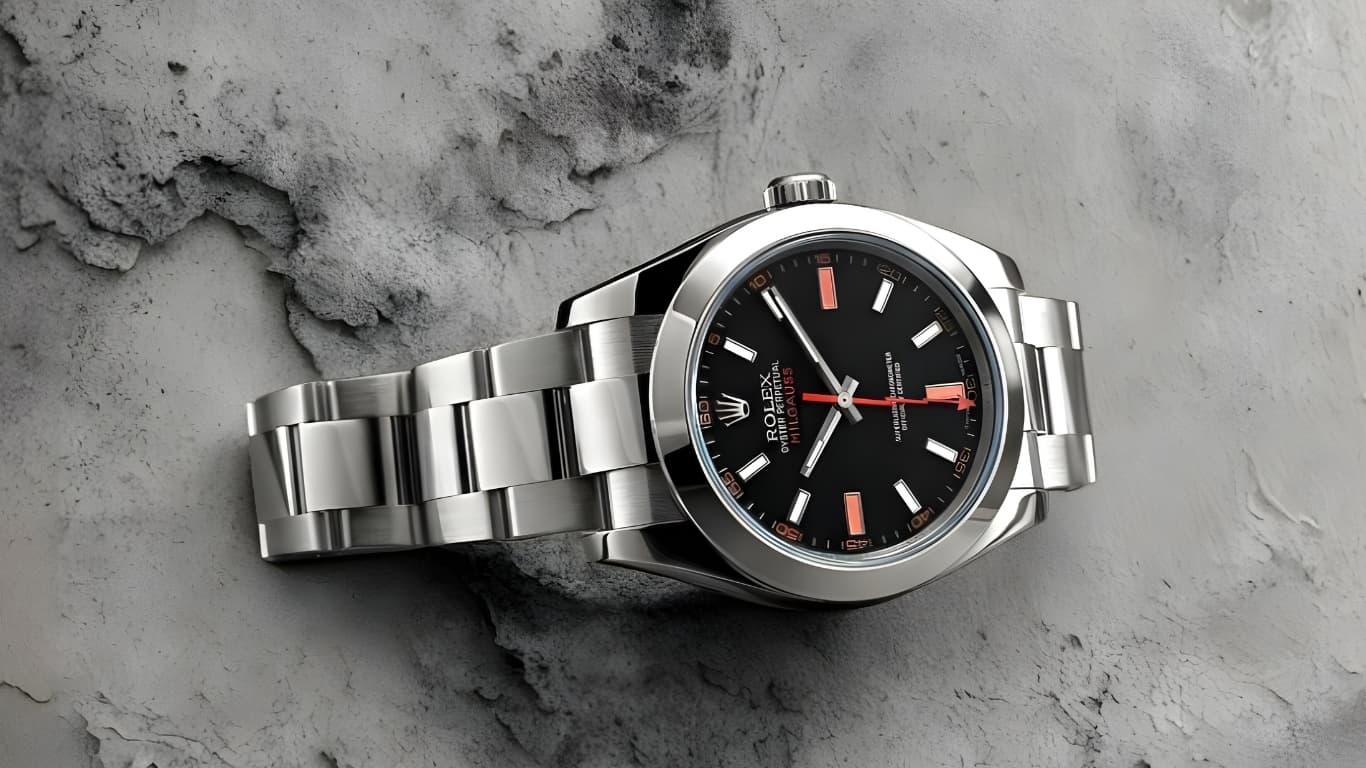
The design language carries the third pillar. The lightning-bolt seconds hand on the vintage references, the green crystal on the modern, the orange or red minute markers depending on configuration: each detail gives the line a distinctive identity within the broader Rolex visual register. Nothing else in the contemporary Rolex catalogue does quite what the green-crystal 116400GV does on the wrist.
The vintage Milgauss tier: 6541 and 1019
The vintage Milgauss references anchor the upper tier of cult collecting. The 6541 is the original 1956 reference, with the lightning-bolt seconds hand and the rotating bezel, designed in consultation with the engineers at CERN in Geneva. The 1019, from the 1960s and 1970s, carries the cleaner dial and the fixed bezel that defined the line's second generation.
Clean 6541 references with original lightning-bolt seconds hands have cleared $80,000 and considerably higher at Phillips and Christie's. The 1019 references trade between $25,000 and $60,000 depending on dial variant and condition. Both references sit in the upper tier of vintage Rolex collecting at the technical specialist end, where heritage narrative and movement architecture both carry weight.
Originality discipline matters substantially on vintage Milgauss. The lightning-bolt seconds hand on the 6541 was frequently replaced during service across the decades; Rolex itself often substituted standard seconds hands during routine service, and the original lightning-bolt hands required specific service-parts inventory that wasn't always available. Pieces with original lightning-bolt hands command meaningful premiums.
Original dial finish, original bezel insert on the 6541, and credible service histories all carry weight. The established specialist vintage Rolex dealers, Bob's Watches and Hodinkee's vintage operation among them, generally publish detailed condition reports on vintage Milgauss examples that pass through them. Those reports are themselves valuable references for any collector approaching the category.
The modern Milgauss: 116400 and the green-crystal 116400GV
The modern Milgauss reference 116400, with the standard sapphire crystal and the choice of black, white, or rare blue dial, and the 116400GV with the distinctive green-tinted sapphire crystal that became the line's contemporary signature, ran from 2007 to 2023. Retail at the line's discontinuation sat around $9,400 for both references. Secondary market in 2026 trades between $10,000 and $14,000 for clean examples, with the green-crystal GV variant carrying the stronger premium.
The Calibre 3131 movement is the antimagnetic version of the broader Calibre 3130 family. It uses a soft-iron Faraday cage around the movement to provide the antimagnetic resistance the line is named for. The movement architecture isn't the most technically ambitious in the modern Rolex catalogue, but it's coherent with the line's historical positioning and it carries the standard Rolex finishing and reliability the broader catalogue is judged against.
The Z-Blue and the modern cult tier
The Z-Blue dial variant of the GV, introduced in 2014, is the most-discussed modern Milgauss configuration. The electric blue dial with the green-tinted crystal creates a distinctive visual register that no other current Rolex reference matches. The dial colour is unique within Rolex production and was created specifically for the Milgauss line.
Clean Z-Blue examples trade meaningfully above the standard GV references. The Z-Blue typically sits between $13,000 and $16,000 against the standard GV's $10,000 to $13,000. The combination of the dial colour, the green crystal, and the post-2023 discontinuation has consolidated the Z-Blue at the upper tier of modern Milgauss collecting.
The collector following
The collector following the Milgauss has built across the past fifteen years tends to be the engineering-oriented end of Rolex collecting. The buyers drawn to the technical case, the antimagnetic positioning, the unusual movement architecture, and the production-discontinuation discipline tend to stay with the line. The buyers drawn primarily to the broader Rolex prestige register tend not to.
Hodinkee, Bob's Watches, the established European specialist dealers, and the dedicated Rolex collecting forums all give the Milgauss substantial coverage as one of the brand's most considered cult references. The watch quietly occupies a space that other Rolex references don't reach, and that space has held its character across both the modern and the vintage tiers.
What collectors look for in a Milgauss
For modern Milgauss, the references that come up most consistently in serious collector conversation are the 116400GV in the standard black-dial green-crystal configuration, the Z-Blue dial GV variant, and the original 116400 with the white or black dial. Box-and-papers documentation matters substantially; the post-2023 discontinuation has tightened secondary trading on the cleanest examples.
The strongest examples clear the highest premiums: full set, original strap, unworn condition with the original Rolex green hangtags, and credible service history through Rolex's authorised network. The dealer relationships matter on a discontinued reference more than on current production, and specialist dealers who handle the line consistently anchor the considered secondary market.
For vintage, the 6541 references with original lightning-bolt seconds hands anchor the upper tier. The 1019 references in clean condition with original components anchor the broader vintage tier. Phillips and Christie's both handle vintage Milgauss at their major sales; the established specialist dealers handle the broader vintage market.
What this means for collectors
The longer story is whether Rolex eventually revives the Milgauss again. Given the line's twice-discontinued history and the brand's pattern of measured cadence on revival decisions, any return is unlikely to come quickly. The original 1988-2007 hiatus ran nineteen years, and the 2023 discontinuation is recent enough that no credible revival signal has surfaced from the brand.
So long as the line stays discontinued, the existing references should retain the production-constraint discipline that anchors their collector category. We'd argue the Milgauss is the contemporary Rolex reference most likely to read well across the next decade specifically because of the discontinuation discipline. The modern 116400GV with the green crystal and the rare Z-Blue dial is, on most reasonable readings, undervalued at current secondary levels relative to where the broader modern Rolex catalogue trades.
We last reviewed this analysis in May 2026.

Frequently Asked Questions
- Why was the Rolex Milgauss discontinued?
- Rolex discontinued it in 2023 without a replacement. The brand has not given a reason, but low sales volume and niche appeal may have contributed.<br><br>
- Will Rolex Milgauss prices keep rising?
- Over the long term, discontinued steel Rolex models with strong stories have tended to appreciate, but the post-2022 watch-market correction shows prices can also fall 20–30% from peaks. Expect moderate, uneven growth rather than a straight line up.<br><br>
- Where can I buy a Rolex Milgauss now?
- Only on the secondary market. Authorized dealers no longer stock it post-2023 discontinuation.<br>

Stefanos Moschopoulos
Stefanos Moschopoulos founded The Luxury Playbook in Athens and has spent the better part of a decade following the auction calendar, the en primeur releases, and the watchmakers, gallerists, and shipyards the magazine covers. He writes the field guides and listicles that anchor the Connoisseur section — pieces built on Phillips and Christie's results, Liv-ex movements, and conversations with collectors he has met across Geneva, Bordeaux, Basel, and Monaco. His own collecting habits sit closer to watches and wine than art, and it shows in the level of detail in the magazine's coverage of those categories. Under his direction, The Luxury Playbook now publishes long-form field guides, market-defining year-end listicles, and the Voices interview series with the founders behind the houses and the brands.