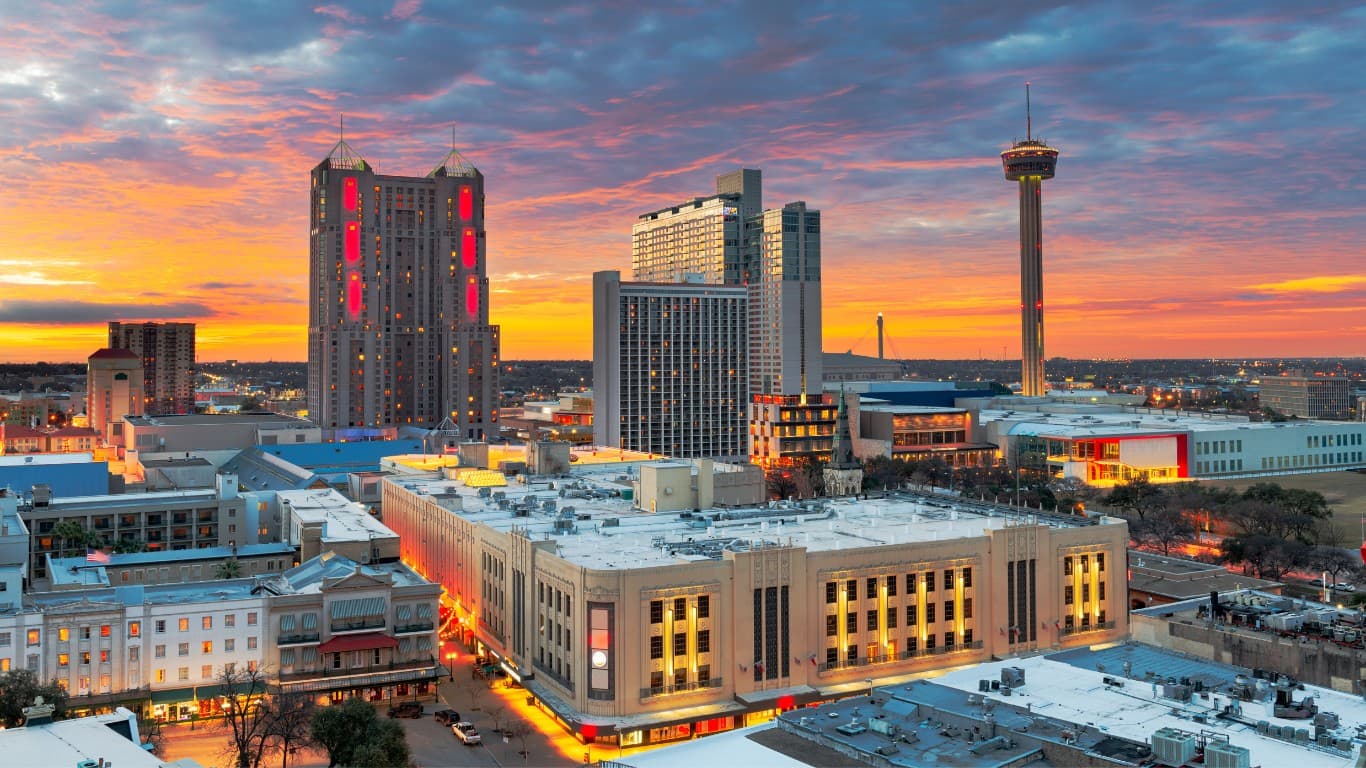
The 2026 San Antonio real estate market is doing what the rest of Texas' Big Four metros increasingly cannot do, namely keep entry prices accessible while population growth remains structural. The median sale price sits at $266,000, up 2. 8 percent year-on-year, with the metro adding roughly 30,000 residents in 2024.
Knight Frank's 2026 US Cities Prime Index flags San Antonio as the most affordable major Texas market by a meaningful margin.
The San Antonio Board of Realtors and the brokerages tracking the prime side (Phyllis Browning Company, Kuper Sotheby's International Realty, Compass) describe a market that has stabilized after the 2022 peak without softening. The pace of activity is slower than Austin or Dallas, but the structural fundamentals (population growth, employment diversification, the Joint Base San Antonio anchor) sit firmly in the same direction.
Buyer flows from California and from the higher-cost Texas metros continue to redirect capital here for value. The picture is one of measured, steady absorption with a widening price band as prime neighborhoods like Alamo Heights and Olmos Park separate from the citywide median.
- San Antonio remains one of the most affordable major Texas markets, with median prices materially below Austin and Dallas despite steady population growth into 2026.
- We see military bases including Joint Base San Antonio anchoring a stable demand base, with healthcare, biosciences and tourism adding meaningful diversification.
- Inventory has loosened through 2025 and 2026, with months-of-supply moving closer to balanced conditions across most submarkets in the metropolitan area.
- Stone Oak, Alamo Heights and the broader north side continue to anchor the upper end of the market, with newer build inventory expanding faster in the outer suburbs.
- Property tax burden remains a structural consideration, with combined rates running among the higher levels in the country and warranting careful underwriting attention.
- For most considered buyers we view San Antonio as one of the most accessible large-metro entry points in Texas, with the relative affordability case remaining intact through 2026.
- Who is this for?
- Buyers and investors evaluating San Antonio for primary residence or income property, alongside relocation clients and the brokers, lenders and tax advisers supporting metro transactions.
- What is happening?
- A market overview and 2026 forecast for the San Antonio real estate market, covering price levels, inventory dynamics, employment drivers and the property tax considerations.
- When did this emerge?
- The article covers conditions through 2025 and 2026, with reference to the recent inventory cycle and the latest military, healthcare and biosciences employment data.
- Where is this happening?
- The piece focuses on the San Antonio metropolitan area, including Stone Oak, Alamo Heights, the broader north side and the outer Bexar County submarkets.
- Why does it matter?
- San Antonio offers the most accessible Texas large-metro entry point in 2026, which is why understanding both the demand drivers and the property tax structure matters here.
The San Antonio housing market today
The median sale price of $266,000 sits at roughly half the Austin median and below most large US metros. Days on market average 51, slightly longer than Houston or Dallas, but the sale-to-list ratio of 97.8 percent confirms that quality stock still transacts close to asking.
Realtor.com's 2026 affordability rankings place San Antonio in the top decile of major metros. Bloomberg has tracked the city's steady absorption of inbound capital, noting the absence of the inventory glut that affected several Sun Belt peers.
- Median sale price: $266,000, up 2.8 percent YoY
- Median list price: $285,000
- Average days on market: 51
- Sale-to-list price ratio: 97.8 percent
- Strongest demand: Alamo Heights, Olmos Park, Stone Oak, Southtown
San Antonio neighborhoods defining 2026
San Antonio operates as several distinct markets within one metro footprint. The prime tier concentrates in a narrow inner ring; the family-buyer demographic dominates the suburban edges. The brokers tracking the prime side flag five neighborhoods carrying the citywide narrative.
Alamo Heights
Alamo Heights remains the city's most coveted address. The median home price sits at $895,000, up 3. 4 percent year-on-year.
Mature trees, a strong school district and proximity to downtown anchor demand, with Phyllis Browning and Kuper Sotheby's tracking it as the city's most stable prime submarket.
Olmos Park
Olmos Park, the small enclave between Alamo Heights and downtown, runs even tighter. Median home prices clear $1. 1 million, with inventory historically limited to a few dozen transactions per year.
Christie's International Real Estate affiliate Kuper Sotheby's publishes the cleanest data on the segment.
Stone Oak
Stone Oak, on the city's north side, draws family buyers and corporate relocations. The median price sits at $475,000, up 3. 2 percent year-on-year.
Strong school systems, master-planned community design and proximity to USAA, HEB headquarters and Valero Energy's corporate footprint sustain demand.
Southtown
Southtown has been the city's most consistent urban-redevelopment story. The median home price sits near $385,000, up 4. 6 percent year-on-year.
The King William historic district inside Southtown continues to draw design-oriented buyers willing to pay premiums for restored 19th-century stock.
Helotes
Helotes, on the metro's northwest edge, has become one of the fastest-growing suburbs. The median price sits at $415,000, up 4.1 percent year-on-year, with new construction continuing to deliver into expanding school districts.
Median prices and price per square foot
| Neighborhood | Median Listing Price | Price per SqFt |
|---|---|---|
| Downtown | $310,000 | $265 |
| Alamo Heights | $450,000 | $310 |
| Stone Oak | $350,000 | $215 |
| Southtown | $275,000 | $230 |
| West San Antonio | $240,000 | $185 |
| Tobin Hill | $295,000 | $248 |
| Alamo Ranch | $325,000 | $205 |
| Northeast Crossing | $265,000 | $190 |
| Terrell Hills | $525,000 | $315 |
| Harlandale | $220,000 | $175 |
San Antonio rental market in 2026
Average rent across the metro sits at $1,295 per month, up 3.1 percent year-on-year. San Antonio retains the cheapest rent floor among the four major Texas metros, with one-bedrooms in Southtown leasing between $1,400 and $1,700 and suburban two-bedrooms commonly under $1,600.
Vacancy stands at 6.5 percent, slightly above Houston but inside healthy market territory. JLL's 2026 Texas Multifamily Outlook notes that San Antonio absorption rates have improved through Q1 2026 as the post-2022 delivery cycle compressed.
What is shaping the San Antonio map in 2026
Three forces are pushing the market. Population growth (around 30,000 new residents in 2024, per US Census Bureau estimates) provides a steady demand floor. Employment diversification beyond the historical military and tourism base (USAA, Valero, HEB, the growing medical district on the north side) has broadened the buyer pool.
The third driver is value relocation. Buyer flows from Austin and Dallas, where median prices now run at two to three times the San Antonio level, have been steady through 2024 and 2025. Bloomberg has tracked the cross-metro reallocation as one of the cleaner intra-Texas patterns.
Mortgage rates in the 6.5 to 7 percent range have shifted activity toward the $250K-$400K band, where San Antonio's inventory remains deepest. The prime tier above $1M continues to clear at its own pace.
What this means for buyers
San Antonio in 2026 is a structurally affordable market that has begun to attract serious capital. Home prices are projected to rise 2 to 4 percent through 2026, with the strongest gains in inner-ring prime submarkets and the master-planned northside suburbs.
Rents are forecast to climb 3 to 4 percent, with the tightest absorption in Southtown and the medical district. For buyers tracking Texas value, San Antonio continues to read as the cheapest entry point among the four major metros without sacrificing economic fundamentals.
We last reviewed this analysis in May 2026.
Frequently asked questions
Is San Antonio cheaper than Austin or Dallas?
Yes, materially. Median sale prices run at roughly 40 to 50 percent of Austin's level and around 60 percent of Dallas. Knight Frank's 2026 US Cities Prime Index ranks San Antonio as the most affordable Texas major metro.
Which San Antonio neighborhoods are appreciating fastest?
Southtown leads the citywide gain rate at 4. 6 percent, followed by Helotes at 4. 1 percent.
The prime tier (Alamo Heights, Olmos Park) appreciates more slowly but at higher absolute prices, tracked closely by Phyllis Browning and Kuper Sotheby's.
What is driving demand for San Antonio real estate?
Population growth of around 30,000 residents per year, employment diversification beyond the military base (USAA, Valero, HEB, expanding medical district), and value relocation from Austin and Dallas. Bloomberg tracks the intra-Texas flow as one of the cleaner migration patterns.
Is San Antonio a good market for rental property?
Yes. Average rent of $1,295 with vacancy around 6. 5 percent, combined with property prices roughly half the Austin level, gives strong rent-to-price ratios.
Southtown and the medical district carry the tightest absorption.


Savvas Agathangelou
Savvas Agathangelou co-founded The Luxury Playbook and has spent years reporting from the prime postcodes the magazine covers — Mayfair, Knightsbridge, the Athens Riviera, Dubai's Palm crescents, and the southern Mediterranean coastlines where the world's wealthy keep coming back. His background is in international hospitality, and that frame shapes how he writes about property: the developer's choices, the architect's signature, the agency's bench of named brokers, the building's service standard once the buyer moves in. He files developer spotlights, agency profiles, and the seasonal "Properties That Defined" listicles, and he hosts the magazine's founder-and-leadership interviews on the Voices side.