The Thessaloniki property market has spent the past three years quietly emerging as the most consequential secondary property market in Greece. Long considered a quieter counterpart to Athens, the country's second city has been repositioned by a combination of meaningful infrastructure investment, a young university-driven demographic, and an architectural depth that rivals any city of its size in southern Europe.
As of Q2 2026, average residential prices in Thessaloniki sit at approximately EUR 1,720 per square metre, up roughly 6.4 percent year on year, with the most consequential growth concentrated in the central districts and the upper city. Mansion Global's recent Greek coverage and Knight Frank's southeastern European market commentary both place Thessaloniki among the more interesting structural property stories in the eastern Mediterranean.
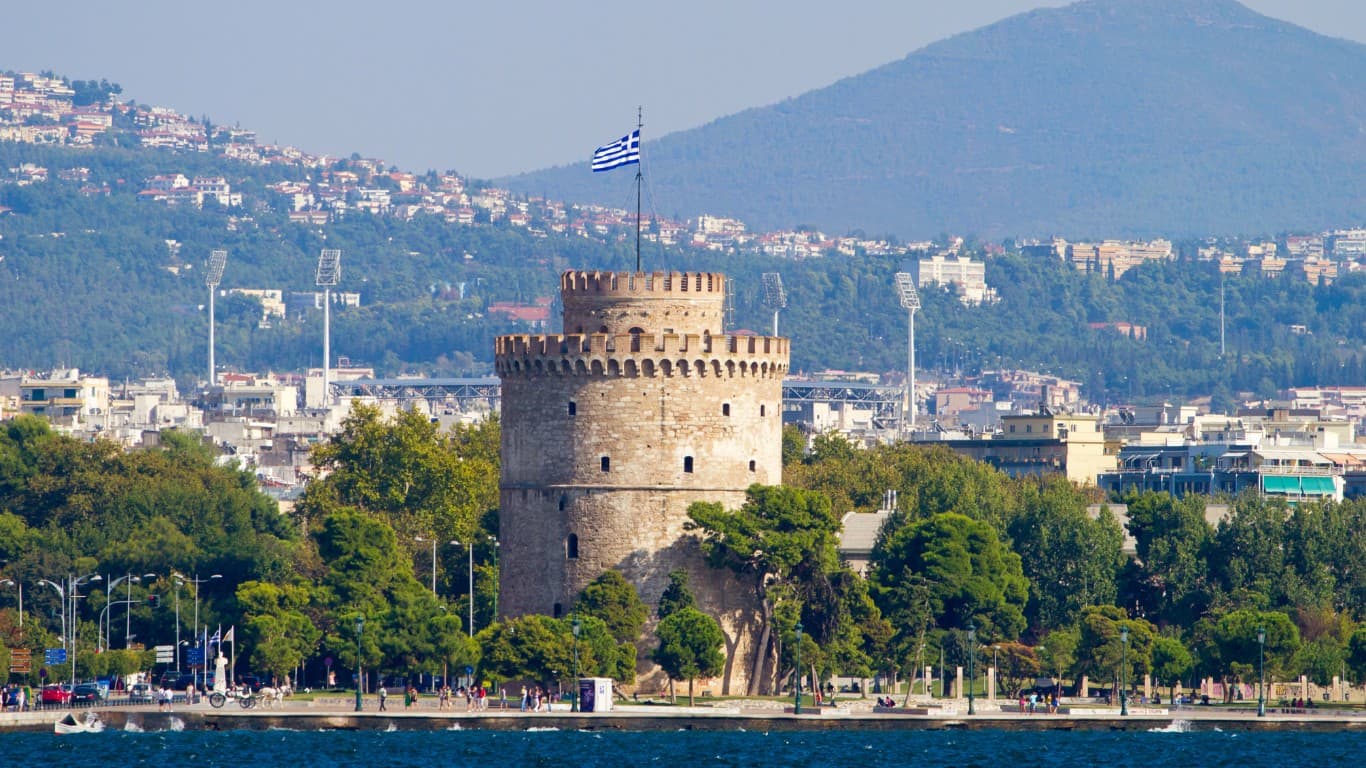
The architectural register that defines the Thessaloniki prime-residential offer is unusual within Greece. The city's UNESCO-listed Byzantine and early Christian monuments (the Rotunda originally built in 306 AD by Roman Emperor Galerius, Hagia Sophia of Thessaloniki, the Walls of Thessaloniki, and the broader cluster of fifteen UNESCO World Heritage-listed early Christian and Byzantine sites) anchor a historic core that very few European cities of this size can match.
The Ladadika and Ano Poli neighborhoods preserve some of the most consequential restoration work in the eastern Mediterranean.
The contemporary developments along the redeveloping waterfront and the metro corridor have introduced a meaningfully new architectural register.
- Thessaloniki has emerged as a credible second city for international property buyers, with infrastructure investment and a deepening student population supporting steady residential demand.
- We see central neighbourhoods including Kalamaria, Panorama and the seafront arc anchoring the upper end of the local market, with materially lower entry pricing than central Athens.
- Bank of Greece data shows residential appreciation in Thessaloniki tracking just below Athenian rates through 2025 and 2026, with stronger value at the entry-to-mid segments.
- Metro completion has reshaped urban accessibility, with adjacent residential pricing reflecting the delivery of the network and the improvement in central-area logistics.
- Short-term rental yields have remained attractive in well-located stock, although licensing requirements have tightened in line with the broader Greek regulatory framework.
- For most considered Greek buyers we view Thessaloniki as offering a credible alternative to Athens, particularly for cash-flow-focused investors weighing entry price and yield together.
- Who is this for?
- International and Greek diaspora buyers evaluating Thessaloniki as an alternative to Athens, alongside the advisers and brokers serving the northern Greek market.
- What is happening?
- A market read of Thessaloniki property in 2026, covering Kalamaria, Panorama, the seafront, metro completion impact and the short-term rental landscape.
- When did this emerge?
- The article reflects current Bank of Greece, ELSTAT and Hellenic Property Federation data through 2025 and 2026, with the multi-year recovery context.
- Where is this happening?
- The piece focuses on Thessaloniki, including Kalamaria, Panorama and the seafront, with reference to broader northern Greek market dynamics.
- Why does it matter?
- Thessaloniki offers a different entry profile from Athens, which is why the city deserves attention from buyers focused on yield and value rather than headline prime market exposure.
The Thessaloniki housing market today
Q2 2026 transactions reached over 4,800 residential sales, with foreign buyers accounting for approximately 22 percent. Time on market has dropped to 65 days from 82 days a year earlier. The median apartment price runs roughly EUR 110,000 to EUR 165,000, with renovated heritage units in the central districts moving fastest.
The Greek Golden Visa programme threshold (EUR 500,000 in central Athens, EUR 250,000 elsewhere) has supported international demand at specific price points. The broader Greek tax framework, including the 7-percent flat tax for new tax residents on foreign-sourced income and the non-domiciled tax regime for high-net-worth international relocators, has been one of the structural supports for the international buyer activity that has reshaped the city.
- Average residential prices: EUR 1,720 per sqm, up 6.4 percent YoY
- Q2 2026 transactions: 4,800+
- Foreign buyer share: approximately 22 percent
- Time on market: 65 days (down from 82)
Thessaloniki neighborhoods defining the prime tier in 2026
Ano Poli: the upper city, historic walls, panoramic views over the Aegean. The labyrinthine streets of the upper city sit within the UNESCO World Heritage zone. The surviving Ottoman-era timber-frame houses (the konaki residences that survived the great fire of 1917) anchor the area's heritage character.
Restoration culture is among the most active in northern Greece, with named Greek architects (Tense Architecture Network, Tsolakis Architects, Mold Architects' Thessaloniki commissions) producing some of the most considered work in the area.
Ladadika: the historic warehouse district named for the olive-oil merchants who originally occupied the area, restored as one of the city's most consequential restaurant and cultural clusters. The conversion of warehouse and industrial inventory into restored residential and mixed-use developments has produced some of the most distinctive contemporary architectural work in Thessaloniki.
Kalamaria: the established residential neighborhood east of the city centre, drawing consistent family-buyer demand. The combination of mature infrastructure, the proximity to the airport corridor and the established schools network has supported the area's structural family-buyer profile.
The waterfront: the redeveloping coastal strip with contemporary residential developments and the Thessaloniki Metro corridor. The Nikis seafront promenade redesign by Prodromos Nikiforidis and Bernard Cuomo has been one of the most-discussed contemporary urban-design projects in southern Europe; the continued waterfront regeneration extends through the redeveloping former International Trade Fair site.
Toumba and the eastern districts: the established residential neighborhoods east of the centre, with more accessible pricing and the broader infrastructure development tied to the Aristotle University campus.
The Thessaloniki rental landscape
Rental demand is supported by the substantial student population. Aristotle University, with over 70,000 enrolled students, is the largest university in Greece and one of the largest in southeastern Europe. Domestic professionals and the continuing flow of international relocations under the Greek tax framework round out the rental demographic.
The seasonal rental market is meaningfully thinner than in Athens or the islands; the residential rental dynamics are structurally more stable.
What is shaping the Thessaloniki property market in 2026
The Thessaloniki Metro, a long-delayed EUR 1.6 billion infrastructure project that opened in November 2024 after multiple decades of construction delays, has structurally reshaped accessibility across the city. The system's 13 stations connect the city's airport corridor, central districts, university zone and waterfront, and the metro opening has reshaped demand around specific corridors.
The redevelopment of the former International Trade Fair site (the Helexpo Convention Centre redevelopment, led by Greek architect Renzo Piano Building Workshop's local partners), the broader waterfront regeneration and the continuing expansion of the port have repositioned the city's economic and demographic trajectory. Aristotle University and the broader academic sector continue to anchor demographic stability.
The Thessaloniki International Film Festival (one of the most established cultural events in southeastern Europe) supports the broader buyer demographic shift.
Where the Thessaloniki property market reads now
Prices are projected to climb 5 to 8 percent through the back half of 2026. Growth is expected to concentrate in the central restoration districts, the metro corridor and the redeveloping waterfront. The architectural-pedigree subcategory (restoration projects in Ano Poli with named architect credit, contemporary residential commissions along the waterfront) is the area where the strongest premium consolidation has been visible across the past two years.
What this means for buyers
For the buyer who values architectural depth at meaningfully more accessible pricing than Athens, an unusual cultural and historical foundation (UNESCO World Heritage Byzantine monuments), and a city that has been substantially repositioned by major infrastructure investment, Thessaloniki continues to read as a structurally important secondary property market.
The neighborhoods responding most distinctly to the design-led buyer shift, namely Ano Poli, Ladadika and the waterfront, are quietly outperforming the broader market. We last reviewed this analysis in May 2026.
Frequently asked
How is the Thessaloniki property market evolving in 2026?
Prices are projected to climb 5 to 8 percent through 2026, supported by the new metro infrastructure, the waterfront regeneration and increasing international buyer interest. Mansion Global and Knight Frank both flag the market as one of the more interesting secondary stories in southeastern Europe.
Which Thessaloniki areas are seeing the most buyer attention?
Ano Poli, Ladadika, Kalamaria, Toumba and the redeveloping waterfront are drawing the most consistent demand. The metro corridor has been the standout growth zone of the cycle.
How does Thessaloniki compare against Athens?
Thessaloniki remains meaningfully more accessible than Athens at most price points while offering comparable architectural depth and the unusual cultural foundation of UNESCO World Heritage Byzantine monuments. Prime Thessaloniki pricing at EUR 1,720 per sqm sits well below the EUR 2,450 per sqm Athens average.
Has the new metro changed the market?
Yes. The November 2024 opening of the Thessaloniki Metro has structurally repositioned demand around specific corridors and supported the broader market trajectory. Rental clearances in the metro-adjacent districts have outperformed the broader city averages.
What is the Greek tax framework for international buyers?
Greece offers a 7-percent flat tax for new tax residents on foreign-sourced income, a non-domiciled tax regime for high-net-worth international relocators, and the Golden Visa programme providing residency for property purchases above specified thresholds (EUR 500,000 in central Athens, EUR 250,000 elsewhere).


Savvas Agathangelou
Savvas Agathangelou co-founded The Luxury Playbook and has spent years reporting from the prime postcodes the magazine covers — Mayfair, Knightsbridge, the Athens Riviera, Dubai's Palm crescents, and the southern Mediterranean coastlines where the world's wealthy keep coming back. His background is in international hospitality, and that frame shapes how he writes about property: the developer's choices, the architect's signature, the agency's bench of named brokers, the building's service standard once the buyer moves in. He files developer spotlights, agency profiles, and the seasonal "Properties That Defined" listicles, and he hosts the magazine's founder-and-leadership interviews on the Voices side.