A mechanical watch is a machine, and like every machine with hundreds of moving parts running ceaselessly under tension, it wears. Oils thin and migrate, gaskets harden, pivots polish themselves against their jewels with each tiny oscillation. Servicing is how that wear is arrested, reversed, and reset. Done well, it can keep a movement running for a century or more. Done badly, or done needlessly, it can do permanent harm to the very thing it was meant to preserve.
Most owners get the question backwards. They ask how often a watch must be serviced, as though there were a single correct number, when the houses themselves disagree. Rolex, Omega, and the rest publish recommended intervals that vary by movement and era, and Hodinkee and the wider watchmaking press have spent years pushing back on the idea that a healthy mechanical watch needs the bench on a rigid schedule. The truer guide is the watch itself.

Key Takeaways & The 5Ws
- A full service means disassembly, cleaning, lubrication, regulation, and a water resistance test.
- Brands commonly cite intervals of roughly four to seven years.
- Many modern movements run far longer without trouble.
- Service by symptom, such as moisture, drift, or a weak power reserve.
- Polishing a vintage case too aggressively destroys originality and cannot be undone.
- Who is this for?
- Owners of mechanical watches who want to keep them running and intact, from daily wearers to vintage stewards.
- What is it?
- A full overhaul: complete disassembly, cleaning, fresh lubrication, regulation, gasket replacement, and water resistance testing.
- When does it matter most?
- When the watch shows symptoms, or before exposure to water if the seals are old and untested.
- Where does it apply?
- The brand's own service centre or a trusted independent watchmaker, each with distinct trade offs.
- Why consider it?
- Because a serviced movement runs true and a neglected one fails, but careless work harms originality forever.
What a Full Service Actually Involves
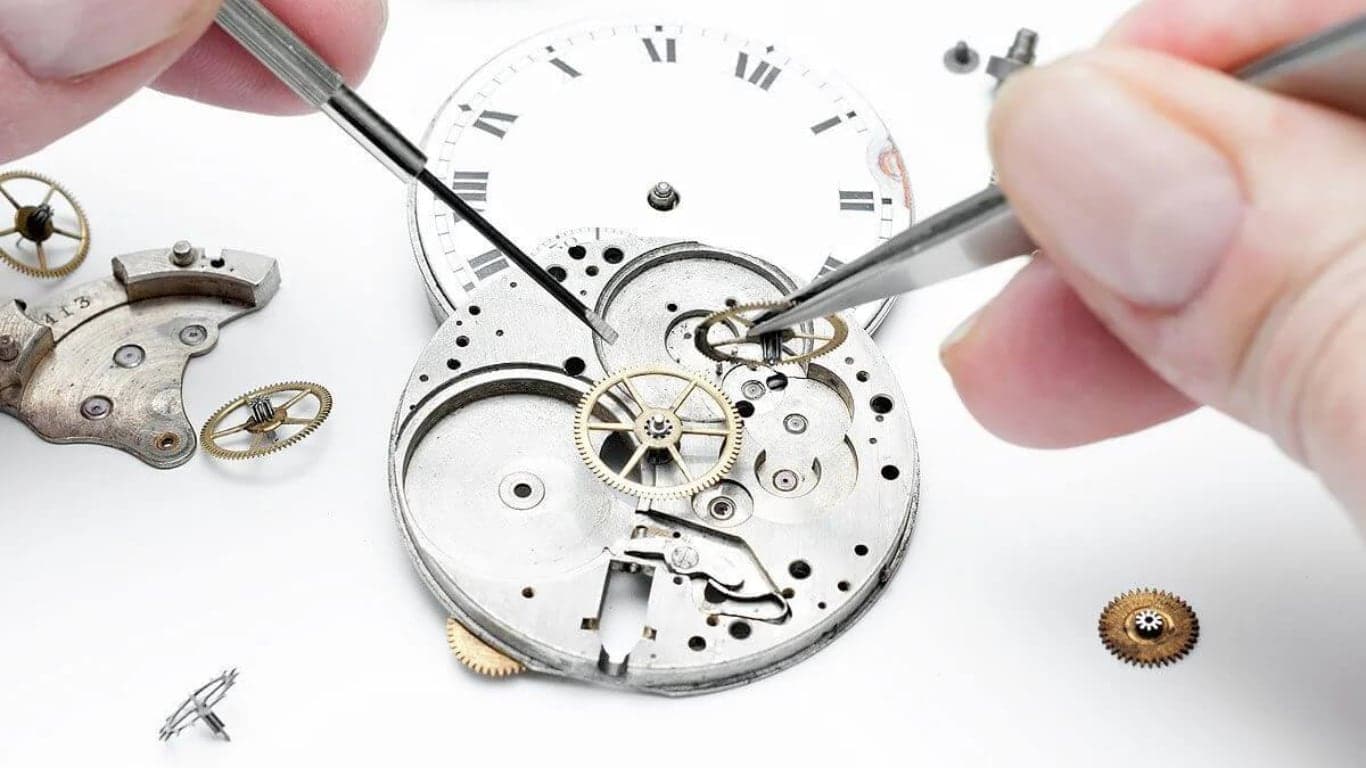
The word service is used loosely, so it pays to be precise about what a proper one entails. A full service means the movement is taken completely apart, every component down to the smallest wheel and spring. Those parts are cleaned, often ultrasonically, to strip away old oil, dried lubricant, and accumulated grit. The watchmaker inspects each one for wear, replaces what is worn, then reassembles the calibre and lubricates it precisely, with different oils and greases specified for different points in the going train.
The work does not end there. The movement is regulated so it keeps time within tolerance across positions. The gaskets at the caseback, crown, and crystal are replaced, since rubber and synthetic seals harden and shrink with age. Finally the watch is tested for water resistance, ideally under both pressure and vacuum. Anything less is a partial job, however it is billed. A genuine service touches the whole machine, not merely the parts that happen to be giving trouble.
How Often, Really
This is where myth has done real damage. Brands commonly cite service intervals in the range of roughly every four to seven years, and there is sound logic behind the guidance: lubricants do degrade over time, and a dry pivot wears far faster than a lubricated one. For a watch that lives a hard life, or an older movement with less durable oils, that window is sensible. Taken as gospel for every watch, it sends perfectly healthy movements to the bench long before they need it.
The reality is that many modern movements, well made and well lubricated, run accurately and reliably for well beyond a decade. Synthetic oils are more stable than the natural lubricants of the past, and tolerances are tighter. A contemporary watch keeping excellent time, holding its power reserve, and showing no signs of trouble is rarely crying out for a teardown simply because a calendar page turned. The interval is a prompt to pay attention, not a deadline to obey. Treat it as the outer edge of prudence rather than a recurring appointment.
Let the Watch Tell You
The most reliable signal that a watch needs attention is the watch behaving like a watch that needs attention. Learn the symptoms and you will rarely service too early or too late. Moisture or condensation under the crystal is the clear emergency; it means the seals have failed and water has found its way in, and it demands immediate service before corrosion sets in. A large, sudden change in timekeeping, a watch that was running well now gaining or losing minutes, points to a problem in the regulating organ or a lubrication that has finally given out.
Other signs are subtler but no less telling. A rotor that feels gritty, sounds rough, or rattles as it winds suggests wear in the automatic works. A power reserve that has quietly collapsed, so the watch no longer runs through the night off the wrist, hints at a tired mainspring or thickened oil dragging on the train. None of these waits for a schedule. A watch that shows them needs the bench now; a watch that shows none of them, even one years past its nominal interval, very often does not.
Brand Service Centre or Independent Watchmaker
Where the work is done matters as much as when. The brand's own service centre is the orthodox route, and it has real advantages. It guarantees genuine parts, factory correct finishing, and watchmakers trained on that specific calibre. It is also slower, dearer, and increasingly the only road open, as a number of houses now restrict the supply of spare parts to their own networks and a small circle of authorised watchmakers. For a current production piece under warranty, it is usually the obvious choice.
The independent watchmaker offers a different set of virtues. A good one is often more transparent about what was done and why, more willing to talk through options, and frequently far gentler with vintage, where sympathy matters more than a factory refresh. The trade off is parts access, which varies considerably by brand and by the watchmaker's standing. The decision turns on the watch. A modern sports model, a Tudor Black Bay or the like, may belong at the brand; a fragile vintage piece is frequently safer in the hands of a specialist independent who understands that the goal is preservation, not renewal. Anyone weighing one of those contemporary steel divers will find the trade offs laid out in a modern buyer's guide before the question of servicing ever arises.
The Damage Servicing Can Do
Here is the part the brochures rarely mention, and it is the most important thing in this guide. Servicing is not automatically benign. The single greatest threat to a collectable watch on the bench is not failure but excessive restoration, and above all excessive polishing. When a case is polished to remove scratches, metal is removed with them. Do it once too often, or too aggressively, and the crisp lugs soften, the sharp bevels round over, the original brushed and polished surfaces blur into a vague shine. Serious collectors treat this as a permanent loss, because it is. Metal does not grow back, and a repolished case can never be made original again. The premium commanded by the finest vintage Omega examples rests almost entirely on sharp, untouched cases, which is precisely what an overzealous polish destroys.
The discipline, then, is restraint, and the watchword is stewardship. Tell the watchmaker explicitly to clean rather than polish a vintage case unless you have decided otherwise with open eyes. Keep the service records, since a documented history is part of the watch's story. Ask for the replaced parts back and retain them, especially anything original, so the next custodian can see what was changed. Preserve the box and papers as carefully as the watch itself. You are not maintaining a possession so much as holding an object in trust, and the best service is frequently the lightest one that does the job.
A watch outlives its owner if it is treated with sense, and treating it with sense means knowing the difference between care and interference. Service when the movement asks for it, choose the bench that suits the piece, and guard its originality as the irreplaceable thing it is. The collectors whose watches will still matter in fifty years are not the ones who serviced most often or polished brightest. They are the ones who understood that a mechanical watch is a thing to be kept, not improved, and who left it, wherever they could, exactly as its maker intended. That same instinct for originality and condition is what separates a watch that merely survives from one that endures as an object of record.
Frequently Asked Questions
- How often should a mechanical watch be serviced?
- Brands commonly recommend a full service every four to seven years, though many modern movements run reliably for far longer. Rather than following the calendar rigidly, service by symptom: moisture under the crystal, a large change in timekeeping, a gritty rotor, or a collapsed power reserve. A healthy watch keeping good time rarely needs the bench on schedule.
- What does a full watch service include?
- A complete service means full disassembly of the movement, ultrasonic cleaning of every part, inspection and replacement of worn components, fresh lubrication, regulation for accuracy, replacement of all gaskets, and a water resistance test under pressure. Anything less, however it is described, is a partial job that leaves part of the machine untouched.
- Should I use the brand or an independent watchmaker?
- The brand guarantees genuine parts and factory finishing and is often the only route for current pieces, but it is slower and costlier. A trusted independent is frequently more transparent and gentler on vintage, though parts access varies by brand. Modern watches often suit the brand; fragile vintage is frequently safer with a specialist independent.
- Why is polishing a watch too much a problem?
- Polishing a case removes metal along with scratches. Done too often or too aggressively, it softens the lugs, rounds the bevels, and erases the original surfaces, blurring the case the maker shaped. Collectors treat this as a permanent loss, because metal cannot be restored. For vintage especially, ask the watchmaker to clean rather than polish.

Stefanos Moschopoulos
Stefanos Moschopoulos founded The Luxury Playbook in Athens and has spent the better part of a decade following the auction calendar, the en primeur releases, and the watchmakers, gallerists, and shipyards the magazine covers. He writes the field guides and listicles that anchor the Connoisseur section — pieces built on Phillips and Christie's results, Liv-ex movements, and conversations with collectors he has met across Geneva, Bordeaux, Basel, and Monaco. His own collecting habits sit closer to watches and wine than art, and it shows in the level of detail in the magazine's coverage of those categories. Under his direction, The Luxury Playbook now publishes long-form field guides, market-defining year-end listicles, and the Voices interview series with the founders behind the houses and the brands.