The bid-ask spread is one of the most important concepts you need to understand before placing a single trade. It marks the gap between what buyers are prepared to pay and the lowest price sellers will accept. The bid is the maximum a buyer offers.
The ask is the minimum a seller will take. That gap between the two is where your real transaction cost lives, and it tells you a lot about a market’s liquidity and momentum. Narrow spreads mean smoother pricing and better odds of a clean trade, especially in highly liquid markets like forex.
Wider spreads, on the other hand, tend to show up in markets with lower liquidity, like small-cap stocks. They signal higher trading costs and a bumpier ride overall. If you’re not accounting for the spread in your strategy, you’re already leaving money on the table.
- The bid-ask spread is the gap between the price buyers are willing to pay and the price sellers are willing to accept for a given security at any moment.
- Tight spreads typically signal deep liquidity and competitive market making, while wide spreads point to thin volume or elevated volatility around the name.
- Spreads are wider for small-cap stocks, exotic ETFs and after-hours trading, and tighter for mega-cap names and major index futures during regular hours.
- Crossing the spread by hitting bids or lifting offers is a real cost that compounds for active traders, often outweighing visible commissions over time.
- Limit orders sit on the book and capture spread rather than pay it, but they trade off execution certainty against price improvement during fast markets.
- Understanding spread dynamics helps investors size trades sensibly, choose appropriate order types and avoid the silent erosion of returns through poor execution.
- Who is this for?
- Self-directed investors and active traders who want to understand how the bid-ask spread shapes execution costs and what it implies about liquidity in any specific security they trade.
- What is happening?
- A clear explanation of the bid-ask spread, covering how it is set, what drives its width and how traders manage it through order type selection and execution timing across listed securities.
- When did this emerge?
- Always relevant for any active trader, with particular focus during periods of elevated volatility, low volume or earnings releases when spreads tend to widen materially and execution risk rises.
- Where is this happening?
- Universal across global equity, ETF, options and futures markets, with the tightest spreads on US large-cap stocks and major indices and wider spreads in smaller or emerging markets.
- Why does it matter?
- Bid-ask spreads are one of the most under-appreciated drivers of long-term net returns. Managing them deliberately is a low-effort, high-impact source of incremental performance.
Understanding the Basics of Bid-Ask Spread
The bid-ask spread is governed by market-structure rules documented in detail by the major exchanges. The New York Stock Exchange and Nasdaq both publish the order-handling rules that determine how spreads form, while FINRA oversees the broker-dealer disclosures around execution quality.
The regulatory backbone runs through the SEC's Regulation NMS, which shapes the National Best Bid and Offer. Bloomberg covers spread dynamics across asset classes as part of its trading-desk coverage.
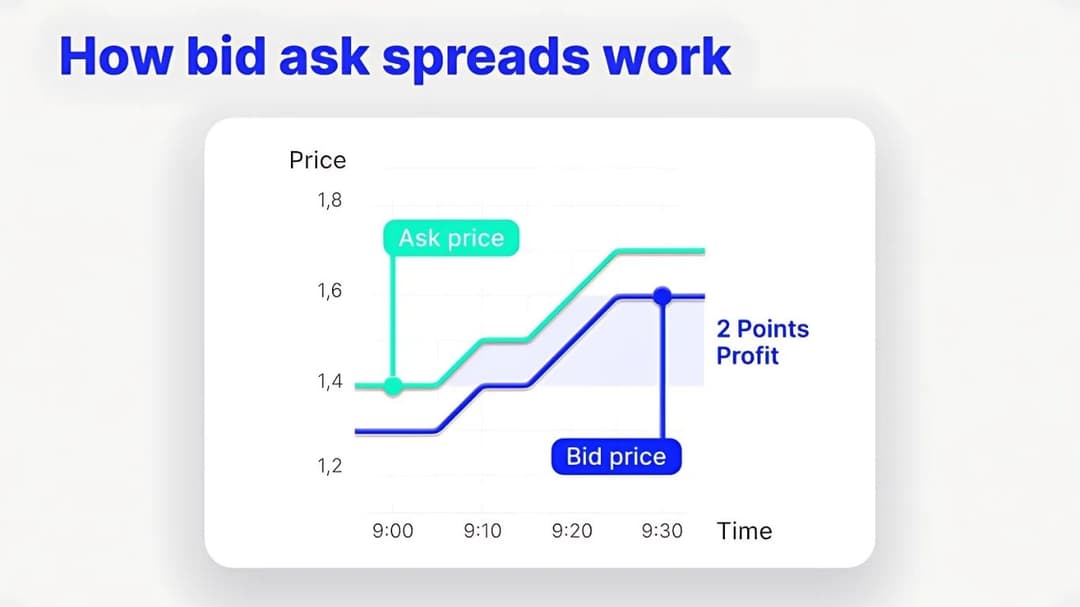
The bid-ask spread sits at the heart of every trade you make. It shows you the gap between what buyers will pay (the bid price) and the lowest price sellers will accept (the ask price). That difference is your primary lens for reading market liquidity, and it shapes both your costs and your potential profit.
Highly liquid assets like Amazon often trade with a spread of just $0.01, which means you’re getting in and out with minimal friction.
Think of the bid-ask spread as a live readout of market order dynamics. In fast-moving stocks, bid and ask prices can shift in seconds, and if you’re not careful, you’ll end up with slippage. A $0.05 spread on a $0.50 stock works out to a 10% cost right off the top, which can gut your returns before the trade even plays out.
The traders who consistently win understand the order book deeply enough to spot arbitrage opportunities that others miss.
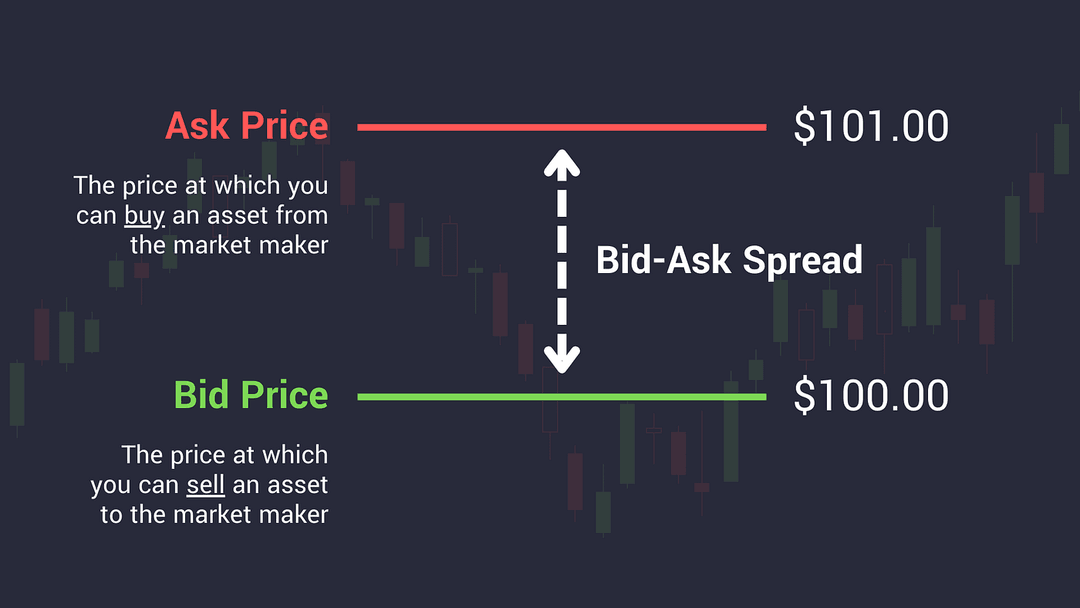
- Bid Price: The highest price buyers are willing to pay for a security.
- Ask Price: The lowest price sellers will accept for the security.
- Spread: Calculated as the difference between the bid and ask prices.
Role of Market Makers
Market makers are the engine behind tight spreads and steady liquidity. They commit to posting consistent bids and asks, which keeps trading volume flowing and transactions running smoothly. By holding inventory, they absorb price swings that would otherwise rattle the market. Their edge comes from buying at the bid and selling at the ask, profiting from the spread across a high volume of transactions. Without them, your cost to trade would be considerably higher.
Getting a firm grip on bid-ask spread dynamics is non-negotiable if you want to sharpen your strategy. Securities with higher trading volumes tend to have narrower spreads, which translates directly into lower transaction costs and a more efficient market for you to operate in. The tighter the spread, the closer the market is to fair value at any given moment.
Factors Influencing Bid-Ask Spread
For deeper context, the breakdown in how spreads compound the trading-fee burden over time is worth reading alongside this analysis.
The bid-ask spread reflects the difference between the highest price a buyer will pay and the lowest price a seller will accept. But what actually drives that gap wider or narrower? Several forces are at work, each revealing something different about market conditions.
Understanding these forces gives you a real edge when optimizing your trades and keeping costs under control.
Market Liquidity
Market liquidity is one of the biggest drivers of spread size. Liquidity measures how easily you can buy or sell an asset without moving the price against yourself. The more participants in a market, the faster transactions clear, and the tighter the spread tends to be.
Take stocks like Google (Alphabet), Apple, and Microsoft. These names trade with spreads of just a few cents because of their enormous daily volume and deep market presence. According to Nasdaq, the sheer depth of liquidity in these stocks keeps pricing tight and execution clean.
Small-cap stocks tell a very different story. If a stock is trading under 10,000 shares a day, you can easily see spreads stretching several percentage points, especially when market activity slows down. That’s a cost you feel immediately the moment you enter or exit a position.
Volatility
Volatility is another force that pushes spreads wider. During market corrections or periods of economic uncertainty, market makers raise the spread to protect themselves from rapid price swings that could leave them holding losing inventory. The riskier the environment, the more cushion they need.
The COVID-19 market crash in March 2020 is the clearest recent example. The VIX surged past 80, and spreads across the board widened sharply as traders and market makers scrambled to navigate the chaos. Lower-priced stocks, including many small-caps, felt the impact the hardest.
Trading Volume
Trading volume has an equally direct impact on the spread. When a security changes hands frequently, there are more opportunities for buyers and sellers to find each other at a price that works for both sides. High volume creates competition that naturally tightens the spread.
ETFs like the SPDR S&P 500 ETF (SPY) are a perfect example. With millions of shares trading daily, SPY typically carries spreads well under 0.01%. Niche ETFs focused on emerging sectors or specialized markets?
They can run much wider due to thinner trading activity.
Time of Day
The time of day matters more than most traders realize. Spreads tend to be widest in the first hour after markets open and the last hour before they close. During these windows, uncertainty is higher, liquidity is thinner, and the mismatch between buyers and sellers drives volatility up along with the spread.
Big economic announcements, like Federal Reserve rate decisions or employment reports, can temporarily blow spreads wide open as well. High-frequency traders are built to exploit exactly these moments, rapidly adjusting their bids and asks to capture value from the short-lived volatility. If you’re trading around these events without a plan, you’re playing on their turf.
Bid-Ask Spread Calculation
The bid-ask spread calculation is straightforward at its core. You take the ask price and subtract the bid price, and the result is the spread. That number tells you the direct cost of executing a trade in that market at that moment.
Bid-Ask Spread=Ask Price−Bid PriceHere’s a clean example. If the bid on a stock is $49.50 and the ask is $50.00, your bid-ask spread is $0.50. That $0.50 is effectively what you pay to enter the trade, and it’s a cost that applies whether you’re buying or selling.
For active traders making dozens of moves a day, those fractions add up fast.
But in more complex market environments, especially during high volatility or in markets with layered order books, a simple subtraction only tells part of the story. That’s where more refined methods come in.
Weighted Average Spread
When a market has multiple tiers of bids and asks stacked at different price levels, the simple spread calculation can understate your true trading cost. The weighted average spread accounts for the distribution of orders at various price levels, giving you a more accurate picture of actual liquidity. If significant volume sits just below the best bid or just above the best ask, the weighted average will reflect that, helping you estimate what it truly costs to execute in that market.
Effective Spread
The effective spread goes a step further by measuring what you actually paid to trade, not just what the order book showed you. Rather than relying on displayed bid and ask prices, it uses the real execution price of your market order. The formula works out to two times the absolute difference between the execution price and the midpoint of the bid-ask spread.
Effective Spread = 2 x [(Execution Price - Midpoint of Bid-Ask Spread) / Midpoint of Bid- Ask Spread)]This method is especially valuable in highly liquid markets where large orders can nudge the execution price away from the displayed quote. A stock like Apple (AAPL), where massive daily volume moves prices in real time, is a good case where the effective spread gives you a more honest read on transaction cost than the raw spread alone.
Percentage Spread
The percentage spread lets you compare trading costs across securities regardless of their nominal price. You calculate it by dividing the bid-ask spread by the ask price, then multiplying by 100 to get a percentage.
Percentage Spread = ( Midpoint of Bid and Ask Prices / Bid-Ask Spread) × 100Say the bid-ask spread is $1 on a stock trading at $50. Your percentage spread is 2%. That framing makes it easy to compare liquidity across assets with very different price tags.
A $1 spread on a $10 stock is a very different cost burden than a $1 spread on a $500 stock, and the percentage spread makes that distinction immediately clear.
We last reviewed this analysis in May 2026.


Alex Tzoulis
Alex Tzoulis is Co-Owner and Markets Analyst at The Luxury Playbook, specializing in equities, crypto, forex, and global financial markets. His work focuses on analyzing macroeconomic trends, geopolitical developments, and monetary policy, translating them into actionable insights across both traditional and digital asset classes. He leads the platform's financial market coverage, providing structured analysis across stock market investing, trading strategies, and cryptocurrency markets. His expertise strengthens the publication's authority in financial markets and capital allocation, bridging traditional finance with emerging digital investment ecosystems.