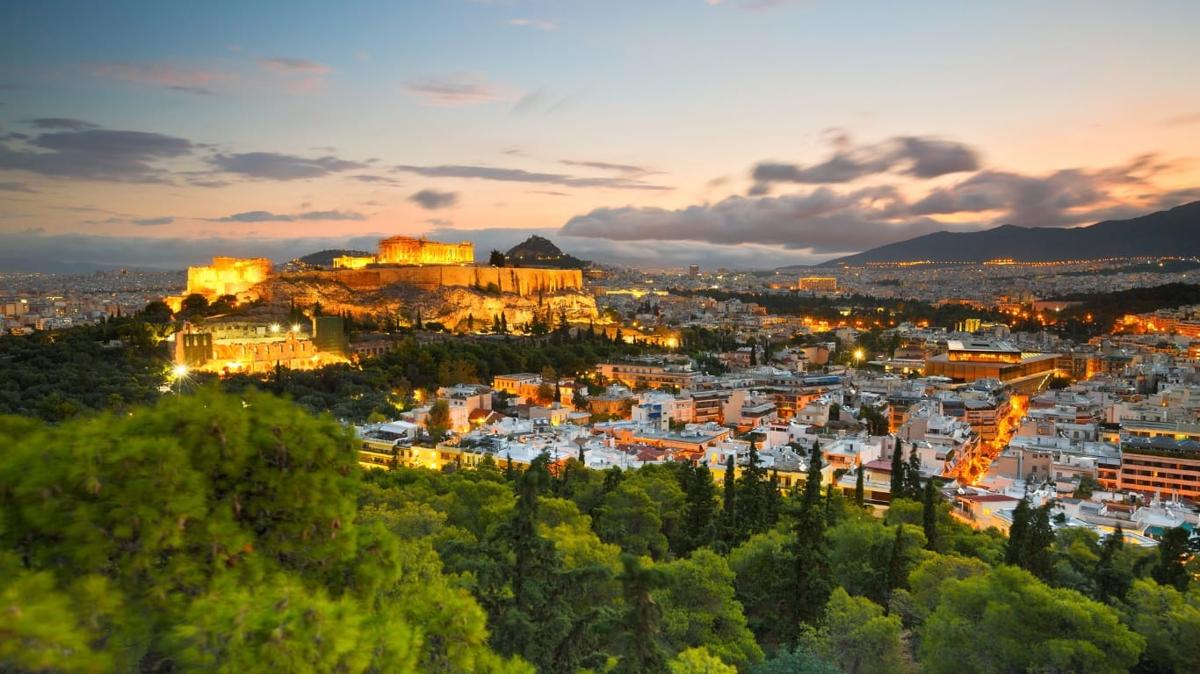

The Greek Golden Visa has been reshaped again. Under the 2024 overhaul that still governs applications in 2026, the entry threshold for property in central Athens and the rest of Attica, Thessaloniki, and the most coveted islands sits at €800,000. Step outside those high-demand zones and the bar drops to €400,000.
For commercial-to-residential conversions and listed buildings under restoration, the figure is lower still at €250,000. The program isn't quietly catering to volume buyers anymore. It has been recalibrated to attract owners who actually want to live in Greece, or at least visit often enough to justify the paperwork.
Greece introduced the scheme in 2013, and it has since become one of the most quoted residency-by-property routes into the EU. For international buyers weighing a European base, it now has fewer rivals: Spain closed its golden visa in April 2025, and Portugal dropped property from its scheme in 2023. What has changed is the buyer profile.
Where the Athens market a decade ago leaned heavily on Chinese demand, Bank of Greece figures for 2025 show a more distributed picture. Turkey, Switzerland, Hong Kong, Israel and the United States led non-EU property investment, with mainland China well down the list. Athens estate agents tell us the inquiries are coming from buyers who want a second home with a working visa attached, not a paper qualification.
- The Greek Golden Visa programme grants five-year renewable residency to non-EU investors meeting tiered property investment thresholds, currently EUR 250,000, EUR 400,000 or EUR 800,000 by location and property type.
- We see the higher threshold of EUR 800,000 applying across Attica, Thessaloniki, Mykonos, Santorini and islands of more than 3,100 residents, with EUR 400,000 covering the rest of Greece and EUR 250,000 reserved for conversions and listed-building restorations.
- Residency status does not require physical presence in Greece, which has supported the programme's popularity with buyers from Turkey, China, Israel and the Gulf, although qualifying homes may not be let short term.
- Pathway to citizenship requires seven years of legal residence with associated language and integration requirements, although many investors hold Golden Visa status without pursuing naturalisation.
- Renewal of the visa requires continued ownership of the qualifying property, with disposition of the asset triggering loss of the residency status for the principal investor.
- For most considered international buyers we view the Greek Golden Visa as one of the more attractive European residency-by-investment programmes, though a planned 15 percent transfer tax for non-EU buyers, likely from July 2027, would raise the cost of entry.
- Who is this for?
- Non-EU international buyers weighing the Greek Golden Visa programme, alongside the immigration lawyers, advisers and family office staff coordinating those applications.
- What is happening?
- A practical read of the Greek Golden Visa programme in 2026, covering the tiered thresholds, residency benefits, physical presence flexibility, processing and the citizenship pathway.
- When did this emerge?
- The article reflects programme conditions as of October 2026, including the 2024 threshold increases, the 2026 fall in new applications and the transfer-tax plan announced in September.
- Where is this happening?
- The piece covers Greece broadly, with reference to the threshold variations across Athens, Thessaloniki, Mykonos, Santorini and the secondary cities and regions.
- Why does it matter?
- Greek Golden Visa structure has shifted materially in recent years, which is why current eligibility rules deserve explicit attention before any property selection decision.
The basics, refreshed
The headline benefit has not moved. A qualifying property purchase grants the holder, their spouse, dependent children, and dependent parents a five-year residence permit, renewable indefinitely while the property is owned. The permit allows visa-free travel across the Schengen zone.
The permit carries no minimum-stay requirement, which keeps it unusually light. Citizenship is a separate test: naturalisation requires seven years of legal residence, and applicants are expected to show they have genuinely lived in Greece. The current framework keeps the broad architecture but tightens the geography. The €800,000 zones cover all of Attica (the historic centre, Kolonaki, Glyfada and Vouliagmeni alike), the Thessaloniki regional unit, Mykonos, Santorini and any island with more than 3,100 residents, which takes in Paros but not Antiparos.
Anywhere outside that map sits at €400,000, and both tiers require a single property with at least 120 square metres of main space. A separate €250,000 tier remains for listed heritage buildings undergoing full restoration, and for commercial-to-residential conversions, which must be legally complete before the application is filed. The idea to watch is a portfolio route for investors holding several homes on long-term lets, proposed in the July 2026 national housing strategy but not yet legislated.
What the buyers are actually choosing
The Athenian Riviera has been the breakout story. The strip from Glyfada through Vouliagmeni to Lagonisi has repriced sharply in recent years. Branded hospitality has anchored the upper bracket, from the Four Seasons Astir Palace in Vouliagmeni to the Mandarin Oriental at Costa Navarino and the One&Only private homes on Kea.
Greece Sotheby's International Realty's December 2025 review of high-end sales put the Riviera average at about €10,500 per square metre. Sotheby's and Engel & Völkers Greece are both active at the top of the Riviera market, where the largest deals are often done privately. That is a different conversation from the Athens of 2018.
The Cyclades remain the trophy choice. On the same figures Mykonos edges the Riviera at about €10,800 per square metre, and Paros and Tinos rank among the Mediterranean's 20 priciest coastal markets. Santorini has cooled at the very top end, after the seismic swarm of early 2025 and a freeze on caldera building permits that holds until the island's special urban plan is approved, and no later than the end of 2026.
Antiparos has quietly become the Cycladic favorite of architects and gallerists. The island's planning rules cap building height and demand traditional whitewash, which has kept the texture intact. Tinos and Sifnos sit one rung below the price curve and are doing more of the interesting architectural work.
On the mainland, Costa Navarino in Messinia has built itself into a self-contained ecosystem of golf, hotels, and branded residences. The Westin opened in 2010, the W in 2022 and the Mandarin Oriental in 2023. The villa releases there have absorbed a meaningful share of the post-pandemic appetite from US and UK buyers looking for a Mediterranean base with operational infrastructure built in.
The buyers' field
The pattern of who is buying matters because it shapes which neighborhoods come back into rotation. The post-2022 wave skewed older, with buyers in their fifties and sixties looking for a part-time residence with a Schengen visa attached. The wave we are now watching skews younger, with more single buyers and couples in their thirties and forties choosing Athens or Thessaloniki over the islands.
The shift owes much to remote-work flexibility and to the Athens cultural revival the city has staged across the Stavros Niarchos Foundation, the Onassis Stegi, and the gallery scene around Pireos Street. For Americans, the program's appeal is partly geographic and partly tax-adjacent: a base in the EU without committing to French or Italian residency. For Gulf buyers, Greece reads as the Mediterranean alternative to a property elsewhere on the Côte d'Azur.
For UK buyers post-Brexit, the visa solves the Schengen 90/180 cap that turned a second home into a logistical headache. Israeli buyers have become one of the most visible cohorts: when the finance minister set out September's transfer-tax plan, he named Israel alongside Turkey and China as sources of demand. The buyer mix has structurally widened.
The properties themselves
Three formats dominate at the upper threshold. Branded residences within hotel resorts (the Mandarin Oriental, Four Seasons, One&Only programs) sell for delivery and management; the model is familiar to anyone who has bought into a Caribbean branded program. Restored neoclassical townhouses in Plaka and Anafiotika typically trade in the low millions, often as second-line trophy purchases for owners already familiar with Greece.
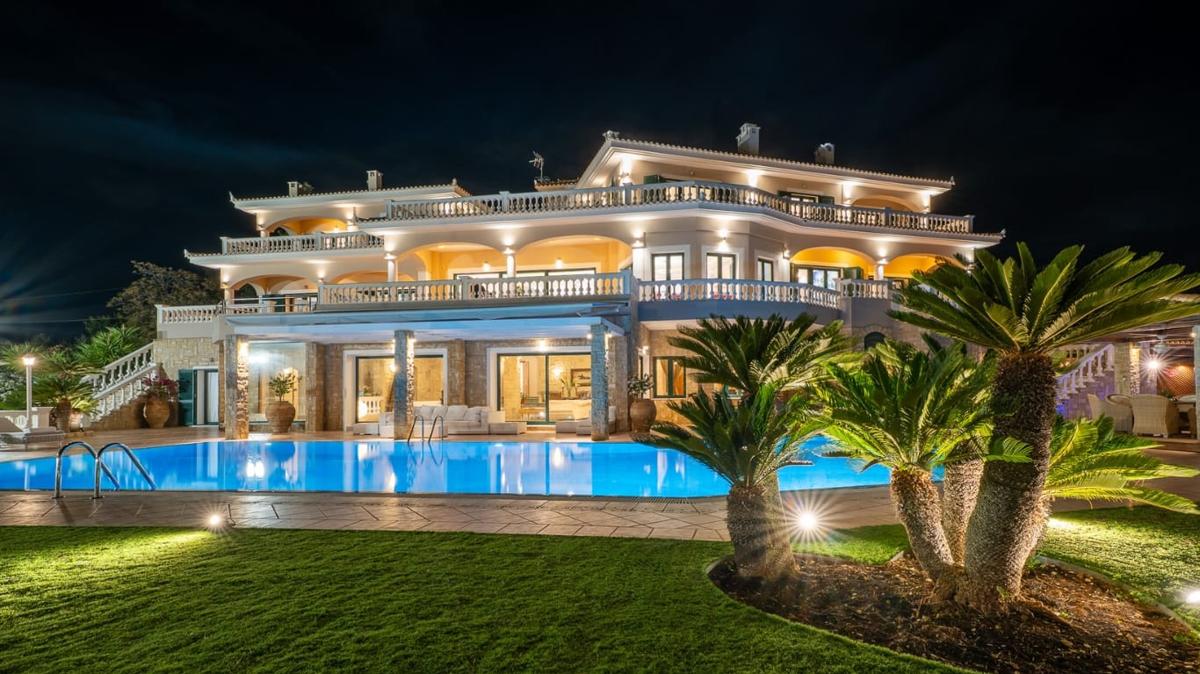
Modernist villas on the Riviera anchor the top end of the contemporary segment. The language of Aris Konstantinidis and Takis Zenetos lives on in the work of architects like Kokkinou Kourkoulas, Divercity, and Potiropoulos & Partners. The standard brief is a four-to-six-bedroom seafront residence with a pool, staff quarters, and a wine room.
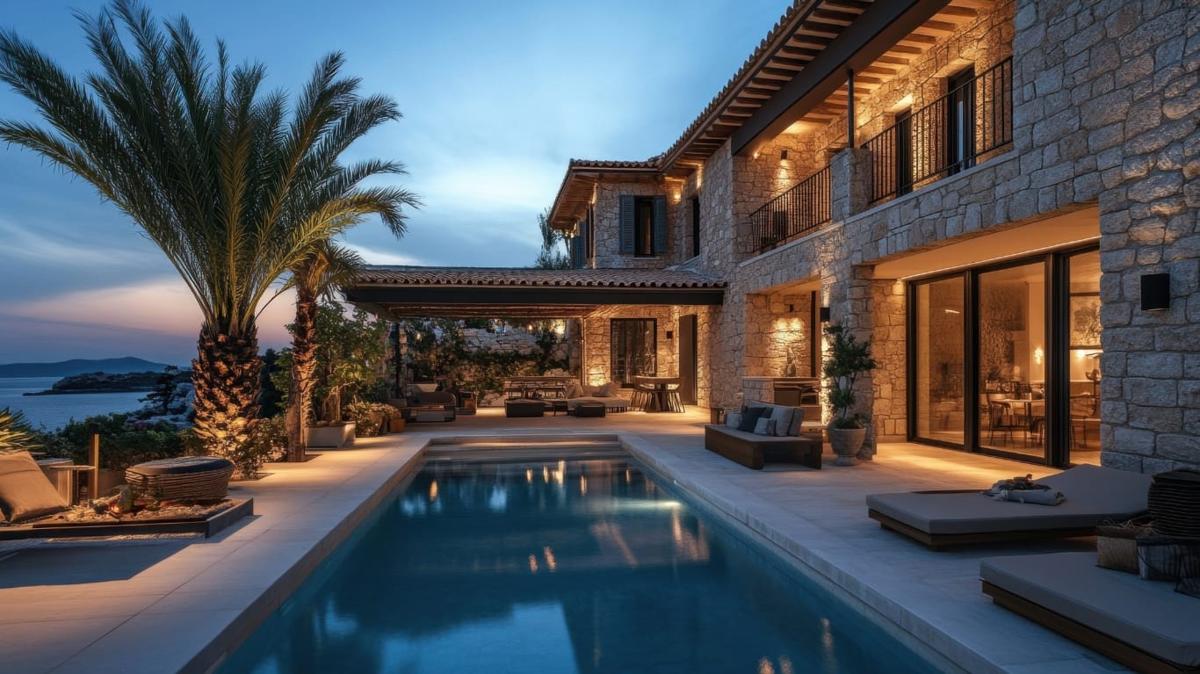
The island work is more textural. Owners hire architects who have spent years on the islands, including deca Architecture (Antiparos), KRAK Architects (Corfu and Rhodes), and Kapsimalis Architects (Santorini). The studios keep the regional dialect of drystone walls, lime-washed surfaces, and cypress beams, and adapt it for owners who want air conditioning, lap pools, and a wine room.
What the program isn't
The Greek Golden Visa's property route is not a fund play. Greece keeps separate capital-market options, but the property path requires a single real home, not a bundle of small flats. Long-term letting is permitted; short-term letting of a qualifying property is banned, and a breach costs the permit plus a €50,000 fine.
The Independent Authority for Public Revenue's short-term rental register has tightened too: new registrations in central Athens have been frozen since 2025, and the government has said the freeze will run to the end of 2027. It is also not a fast-track to citizenship. Greek nationality remains a seven-year process, with language and integration components.
Nor is it quick or cheap to enter. A backlog built up in 2024 and 2025, and in the first half of 2026 new applications fell 44% on a year earlier while permits issued rose 21% as officials worked through it. In September the government also announced plans to raise transfer tax on homes bought by non-EU individuals from 3% to 15%, most likely from July 2027. As briefed, the exemptions cover EU citizens and long-term residents, not Golden Visa buyers, though no bill had been published at the time of review.
The visa is best read as exactly what it says, a residence permit tied to property ownership, with the secondary benefit of EU travel. Buyers planning to chase citizenship should read Greece's path as the slower of the EU options. Buyers planning to chase a Mediterranean residence with the Schengen visa attached will find the Greek program one of the most thoughtful currently available.
What this means for buyers
The version of the Greek Golden Visa available in 2026 is more deliberate than the program of a decade ago. The price floor has risen, the geography has narrowed, and the program is selecting for buyers who actually want to spend time in the country. The planned transfer tax would push the same way. From an editorial reading of the market, that has been good for the texture.
The neighborhoods absorbing the new arrivals (Vouliagmeni, Kolonaki, the Cyclades, Costa Navarino) are doing more interesting work because the buyers landing there are more committed. Greece has stopped being a residency hack and started being a place people choose. That is a healthier place for the program to land.
We last reviewed this analysis on 17 October 2026.