The American watchmaking revival is finally drawing the collector attention it deserves. After roughly a century where serious wristwatch production sat almost exclusively in Switzerland and Germany, a small group of contemporary American makers have built credible hand-finished watchmaking operations that increasingly attract serious collector consideration.
- American-made watches have re-emerged as a credible collector category, with RGM, Weiss, and Vortic leading the renewed attention on domestic horological capability.
- RGM Caliber 801 and Pennsylvania Tourbillon references demonstrate that Lancaster, Pennsylvania can still build movements that compete with Swiss and German alternatives.
- Weiss Watch Company's use of vintage Hamilton movements and modern American assembly draws collectors who value the heritage transfer through historical calibre work.
- We see Vortic Watch Company as the most interesting cased-up vintage American reference programme, with antique pocket-watch movements supporting a modern wrist format.
- Shinola represents a separate value tier, with assembled-in-Detroit watches offering accessible entry points for collectors interested in American manufacturing positioning.
- Secondary market depth on American-made references remains thinner than European alternatives, but collector education continues to expand the category at a steady pace.
- Who is this for?
- Collectors interested in domestic horological capability, students of American watchmaking history, and buyers drawn to small-run manufactured pieces.
- What is happening?
- A grounded read on why American-made watches are drawing collector attention, covering RGM, Weiss, Vortic, and Shinola programmes.
- When did this emerge?
- The current category renaissance reflects the last decade of small-run American manufacturing investment, with auction visibility growing through 2026.
- Where is this happening?
- Direct manufacturer websites, authorised dealers, and specialist American watchmaking events handle the bulk of the modern American-made market.
- Why does it matter?
- American-made watches offer domestic horological capability and manufacturing transparency that no Swiss or Japanese alternative can replicate at the same scale.
RGM in Pennsylvania, J.N. Shapiro in California, Cameron Weiss in Tennessee, and the various smaller independents are operating at scales that are tiny by Swiss standards but real on their own terms. In our coverage of the past three Watches and Wonders cycles and the various independent watchmaking events in New York and Los Angeles, American-made watches have appeared with increasing frequency in serious collector conversation.
RGM Watch Company and the longest American run
RGM Watch Company, founded by Roland Murphy in 1992 and operating from Mount Joy, Pennsylvania, is the longest-running of the contemporary American makers. The brand's PS-801 reference, with the in-house Calibre 801 (a manual-wind movement designed and produced in-house by RGM), is the brand's defining contemporary execution. The Caliber 20 references with engraved bridges and the larger movement architecture anchor the upper tier of RGM production.
Pricing runs from around $9,000 in the entry tier through $50,000-plus in the upper complicated references. RGM operates at single-digit to low-double-digit annual production across the considered references, and the waiting list runs into multiple years for the in-house Calibre 801 and Caliber 20 pieces.
J.N. Shapiro at the upper hand-finishing tier
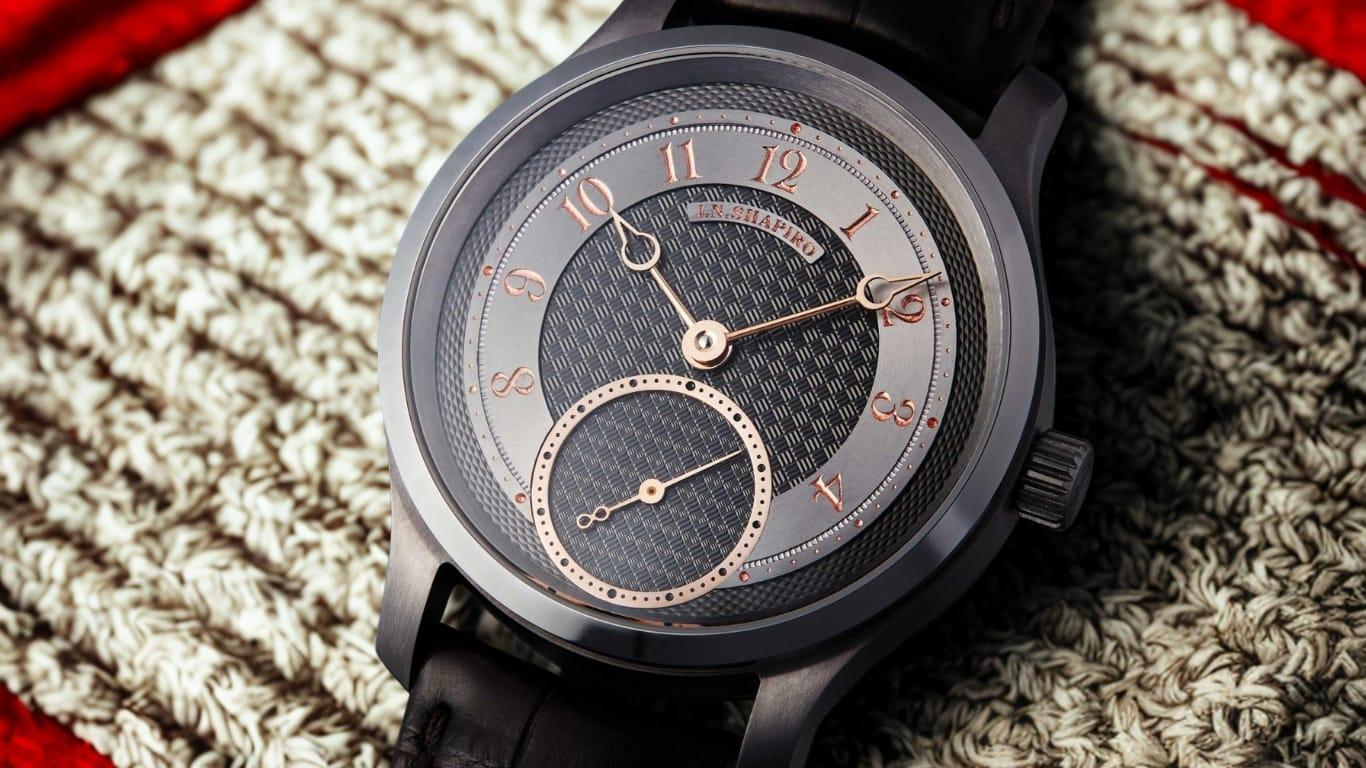
J.N. Shapiro, founded by Joshua Shapiro in 2018 from a California base, has built one of the most considered contemporary American watchmaking operations in single-digit annual production. The Resurgence reference, with the in-house JNS-01 movement designed in collaboration with experienced watchmakers, anchors the brand's contemporary work.
Pricing runs in the upper-five-figure to low-six-figure tier per piece, with the waiting list running years. Shapiro's case-engraving work specifically (the brand has built a reputation around hand-engraved cases and movement bridges executed to a standard most contemporary Swiss makers do not attempt) has drawn the kind of trade-press attention typically reserved for the established independents.
Weiss Watch Company and the accessible American tier
Cameron Weiss founded Weiss Watch Company in 2013, operating from Nashville, Tennessee. The brand's Standard Issue Field Watch with the Caliber 1003 in-house manual-wind movement at around $1,200 retail is the brand's most accessible contemporary execution.
The various American Issue references with higher-end finishing and the various special-edition pieces extend the line into the upper tier. Weiss has built a particular following for the field-watch register, and the brand's commitment to American-sourced components where possible has anchored a distinctive identity in the contemporary independent watchmaking conversation.
The smaller independents and the historical context
The broader American watchmaking ecosystem includes a number of smaller independent makers. Vortic Watch Company focuses on antique American pocket-watch movements housed in contemporary 3D-printed cases; Devon Tread produces the architectural quartz pieces; the various smaller workshops produce hand-assembled watches in single-digit annual quantities.
The collective American production is still tiny by Swiss standards but represents the most serious American watchmaking activity since the postwar decline of the historical Hamilton, Elgin, Waltham, and Illinois operations. At the height of American watchmaking in the 1900s, the country produced more pocket-watch movements than Switzerland; that ecosystem effectively ended between 1969 and 1985 as the quartz crisis collapsed the established American houses.
Why the American revival is drawing collector attention
Three reasons. First, the work itself. The serious American makers are producing in-house movements with hand-finished components at standards that genuinely earn comparison to the established independent Swiss and German names.
Second, the historical anchor. The American watchmaking tradition was once the largest in the world, and the contemporary revival reads as the credible continuation of that history rather than a startup category.
Third, the production constraint. RGM, J.N. Shapiro and Cameron Weiss all operate at single-digit to low-double-digit annual production, and that scarcity gives the considered references genuine collecting structure.
What collectors look for in an American-made pick
For contemporary American watches, the references that come up most consistently in serious collector conversation are the RGM PS-801 and the Caliber 20 references for collectors weighting the in-house movement work, the J.N. Shapiro Resurgence for collectors operating at the upper hand-finishing tier, and the Weiss Standard Issue and American Issue references for collectors entering the category at more accessible price points.
Box-and-papers documentation matters; service through the makers' own facilities is the practical baseline. The waiting-list dynamic means most considered references trade at or above retail in the small but real secondary market, and the production constraint suggests that pattern is likely to hold.
What this means for collectors
The longer story collectors recognise is that contemporary American watchmaking sits at an interesting moment. The makers are small, the production is constrained, and the broader collector recognition has been building gradually rather than suddenly.
The American making tradition that essentially ended with the postwar decline of the historical houses has, across the past three decades, been quietly rebuilt by makers committed to the work for its own sake. The collectors who recognise this trajectory now are buying into a category that may, over decades, build the kind of historical depth the broader Swiss and German makers have spent centuries establishing.
For collectors weighing the category in 2026, the practical sequencing depends on the price tier the buyer wants to enter. The Weiss Standard Issue at $1,200 retail is the most accessible serious-American entry point; the RGM PS-801 and Caliber 20 references occupy the mid-tier for collectors weighting the longest American manufacture history; the J.N.
Shapiro Resurgence anchors the upper tier for collectors operating at the hand-finishing standard the established independent Swiss and German makers set. Each maker's annual production is small enough that allocation timing matters substantially.
We last reviewed this analysis in May 2026.