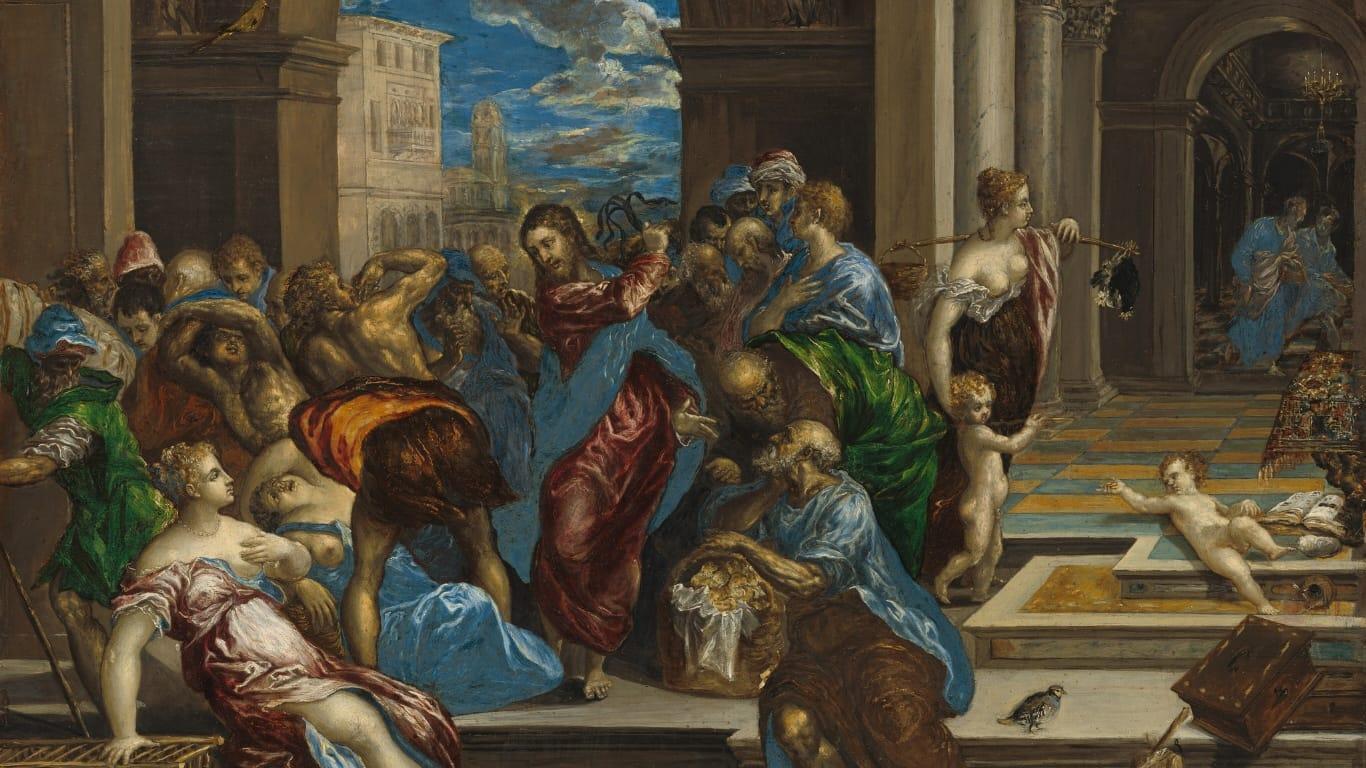
El Greco (Domenikos Theotokopoulos, 1541-1614) has been one of the quietest revaluation stories in the senior Old Masters market for the past decade. Born in Crete, trained in Venice and Rome, settled in Toledo from 1577 until his death, El Greco produced a body of work that resisted easy categorization for centuries: too Byzantine in early eyes, too distorted in the eighteenth and nineteenth centuries, too modern-feeling for the high tradition of Renaissance painting that surrounded him. The twentieth century rehabilitated him as a major figure; the twenty-first has continued to consolidate that position quietly, and the market is now beginning to reflect it.
The collectors moving on El Greco in 2026 are doing so for reasons that say something about how the senior market is reading the broader Old Masters category. Supply at the top is thin. Institutional positions are unusually deep.
The price gap between confirmed autograph El Greco and comparable Renaissance Masters has narrowed but remains meaningful. The buying we are watching is patient, well-advised, and focused on quality.
- Collectors are quietly buying El Greco because his work sits at the structural top of the Old Master market with genuinely limited supply at auction.
- Domenikos Theotokopoulos, working in Toledo between roughly 1577 and his death in 1614, produced a body of religious painting that remains uniquely identifiable.
- Major El Greco works are held primarily at the Prado in Madrid, the Met in New York and a small group of leading institutions across Europe and the Americas.
- Auction supply is genuinely scarce, with very few canonical works appearing at public sale in any given year and most movement happening through private channels.
- Recent quiet interest from senior private and institutional collectors has steadied prices and reinforced El Greco’s position within the deepest Old Master tier.
- For serious Old Master collectors, El Greco offers genuine scholarly depth and lasting aesthetic distinction at the very top of the museum-quality market.
- Who is this for?
- Old Masters collectors, advisors and family offices tracking the deepest scholarly and market interest in El Greco within the broader European painting tradition.
- What is happening?
- An editorial read on why collectors are quietly buying El Greco, covering his Toledo period, museum holdings, scarce auction supply and his structural position within the Old Master tier.
- When did this emerge?
- Most relevant around the January and July Old Master sales at Christie’s, Sotheby’s and Bonhams and around major El Greco loan exhibitions across Spain and the broader European institutional circuit.
- Where is this happening?
- Centred on the Madrid market historically, with major institutional holdings at the Prado, the Met and selected leading museums across Europe and the Americas.
- Why does it matter?
- El Greco sits at the deepest tier of the Old Master market, and understanding why senior collectors continue to pursue his work is essential context for any serious European-painting programme.
Why El Greco's position has shifted
The twentieth-century rehabilitation of El Greco was driven by the early modernists (Cézanne, Picasso, the German Expressionists) who recognized in his elongated figures and intense palette a direct precursor to their own work. The 1902 retrospective at the Prado in Madrid was the watershed moment; Picasso's "Les Demoiselles d'Avignon" of 1907 carries direct visual debt to El Greco's compositions.
The institutional record built through the twentieth century reinforced that position. The Prado, the Museo del Greco in Toledo, the Hospital de Tavera, the Metropolitan Museum, the Frick Collection (with "St. Jerome as Cardinal"), the National Gallery in Washington, the National Gallery in London, the Louvre, and the Hermitage all hold canonical material.
The twenty-first century has continued the consolidation. Major retrospectives at the Prado (2014, the 400th anniversary), the Grand Palais (2019), the Art Institute of Chicago, and other institutions have reaffirmed his canonical position. The 2014 Prado show was particularly consequential, drawing significant attendance and scholarly attention.
How the El Greco market actually trades
El Greco appears at the Old Masters evening sales at Christie's, Sotheby's, and (selectively) Bonhams. The supply at the top is unusually thin: most major confirmed autograph paintings are in museum or church collections, with limited circulation through private hands. When a confirmed top-tier work appears, the salesroom behaves with focused attention from a small but committed buyer pool.
The headline numbers frame the position. "The Entombment of Christ" sold at Sotheby's London in July 2010 for £9. 2 million. "St. Dominic in Prayer" sold at Sotheby's London in July 2013 for £9. 2 million. "Saint Jerome" sold privately in 2017 in the high seven figures.
The strongest works price in the high seven and low eight figures consistently.
Below the top tier, the broader El Greco market includes workshop attributions, school works, and the religious paintings produced in series during his Toledo period. These secondary-tier works trade at meaningful discounts to autograph paintings, though strong attributable workshop pieces continue to find buyers in the high six and low seven figures.
What attribution actually means in this market
El Greco operated a substantial workshop in Toledo, with his son Jorge Manuel Theotokopoulos and assistants producing variants of the master's compositions for church commissions. Many surviving El Greco works are workshop or studio pieces rather than autograph, and the market discipline around attribution is strict.
Confirmed autograph works require strong technical analysis, documentation back to original commission sources where possible, and the support of the senior specialists at the major houses. The Prado's research department, the Royal Academy of History in Madrid, and the senior Old Masters specialists at Christie's and Sotheby's are the principal reference points for attribution work.
Technical analysis (infrared reflectography, X-ray, dendrochronology for any panels, pigment analysis) is part of standard due diligence on any serious lot. The conservation history matters: many El Greco works have been heavily restored over four centuries, and the technical record on each major piece is part of the catalogue documentation.
The senior collector base building positions
The El Greco buyer pool is small and unusually committed. American collectors with deep Old Masters positions remain the most active. European collectors (Spanish, French, Italian, British) operate through long-tenure relationships with the senior Old Masters dealers and the major-house specialists.
The Spanish institutional position is particularly deep. The Prado and the Toledo institutions (Museo del Greco, Hospital de Tavera, the Toledo Cathedral) anchor the national patrimony. Any major El Greco appearing at auction is read against this institutional baseline.
The Louvre Abu Dhabi has shown selective interest in the broader Old Masters category, and the Gulf institutional buildup represents potential new demand for top-tier material across the segment. The Met's deep Old Masters position has also continued to draw New York-based collector interest in the broader category.
Where El Greco sits relative to other Renaissance Masters
El Greco sits at the late end of the Renaissance and early Baroque conversation. Born thirteen years after Titian's death, his career runs alongside the Counter-Reformation reshaping of religious painting and into the early Baroque sensibility. He overlaps in years with Caravaggio (1571-1610), who shaped a parallel and very different path for religious painting in Italy.
His position in the broader Old Masters market puts him in the same tier as Picasso the modernists (interestingly enough, given the twentieth-century influence) and the major Renaissance and Baroque names. Cézanne's admiration for El Greco is documented in his late letters and conversations, and the bridge between sixteenth-century Toledo and nineteenth-century Aix is one of the more interesting lines in European art history.
For collectors building serious Old Masters positions, El Greco offers an unusual combination: deep institutional record, mature scholarship, thin supply at the top, and a price tier that has lagged some of the more obvious Renaissance Masters despite its cultural and historical weight.
What distinguishes serious El Greco collecting
Three disciplines define serious acquisition in this market. First, attribution rigor. The autograph versus workshop distinction is sharp, and the market prices the distinction carefully.
Senior dealer and major-house engagement is part of any serious acquisition.
Second, condition discipline. Four centuries of cleaning, varnish removal, and restoration have left many El Greco works in compromised states. A work in good condition can be worth multiples of one in poor condition.
The technical documentation and the conservation history are part of the catalogue conversation.
Third, provenance research. Many El Greco works trace back through Spanish ecclesiastical and aristocratic collections. The Spanish Civil War period and the broader twentieth-century redistribution of European collections have created provenance lines that require careful research.
The Art Loss Register and the Spanish national restitution archives are part of standard due diligence.
What this means for collectors
El Greco in 2026 is a deep institutional category with a thin supply at the top and a quietly building collector base. The work has lagged some of its Renaissance contemporaries in price for decades; the recent institutional consolidation and continued scholarly attention suggest that gap is beginning to close.
For collectors interested in the segment, the practical starting points are workshop attributions, drawings (extremely rare), and the broader Toledo-period religious painting tradition. The senior Old Masters dealers (Colnaghi, Otto Naumann, Adam Williams, Daniel Katz) and the major-house specialists are the access points. Engagement with the Prado, the Museo del Greco, and the major retrospectives is the standard discipline.
What we'll watch next
The 2026 Old Masters evening sales in January and July remain the calendar venues. We are watching for any confirmed autograph El Greco appearances, which would be meaningful market moments. The supply pipeline at the top tier is genuinely thin, and any major work will draw deep attention.
We are also watching the broader Old Masters institutional buildup in the Gulf and East Asia. The Louvre Abu Dhabi, the Qatar Museums network, and the Saudi Arabian programmes have continued to acquire selectively, and the continued institutional demand at the top end of the category is the structural force that supports prices over the long cycle.
We last reviewed this analysis in May 2026.