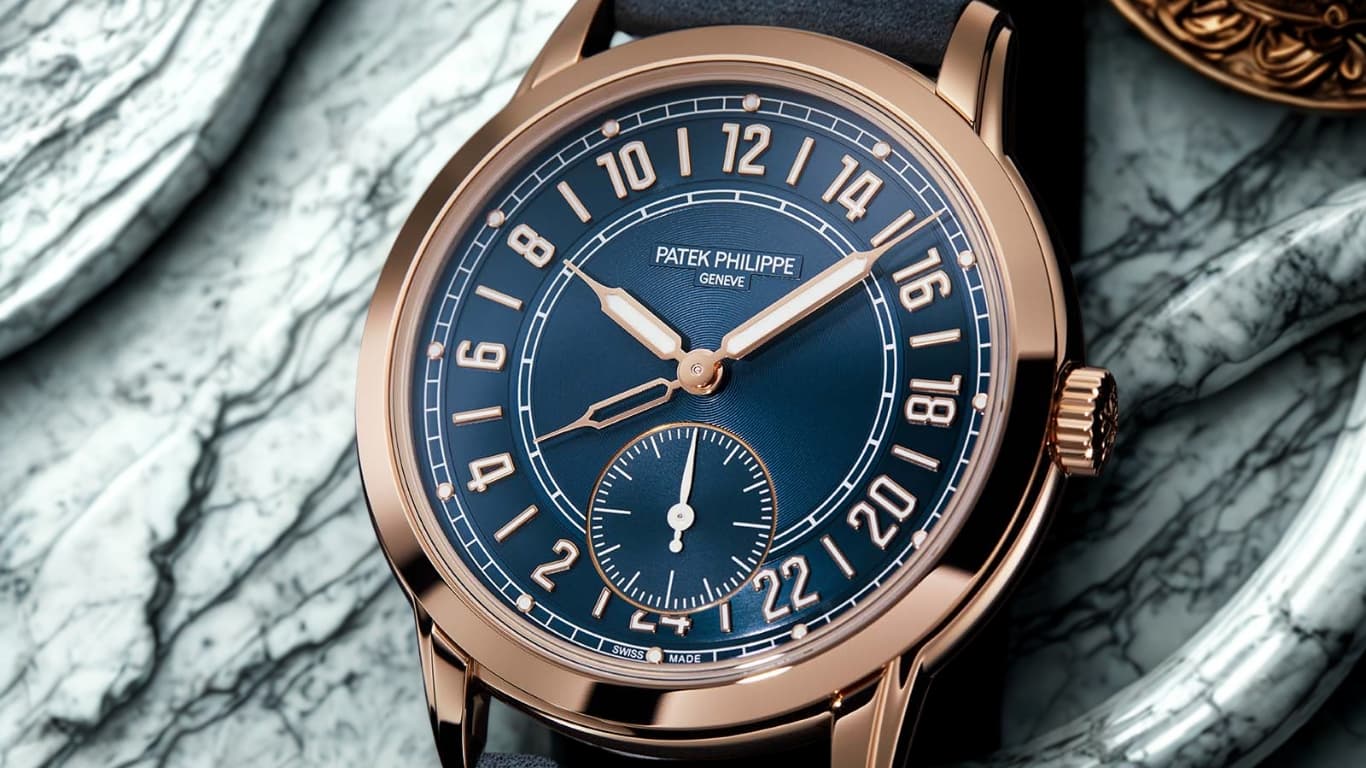
The Patek Philippe Calatrava stays a cornerstone of serious collecting because it is the Patek that asks the least of its owner and quietly rewards the most. The Calatrava reference 96 launched in 1932, designed by David Penney and Adolphe Stern with the clean round case, the applied baton or Roman numeral indices, the dauphine hands, and the pure dial geometry that defined classical Swiss dress watchmaking for the next ninety-plus years.
- The Patek Philippe Calatrava remains the cornerstone dress watch in serious collecting, with Bauhaus design principles and finishing standards that have anchored the brand for nearly a century.
- Reference 6119G and 6119R anchor the modern catalogue, with the Calibre 30-255 PS hand-wound movement supporting the dress-watch purity that defines the line.
- Vintage 96 and 565 Calatrava references remain the strongest collector entries, with original conditions and unpolished cases commanding meaningful auction premiums.
- We see the Calatrava as the most reasonable single Patek purchase for collectors building dress-watch depth, with brand pedigree and design purity aligned uniquely.
- Limited Calatrava editions tied to brand anniversaries and unique-piece commissions continue to outperform the broader catalogue on the secondary market.
- Service infrastructure and parts availability favour Patek's perpetual service programme, with the brand's commitment to repairing every watch it has ever made supporting long-term ownership.
- Who is this for?
- Patek Philippe collectors building dress-watch depth, design-anchored buyers, and serious students of Bauhaus-influenced watchmaking.
- What is happening?
- A grounded case for the Patek Philippe Calatrava as a cornerstone dress watch, covering Bauhaus design lineage, modern catalogue, and vintage collector entries.
- When did this emerge?
- The case has held across nearly a century, with the modern 6119G and 6119R references continuing to anchor the Calatrava position into 2026.
- Where is this happening?
- Authorised Patek dealers globally maintain quiet waitlists, while Phillips, Christie's, and specialist auctions handle the vintage market.
- Why does it matter?
- The Calatrava offers Patek pedigree and Bauhaus design purity in a dress-watch package that no other manufacturer can replicate at comparable finishing standards.
The reference is the Patek the brand's most considered collectors keep coming back to. The Calatrava is the watch a serious collector wears when they want to think about watchmaking rather than to be seen wearing one. The Nautilus dominates secondary-market conversation; the Grand Complications anchor the auction headlines; the Calatrava does neither and yet runs almost without interruption since 1932.
Why the Patek Philippe Calatrava stays a cornerstone
Three reasons. The design discipline (the Calatrava's dial-and-case geometry has been refined gradually rather than reinvented across nearly a century, and the result reads as canonical classical Swiss dress watchmaking). The movement architecture (the Calibre 215 PS in the 5196 is one of the most considered manual-wind dress calibers in contemporary production, with traditional finishing and the kind of design discipline that anchors classical watchmaking).
The brand discipline carries the third pillar. Patek's annual production cap of roughly 68,000 watches across the entire global catalogue keeps the Calatrava production tier genuinely constrained. The constraint isn't artificial: Patek is a small production maker by upper-tier standards, and the brand's stewardship has held that discipline across the entire post-Stern-family era of contemporary production.
The defining contemporary references
The reference 5196 (the contemporary 37mm Calatrava with the manual-wind Calibre 215 PS, retailing around €23,000) is the cleanest current expression of the historical Calatrava reference. The reference 5227 (the 39mm Calatrava with the off-centre date and the Calibre 324 S C, around €32,000) extends the line into the slightly more ambitious register. The reference 5119 (the 36mm Calatrava with the more ornate hobnail-pattern bezel, around €25,000) anchors the dressier configuration.
The vintage Calatrava reference 96 from the 1930s and 1940s anchors the upper tier of vintage Patek collecting at the dress register. Clean examples with original dials and credible service histories trade between $25,000 and $60,000 at Phillips and Christie's depending on case material, dial variant, and condition.
Phillips and Christie's catalogue notes on vintage reference 96 examples routinely describe the dial finish and the case-edge crispness as the load-bearing condition factors. That register is what the contemporary 5196 attempts to extend, and the modern execution sits closer to the historical reference than any contemporary Patek reference outside the Calatrava line.
The Calatrava inside the wider Patek catalogue
Read against the rest of the Patek catalogue, the Calatrava sits in a particular place. The Nautilus and the Aquanaut dominate secondary-market conversation; the Grand Complications anchor the auction headlines; the Calatrava does neither and yet runs almost without interruption since 1932.
Patek's roughly 68,000-piece global annual production cap, a figure the brand publishes openly, means every Calatrava configuration is allocated against the same constrained supply that drives the rest of the line. The reference 5196 in particular has remained a steady secondary fixture at €25,000 to €35,000 across the post-correction window, almost untouched by the 2022 peak and the 2023 unwind that reset the Nautilus.
That stability is the structural argument for the line. The Calatrava is the Patek reference that doesn't behave like a Patek reference on the secondary market. Collectors who want a Patek without the speculation tax that the Nautilus 5811 still carries have, in practice, been routed toward the Calatrava for years.
Where the Calatrava sits against the trinity register
Compared with Vacheron Constantin's Patrimony and Lange's Saxonia, the Calatrava is the most architecturally restrained of the three. Vacheron leans into the Maltese-cross detailing on the case-back; Lange weights the three-quarter plate movement architecture as the visible signature. Patek's argument with the Calatrava is the absence of either move: a watch judged on dial geometry, hand proportion, and case finish alone.
That stripped-down register is the harder design brief to execute. A Calatrava can hide nothing. Every imperfection in the dial finish, every case-edge transition, every applied index alignment reads under examination.
The line earns its cornerstone status precisely because the brand has held the discipline across nearly a century of continuous refinement.
The complications that quietly extend the line
The Calatrava Travel Time references (the 5524 in particular) and the various perpetual-calendar Calatrava configurations sit at the upper register of the line without abandoning the dress-watch geometry. The 5524G in white gold with the blue dial trades at €30,000 to €45,000 secondary. The perpetual-calendar Calatrava references run from €70,000 through six figures depending on configuration.
These are the references serious collectors arrive at after the standard 5196 has done its work. The complications extend the line without reaching for the Grand Complication tier; the design discipline holds across the more complicated configurations, and the references function as the natural next step for collectors building out the Calatrava axis of a serious Patek collection.
What collectors look for in a Calatrava
For modern Calatrava, the references that come up most consistently in serious collector conversation are the 5196 in the various dial configurations (the cleanest current expression), the 5227 with the off-centre date, the 5119 in the dressier hobnail bezel configuration, and the various Patek Calatrava Pilot Travel Time references for collectors drawn to the more contemporary register.
Box-and-papers documentation matters substantially. Service-network access through Patek's authorised facilities is the practical baseline for any reference where future provenance will matter. The brand's archive service, which provides documented confirmation of a reference's production date and original configuration, is one of the most considered authentication resources in classical watchmaking and warrants the cost on any reference where future provenance documentation matters.
For vintage, the reference 96 in clean condition with original dial and case finish anchors the upper tier. Originality of dial, hands, and case finish all matter substantially; refinished cases drop value meaningfully. Phillips and Christie's both handle vintage Calatrava at their major sales; the established Patek specialist dealers handle the broader vintage market.
What this means for collectors
The Calatrava rewards the collector who treats the watch as a long-arc acquisition rather than a cyclical position. The reference's structural place inside Patek's broader catalogue, the trinity-standard finishing, and the production discipline that keeps the line genuinely constrained all support holding a Calatrava across decades.
Vintage reference 96 examples with clean dials and credible service histories continue to find buyers at the major auction houses; contemporary 5196 examples that come up with full box-and-papers documentation transact reliably through specialist dealers and the boutique pre-owned channels. For collectors who already hold a Nautilus or are watching the Lange Saxonia line from outside, the Calatrava remains the most credible quiet entry, and the most likely to look correct twenty years from acquisition.
We last reviewed this analysis in May 2026.

Frequently Asked Questions
- Which Calatrava models hold their value best?
- References like the 6119G, 5196, 5127, and vintage Ref. 96 show the strongest resale performance. Full box, papers, and service history significantly increase value.<br><br>
- How much does a Patek Philippe Calatrava cost in 2025?
- Retail prices range from $31,000 to $45,000 for most current models. Vintage or platinum-cased versions can exceed $80,000–$120,000 depending on rarity and condition.<br><br>
- Does the Patek Philippe Calatrava appreciate over time?
- Yes. While it grows slower than hype-driven sports models, many Calatravas—especially manually wound and limited references—consistently appreciate over 5–10 year periods.<br><br>
- Is the Patek Philippe Calatrava better than the Rolex Cellini?
- For most collectors, yes. The Calatrava has stronger brand equity, more consistent resale value, and deeper historical significance than Rolex’s discontinued Cellini line.<br><br>
- What size is the best for a Calatrava watch?
- The most popular sizes in 2025 are 37mm–39mm. These offer ideal proportions for both modern and traditional tastes, with strong resale demand in global markets.<br><br>
- What is the most iconic Calatrava reference?
- The Ref. 96 is considered the most iconic and collectible. Among modern models, the 5196 and 6119G are favored by collectors for their classic proportions and movement quality.<br>

Stefanos Moschopoulos
Stefanos Moschopoulos founded The Luxury Playbook in Athens and has spent the better part of a decade following the auction calendar, the en primeur releases, and the watchmakers, gallerists, and shipyards the magazine covers. He writes the field guides and listicles that anchor the Connoisseur section — pieces built on Phillips and Christie's results, Liv-ex movements, and conversations with collectors he has met across Geneva, Bordeaux, Basel, and Monaco. His own collecting habits sit closer to watches and wine than art, and it shows in the level of detail in the magazine's coverage of those categories. Under his direction, The Luxury Playbook now publishes long-form field guides, market-defining year-end listicles, and the Voices interview series with the founders behind the houses and the brands.