The Rolex Daytona stays the most-coveted reference in modern watch collecting, and has been for the better part of two decades. Walk into any boutique conversation about contemporary Rolex, scan any Phillips or Christie's watch catalogue, browse the Hodinkee Shop's curated pre-owned selection: the Daytona is the reference that shows up most consistently and with the strongest pricing pressure.
- The Daytona remains the single most coveted Rolex reference, with both vintage and modern pieces commanding multi-year waitlist demand from authorised dealers.
- Pre-Daytona Cosmographs, four-digit references, and the Paul Newman exotic dials still set auction headlines, with provenance amplifying every condition premium.
- The 116500LN ceramic bezel reference has held strong secondary pricing despite the broader post-2022 reset, with patient buyers waiting years for grey-market parity.
- We see the new 126500LN as the cornerstone modern Daytona, with the in-house 4131 calibre representing a meaningful step forward over the long-running 4130.
- Yellow gold and platinum Daytonas have outperformed expectations through the cycle, and Le Mans editions continue to command meaningful premiums when they surface.
- Daytona liquidity remains the deepest in collecting, so condition mistakes can be corrected with less friction than on rarer references in adjacent categories.
- Who is this for?
- Rolex collectors at every tier, motorsport enthusiasts entering watch collecting, and investors tracking the most liquid Rolex reference in the market.
- What is happening?
- A grounded look at why the Daytona retains its singular position in Rolex collecting, across vintage, transitional, and modern in-house calibre eras.
- When did this emerge?
- The Daytona's collector status has compounded since the 1980s Paul Newman discovery, and current modern demand sits at multi-year waitlist depths.
- Where is this happening?
- Authorised dealers globally maintain waitlists, while Chrono24, Subdial 50, and the major auction rooms set transparent secondary pricing.
- Why does it matter?
- No other single reference combines the racing heritage, design durability, and secondary-market depth that the Daytona has built across six decades.
The combination of motorsport heritage, the Paul Newman provenance story, the production discipline that keeps steel Daytonas effectively unavailable at retail, and the design language of the 116500LN and now the 126500LN: these are the conditions that have made the Daytona the watch the rest of the modern Rolex catalogue is measured against.
The 2017 Phillips sale of Paul Newman's personal Daytona reference 6239 at $17. 75 million remains the single highest auction price ever paid for a wristwatch. That number is the headline most people remember.
What's interesting for collectors is the rest of the secondary market built around it.
From racing instrument to defining Rolex reference
The Daytona arrived in 1963 as Rolex's chronograph for racing drivers, named after the Daytona International Speedway. The early manual-wind references (6239, 6241, 6262, 6263, 6265) used the Valjoux 72 calibre and were produced through the late 1980s.
The "Paul Newman" dial variant, with its art-deco markers and contrasting subdials, was offered on several of these references. Newman wore his reference 6239 through the 1970s and into the 1980s, which is how the dial variant came to carry his name in collector terminology.
The watch's transition from working chronograph to cultural reference happened across the 1990s and 2000s. The reference 16520 (the first automatic Daytona, with the Zenith El Primero-derived calibre) ran from 1988 to 2000 and is the bridge reference between the manual-wind vintage Daytona and the modern in-house calibre era.
The modern Daytona reference lineage
The reference 116520 (with Rolex's in-house 4130 calibre) ran from 2000 to 2016. The reference 116500LN (the ceramic-bezel Daytona with the white "Panda" or black "reverse Panda" dial) ran from 2016 to 2023, and is the reference most current Daytona buyers want.
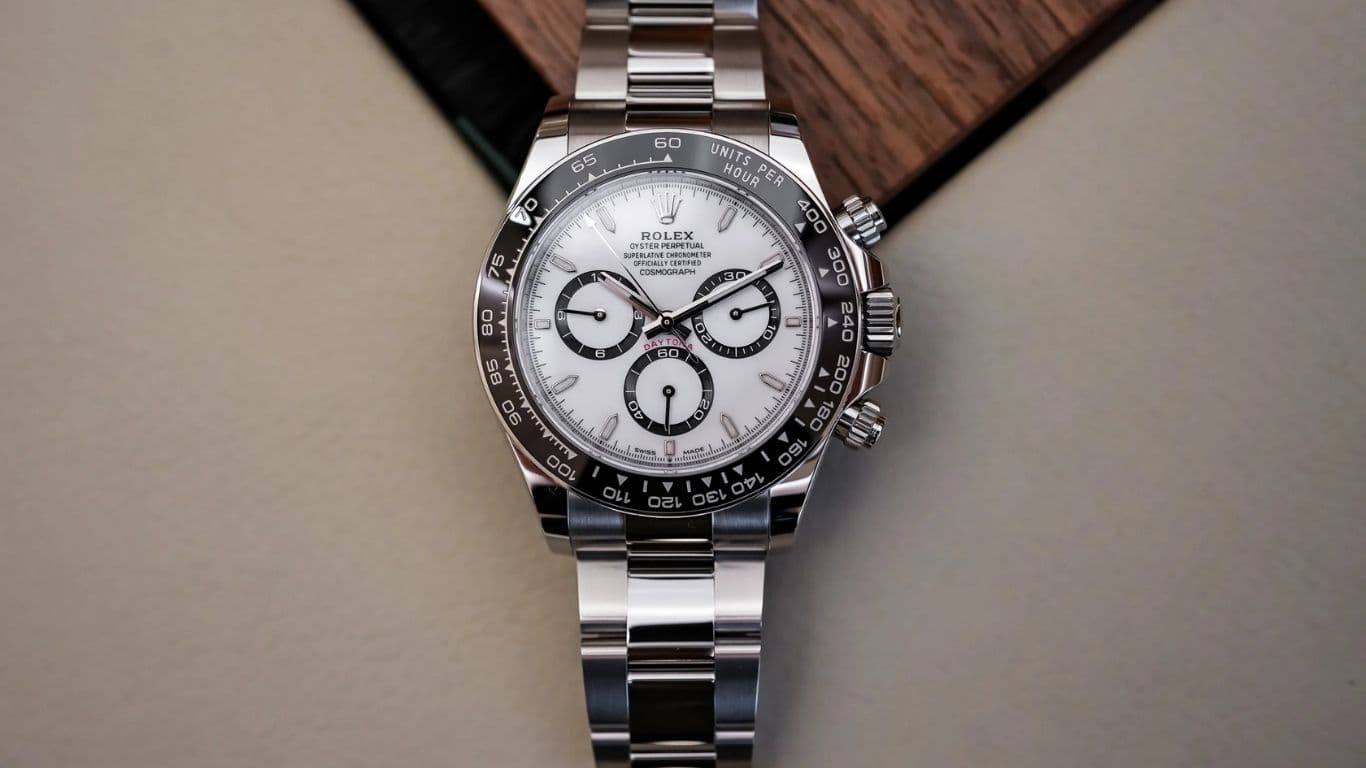
The current 126500LN, introduced in 2023, is the latest evolution. It carries the calibre 4131 and the ceramic Cerachrom bezel that has come to define the modern Daytona's look in the press.
What the Daytona secondary market actually shows
The current 126500LN retails at around $16,500 in the United States and roughly €16,400 in Europe. Authorised-dealer allocation is essentially impossible to obtain without an extensive purchase history with the boutique.
For most collectors, the secondary market is the practical route. WatchCharts and Chrono24 have steel Daytona pre-owned pricing clustered between €24,000 and €28,000 for clean examples with full set documentation. That 50 percent-plus premium over retail has compressed slightly from the 2022 peak but remains structural.
The previous-generation 116500LN, discontinued in 2023, trades at similar or slightly higher levels than the current 126500LN. Collectors recognise the discontinuation and the design refinement of that reference, and the secondary market prices it accordingly.
The earlier in-house references
The earlier 116520 (pre-ceramic, with the metal bezel) trades between $20,000 and $26,000 depending on dial colour and condition. The 16520 (the El Primero Daytona) sits below the in-house references on the secondary market but has its own collector following based on the distinctive movement architecture.
Vintage manual-wind Daytonas, the 6239, 6241, 6263, 6265 references, are the upper tier of Daytona collecting. Clean examples with original dials and credible provenance trade between $50,000 and $200,000 at Phillips and Christie's, depending on reference, dial variant and condition.
Paul Newman dial variants and the auction record
Paul Newman dial variants of these references run substantially higher. Documented Newman-era pieces with credible provenance have cleared seven-figure sums regularly across the past decade. The 2017 Newman sale at $17.
75 million remains the outlier.
Bob's Watches and the major auction houses have tracked the Daytona category broadly moving roughly 350 to 370 percent across the 2010 to 2026 window. That's a measure of where the category as a whole sits, not a forecast of forward movement, and steel sport Rolex references generally have led that movement.
The allocation reality behind Daytona pricing
The defining feature of the current Daytona market is allocation discipline. Authorised dealers receive small numbers of steel Daytonas annually, often single digits per dealer, and reserve them for established clients with substantial purchase histories.
The allocation game is the structural reason the secondary-market premium exists. If Rolex doubled production tomorrow, the secondary market would soften meaningfully within months. That's not going to happen, which is part of what gives the Daytona its position in serious collecting.
Rolex's pricing strategy has compounded the dynamic. Retail price increases of 3 to 8 percent across the Daytona range heading into 2026 have raised the floor on secondary-market pricing without meaningfully changing allocation availability. Rising material costs, currency dynamics and brand pricing discipline all contribute.
The practical effect for collectors is that the secondary market is the only realistic acquisition route for nearly everyone outside the boutique-relationship tier.
What serious Daytona collectors look for
For modern Daytona, the references that matter most to collectors are the discontinued 116500LN (in both Panda and reverse-Panda dial variants), the ceramic-bezel 116515LN in rose gold, and the platinum 116506 with the ice-blue dial. The current 126500LN is the watch most boutique buyers actually want.
The discontinued reference 116500LN trades at a small premium because of the production-window discipline. Collectors who recognise that pattern have consistently come out ahead over the past several Daytona transitions.
For vintage Daytona, originality of dial, hands and case finish all matter substantially. Paul Newman dial pieces with credible provenance command the upper end of the market. Non-Newman vintage Daytonas with original dial finish and unpolished cases sit just below.
Where Daytona transactions actually happen
Box-and-papers documentation is rare for vintage Daytona but carries significant weight when present. Service history through Rolex's own service network is the practical baseline.
The Phillips watch department, the Christie's watch specialists, and the Sotheby's New York and Geneva watch sales are the three channels where most serious vintage Daytona transactions actually happen. Antiquorum's daily-trade arm and the established specialist dealers (Bob's Watches, Watches of Switzerland's pre-owned operation, Watchfinder, the named London and Geneva specialists) handle the bulk of the modern-reference secondary market.
Further reading
What this means for collectors next
The longer story collectors are watching is whether Rolex maintains the production discipline that has, so far, kept the Daytona's collector category credible. The 2023 transition from 116500LN to 126500LN was handled with the kind of measured cadence the brand has built its reputation on.
So long as the discipline holds, the Daytona's place at the top of the modern Rolex catalogue looks structurally secure. For collectors building toward the reference, the discontinued 116500LN remains the most considered modern entry, and the vintage references remain the upper-tier study for any collector serious about Rolex's defining chronograph.
We last reviewed this analysis in May 2026.


Stefanos Moschopoulos
Stefanos Moschopoulos founded The Luxury Playbook in Athens and has spent the better part of a decade following the auction calendar, the en primeur releases, and the watchmakers, gallerists, and shipyards the magazine covers. He writes the field guides and listicles that anchor the Connoisseur section — pieces built on Phillips and Christie's results, Liv-ex movements, and conversations with collectors he has met across Geneva, Bordeaux, Basel, and Monaco. His own collecting habits sit closer to watches and wine than art, and it shows in the level of detail in the magazine's coverage of those categories. Under his direction, The Luxury Playbook now publishes long-form field guides, market-defining year-end listicles, and the Voices interview series with the founders behind the houses and the brands.