The Rolex GMT-Master II stays the reference travel watch for serious collectors because the line has, across nearly seventy years of continuous production, refined the dual-time-zone register to a structural standard the broader category mostly chases.
- The Rolex GMT-Master II remains the cornerstone travel reference in collecting, with dual time-zone functionality and pilot heritage supporting decades of collector enthusiasm.
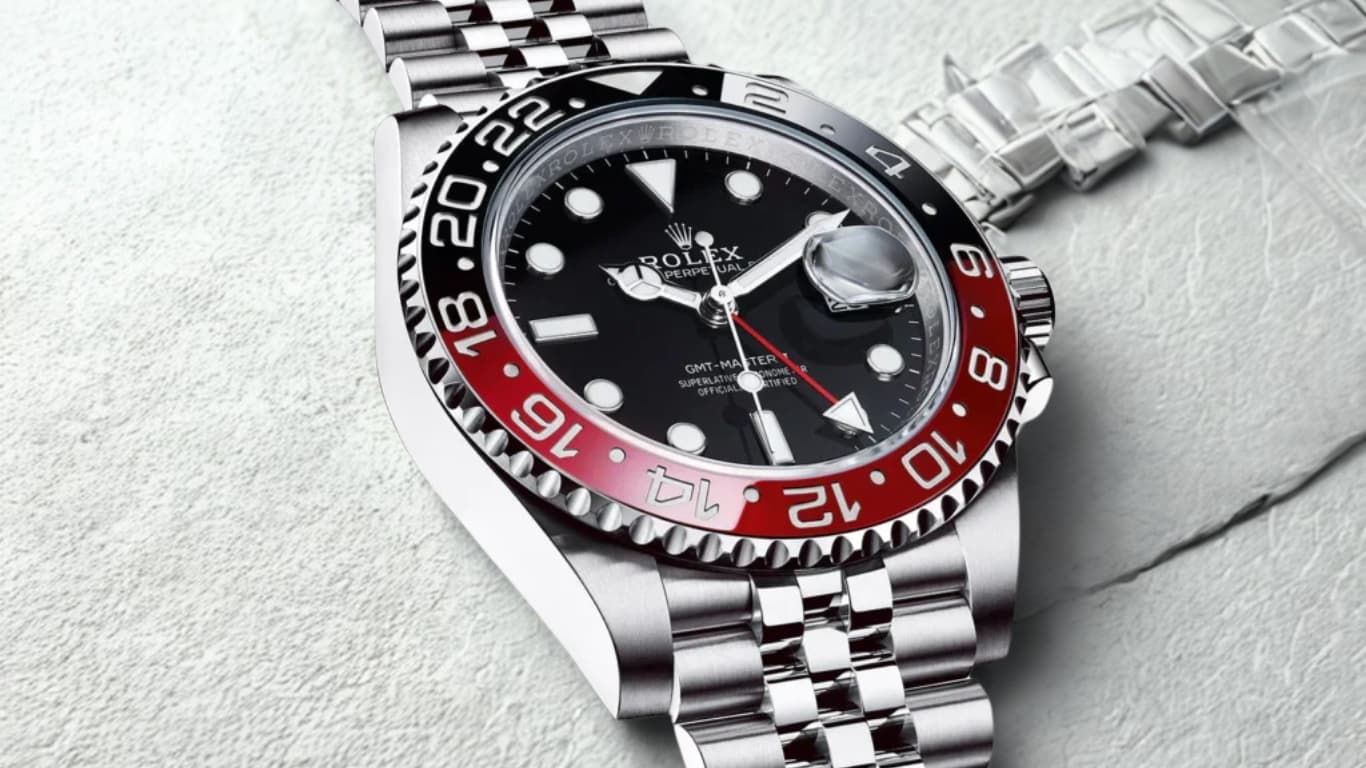
- Reference 126710BLNR (Batman) and 126710BLRO (Pepsi) anchor the modern catalogue, with the Calibre 3285 supporting both daily wear and frequent travel use.
- Vintage 1675 and 16710 references remain the strongest collector entries, with original conditions and matte dials commanding meaningful auction premiums.
- We see the GMT-Master II as the strongest single travel watch in current production, with the bidirectional bezel and dual time-zone architecture aligned perfectly for international travellers.
- Limited GMT-Master II editions and full gold configurations have outperformed expectations through the cycle, with collector demand validating the design ambition.
- Service infrastructure and parts availability remain among the strongest in luxury watchmaking, with Rolex's commitment to long-term service supporting decades of ownership.
- Who is this for?
- Frequent international travellers, pilot-watch enthusiasts, and Rolex collectors building dual time-zone reference depth.
- What is happening?
- A grounded case for the Rolex GMT-Master II as a cornerstone travel reference, covering modern Batman and Pepsi catalogue, vintage entries, and the dual time-zone architecture.
- When did this emerge?
- The case has held across multiple decades, with the modern 126710BLNR and 126710BLRO references continuing to anchor the GMT position into 2026.
- Where is this happening?
- Authorised Rolex dealers globally maintain waitlists, while Chrono24, Subdial 50, and specialist auctions handle the vintage market.
- Why does it matter?
- The GMT-Master II offers the most credible single travel watch in current production, with pilot heritage and dual time-zone engineering aligned at a single reference family.
The combination of the rotating 24-hour bezel and the additional GMT hand allows the watch to track home time and a second time zone simultaneously, and the considered evolution across generations has held the reference at the centre of modern travel-watch collecting.
The various coloured-bezel configurations (the Pepsi, the Batman, the Sprite) anchor the contemporary catalogue with the kind of distinctive collector identity few other Rolex references match. The collectors we hear from at international watch events who travel regularly consistently cite the GMT-Master II as the one reference that proves its case across years of actual use, and the brand's structural place in modern collecting reinforces the line's standing.
Why the Rolex GMT-Master II stays a travel reference
Three structural reasons. The dual-time-zone functionality is genuinely useful for collectors who travel across time zones regularly. The rotating 24-hour bezel allows tracking of a third time zone with quick reference, and the feature proves itself useful across years of ownership in a way few complication features actually manage.
The design discipline carries the second pillar. The GMT-Master geometry has been refined gradually rather than reinvented across nearly seven decades. The various coloured-bezel configurations carry their own distinctive identity within the broader Rolex sport catalogue, and the line reads as a coherent design evolution rather than a series of marketing-led departures.
The cultural anchor carries the third. The original GMT-Master was developed in the 1950s for Pan American World Airways pilots, who needed simultaneous tracking of home time and destination time across long-haul international routes. The travel-watch identity isn't constructed; it sits in the line's documented commercial origin, and the contemporary references inherit that institutional provenance.
The current GMT-Master II catalogue
The current references anchor the contemporary GMT-Master II catalogue across a wide price band. The 126710BLRO ("Pepsi" with the red-and-blue ceramic bezel) sits at around $10,900 retail, with secondary trading between $16,000 and $20,000. The 126710BLNR ("Batman" with the black-and-blue ceramic bezel) sits at around $10,900 retail, with secondary trading between $14,000 and $18,000.
The 126720VTNR ("Sprite" with the green-and-black bezel) sits at around $11,200 retail, with secondary trading between $18,000 and $22,000. The various precious-metal references in two-tone steel-and-yellow-gold ("Root Beer") and full Everose configurations extend the line into the upper tier.
The Calibre 3285 movement provides the 70-hour power reserve and the technical platform standard across the modern Rolex sport catalogue. The movement architecture, with the Chronergy escapement and the Superlative Chronometer certification, anchors the contemporary references in the same technical register the broader modern Rolex sport line occupies.
The vintage GMT-Master tier
Vintage GMT-Master references anchor the upper tier of vintage collecting. The 1675 Pepsi from the 1960s and 1970s, with the aluminum bezel and the Calibre 1575 movement, is the most-cited vintage reference. The earlier 6542 with the original Bakelite bezel and the various transitional references extend the tier.
Clean 1675 references with original aluminum Pepsi bezels trade between $15,000 and $40,000 depending on dial variant and condition. The 6542, with its original (and now usually replaced for safety) Bakelite bezel, runs higher when the original bezel is preserved. Originality of bezel, dial, and hands carries substantial weight on the vintage market, and the dealer relationships that handle these references operate at the considered specialist tier.
The 16710, the late-1990s and early-2000s reference with the bridge between the vintage and modern aesthetic, is the late-vintage GMT-Master reference most contemporary collectors with vintage interest gravitate toward. Clean 16710 references trade between $14,000 and $25,000 depending on bezel configuration. The Pepsi, the Coke, and the all-black bezels each carry their own followings.
Why collectors stay with the GMT-Master II
The travel-watch case is genuine. Collectors who actually travel across time zones use the GMT-Master II's dual-time functionality regularly. The rotating 24-hour bezel allowing tracking of a third time zone with quick reference is the kind of feature that proves itself useful across years of ownership.
The design discipline anchors the second-tier reasoning. The various coloured-bezel configurations carry their own distinctive identity within the broader Rolex sport catalogue, and the references read as evolutions of a coherent line rather than departures from it. The Pepsi configuration draws on the original 1950s reference; the Batman extends the line into a more contemporary register; the Sprite occupies a distinctive position the broader category doesn't really match.
The secondary-market depth carries the third. The GMT-Master II trades reliably through specialist channels and through the broader pre-owned Rolex market. Box-and-papers documentation matters; the standard Rolex authorisation discipline applies; and the boutique pre-owned channels through Rolex authorised dealers handle a meaningful portion of clean secondary inventory.
What collectors look for in a GMT-Master II
For modern GMT-Master II, the references that come up most consistently in serious collector conversation are the 126710BLRO Pepsi (the most-cited contemporary configuration), the 126710BLNR Batman for collectors preferring the more discreet bezel, the 126720VTNR Sprite as the contemporary statement reference, and the various two-tone and precious-metal Root Beer references for collectors operating at the upper tier.
The dial configurations matter on the contemporary references. Most GMT-Master II references run with the standard black dial; the precious-metal references extend into meteorite, brown, and various exotic configurations. The dealer allocation discipline at the boutique level keeps the contemporary references genuinely supply-constrained on the most-discussed bezel configurations.
For vintage, the 1675 Pepsi with the original aluminum bezel and unrestored case anchors the upper accessible vintage tier. The 16710 in clean condition with the bezel configuration of choice (Pepsi, Coke, or matte black) is the bridge reference most contemporary collectors with vintage interest start with. The dealer relationships matter on the vintage tier in ways they don't on the broader contemporary catalogue.
What this means for collectors
The GMT-Master II has held its travel-watch register across nearly seventy years of refinement without compromise. The contemporary Sprite, Batman, and Pepsi references all read as cohesive evolutions of the line rather than departures. The structural place of the GMT-Master II in serious modern collecting looks secure as long as Rolex maintains the production discipline that has anchored the line since 1955.
We'd argue the GMT-Master II is the modern Rolex reference where the practical case for ownership remains strongest. The watch earns its place in serious collections through a combination of cultural anchor, technical execution, and proven utility that the broader category mostly chases. For collectors who travel and want a reference that justifies its complication every time the home-time disc gets adjusted, the line continues to read as the reasonable answer.
We last reviewed this analysis in May 2026.

Frequently Asked Questions
- Which GMT-Master II models are most likely to appreciate?
- Models like the Pepsi (Ref. 126710BLRO) and Batman (Ref. 126710BLNR) are top performers due to their collector appeal and historical significance. Special editions or discontinued models tend to appreciate faster in the secondary market.<br><br>
- What is the current retail price of the Rolex GMT-Master II?
- As of 2025, most GMT-Master II models retail between $10,700 and $12,300, depending on the reference and bracelet configuration. However, secondary market prices can range from $14,000 to over $20,000, especially for sought-after versions.<br><br>
- Why is the GMT-Master II often priced higher on the secondary market?
- High demand, limited supply, and waitlists at authorized dealers drive up resale prices. Collectors are often willing to pay a premium to skip the wait and secure rare or discontinued models.<br><br>
- Is it better to buy a new or pre-owned GMT-Master II?
- If you're able to buy at retail from an authorized dealer, that’s ideal. However, pre-owned models in excellent condition often hold or exceed retail pricing, especially if they come with box and papers.<br><br>
- How often does Rolex release new GMT-Master II models?
- Rolex typically updates the GMT-Master II line every few years. Changes often include new bezel colors, movement upgrades, or material variations. Limited releases can significantly impact market dynamics and collector interest.<br>

Stefanos Moschopoulos
Stefanos Moschopoulos founded The Luxury Playbook in Athens and has spent the better part of a decade following the auction calendar, the en primeur releases, and the watchmakers, gallerists, and shipyards the magazine covers. He writes the field guides and listicles that anchor the Connoisseur section — pieces built on Phillips and Christie's results, Liv-ex movements, and conversations with collectors he has met across Geneva, Bordeaux, Basel, and Monaco. His own collecting habits sit closer to watches and wine than art, and it shows in the level of detail in the magazine's coverage of those categories. Under his direction, The Luxury Playbook now publishes long-form field guides, market-defining year-end listicles, and the Voices interview series with the founders behind the houses and the brands.