The Zaragoza property market in 2026 is the Spanish secondary city the international relocation buyer has been quietly studying. Strategically placed halfway between Madrid and Barcelona along the AVE high-speed rail corridor, Zaragoza is Spain's fifth-largest city and the capital of Aragón. Average residential pricing now sits near EUR 1,875 per square metre, up roughly 12.3 percent year on year.
Knight Frank's coverage of Spain's regional capitals and Engel & Völkers's Aragón listings both register Zaragoza as a city steadily entering the international relocation conversation. JLL Iberia and Christie's International Real Estate both describe the same picture.
We track Zaragoza as the most accessible entry point into the Spanish architectural-heritage tier. The Roman, Moorish and Mudéjar inheritance, the contemporary economic base (logistics, aerospace, automotive at the Opel / Stellantis plant at Figueruelas, the deepening technology cluster) and the AVE connectivity to both major Spanish capitals together build the relocation case.
- Zaragoza offers the most accessible Aragon property market, with steady industrial employer base and central geographic positioning supporting consistent residential demand.
- We see central neighbourhoods including the historic Casco Antiguo and Universidad anchoring the upper end of the local prime segment.
- INE and Idealista data confirms steady Zaragoza residential appreciation through 2025 and 2026, with pricing materially lower than Madrid and Barcelona benchmarks.
- Yields on well-located Zaragoza rental stock remain attractive given the lower entry pricing, with stable tenant demand from the local employer base.
- Geographic positioning between Madrid, Barcelona and Bilbao supports steady infrastructure investment, with high-speed rail connectivity adding to long-term appeal.
- For most considered Spanish buyers we view Zaragoza as offering an accessible entry point with steady fundamentals, particularly for yield-focused investors.
- Who is this for?
- International and Spanish buyers evaluating Zaragoza property acquisition, alongside the advisers, brokers and family office staff framing those decisions.
- What is happening?
- A market read of Zaragoza property in 2026, covering Casco Antiguo, Universidad, industrial employer dynamics and the rental yield landscape.
- When did this emerge?
- The article reflects 2026 market conditions through INE, Idealista and Knight Frank Spain data alongside our observations.
- Where is this happening?
- The piece focuses on Zaragoza, including Casco Antiguo and Universidad neighbourhoods.
- Why does it matter?
- Zaragoza offers a distinctive Aragon entry point in the Spanish market, which is why understanding the fundamentals matters before any acquisition conversation.
The Zaragoza market today
The market in 2026 is supply-constrained at the centre, supported by strong domestic demand, and increasingly attracting international relocators. The Aragonese regional government has not implemented formal rent-control caps as of 2026.
The Spanish Golden Visa property pathway ended in April 2025. Zaragoza's accessible pricing has continued to draw international buyers despite the end of the residency-by-investment route.
New construction has been concentrated in the periphery (Valdespartera, Parque Goya, Arcosur) where municipal planning has opened greenfield land. Most central-district turnover is renovation-led, with strict heritage protections in the Casco Histórico keeping new-build supply rationed.
- Citywide average around EUR 1,875 per square metre
- Prime central pricing EUR 2,500 to EUR 3,000 per square metre
- Value corridors EUR 1,400 to EUR 1,700 per square metre
- Annual price movement around 12.3 percent (2024 to 2025)
Neighbourhoods defining Zaragoza in 2026
Centro and Casco Histórico
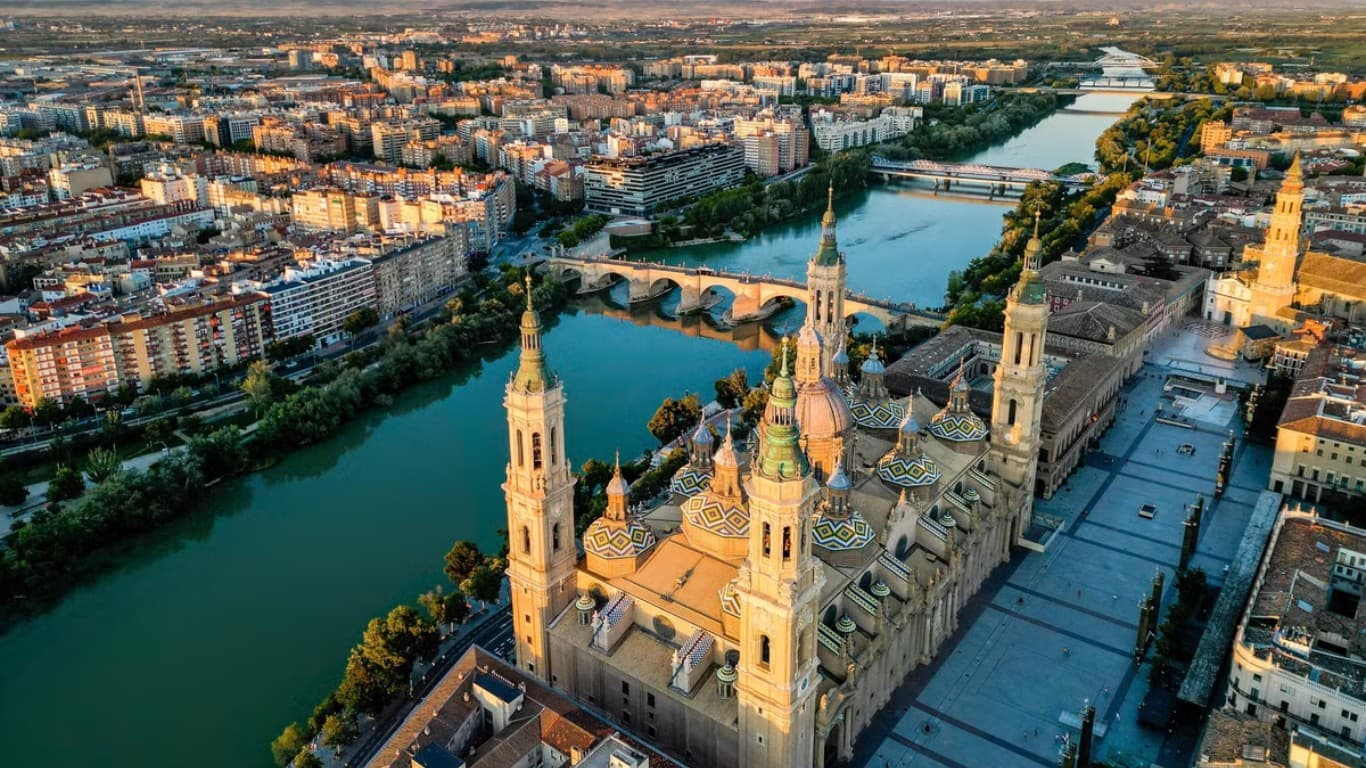
The historic core concentrates the Basílica del Pilar, La Seo Cathedral with its Mudéjar exterior (both on UNESCO's Mudéjar Aragonese inscription), the Aljafería palace and the Roman remains. Average prices run EUR 2,500 to EUR 3,000 per square metre, with restored apartments in the Casco Histórico routinely above EUR 3,200.
Universidad and Romareda
Universidad and Romareda anchor the family-buyer demographic. Proximity to schools, the University of Zaragoza and the Real Zaragoza stadium underpins steady demand. Pricing typically runs EUR 2,200 to EUR 2,600 per square metre.
Actur-Rey Fernando
Actur-Rey Fernando is the city's main 1980s and 1990s residential expansion zone. Average pricing sits around EUR 1,800 per square metre, with three-bedroom apartments trading EUR 180,000 to EUR 250,000.
Valdespartera
Valdespartera is the city's most active new-build corridor. Energy-efficient developments and contemporary architecture price around EUR 2,000 per square metre, drawing professional buyers from the broader logistics, aerospace and automotive cluster.
San José
San José combines suburban character with central connectivity. Pricing averages EUR 1,500 per square metre, with the most reliable rental absorption in the city's value tier.
The architectural and cultural register
The architectural depth is more interesting than the secondary-city profile suggests. The Basílica del Pilar (the Baroque pilgrimage church on the Ebro waterfront) and La Seo Cathedral with its Mudéjar exterior are both on UNESCO's Mudéjar Aragonese inscription.
The Aljafería palace anchors the Moorish heritage, the Roman walls and the Caesaraugusta theatre extend the heritage register back two millennia. The Expo 2008 redevelopment along the Ebro produced contemporary work by Zaha Hadid (the Bridge Pavilion) and Carme Pinós (the Expo Tower).
Mansion Global and Architectural Digest have used the Mudéjar inscription as the journalistic entry point into Zaragoza prime. Engel & Völkers Aragón and Christie's International Real Estate both describe a market where the architectural register matters more to the buyer than the headline price differential to Madrid or Barcelona.
The Zaragoza rental landscape
The Zaragoza rental market in 2026 is stable, supported by university demand, the broader employer base and a steady professional inflow from Madrid and Barcelona. Rent growth has been moderate.
One-bedroom apartments rent between EUR 550 and EUR 750 per month, two-bedrooms between EUR 750 and EUR 950, three-bedrooms between EUR 950 and EUR 1,250. Premium units in Centro and Romareda exceed EUR 1,400.
Short-term tourist rentals are permitted with Aragonese regional licensing. The framework is substantially less restrictive than Barcelona's, and no formal rent caps are in place.
How Zaragoza compares with European prime markets
Zaragoza prime at EUR 3,000 per square metre sits well below Madrid (above EUR 8,500 per square metre at the central prime tier), Barcelona (around EUR 7,000 per square metre) and Valencia (EUR 3,200 to EUR 3,800 per square metre at the prime tier).
Mayfair sits around GBP 30,000 to GBP 40,000 per square metre, an entirely different category. Monaco prime trades near EUR 55,000 per square metre according to Savills's World Cities Prime tracker. Dubai Marina prime trades near AED 22,000 per square metre (around EUR 5,500), above Zaragoza prime.
The Greek Golden Visa programme (EUR 250,000 in qualifying regions, EUR 800,000 in central Athens, Thessaloniki, Mykonos and Santorini from August 2024) sits in a different category. Zaragoza is now an accessible-pricing, AVE-connected play, no longer a residency-by-investment pathway. The comparison readers find more useful is Zaragoza against Seville (EUR 2,800 to EUR 3,400 per square metre at the prime tier) and Lisbon (EUR 6,500 to EUR 8,000 per square metre at the prime tier).
What we expect through year-end 2026
Property prices are projected to rise 5. 0 to 7. 0 percent through 2026.
The strongest movement is expected in central neighbourhoods where renovated, move-in-ready properties remain undersupplied (Centro, Universidad, Romareda).
Valdespartera and Arcosur are projected to track 6. 0 to 8. 0 percent as infrastructure improvements continue.
Citywide average prices are expected to reach EUR 1,975 to EUR 2,050 per square metre by year-end.
Rental prices are projected to grow 3. 5 to 5. 0 percent.
The fibre-optic and broadband infrastructure (consistently strong across Aragón) continues to support the remote-worker demographic.
What this means for buyers
Zaragoza rewards the buyer drawn to Spanish architectural heritage, AVE high-speed rail connectivity to Madrid and Barcelona, and one of the most accessible entry points in the Spanish prime conversation. The Mudéjar inscription, the Expo 2008 contemporary commissions and the contemporary economic base together build a relocation case the international community has been steadily exploring.
The end of the Golden Visa removes the residency-pathway sweetener but leaves the architectural and accessibility cases intact. For buyers comparing Spanish secondary cities, Zaragoza reads as one of the most defensible value-tier positions we cover.
We last reviewed this analysis in May 2026.
Frequently asked
What is the average property price per square metre in Zaragoza in 2026?
The citywide average sits near EUR 1,875 per square metre. Prime areas exceed EUR 3,000.
Can international buyers purchase property in Zaragoza?
Yes. Spain imposes no restrictions on foreign property ownership. The Golden Visa property pathway ended in April 2025, but ownership itself remains open.
Are short-term rentals permitted?
Yes, with Aragonese regional licensing. The framework is less restrictive than Catalonia's.
Are rent caps in effect?
Not currently. The Aragonese regional government has not implemented formal rent-control caps as of 2026.
Which neighbourhoods are seeing the most buyer attention?
Centro and the Casco Histórico, Universidad, Romareda, Valdespartera and the Actur expansion corridor draw the most consistent demand from buyers tracking architectural depth, AVE connectivity and accessible pricing.


Savvas Agathangelou
Savvas Agathangelou co-founded The Luxury Playbook and has spent years reporting from the prime postcodes the magazine covers — Mayfair, Knightsbridge, the Athens Riviera, Dubai's Palm crescents, and the southern Mediterranean coastlines where the world's wealthy keep coming back. His background is in international hospitality, and that frame shapes how he writes about property: the developer's choices, the architect's signature, the agency's bench of named brokers, the building's service standard once the buyer moves in. He files developer spotlights, agency profiles, and the seasonal "Properties That Defined" listicles, and he hosts the magazine's founder-and-leadership interviews on the Voices side.